1. Operations With Radical Expressions
Sign In
An error ocurred, try again later!
Chapter 3
1.
Operations With Radical Expressions
This lesson delves into the complexities of working with radical expressions, focusing on techniques for simplification and rationalization. It provides a variety of examples and exercises that help in understanding how to operate with square roots effectively. These techniques are not just theoretical; they have practical applications in fields like engineering, physics, and computer science. For instance, understanding how to simplify radicals can be crucial when solving equations in electrical engineering or optimizing algorithms in computer science. The lesson also discusses the properties of square roots and how they can be manipulated for different mathematical operations. Overall, it serves as a comprehensive guide for anyone looking to master the subject and apply it in various professional fields.
Show less Show more expand_more 


Lesson Settings & Tools
| | 15 Theory slides |
| | 11 Exercises - Grade E - A |
| | Each lesson is meant to take 1-2 classroom sessions |
Operations With Radical Expressions
Slide of 15
When solving geometry problems, radical expressions — like square roots or cube roots — are present in a lot of concepts and formulas. For example, the diagonal of a square is calculated by asqrt(2), where a is the side length of the square. This lesson will explore the operations on more general radical expressions and how radicals might apply to geometry and physics.
Catch-Up and Review
Here are a few recommended readings before getting started with this lesson.
- Square Root
- Radical
- Translating Between Rational Exponents and Radicals
- Extending the Properties of Exponents to Rational Exponents
- Operating with Square Roots
Here are a few practice exercises before getting started with this lesson.
a Write 8^(25) as a radical.
{"type":"text","form":{"type":"math","options":{"comparison":"1","nofractofloat":false,"keypad":{"simple":false,"useShortLog":false,"variables":[],"constants":[]},"rendered":false},"text":" "},"formTextBefore":"8^(25)=","formTextAfter":null,"answer":{"text":["\\sqrt[5]{64}","\\sqrt[5]{8^2}"]}}
b Consider the following algebraic expression. Assume that the variable x is positive.
sqrt(8x^3)*(x^()12)^5/sqrt(2) * x^3
What is the simplest form of the expression?{"type":"text","form":{"type":"math","options":{"comparison":"1","nofractofloat":false,"keypad":{"simple":false,"useShortLog":false,"variables":["x"],"constants":[]},"rendered":false},"text":" "},"formTextBefore":null,"formTextAfter":null,"answer":{"text":["2x"]}}
c Write the following expression in its simplest form.
1+sqrt(16)/sqrt(9) - 2sqrt(2)
{"type":"text","form":{"type":"math","options":{"comparison":"1","nofractofloat":false,"keypad":{"simple":false,"useShortLog":false,"variables":[],"constants":[]},"rendered":false},"text":" "},"formTextBefore":null,"formTextAfter":null,"answer":{"text":["15+10\\sqrt{2}"]}}
Challenge
Share
Report error
Length of a Triangular Fencing
Ignacio is planning to build an astronomical observatory in his garden. The building will be enclosed by a fence with a triangular shape. The dimensions of Ignacio's garden are presented in the following diagram.
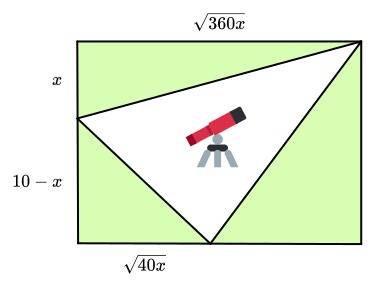
In this diagram, all dimensions are measured in meters. Although some side lengths are still not decided, help Ignacio calculate the length of the fence L(x) with respect to x. What is the value of L(5)?
{"type":"text","form":{"type":"math","options":{"comparison":"1","nofractofloat":false,"keypad":{"simple":false,"useShortLog":false,"variables":[],"constants":[]},"rendered":false},"text":" "},"formTextBefore":"L(5)=","formTextAfter":"meters","answer":{"text":["45 + 5\\sqrt{73}"]}}
Discussion
Share
Report error
n^\text{th} Root
The n^(th) root of a real number a expresses another real number that, when multiplied by itself n times, will result in a. In addition to the radical symbol, the notation is made up of the radicand a and the index n.
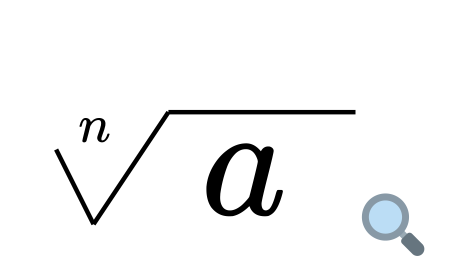 The resulting number is commonly called a radical. For example, the radical expression sqrt(16) is the
fourth rootof 16. Notice that sqrt(16) simplifies to 2 because 2 multiplied by itself 4 times equals 16. sqrt(16) = sqrt(2^4) = 2 The general expression sqrt(a) represents a number which equals a when multiplied by itself n times.
sqrt(a) * sqrt(a) * ... * sqrt(a)_(ntimes)=a or ( sqrt(a) )^n=a
Some numbers have more than one real n^\text{th} root. For example, 16 has two fourth roots, 2 and -2, because both 2^4 and (-2)^4 are equal to 16. The number of real n^\text{th} roots depends on the sign of a radicand a and an integer n.
| n is Even | n is Odd | |
|---|---|---|
| a>0 | Two unique real n^\text{th} roots, sqrt(a) and -sqrt(a) | One real n^\text{th} root, sqrt(a) |
| a=0 | One real n^\text{th} root, sqrt(0) = 0 | One real n^\text{th} root, sqrt(0) = 0 |
| a<0 | No real n^\text{th} roots | One real n^\text{th} root, sqrt(a) |
By the definition of an n^\text{th} root, calculating the n^\text{th} power of the n^\text{th} root of a number a results in the same number a. The following formula shows what happens if these two operations are swapped.
Rule
Share
Report error
n^\text{th} Roots of n^\text{th} Powers
To simplify an n^(th) root, the radicand must first be expressed as a power. If the index of the radical and the power of the radicand are equal such that sqrt(a^n), the radical expression can be simplified as follows.
sqrt(a^n)= a, & if n is odd |a|, & if n is even
The absolute value of a number is always non-negative, so when n is even, the result will always be non-negative. Consider a few example n^\text{th} roots that can be simplified by using the formula.
| a | n | sqrt(a^n) | Is n even? | Simplify |
|---|---|---|---|---|
| 4 | 3 | sqrt(4^3) | * | 4 |
| -6 | 5 | sqrt((-6)^5) | * | -6 |
| 2 | 6 | sqrt(2^6) | ✓ | |2| = 2 |
| -3 | 4 | sqrt((-3)^4) | ✓ | |-3| = 3 |
Proof
Informal JustificationTo write the expression for sqrt(a^n), there are two cases to consider.
- a≥ 0
- a<0
Both cases will be considered one at a time.
a≥ 0
Start by noting that since a is non-negative, a^n is also non-negative. This means that the n^\text{th} root can be rewritten using a rational exponent. sqrt(a^n) = ( a^n )^(1n) Since both n and 1n are rational numbers, the Power of a Power Property for Rational Exponents can be applied to simplify the obtained expression. Therefore, sqrt(a^n) is equal to a if a is non-negative.a<0
In case of a negative value of a, there are also two cases two consider.
- n is even
- n is odd
Even n
Recall that a root with an even index n_e is defined only for non-negative numbers. Although a is negative, a^(n_e) is positive. Also, a power with a negative base and an even exponent can be rewritten as a power with a positive base. a^(n_e) = (- a)^(n_e) Now, since - a is positive, the Power of a Power Property for Rational Exponents can be applied again to simplify sqrt(a^(n_e)).sqrt(a^(n_e))
▼
Simplify
NegBaseToPosPow
(- a)^(n_e) = a^(n_e)
sqrt((- a)^(n_e))
RootToPowD
sqrt(a)=a^(1n)
( (- a)^(n_e) )^()1n_e
PowPow
(a^m)^n=a^(m* n)
(- a)^(n_e* 1n_e)
a * 1/a=1
(- a)^1
ExponentOne
a^1=a
- a
Odd n
A root with an odd index n_o is defined for all real numbers. By the definition of the n^\text{th} root, the expression sqrt(a^(n_o)) is the number y that, when multiplied by itself n_o times, will result in a^(n_o). y * y * ... * y_(n_otimes)=a^(n_o) Because n_o is odd and a is negative, a^(n_o) is also negative. This means that the best candidate for y is simply a. sqrt(a^n) = a
Summary
If a is non-negative, sqrt(a^n) is always equal to a. However, in case of negative a, the value of sqrt(a^n) depends on the parity of n.
| a≥ 0 | a<0 | |
|---|---|---|
| Even n | sqrt(a^n) = a | sqrt(a^n) = - a |
| Odd n | sqrt(a^n) = a | sqrt(a^n) = a |
To conclude, for odd values of n, the expression sqrt(a^n) is equal to a. On the other hand, if n is even, sqrt(a^n) can be written as |a|.
sqrt(a^n)= a, & if n is odd |a|, & if n is even
Extra
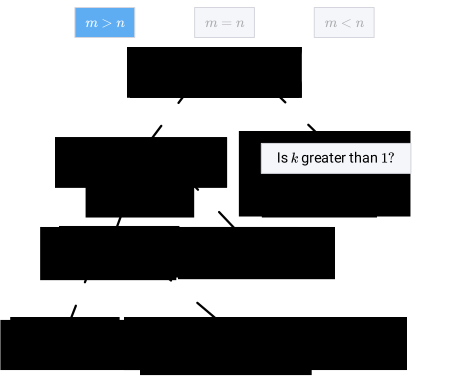
Simplifying sqrt(a^m)Depending on the index of the root and the power in the radicand, simplifying sqrt(a^m) may be problematic. Because real n^\text{th} roots with an even index are defined only for non-negative numbers, the absolute value is sometimes needed.
If n is even, sqrt(a^m) is defined only for non-negative a^m.
| a | m | n | sqrt(a^m) | Simplify |
|---|---|---|---|---|
| 2 | 8 | 4 | sqrt(2^8) | 2^()84 = 2^2 = 4 |
| -3 | 6 | 2 | sqrt((-3)^6) | | (-3)^()62 | = | (-3)^3 | = |-27| = 27 |
| x | 6 | 3 | sqrt(x^6) | x^()63 = x^2 |
| -3 | 2 | 8 | sqrt((-3)^2) | sqrt(|-3|) = sqrt(3) |
| 2 | 3 | 6 | sqrt(2^3) | sqrt(2) |
| -2 | 3 | 9 | sqrt((-2)^3) | sqrt(-2) |
| 2 | 6 | 8 | sqrt(2^6) | sqrt(2^3) = sqrt(8) |
| -2 | 6 | 8 | sqrt((-2)^6) | sqrt(|-2|^3) = sqrt(2^3) = sqrt(8) |
Example
Share
Report error
Homework on Radical Expressions
In addition to physics and astronomy, Ignacio is also interested in algebra. Unfortunately, he missed one class and he cannot solve his homework on radical expressions. Help Ignacio pair each expression to its simplified form.
Each of the remaining expressions should be rewritten as a power with the exponent equal to the index of the corresponding root. Notice that the radicand in the first expression is a perfect square trinomial. x^2- 4x+ 4 = x^2- 2(2)x+ 2^2
Now, the radical expression can be simplified by writing the radicand as the square of a binomial. Because the index of the root is an even number, the result will require the absolute value.
Therefore, the first expression simplifies to |x-2|.
Next, properties of exponents will be used to write the radicand 16x^8 as a power with the exponent of 4.
Since x^2 is non-negative, 2x^2 is also non-negative. This means that | 2x^2 | is equal to 2x^2.
Now the final expression sqrt(4x^2) will be examined. Similar to the previous expression, properties of exponents will be used to rewrite the radicand as a square.
This time, it is not known whether 2x is non-negative. Therefore, the absolute value is needed in this expression. Finally, all simplified forms may be written in the table.
{"type":"pair","form":{"alts":[[{"id":0,"text":"sqrt(x^2-4x+4)"},{"id":1,"text":"sqrt((x-2)^5)"},{"id":2,"text":"sqrt(16x^8)"},{"id":3,"text":"sqrt(4x^2)"}],[{"id":0,"text":"|x-2|"},{"id":1,"text":"x-2"},{"id":2,"text":"2x^2"},{"id":3,"text":"|2x|"}]],"lockLeft":true,"lockRight":false},"formTextBefore":"","formTextAfter":"","answer":[[0,1,2,3],[0,1,2,3]]}
Hint
Write the radicand as a power. Then, use the n^\text{th} Roots of n^\text{th} Powers Property to simplify the radical expression.
Solution
To simplify the given expressions, the n^\text{th} Roots of n^\text{th} Powers Property will be used. sqrt(a^n)= a, & if n is odd |a|, & if n is even Unfortunately, only the second expression is written in the form that allows to use the property right away. Because the power and the index of the root are both 5 and 5 is an odd number, the second expression simplifies to x-2.
| Radical Expression | Simplified Form |
|---|---|
| sqrt(x^2-4x+4) | ? |
| sqrt((x-2)^5) | x-2 |
| sqrt(16x^8) | ? |
| sqrt(4x^2) | ? |
| Radical Expression | Simplified Form |
|---|---|
| sqrt(x^2-4x+4) | |x-2| |
| sqrt((x-2)^5) | x-2 |
| sqrt(16x^8) | ? |
| sqrt(4x^2) | ? |
sqrt(16x^8)
▼
Rewrite
WritePow
Write as a power
sqrt(2^4 x^8)
SplitIntoFactors
Split into factors
sqrt(2^4 x^(2* 4))
ProdInExponent
a^(m* n)=(a^m)^n
sqrt(2^4 (x^2)^4)
ProdPowII
a^m b^m = (a b)^m
sqrt((2x^2)^4)
sqrt(a^4)=|a|
| 2x^2 |
| Radical Expression | Simplified Form |
|---|---|
| sqrt(x^2-4x+4) | |x-2| |
| sqrt((x-2)^5) | x-2 |
| sqrt(16x^8) | 2x^2 |
| sqrt(4x^2) | ? |
sqrt(4x^2)
|2x|
| Radical Expression | Simplified Form |
|---|---|
| sqrt(x^2-4x+4) | |x-2| |
| sqrt((x-2)^5) | x-2 |
| sqrt(16x^8) | 2x^2 |
| sqrt(4x^2) | |2x| |
Discussion
Share
Report error
Product and Quotient Properties of Radicals
Usually, the n^\text{th} Roots of n^\text{th} Powers Property is not enough to simplify radical expressions. Therefore, more properties will be presented and proven in this lesson. The first one refers to the root of a product.
Rule
Share
Report error
Product Property of Radicals
Given two non-negative numbers a and b, the n^\text{th} root of their product equals the product of the n^\text{th} root of each number.
sqrt(ab) = sqrt(a)* sqrt(b), for a≥ 0 and b≥ 0
If n is an odd number, the n^\text{th} root of a negative number is defined. In this case, the Product Property of Radicals for negative a and b is also true.
Proof
First, a special case of the property will be proven. Assume that a or b is equal to 0. By the Zero Property of Multiplication, the radicand in left-hand side of the formula is equal to 0.
\begin{array}{ccc}
\underline\textbf{Left-Hand Side} & & \underline\textbf{Right-Hand Side} \\[0.5em]
\sqrt[n]{0} & \stackrel{?}{=} & \sqrt[n]{a}\cdot \sqrt[n]{b}
\end{array}
Because 0^n = 0, n^\text{th} root of 0 is equal to 0. This means that both the left-hand side and one of the factors on the right-hand side equal 0. Again, by the Zero Property of Multiplication, the right-hand side is also 0.
\begin{array}{ccc}
\underline\textbf{Left-Hand Side} & & \underline\textbf{Right-Hand Side} \\[0.5em]
0 & = & 0
\end{array}
Therefore, the property is true when a or b is equal to 0. Next, assume that both a and b are nonzero. Let x, y, and z be real numbers such that x = sqrt(a), y = sqrt(b), and z = sqrt(ab). By the definition of an n^\text{th} root, each of these numbers raised to the n^\text{th} power is equal to its corresponding radicand.
x^n = a & (I) y^n = b & (II) z^n = ab & (III)
Next, because b is not equal to 0, Equation (I) can be multiplied by y^n, which is equal to b. x^n = a ⇓ x^n y^n = a y^n
Now, substitute Equations (II) and (III) into the obtained equation.
Since xy and z are of the same sign, the final equation implies that z=xy. z^n=(xy)^n ⇒ z=xy
The last step is substituting z=sqrt(ab), x=sqrt(a), and y=sqrt(b) into this equation.
z=xy ⇔ sqrt(ab)=sqrt(a)* sqrt(b)
x^n y^n = a y^n
▼
Substitute values and simplify
Substitute
y^n= b
x^n y^n = a b
Substitute
ab= z^n
x^n y^n = z^n
ProdPowII
a^m b^m = (a b)^m
(xy)^n = z^n
RearrangeEqn
Rearrange equation
z^n = (xy)^n
The following property indicates how to work with roots of a quotient.
Rule
Share
Report error
Quotient Property of Radicals
Let a be a non-negative number and b be a positive number. The n^\text{th} root of the quotient ab equals the quotient of the n^\text{th} roots of a and b.
sqrt(a/b) = sqrt(a)/sqrt(b), for a≥ 0, b > 0
If n is an odd number, the n^\text{th} root of a negative number is defined. In this case, the Quotient Property of Radicals for negative a and b is also true.
Proof
First, a special case of the property will be proven. Assume that a is equal to 0. Because 0b=0, the radicand in left-hand side of the formula is equal to 0.
\begin{array}{ccc}
\underline\textbf{Left-Hand Side} & & \underline\textbf{Right-Hand Side} \\[0.5em]
\sqrt[n]{0} & \stackrel{?}{=} & \dfrac{\sqrt[n]{0}}{\sqrt[n]{b}}
\end{array}
Because 0^n = 0, n^\text{th} root of 0 is equal to 0. This means that both the left-hand side and the numerator on the right-hand side equal 0. Again, since dividing 0 by a nonzero number results in 0, the right-hand side is also 0.
\begin{array}{ccc}
\underline\textbf{Left-Hand Side} & & \underline\textbf{Right-Hand Side} \\[0.5em]
0 & \stackrel{{\color{#009600}{\checkmark}}}{=} & 0
\end{array}
Therefore, the property is true when a is equal to 0. Next, assume that both a and b are nonzero. Let x, y, and z be real numbers such that x = sqrt(a), y = sqrt(b), and z = sqrt(ab). By the definition of an n^\text{th} root, each of these numbers raised to the n^\text{th} power is equal to its corresponding radicand.
x^n = a & (I) y^n = b & (II) z^n = ab & (III)
Next, because b is not equal to 0, Equation (I) can be divided by y^n, which is equal to b. x^n = a ⇓ x^n/y^n = a/y^n
Now, substitute Equations (II) and (III) into the obtained equation.
Since xy and z are of the same sign, the final equation implies that z= xy. z^n=(x/y)^n ⇒ z=x/y
The last step is substituting z=sqrt(ab), x=sqrt(a), and y=sqrt(b) into this equation.
z=x/y ⇔ sqrt(a/b)=sqrt(a)/sqrt(b)
x^n/y^n = a/y^n
▼
Substitute values and simplify
Substitute
y^n= b
x^n/y^n = a/b
Substitute
a/b= z^n
x^n/y^n = z^n
a^m/b^m=(a/b)^m
(x/y)^n = z^n
RearrangeEqn
Rearrange equation
z^n = (x/y)^n
Example
Share
Report error
The Voltage in an Electric Circuit
To work on physics experiments in his astronomical observatory, Ignacio needs the right lighting for the new workstation. He has already designed a simple electric circuit for a 48-watt light bulb.
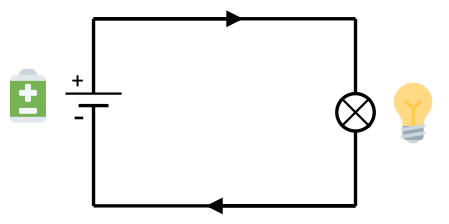
The voltage V required for a circuit is given by V = sqrt(P)*sqrt(R). In this formula, P is the power in watts and R is the resistance in ohms.
a What voltage of battery is needed to light the light bulb if its resistance is 12 ohms?
{"type":"text","form":{"type":"math","options":{"comparison":"1","nofractofloat":false,"keypad":{"simple":true,"useShortLog":false,"variables":[],"constants":[]},"rendered":false},"text":" "},"formTextBefore":null,"formTextAfter":"volts","answer":{"text":["24"]}}
b Does the battery need to have a higher, lower, or the same voltage in order to light a 20-watt light bulb with a 32-ohm resistance?
{"type":"choice","form":{"alts":["Higher","Lower","Same"],"noSort":true},"formTextBefore":"","formTextAfter":"","answer":0}
Hint
a Substitute the given values into the formula for the voltage V. Then, evaluate the expression using the Product Property of Radicals.
b Similar to Part A, evaluate the voltage needed to light the other light bulb. How is the lower bound of the obtained root calculated?
Solution
a The formula for the voltage V required for a circuit is given. In this equation, P represents the power in watts and R represents the resistance in ohms.
b In Part A, it was found that the voltage needed to light a 48-watt light bulb is 24 volts. Now, the number of volts V_2 needed to light a 20-watt light bulb with a resistance of 32 ohms will be calculated. To do so, substitute P= 20 and R= 32 into the given formula and simplify.
Example
Share
Report error
Calculating the Length of the Diagonal in TV Screen
Ignacio wants to organize a movie night to celebrate the grand opening of his astronomical observatory. He plans to buy a brand new TV for the occasion, but he does not know what size of TV screen will fit on his wall.
The shape of a TV screen is represented by its aspect ratio, which is the ratio of the width of a screen to its height. The most common aspect ratio for TV screens is 16:9, which means that the width of the screen is 169 times its height.
a Write an expression for the width of a TV screen with this aspect ratio in terms of the length of the diagonal d.
{"type":"text","form":{"type":"math","options":{"comparison":"1","nofractofloat":false,"keypad":{"simple":false,"useShortLog":false,"variables":["d"],"constants":[]},"rendered":false},"text":" "},"formTextBefore":"w=","formTextAfter":null,"answer":{"text":["\\dfrac{16}{\\sqrt{337}}d","\\dfrac{16\\sqrt{337}}{337}d"]}}
b Find the area of the screen if the length of the diagonal is sqrt(3033) inches.
{"type":"text","form":{"type":"math","options":{"comparison":"1","nofractofloat":false,"keypad":{"simple":true,"useShortLog":false,"variables":[],"constants":[]},"rendered":false},"text":" "},"formTextBefore":null,"formTextAfter":"square inches","answer":{"text":["1296"]}}
Hint
a The length of the diagonal of a rectangle can by found by using the Pythagorean Theorem.
b Use the expression found in Part A. The area of a rectangle is calculated by multiplying its length times its width.
Solution
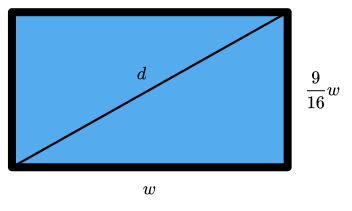
a A TV screen can be modeled by a rectangle. Let w and h denote the width and height of the rectangle, respectively. Since it is given that the aspect ratio of the screen is 16:9, the height can be written in terms of the width.
w = 16/9h ⇕ h = 9/16w Next, the height and the width of the rectangle will be labeled on a diagram. The length of the diagonal d will be marked in the rectangle as well.
d^2 = w^2 + (9/16w )^2
▼
Solve for w
PowProdII
(a b)^m=a^m b^m
d^2 = w^2 + (9/16 )^2 w^2
PowQuot
(a/b)^m=a^m/b^m
d^2 = w^2 + 81/256 w^2
MoveRightFacToNum
a/c* b = a* b/c
d^2 = w^2 + 81w^2/256
NumberToFrac
a = 256* a/256
d^2 = 256w^2/256 + 81w^2/256
AddFrac
Add fractions
d^2 = 256w^2+81w^2/256
AddTerms
Add terms
d^2 = 337w^2/256
MovePartNumRight
a* b/c=a/c* b
d^2 = 337/256w^2
MultEqn
LHS * 256/337=RHS* 256/337
256/337d^2 = w^2
RearrangeEqn
Rearrange equation
w^2 = 256/337d^2
SqrtEqn
sqrt(LHS)=sqrt(RHS)
sqrt(w^2) = sqrt(256/337d^2)
SqrtToAbs
sqrt(a^2)=|a|
|w| = sqrt(256/337d^2)
ProdSqrt
sqrt(a)*sqrt(b)=sqrt(a* b)
|w| = sqrt(256/337)sqrt(d^2)
SqrtQuot
sqrt(a/b)=sqrt(a)/sqrt(b)
|w| = sqrt(256)/sqrt(337)sqrt(d^2)
CalcRoot
Calculate root
|w| = 16/sqrt(337)sqrt(d^2)
SqrtToAbs
sqrt(a^2)=|a|
|w| = 16/sqrt(337)|d|
AbsPos
|w|=w &|d|=d
w = 16/sqrt(337)d
b It is given that the length of the diagonal is sqrt(3033) inches. Therefore, d=sqrt(3033) will be substituted into the equation written in Part A to calculate the width of the rectangle.
Example
Share
Report error
The Surface Area of the Earth
Ignacio wants to decorate his observatory by hanging a model of the solar system on the ceiling. He has already bought some of the planets, which are modeled by gleaming spheres. The volume of the miniature Earth is 4π3 cubic inches.
The volume of a sphere is given by the formula V= 43π r^3. In this formula, r is the radius of the sphere. Ignacio wants to find the surface area of the model to approximate the surface area of the Earth by using the model scale.
a Using the formula for the surface area of a sphere, S=4π r^2, represent S in terms of the volume V. Choose the correct answer written as a product of radicals.
{"type":"choice","form":{"alts":["S=sqrt((4\u03c0)^2)*sqrt(3V)","S=sqrt((4\u03c0)^3)*sqrt((3V)^2)","S=sqrt(4\u03c0)*sqrt((3V)^2)","S=sqrt(4\u03c0)*sqrt(3V)"],"noSort":true},"formTextBefore":"","formTextAfter":"","answer":2}
b Calculate the surface area of the model of the Earth.
{"type":"text","form":{"type":"math","options":{"comparison":"1","nofractofloat":false,"keypad":{"simple":false,"useShortLog":false,"variables":[],"constants":["PI"]},"rendered":false},"text":" "},"formTextBefore":null,"formTextAfter":"square inches","answer":{"text":["4\\pi"]}}
Hint
a Solve the formula for the volume of a sphere for r. Then, substitute the expression for r into the formula for the surface area of a sphere.
b Substitute the given volume into the formula written in Part A. Use the properties of radicals to calculate the surface area.
Solution
a The formulas for both the volume and the surface area of a sphere are given. Note that both quantities depend on the radius of the sphere.
V=4/3π r^3
▼
Solve for r
MoveRightFacToNum
a/c* b = a* b/c
V=4π/3 r^3
MultEqn
LHS * 3/4π=RHS* 3/4π
3/4πV = r^3
MoveRightFacToNum
a/c* b = a* b/c
3V/4π = r^3
RearrangeEqn
Rearrange equation
r^3 = 3V/4π
RadicalEqn
sqrt(LHS)=sqrt(RHS)
sqrt(r^3) = sqrt(3V/4π)
RootPowToNumber
sqrt(a^3)=a
r = sqrt(3V/4π)
S = 4π r^2
Substitute
r= sqrt(3V/4π)
S = 4π( sqrt(3V/4π) )^2
▼
Simplify right-hand side
RootToPowD
sqrt(a)=a^(1n)
S = 4π( (3V/4π)^()13 )^2
PowPow
(a^m)^n=a^(m* n)
S = 4π (3V/4π)^(13* 2)
MoveRightFacToNumOne
1/b* a = a/b
S = 4π (3V/4π)^(23)
PowQuot
(a/b)^m=a^m/b^m
S = 4π (3V)^(23)/(4π)^(23)
a * b/c= a/c* b
S = 4π/(4π)^(23) (3V)^(23)
a=a^1
S = (4π)^1/(4π)^(23) (3V)^(23)
DivPow
a^m/a^n= a^(m-n)
S = (4π)^(1- 23) (3V)^(23)
OneToFrac
Rewrite 1 as 3/3
S = (4π)^(33- 23) (3V)^(23)
SubFrac
Subtract fractions
S = (4π)^(13) (3V)^(23)
MoveNumLeft
a/b=a* 1/b
S = (4π)^(13) (3V)^(2* 13)
ProdInExponent
a^(m* n)=(a^m)^n
S = (4π)^(13) ((3V)^2)^()13
PowToRootD
a^(1n)=sqrt(a)
S = sqrt(4π) * sqrt((3V)^2)
b The volume of the model of the Earth is given as 4π3 cubic inches. The surface area of the model can be calculated by substituting V = 4π3 into the formula found in Part A.
S = sqrt(4π) * sqrt((3V)^2)
Substitute
V= 4π/3
S = sqrt(4π) * sqrt((3( 4π/3 ))^2)
▼
Evaluate right-hand side
DenomMultFracToNumber
3 * a/3= a
S = sqrt(4π) * sqrt((4π)^2)
MultRoot
sqrt(a)*sqrt(b)=sqrt(a* b)
S = sqrt(4π(4π)^2)
Multiply
Multiply
S = sqrt((4π)^3)
RootPowToNumber
sqrt(a^3)=a
S = 4π
Discussion
Share
Report error
Irrational Conjugate of an n^\text{th} Root
Some irrational numbers are written as expressions involving n^(th) roots of powers. Previously, the Product Property of Radicals and the n^\text{th} Roots of n^\text{th} Powers Property were used to eliminate the root. Consider the following example. 3sqrt(16) = 3sqrt(4^2) Given an irrational number in this form, it is possible to find another irrational number by changing the power in the radicand.
Concept
Share
Report error
Irrational Conjugate of an n^\text{th} Root
Let a, b, and x be rational numbers and n a natural number so that the n^\text{th} root sqrt(b^x) is irrational. The irrational conjugate of an n^\text{th} root asqrt(b^x) is obtained by raising b to the power of n-x in the radicand. ccc Number & & Conjugate [0.15cm] asqrt(b^x) & Change Power & asqrt(b^(n-x)) For example, the conjugate of 4sqrt(7^2) is 4sqrt(7^3). 4sqrt(7^2) Change Power 4sqrt(7^(5-2)) = 4sqrt(7^3)
The irrational conjugate can be used to rationalize a denominator containing an n^\text{th} root.Pop Quiz
Share
Report error
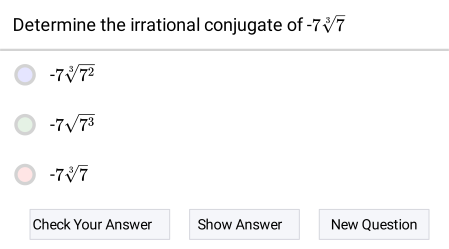
Determining the Irrational Conjugate of a Radical Expression
Find the irrational conjugate of a+bsqrt(c) or the irrational conjugate of an n^\text{th} root.
Discussion
Share
Report error
Rationalizing a Denominator Involving an n^\text{th} Root
When a numeric expression has a denominator that involves an irrational n^\text{th} root, it is convenient to rewrite the expression so that the denominator is a rational number. This process is known as rationalization. Consider the following example.
4/sqrt(27)
Since the denominator involves an n^\text{th} root, the fraction can be rewritten by multiplying both the numerator and denominator by the irrational conjugate of the denominator. The resulting expression can then be simplified.
1
Multiply by the Conjugate of the Denominator
expand_more First, the radicand should be rewritten as a power. 4/sqrt(27) = 4/sqrt(3^3) To get rid of the radical expression in the denominator, the numerator and the denominator are multiplied by its irrational conjugate. Since the radicand involves the third power and the index of the root is 5, multiply by sqrt(3^(5 - 3)) = sqrt(3^2). 4* sqrt(3^2)/sqrt(3^3)* sqrt(3^2)
2
Simplify the Expression
expand_more The obtained expression can now be simplified.
The denominator has now been rationalized because it contains an integer number and no roots.
4*sqrt(3^2)/sqrt(3^3)* sqrt(3^2)
▼
Simplify
MultRoot
sqrt(a)*sqrt(b)=sqrt(a* b)
4*sqrt(3^2)/sqrt(3^3* 3^2)
MultPow
a^m*a^n=a^(m+n)
4*sqrt(3^2)/sqrt(3^(3+2))
AddTerms
Add terms
4*sqrt(3^2)/sqrt(3^5)
RootPowToNumber
sqrt(a^5)=a
4*sqrt(3^2)/3
CalcPowProd
Calculate power and product
4sqrt(9)/3
Notice that this method also works when the denominator is the product of two roots with different indexes. In these cases, the method should be applied twice. However, if the denominator involves a sum of two n^\text{th} roots with different indexes, rationalizing is a more complicated task.
Example
Share
Report error
Calculating the Circular Velocity of a Satellite
While reading some research papers on astronomy, Ignacio came across the fact that the circular velocity v of a satellite circling the Earth is given by the following formula. v = sqrt(K/r) In this formula, v is measured in miles per hour, r is the distance in miles from the satellite to the center of the Earth, and K is a constant depending on the gravitational constant and the mass of the Earth.
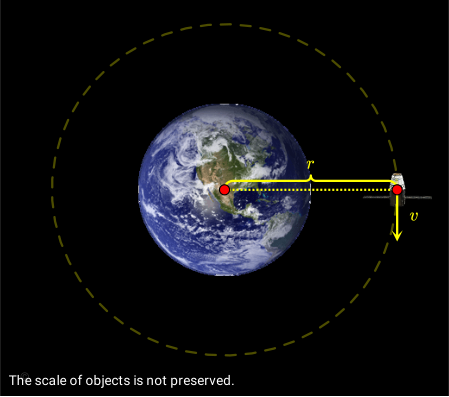
a Rationalize the denominator of the formula for the velocity v of a satellite when r is equal to sqrt(262 528^2). Choose the correct answer.
{"type":"choice","form":{"alts":["A. v = sqrt(K)* sqrt(sqrt(262 528^2))\/sqrt(262 528^2)","B. v = sqrt(K)* sqrt(262 528^2)\/262 528","C. v = K* sqrt(262 528^2)\/262 528","D. v = sqrt(K)* sqrt(262 528)\/262 528"],"noSort":true},"formTextBefore":"","formTextAfter":"","answer":1}
b A second satellite is orbiting the Earth at a distance (3-sqrt(2))^2 times greater than the distance of the satellite from Part A. Write the velocity v_2 of this second satellite in terms of v. Rationalize the denominator if needed.
{"type":"text","form":{"type":"math","options":{"comparison":"1","nofractofloat":false,"keypad":{"simple":false,"useShortLog":false,"variables":["v"],"constants":[]},"rendered":false},"text":" "},"formTextBefore":"v_2=","formTextAfter":null,"answer":{"text":["\\dfrac{3+\\sqrt{2}}{7}v"]}}
Hint
a Rewrite the formula using the Quotient Property of Square Roots. Then, multiply both the numerator and denominator by the irrational conjugate of the n^\text{th} root.
b Write the distance from the second satellite in terms of r. Consider the quotient of the velocities to cancel out common factors.
Solution
a First, notice that the formula for the circular velocity v can be rewritten using the Quotient Property of Square Roots.
v = sqrt(K)/sqrt(r)
Substitute
r= sqrt(262 528^2)
v = sqrt(K)/sqrt(sqrt(262 528^2))
▼
Rewrite
ExpandFrac
a/b=a * sqrt(sqrt(262 528^2))/b * sqrt(sqrt(262 528^2))
v = sqrt(K)* sqrt(sqrt(262 528^2))/sqrt(sqrt(262 528^2))* sqrt(sqrt(262 528^2))
MultSqrt
sqrt(a)* sqrt(a)= a
v = sqrt(K)* sqrt(sqrt(262 528^2))/sqrt(262 528^2)
ExpandFrac
a/b=a * sqrt(262 528^1)/b * sqrt(262 528^1)
v = sqrt(K)* sqrt(sqrt(262 528^2))* sqrt(262 528^1)/sqrt(262 528^2) * sqrt(262 528^1)
MultRoot
sqrt(a)*sqrt(b)=sqrt(a* b)
v = sqrt(K)* sqrt(sqrt(262 528^2))* sqrt(262 528^1)/sqrt(262 528^2 *262 528^1)
MultPow
a^m*a^n=a^(m+n)
v = sqrt(K)* sqrt(sqrt(262 528^2))* sqrt(262 528^1)/sqrt(262 528^3)
RootPowToNumber
sqrt(a^3)=a
v = sqrt(K)* sqrt(sqrt(262 528^2))* sqrt(262 528^1)/262 528
v = sqrt(K)* sqrt(sqrt(262 528^2))* sqrt(262 528^1)/262 528
▼
Simplify right-hand side
SqrtToPowD
sqrt(a)=a^(12)
v = sqrt(K)* ( sqrt(262 528^2))^()12* sqrt(262 528^1)/262 528
RootToPowD
sqrt(a)=a^(1n)
v = sqrt(K)* ( ( 262 528^2 )^()13)^()12* sqrt(262 528^1)/262 528
(a^m)^n= (a^n)^m
v = sqrt(K)* ( ( 262 528^2 )^()12)^()13* sqrt(262 528^1)/262 528
PowPow
(a^m)^n=a^(m* n)
v = sqrt(K)* ( 262 528^(2* 12) )^()13* sqrt(262 528^1)/262 528
a * 1/a=1
v = sqrt(K)* ( 262 528^1 )^()13* sqrt(262 528^1)/262 528
ExponentOne
a^1=a
v = sqrt(K)* ( 262 528 )^()13* sqrt(262 528)/262 528
PowToRootD
a^(1n)=sqrt(a)
v = sqrt(K)* sqrt(262 528) * sqrt(262 528)/262 528
MultRoot
sqrt(a)*sqrt(b)=sqrt(a* b)
v = sqrt(K)* sqrt(262 528 * 262 528)/262 528
ProdToPowTwoFac
a* a=a^2
v = sqrt(K)* sqrt(262 528^2)/262 528
b It is given that the distance r_2 of the second satellite to the center of the Earth is (3-sqrt(2))^2 times greater than the distance r of the first satellite considered in Part A.
v_2/v = sqrt(Kr_2)/sqrt(Kr)
Substitute
r_2= (3-sqrt(2))^2 r
v_2/v = sqrt(K(3-sqrt(2))^2 r)/sqrt(Kr)
▼
Evaluate right-hand side
SqrtQuot
sqrt(a/b)=sqrt(a)/sqrt(b)
v_2/v = sqrt(K)sqrt((3-sqrt(2))^2 r)/sqrt(K)sqrt(r)
DivFracByFracD
.a /b./.c /d.=a/b*d/c
v_2/v = sqrt(K)/sqrt((3-sqrt(2))^2 r) * sqrt(r)/sqrt(K)
MultFrac
Multiply fractions
v_2/v = sqrt(K) * sqrt(r)/sqrt((3-sqrt(2))^2 r) * sqrt(K)
SqrtProd
sqrt(a* b)=sqrt(a)*sqrt(b)
v_2/v = sqrt(K) * sqrt(r)/sqrt((3-sqrt(2))^2) * sqrt(r) * sqrt(K)
CancelCommonFac
Cancel out common factors
v_2/v = sqrt(K) * sqrt(r)/sqrt((3-sqrt(2))^2) * sqrt(r) * sqrt(K)
SimpQuot
Simplify quotient
v_2/v = 1/sqrt((3-sqrt(2))^2)
SqrtToAbs
sqrt(a^2)=|a|
v_2/v = 1/| 3-sqrt(2)|
AbsPos
|3-sqrt(2)|=3-sqrt(2)
v_2/v = 1/3-sqrt(2)
ExpandFrac
a/b=a * (3+sqrt(2))/b * (3+sqrt(2))
v_2/v = 1(3+sqrt(2))/(3-sqrt(2)) (3+sqrt(2))
IdPropMult
Identity Property of Multiplication
v_2/v = 3+sqrt(2)/(3-sqrt(2)) (3+sqrt(2))
(a-b)(a+b)=a^2-b^2
v_2/v = 3+sqrt(2)/3^2 - ( sqrt(2) )^2
CalcPow
Calculate power
v_2/v = 3+sqrt(2)/9 - ( sqrt(2) )^2
PowSqrt
( sqrt(a) )^2 = a
v_2/v = 3+sqrt(2)/9-2
SubTerm
Subtract term
v_2/v = 3+sqrt(2)/7
MultEqn
LHS * v=RHS* v
v_2 = 3+sqrt(2)/7 v
Discussion
Share
Report error
Adding and Subtracting Like Radical Expressions and Roots
Concept
Share
Report error
Like Radical Expressions
Radical expressions are called like radical expressions or like radicals if both the index and the radicand of the corresponding roots are identical.
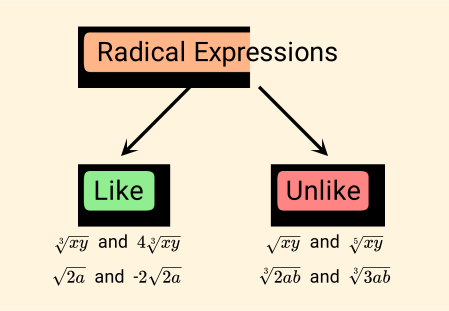
Use the Distributive Property to add or subtract like radical expressions.
asqrt(x) + bsqrt(x) = (a + b) sqrt(x)
asqrt(x) - bsqrt(x) = (a - b) sqrt(x)
Rule
Share
Report error
Adding and Subtracting Radicals
A numeric or algebraic expression that contains two or more radical terms with the same radicand and the same index — called like radical expressions — can be simplified by adding or subtracting the corresponding coefficients.
asqrt(x)± bsqrt(x)=(a± b)sqrt(x)
Here, a,b, and x are real numbers and n is a natural number. If n is even, then x must be greater than or equal to zero.
Proof
If n is an even number, then x is greater than or equal to zero. If n is odd, then x can be any real number. In both cases, sqrt(x) is a real number. This means that the Distributive Property can be used to factor out sqrt(x).
Method
Share
Report error
Adding and Subtracting Radicals
Two radicals can be added or subtracted if it is possible to rewrite them as like radical expressions. Use the Distributive Property to add or subtract like radicals.
asqrt(x) + bsqrt(x) = ( a + b) sqrt(x)
asqrt(x) - bsqrt(x) = ( a - b) sqrt(x)
1
Simplify the Radicals to Have the Same Index and Radicand
expand_more Start by rewriting the expressions as like radicals. To do so, split the radicands into factors and use the properties of radicals.
Since both the index and the radicand of the roots are identical, they are like radical expressions.
sqrt(x^5 y^3) + sqrt(16xy^7)
▼
Rewrite
SplitIntoFactors
Split into factors
sqrt(x^5 * y^3) + sqrt(16* x* y^7)
WriteSum
Write as a sum
sqrt(x^(4+1) * y^3) + sqrt(16* x* y^(4+3))
SumInExponent
a^(m+n)=a^m*a^n
sqrt(x^4 * x^1 * y^3) + sqrt(16* x* y^4* y^3)
CommutativePropMult
Commutative Property of Multiplication
sqrt(x^4 * x^1 * y^3) + sqrt(16 * y^4* x* y^3)
RootProd
sqrt(a* b)=sqrt(a)*sqrt(b)
sqrt(x^4) * sqrt(x^1 * y^3) + sqrt(16 * y^4)* sqrt(x* y^3)
ExponentOne
a^1=a
sqrt(x^4) * sqrt(x * y^3) + sqrt(16 * y^4)* sqrt(x* y^3)
sqrt(a^4)=|a|
|x| * sqrt(x * y^3) + sqrt(16 * y^4)* sqrt(x* y^3)
WritePow
Write as a power
|x| * sqrt(x * y^3) + sqrt(2^4 * y^4)* sqrt(x* y^3)
ProdPow
a^m* b^m=(a * b)^m
|x| * sqrt(x * y^3) + sqrt((2y)^4)* sqrt(x* y^3)
sqrt(a^4)=|a|
|x| * sqrt(x * y^3) + |2y|* sqrt(x* y^3)
Multiply
Multiply
|x| sqrt(xy^3) + |2y| sqrt(xy^3)
2
Add or Subtract Like Radicals
expand_more Now, like radical expressions can by added by using the Distributive Property. |x| sqrt(xy^3) + |2y| sqrt(xy^3) [0.3em] ⇕ [0.3em] (|x| + |2y|)sqrt(xy^3)
3
Simplify the Result as Necessary
expand_more The signs of the x- and y-variables are not given. This means that the expression in parentheses cannot be further simplified and the result of the addition is as follows. (|x| + |2y|)sqrt(xy^3)
Example
Share
Report error
The Area of Triangles on a Door
The last step in designing the observatory is to come up with a new logo. Ignacio has sketched the following prototype of his logo.

{"type":"text","form":{"type":"math","options":{"comparison":"1","nofractofloat":false,"keypad":{"simple":false,"useShortLog":false,"variables":[],"constants":[]},"rendered":false},"text":" "},"formTextBefore":null,"formTextAfter":"square inches","answer":{"text":["(54+\\sqrt[3]{1024})\\sqrt{3}","(54+8\\sqrt[3]{2})\\sqrt{3}"]}}
Hint
How many large and small triangles form the logo? Use the formula for the area of a triangle using sine. Also, keep in mind that sin 60^(∘) = sqrt(3)2.
Solution
It is given that the logo is made of two types of equilateral triangles. To find the area of the design, start by determining the number of triangles of each type.
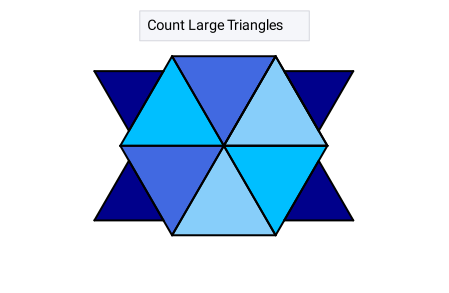 There are 6 large and 4 small triangles. Now, the area of a single triangle of each type will be found. Recall the formula for the area of a triangle involving the sine ratio. Start with the area A_1 of a large triangle.
Area = 1/2absin C
The length of all sides is 6 inches and the measure of all angles in the triangle is 60^(∘). This means that a= 6, b= 6, and C = 60^(∘) can be substituted into the formula to find the area.
Similarly, the area A_2 of a small triangle can be calculated. In this case, the side length is sqrt(32) inches and the measure of the included angle is 60^(∘) as previously.
In this expression, it is important not to make a mistake by using the Product Property of Radicals. The indices of roots are not equal, so they cannot be combined. Next, the total area A can be found by adding 6 times the area of a large triangle to 4 times the area of a small triangle.
A = 6A_1 + 4A_2
Finally, substitute the simplified areas of a single triangle of each type and evaluate the area by adding like radical expressions.
Therefore, the total area of the logo is ( 54 + 8sqrt(2)) sqrt(3) square inches.
There are 6 large and 4 small triangles. Now, the area of a single triangle of each type will be found. Recall the formula for the area of a triangle involving the sine ratio. Start with the area A_1 of a large triangle.
Area = 1/2absin C
The length of all sides is 6 inches and the measure of all angles in the triangle is 60^(∘). This means that a= 6, b= 6, and C = 60^(∘) can be substituted into the formula to find the area.
Similarly, the area A_2 of a small triangle can be calculated. In this case, the side length is sqrt(32) inches and the measure of the included angle is 60^(∘) as previously.
In this expression, it is important not to make a mistake by using the Product Property of Radicals. The indices of roots are not equal, so they cannot be combined. Next, the total area A can be found by adding 6 times the area of a large triangle to 4 times the area of a small triangle.
A = 6A_1 + 4A_2
Finally, substitute the simplified areas of a single triangle of each type and evaluate the area by adding like radical expressions.
Therefore, the total area of the logo is ( 54 + 8sqrt(2)) sqrt(3) square inches.
A_1 = 1/2absin C
SubstituteValues
Substitute values
A_1 = 1/2( 6)( 6)sin 60^(∘)
▼
Evaluate right-hand side
Multiply
Multiply
A_1 = 1/2(36) sin 60^(∘)
MoveNumRight
a/b=1/b* a
A_1 = 36/2 sin 60^(∘)
\ifnumequal{60}{0}{\sin\left(0^\circ\right)=0}{}\ifnumequal{60}{30}{\sin\left(30^\circ\right)=\dfrac{1}{2}}{}\ifnumequal{60}{45}{\sin\left(45^\circ\right)=\dfrac{\sqrt{2}}{2}}{}\ifnumequal{60}{60}{\sin\left(60^\circ\right)=\dfrac{\sqrt{3}}{2}}{}\ifnumequal{60}{90}{\sin\left(90^\circ\right)=1}{}\ifnumequal{60}{120}{\sin\left(120^\circ\right)=\dfrac{\sqrt{3}}{2}}{}\ifnumequal{60}{135}{\sin\left(135^\circ\right)=\dfrac{\sqrt{2}}{2}}{}\ifnumequal{60}{150}{\sin\left(150^\circ\right)=\dfrac{1}{2}}{}\ifnumequal{60}{180}{\sin\left(180^\circ\right)=0}{}\ifnumequal{60}{210}{\sin\left(210^\circ\right)=\text{-} \dfrac 1 2}{}\ifnumequal{60}{225}{\sin\left(225^\circ\right)=\text{-} \dfrac {\sqrt{2}} {2}}{}\ifnumequal{60}{240}{\sin\left(240^\circ\right)=\text{-} \dfrac {\sqrt 3}2}{}\ifnumequal{60}{270}{\sin\left(270^\circ\right)=\text{-}1}{}\ifnumequal{60}{300}{\sin\left(300^\circ\right)=\text{-}\dfrac {\sqrt 3}2}{}\ifnumequal{60}{315}{\sin\left(315^\circ\right)=\text{-} \dfrac {\sqrt{2}} {2}}{}\ifnumequal{60}{330}{\sin\left(330^\circ\right)=\text{-} \dfrac 1 2}{}\ifnumequal{60}{360}{\sin\left(360^\circ\right)=0}{}
A_1 = 36/2 ( sqrt(3)/2 )
MultFrac
Multiply fractions
A_1 = 36sqrt(3)/2(2)
Multiply
Multiply
A_1 = 36sqrt(3)/4
CalcQuot
Calculate quotient
A_1 = 9sqrt(3)
A_2 = 1/2absin C
SubstituteValues
Substitute values
A_2 = 1/2( sqrt(32))( sqrt(32))sin 60^(∘)
▼
Evaluate right-hand side
MultRoot
sqrt(a)*sqrt(b)=sqrt(a* b)
A_2 = 1/2( sqrt(1024) ) sin 60^(∘)
MoveNumRight
a/b=1/b* a
A_2 = sqrt(1024)/2 sin 60^(∘)
\ifnumequal{60}{0}{\sin\left(0^\circ\right)=0}{}\ifnumequal{60}{30}{\sin\left(30^\circ\right)=\dfrac{1}{2}}{}\ifnumequal{60}{45}{\sin\left(45^\circ\right)=\dfrac{\sqrt{2}}{2}}{}\ifnumequal{60}{60}{\sin\left(60^\circ\right)=\dfrac{\sqrt{3}}{2}}{}\ifnumequal{60}{90}{\sin\left(90^\circ\right)=1}{}\ifnumequal{60}{120}{\sin\left(120^\circ\right)=\dfrac{\sqrt{3}}{2}}{}\ifnumequal{60}{135}{\sin\left(135^\circ\right)=\dfrac{\sqrt{2}}{2}}{}\ifnumequal{60}{150}{\sin\left(150^\circ\right)=\dfrac{1}{2}}{}\ifnumequal{60}{180}{\sin\left(180^\circ\right)=0}{}\ifnumequal{60}{210}{\sin\left(210^\circ\right)=\text{-} \dfrac 1 2}{}\ifnumequal{60}{225}{\sin\left(225^\circ\right)=\text{-} \dfrac {\sqrt{2}} {2}}{}\ifnumequal{60}{240}{\sin\left(240^\circ\right)=\text{-} \dfrac {\sqrt 3}2}{}\ifnumequal{60}{270}{\sin\left(270^\circ\right)=\text{-}1}{}\ifnumequal{60}{300}{\sin\left(300^\circ\right)=\text{-}\dfrac {\sqrt 3}2}{}\ifnumequal{60}{315}{\sin\left(315^\circ\right)=\text{-} \dfrac {\sqrt{2}} {2}}{}\ifnumequal{60}{330}{\sin\left(330^\circ\right)=\text{-} \dfrac 1 2}{}\ifnumequal{60}{360}{\sin\left(360^\circ\right)=0}{}
A_2 = sqrt(1024)/2 ( sqrt(3)/2 )
MultFrac
Multiply fractions
A_2 = sqrt(1024)* sqrt(3)/4
A = 6A_1 + 4A_2
SubstituteII
A_1= 9sqrt(3), A_2= sqrt(1024)* sqrt(3)/4
A = 6( 9sqrt(3) ) + 4( sqrt(1024)* sqrt(3)/4 )
▼
Evaluate right-hand side
Multiply
Multiply
A = 54sqrt(3) + 4( sqrt(1024)* sqrt(3)/4 )
DenomMultFracToNumber
4 * a/4= a
A = 54sqrt(3) + sqrt(1024)* sqrt(3)
FactorOut
Factor out sqrt(3)
A = ( 54 + sqrt(1024)) sqrt(3)
SplitIntoFactors
Split into factors
A = ( 54 + sqrt(512* 2)) sqrt(3)
RootProd
sqrt(a* b)=sqrt(a)*sqrt(b)
A = ( 54 + sqrt(512)* sqrt(2)) sqrt(3)
CalcRoot
Calculate root
A = ( 54 + 8sqrt(2)) sqrt(3)
Closure
Share
Report error
Finding the Length of a Fencing
In the challenge presented at the beginning of this lesson, the dimensions of Ignacio's garden were given. He wants to fence in a triangular area of the garden in which to build his observatory. Notice that some side lengths are missing in the diagram. They can be calculated by using the given lengths. Also, unknown side lengths of an interior triangles will be marked.
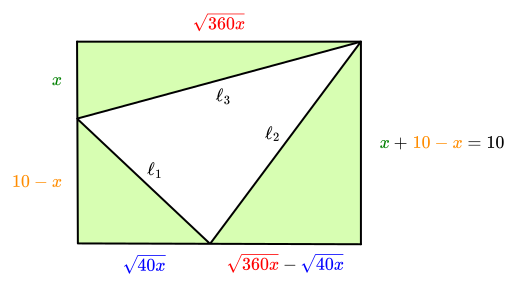
(l_1)^2 = (10-x)^2 + ( sqrt(40x) )^2
▼
Solve for l_1
ExpandNegPerfectSquare
(a-b)^2=a^2-2ab+b^2
(l_1)^2 = 10^2-2(10)x+x^2 + ( sqrt(40x) )^2
CalcPowProd
Calculate power and product
(l_1)^2 = 100-20x+x^2 + ( sqrt(40x) )^2
PowSqrt
( sqrt(a) )^2 = a
(l_1)^2 = 100-20x+x^2 + 40x
AddTerms
Add terms
(l_1)^2 = 100+20x+x^2
WritePow
Write as a power
(l_1)^2 = 10^2+20x+x^2
SplitIntoFactors
Split into factors
(l_1)^2 = 10^2+2(10)x+x^2
FacNegPerfectSquare
a^2-2ab+b^2=(a-b)^2
(l_1)^2 = (10+x)^2
SqrtEqn
sqrt(LHS)=sqrt(RHS)
sqrt((l_1)^2) = sqrt((10+x)^2)
SqrtToAbs
sqrt(a^2)=|a|
|l_1| = |10+x|
AbsPos
|l_1|=l_1
l_1 = |10+x|
(l_2)^2 = 10^2 + ( sqrt(360x) - sqrt(40x) )^2
▼
Solve for l_2
CalcPow
Calculate power
(l_2)^2 = 100 + ( sqrt(360x) - sqrt(40x) )^2
SplitIntoFactors
Split into factors
(l_2)^2 = 100 + ( sqrt(36* 10x) - sqrt(4* 10x) )^2
SqrtProd
sqrt(a* b)=sqrt(a)*sqrt(b)
(l_2)^2 = 100 + ( sqrt(36)* sqrt(10x) - sqrt(4)* sqrt(10x) )^2
CalcRoot
Calculate root
(l_2)^2 = 100 + ( 6sqrt(10x) - 2sqrt(10x) )^2
SubTerm
Subtract term
(l_2)^2 = 100 + ( 4sqrt(10x) )^2
PowProdII
(a b)^m=a^m b^m
(l_2)^2 = 100 + 4^2( sqrt(10x))^2
CalcPow
Calculate power
(l_2)^2 = 100 + 16( sqrt(10x))^2
PowSqrt
( sqrt(a) )^2 = a
(l_2)^2 = 100 + 16(10x)
Multiply
Multiply
(l_2)^2 = 100 + 160x
SqrtEqn
sqrt(LHS)=sqrt(RHS)
sqrt((l_2)^2) = sqrt(100 + 160x)
SqrtToAbs
sqrt(a^2)=|a|
|l_2| = sqrt(100+160x)
AbsPos
|l_2|=l_2
l_2 = sqrt(100+160x)
FactorOut
Factor out 4
l_2 = sqrt(4(25+40x))
SqrtProd
sqrt(a* b)=sqrt(a)*sqrt(b)
l_2 = sqrt(4)*sqrt(25+40x)
CalcPowProd
Calculate power and product
l_2 = 2sqrt(25+40x)
(l_3)^2 = x^2 + ( sqrt(360x) )^2
l_3 = sqrt(x^2 + 360x)
L(x) = 10 + x + 2sqrt(25 + 40x) + sqrt(x^2 + 360x)
Substitute
x= 5
L( 5) = 10 + 5 + 2sqrt(25 + 40( 5)) + sqrt(5^2 + 360( 5))
▼
Evaluate right-hand side
CalcPowProd
Calculate power and product
L(5) = 10 + 5 + 2sqrt(25+200) + sqrt(25 + 1800)
AddTerms
Add terms
L(5) = 15 + 2sqrt(225) + sqrt(1825)
CalcRoot
Calculate root
L(5) = 15 + 2(15) + sqrt(1825)
Multiply
Multiply
L(5) = 15 + 30 + sqrt(1825)
AddTerms
Add terms
L(5) = 45 + sqrt(1825)
SplitIntoFactors
Split into factors
L(5) = 45 + sqrt(25* 73)
SqrtProd
sqrt(a* b)=sqrt(a)*sqrt(b)
L(5) = 45 + sqrt(25)* sqrt(73)
Calculate root and product
L(5) = 45 + 5sqrt(73)
Operations With Radical Expressions
Exercise 3.1
Ignacio did some online research about n^\text{th} roots and found that complex roots are defined in the same way as real roots.
|
The n^\text{th} root of a complex number a, where n is a positive integer, is another complex number x such that, when multiplied by itself n times, will result in a. x^n = a |
{"type":"multichoice","form":{"alts":["A. sqrt(2)-isqrt(2) is a complex 4^\\text{th} root of 16.","B. sqrt(2)-isqrt(2) is a real 4^\\text{th} root of -16.","C. sqrt(2)-isqrt(2) is a complex 4^\\text{th} root of -16.","D. The 4^\\text{th} power of sqrt(2)-isqrt(2) has no real roots.","E. The 4^\\text{th} power of sqrt(2)-isqrt(2) has real roots."],"noSort":true},"formTextBefore":"","formTextAfter":"","answer":[2,3]}
{"type":"text","form":{"type":"math","options":{"comparison":"1","nofractofloat":false,"keypad":{"simple":true,"useShortLog":false,"variables":[],"constants":[]},"rendered":false},"text":" "},"formTextBefore":"a=","formTextAfter":null,"answer":{"text":["8"]}}
security
report
code
security
report
code
To raise sqrt(2)-isqrt(2) to the 4^\text{th} power, apply the the Binomial Theorem.
Let's rewrite the 4^\text{th} power of sqrt(2)-isqrt(2) in the form given in the theorem. ( sqrt(2)-isqrt(2) )^4 = ( sqrt(2)+(- isqrt(2)) )^4 In our case, x= sqrt(2), y= - isqrt(2), and n= 4. Let's substitute these values into the formula.
We can now evaluate the power. To do so, write each term of the sum in a table. We will use the 4^\text{th} row of the Pascal's triangle to calculate the number of combinations for each term of the sum.
| ( sqrt(2)-isqrt(2) )^4 | |||
|---|---|---|---|
| k | _4C_k (sqrt(2))^(4-k) (- isqrt(2))^k | Simplify | Evaluate |
| 0 | _4C_0 (sqrt(2))^(4- 0) (- isqrt(2))^0 | 1(sqrt(2))^4(- isqrt(2))^0 | 4 |
| 1 | _4C_1 (sqrt(2))^(4- 1) (- isqrt(2))^1 | -4(sqrt(2))^3 i^1 (sqrt(2))^1 | -16i |
| 2 | _4C_2 (sqrt(2))^(4- 2) (- isqrt(2))^2 | 6(sqrt(2))^2 i^2 (sqrt(2))^2 | -24 |
| 3 | _4C_3 (sqrt(2))^(4- 3) (- isqrt(2))^3 | -4(sqrt(2))^1 i^3 (sqrt(2))^3 | 16i |
| 4 | _4C_4 (sqrt(2))^(4- 4) (- isqrt(2))^4 | 1(sqrt(2))^0 i^4 (sqrt(2))^4 | 4 |
| Sum | -16 | ||
According to the given definition, since ( sqrt(2)-isqrt(2) )^4 is equal to -16, sqrt(2)-isqrt(2) is a complex 4^\text{th} root of -16. Notice that there are no real 4^\text{th} roots of -16 because -16 is a negative number. Our conclusions correspond to options C and D.
Recall that if -1-isqrt(3) is a complex 3^\text{rd} root of a, then the 3^\text{rd} power of -1-isqrt(3) must be equal to a. a = (-1-isqrt(3))^3 Let's calculate the 3^\text{rd} power to solve for a. Similar to Part A, the cube of a binomial can be expanded using the Binomial Theorem.
security
report
code
While watching a science-fiction movie, Ignacio noticed that cosmic fuel is kept in two types of tanks, a hemisphere and a cylinder.

Both tanks contain the same amount of fuel and are kept in the floor of a spacecraft.
{"type":"text","form":{"type":"math","options":{"comparison":"1","nofractofloat":false,"keypad":{"simple":false,"useShortLog":false,"variables":["r"],"constants":["PI"]},"rendered":false},"text":" "},"formTextBefore":"r_1=","formTextAfter":null,"answer":{"text":["\\sqrt[3]{15 r^2}"]}}
{"type":"choice","form":{"alts":["A. r_1 is increased by sqrt(4).","B. r_1 is sqrt(4) times greater.","C. r_1 is decreased by a factor of 4.","D. r_1 is increased by a factor of 2."],"noSort":true},"formTextBefore":"","formTextAfter":"","answer":1}
security
report
code
security
report
code
Let's begin by writing formulas for the volume of both tanks. Recall that the volume of a sphere is given by 43π r^3. Because a hemisphere is half of a sphere, its volume V_1 is also half the volume of a sphere. V_1 = 1/2*4/3π r_1^3 [0.6em] ⇕ [0.6em] V_1 = 2/3π r_1^3 The volume V of a cylinder can be calculated by the following formula. Recall that the height of the cylindrical tank is 10 feet. V = π r^2 h ⇓ V = 10π r^2 Next, we need to write an equation that shows r_1 as a function of r. Since V_1=V, let's set the two formulas equal. V_1 = V ⇓ 2/3π r_1^3 = 10 π r^2 Let's now solve this equation for r_1.
To find out how doubling the radius of the cylindrical tank will change the radius of the hemispherical tank, substitute 2r into the formula written in Part A. Then, use the Product Property of Radicals to expand the formula for r_1 and determine how the radius will change.
Notice that the second factor in the right-hand side of the equation is the original formula for r_1 before r was doubled. This means that r_1 is sqrt(4) times greater after the radius of the doubled cylinder radius. This corresponds to option B.
security
report
code
Operations With Radical Expressions
Recommended exercises
To get personalized recommended exercises, please login first.
Loading content
≤
>
■2
■▢
e▢
7
8
9
×
÷■1
=
=
√▢
▢√
∫▢▢
4
5
6
+
−
≤
<
log
ln
log▢
1
2
3
()
∣
sin
cos
tan
0
.
π
x
y
Loading content