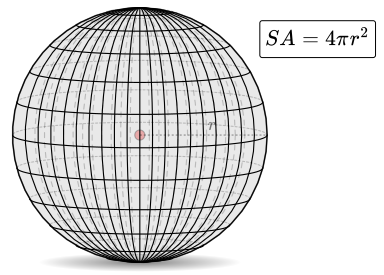
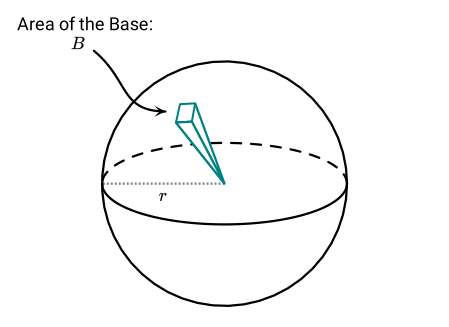
To find the surface area of a sphere, this informal justification will use the areas and volumes of known figures. It includes approximating the ratio between a sphere's surface area and its volume. In considering a known figure, suppose that a sphere is filled with n congruent pyramids. The area of the base of each pyramid is B.
The formula to find the volume of a pyramid uses the height and the area of its base. Here, since the base of the pyramid lies on the surface of the sphere, the height of the pyramid is equal to the radius r of the sphere.
VpyramidVpyramid=31Bh⇓=31Br
The ratio of the area of the base of the pyramid to its volume can be obtained by dividing B by the formula for the volume.
Since these pyramids fill the entire sphere, the sum of all the pyramid's base areas equals the surface area of the sphere. Additionally, the sum of the volumes of all the pyramids approximately equals the volume of the sphere.
SAsphereVsphere=n⋅Apyramidbase=n⋅Vpyramid
Considering these relationships, the ratio of the surface area of the sphere to its volume is the same as the ratio of the areas of the bases of the pyramids to their volumes.