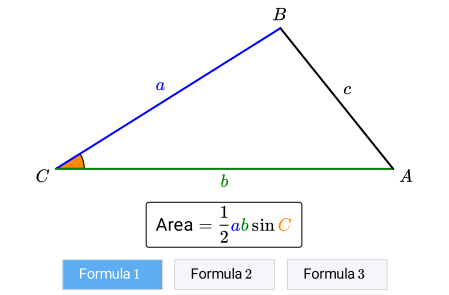
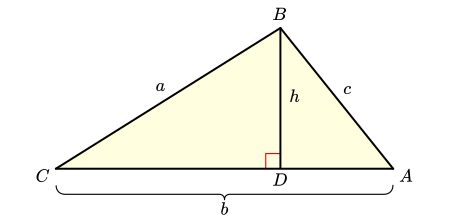
To find the first formula, start by drawing the from B and let h be its length. Since the altitude is to the base, it generates two .
Because
△BCD is a , the height of the triangle can be related to the sine of
∠C using the sine ratio.
sinC=ah⇔h=asinC
Next, substitute the expression found for
h into the general formula for the .
Area=21bh⇓Area=21absinC
The first formula was obtained. To obtain the second formula, notice that
△ABD is also a right triangle. Therefore, the sine ratio can be applied again, this time to connect
h and
∠A.
sinA=ch⇔h=csinA
By substituting this expression into the general formula for the area of a triangle, the second formula can be obtained.
Area=21bh⇓Area=21bcsinA
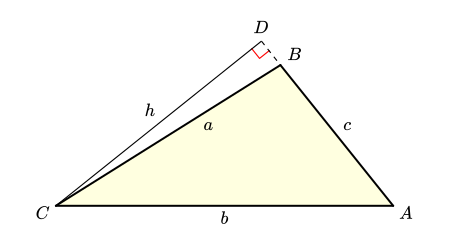
To deduce the third formula, the altitude from C or A should be drawn. In this case, the altitude from C will be drawn and labeled D with a length of h. Because ∠B is obtuse, the altitude will lie outside the triangle.
In this case, the length of the base is
c and the height is
h. Since
△BDC is a right triangle, the sine ratio can be used to connect
∠CBD and
h.
sinCBD=ah
Since
∠CBD and
∠B form a , they are . Recall that . With this information, and using the , a formula connecting
∠B and
h can be written.
⎩⎪⎪⎨⎪⎪⎧sinB=sinCBDsinCBD=ah ⇒ sinB=ah
Multiplying both sides of the last equation by
a, it is obtained that
h=asinB. Finally, substitute this expression for
h into the formula for the area of
△ABC.
Area=21ch⇓Area=21acsinB