Sign In
An error ocurred, try again later!
Volume of a Sphere
Slide 1 of 0
Rule
Volume of a Sphere
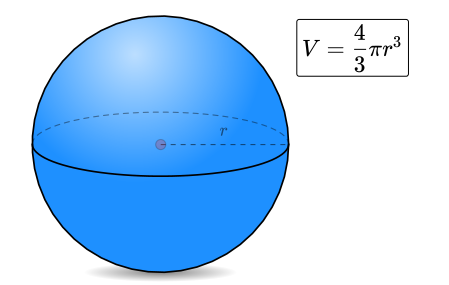
Proof
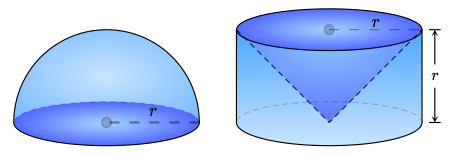
Cavalieri's Principle will be used to show that the formula for the volume of a sphere holds. For this purpose, consider a hemisphere and a right cylinder with a cone removed from its interior, each with the same radius and height.

Finding the Hemisphere's Cross-Sectional Area
Draw a right triangle with height x, base y, and hypotenuse r. Here, x is the distance between the center of the base of the hemisphere and the center of the cross sectional circle, y is the radius of the cross sectional circle, and r is the radius of the hemisphere.
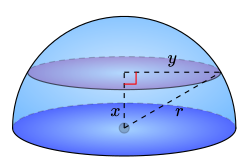
r2=x2+y2
▼
Solve for y
y=±r2−x2
Finding the Cylinder's Cross-Sectional Area
The area of the cross-section of the cylinder can be found similarly. The cross-section's area is equal to the area between two circles. Since the height and the radius of the cylinder are equal, an isosceles right triangle can be formed inside the cylinder. Therefore, the radius of the smaller circle is also x.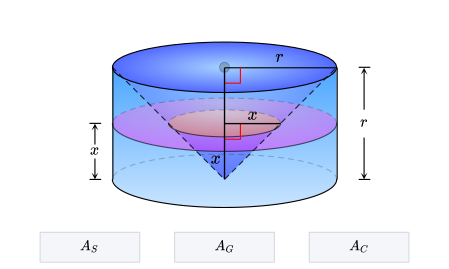
Conclusion
It can be stated that both solids have the same cross-sectional area at every altitude.AH=π(r2−x2)=AC
Moreover, they have the same height. By Cavalieri's Principle, the hemisphere and the cylinder with a cone removed from its interior have the same volume. 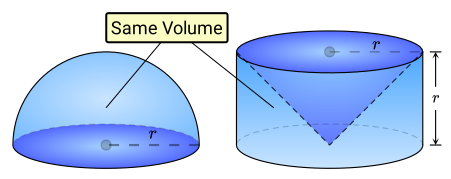
Vhemisphere=Vcylinder−Vcone
SubstituteValues
Substitute values
Vhemisphere=πr3−31πr3
▼
Simplify right-hand side
NumberToFrac
a=33⋅a
Vhemisphere=33πr3−31πr3
MoveRightFacToNum
ca⋅b=ca⋅b
Vhemisphere=33πr3−3πr3
SubFrac
Subtract fractions
Vhemisphere=32πr3
Vsphere=2⋅Vhemisphere=2⋅32πr3=34πr3
Exercises
Recommended exercises
To get personalized recommended exercises, please login first.
Loading content
Loading content