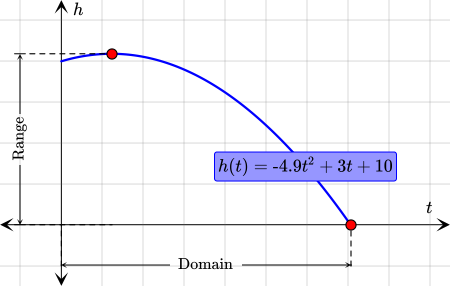
a We are given a model for the height of a diver above the pool and asked to identify the meaningful time and height values.
Domain
The domain contains time values for when the diver is above the water.
The lower bound for the domain is 0, since the diver starts their jump at t=0.
To find the upper bound, we need to find the solution of h(t)=0, which is a quadratic equation.
- 4.9t^2+3t+10=0
Let's use the Quadratic Formula.
2
&Quadratic equation: && ax^2+ bx+ c=0
&Solutions:&&x=- b±sqrt(b^2-4 a c)/2 a
First identify the coefficients in our quadratic expression.
- 4.9t^2+ 3t+ 10
We see that a= - 4.9, b= 3, and c= 10. Let's substitute these values into the Quadratic Formula.
We can use a calculator to find approximate values of these solutions.
-3+sqrt(205)/-9.8&≈ -1.15
-3-sqrt(205)/-9.8&≈ 1.77
Since the solution we are looking for represents time, we need the positive solution.
Using the lower and upper bounds we found, we can write the domain for which the function makes sense.
Domain: 0≤ t≤ 1.77
Range
The range contains height values.
The lower bound of the range is 0, since the diver is above the water for the time values in the domain we found above.
To find the upper bound, we need to find the vertex of the parabolic graph. We know that this vertex is on the axis of symmetry.
2
&Quadratic function: &&f(x)= ax^2+ bx+ c
&Axis of symmetry:&&x=-b/2 a
&Vertex:&&(-b/2 a,f(-b/2 a))
The coefficients are the ones we used above.
a= - 4.9 b= 3 c= 10
We can use these values to find the first coordinate of the vertex.
This means that the diver reaches the maximum after 1549 seconds.
To find the maximum height, we can substitute this value in the expression for height.
The maximum height the diver reaches is approximately 10.46 meters above the pool.
Using the lower and upper bounds we found, we can write the range for which the function makes sense.
Range: 0≤ t≤ 10.46
b The diver hits the water when h(t)=0. We already found the solution to this equation in Part A, when we calculated the upper limit of the domain. The diver hits the water 1.77 seconds after they started the jump.