8. Solving Quadratic Equations With the Quadratic Formula
Sign In
An error ocurred, try again later!
Chapter 8
8.
Solving Quadratic Equations With the Quadratic Formula
This lesson delves into the Quadratic Formula, a powerful tool for solving quadratic equations. The formula offers a systematic approach to find the solutions of any quadratic equation written in standard form. The method is presented, proven, and applied to various scenarios. One real-world example involves Magdalena and Diego, who face a challenge while camping. They need to determine if a stone thrown by Diego can reach a branch 15 feet above the ground. Using the Quadratic Formula, they can predict the stone's trajectory and decide if it will hit the target. Another example showcases Magdalena's fundraiser for paralympic athletes. She aims to determine the ticket price to ensure a profit of at least $200. The Quadratic Formula helps her find the optimal ticket price. The lesson also highlights the discriminant, a part of the formula, which indicates the number of real solutions a quadratic equation has. Overall, the Quadratic Formula is not just a mathematical concept but a practical tool with diverse applications.
Show less Show more expand_more 


Lesson Settings & Tools
| | 10 Theory slides |
| | 10 Exercises - Grade E - A |
| | Each lesson is meant to take 1-2 classroom sessions |
Solving Quadratic Equations With the Quadratic Formula
Slide of 10
There are several methods for solving quadratic equations. In this lesson, the Quadratic Formula will be presented, proven, and used. Additionally, a method for determining the number of solutions without actually solving the equation will be presented.
Catch-Up and Review
Here are a few recommended readings before getting started with this lesson.
Try a few practice exercises as a warm-up!
a Simplify the numeric expression sqrt(4^2 - 4(1)(2)) by using the properties of square roots to remove the perfect-square factor.
{"type":"text","form":{"type":"math","options":{"comparison":"1","nofractofloat":false,"keypad":{"simple":false,"useShortLog":false,"variables":[],"constants":[]},"rendered":false},"text":" "},"formTextBefore":null,"formTextAfter":null,"answer":{"text":["2\\sqrt{2}","2\\t\\sqrt{2}","2\\times\\sqrt{2}","2\\sqrt[2]{2}","2\\t\\sqrt[2]{2}"]}}
b Consider the quadratic function y = (x+2)^2-1. Of the following expressions, which represents the same function written in standard form?
{"type":"choice","form":{"alts":["y = (x+2)^2-1","y = (x+2)^2","y = x^2+4x+3","y = (x+1)(x+3)"],"noSort":false},"formTextBefore":"","formTextAfter":"","answer":2}
c Identify the coefficient b of the quadratic equation x-5=2(x-3)^2 when written in standard form ax^2+bx+c = 0.
{"type":"text","form":{"type":"math","options":{"comparison":"0","nofractofloat":false,"keypad":{"simple":true,"useShortLog":false,"variables":["x"],"constants":[]},"rendered":false},"text":" "},"formTextBefore":"b=","formTextAfter":null,"answer":{"text":["-13","13"]}}
Challenge
Share
Report error
Is There a Solution?
Magdalena and Diego, both huge fans of statistics, went camping to bond under the stars and talk stats. However, they realize that bears are in the area. They need to hang their food basket from a branch 15 feet above the ground. Diego figures he can throw a stone with a rope attached to it over the branch. As Diego winds up, Magdalena sheepishly snickers, "No way that works."

In wondering if Diego's throw will be a success, consider the following quadratic function that models the height, in air, of the stone's location after t seconds of being thrown. h(t) = 5(-3t^2 + 5t + 1)
Magdalena also wonders what quadratic equation represents this scenario. Help her find it. Then, without solving the equation, determine whether it is even possible to know if the stone will reach the branch.Discussion
Share
Report error
The Quadratic Formula
Besides graphing, using square roots, factoring, and completing the square, there is another method for solving a quadratic equation. This method consists of using the Quadratic Formula. Check out how to derive the formula by completing the square!
Rule
Share
Report error
Quadratic Formula
The Quadratic Formula can be used to solve a quadratic equation written in standard form ax^2+bx+c = 0.
x=- b±sqrt(b^2-4ac)/2a
Proof
The Quadratic Formula can be derived by completing the square given the standard form of the quadratic equation ax^2 + bx + c = 0. This method will be used to isolate the x-variable. To complete the square, there are five steps to follow.
1
Factor Out the Coefficient of x^2
expand_more It is easier to complete the square when the quadratic expression is written in the form x^2 + bx + c. Therefore, the coefficient a should be factored out. ax^2+bx+c = 0 ⇕ a(x^2+b/ax+c/a) = 0 Since the equation is quadratic, the coefficient a is not equal to 0. Therefore, both sides of the equation can be divided by a. a(x^2+b/ax+c/a) = 0 ⇕ x^2+b/ax+c/a = 0
2
Identify the Constant Needed to Complete the Square
expand_more The next step is to rewrite the equation by moving the existing constant to the right-hand side. To do so, ca will be subtracted from both sides of the equation. x^2+b/ax+ c/a = 0 ⇕ x^2+ b/ax = - c/a
The constant needed to complete the square can now be identified by focusing on the x-term, while ignoring the rest. One way to find this constant is by squaring half the coefficient of the x-term, which in this case is ba.
Note that leaving the constant as a power makes the next steps easier to perform.
3
Complete the Square
expand_more The square can now be completed by adding the constant found in Step 2 to both sides of the equation. \begin{gathered} x^2+\dfrac{b}{a}x = \text{-} \dfrac{c}{a} \\ \Updownarrow \\ \underbrace{x^2+\dfrac{b}{a}x + {\color{#FD9000}{\left(\dfrac{b}{2a} \right)^2}}}_\text{Perfect Square Trinomial} = \underbrace{\text{-} \dfrac{c}{a} + {\color{#FD9000}{\left(\dfrac{b}{2a} \right)^2}}}_\text{Constant} \end{gathered} The first three terms form a perfect square trinomial, which can be factored as the square of a binomial. The other two terms do not contain the variable x. Therefore, their value is constant.
4
Factor the Perfect Square Trinomial
expand_more The perfect square trinomial can now be factored and rewritten as the square of a binomial.
The process of completing the square is now finished.
x^2+b/ax + (b/2a )^2 = - c/a + (b/2a )^2
DenomMultFracToNumber
2 * a/2= a
x^2+2(b/2a)x + (b/2a )^2 = - c/a + (b/2a )^2
CommutativePropMult
Commutative Property of Multiplication
x^2+2x(b/2a) + (b/2a )^2 = - c/a + (b/2a )^2
FacPosPerfectSquare
a^2+2ab+b^2=(a+b)^2
(x + b/2a)^2 = - c/a + (b/2a )^2
5
Simplify the Equation
expand_more Finally, the right-hand side of the equation can be simplified.
Now, there is only one x-term. To isolate x, it is necessary to take square roots on both sides of the equation. This results in both a positive and a negative term on the right-hand side.
sqrt((x + b/2a)^2) = sqrt(b^2-4ac/4a^2) ⇕ x + b/2a = ± sqrt(b^2-4ac/4a^2)
Now, the equation can be further simplified to isolate x.
Finally, the Quadratic Formula has been obtained.
(x + b/2a)^2 = - c/a + (b/2a )^2
▼
Simplify right-hand side
CommutativePropAdd
Commutative Property of Addition
(x + b/2a)^2 = (b/2a )^2 - c/a
PowQuot
(a/b)^m=a^m/b^m
(x + b/2a)^2 = b^2/(2a)^2 - c/a
PowProdII
(a b)^m=a^m b^m
(x + b/2a)^2 = b^2/4a^2 - c/a
ExpandFrac
a/b=a * 4a/b * 4a
(x + b/2a)^2 = b^2/4a^2 - c* 4a/a * 4a
CommutativePropMult
Commutative Property of Multiplication
(x + b/2a)^2 = b^2/4a^2 - 4ac/4a* a
ProdToPowTwoFac
a* a=a^2
(x + b/2a)^2 = b^2/4a^2 - 4ac/4a^2
SubFrac
Subtract fractions
(x + b/2a)^2 = b^2-4ac/4a^2
x + b/2a = ± sqrt(b^2-4ac/4a^2)
▼
Solve for x
SqrtQuot
sqrt(a/b)=sqrt(a)/sqrt(b)
x + b/2a = ± sqrt(b^2-4ac)/sqrt(4a^2)
SqrtProd
sqrt(a* b)=sqrt(a)*sqrt(b)
x + b/2a = ± sqrt(b^2-4ac)/2sqrt(a^2)
SqrtPowToNumber
sqrt(a^2)=a
x + b/2a = ± sqrt(b^2-4ac)/2a
SubEqn
LHS-b/2a=RHS-b/2a
x = - b/2a ± sqrt(b^2-4ac)/2a
MoveNegFracToNum
Put minus sign in numerator
x = - b/2a ± sqrt(b^2-4ac)/2a
AddSubFrac
Add and subtract fractions
x = - b ± sqrt(b^2-4ac)/2a
x = - b ± sqrt(b^2-4ac)/2a
Example
Share
Report error
Solving a Quadratic Equation Using the Quadratic Formula
Magdalena will sell lottery tickets as a fundraiser to support paralympic athletes. The total profit p(x) depends on the price x of a ticket and can be modeled by using the following quadratic equation.
p(x) = -2x^2 + 32x + 104
Magdalena wants to raise at least $200. However, she has not yet set the price of each lottery ticket. Help Magdalena find the smallest amount that can be charged per ticket and still make a profit of at least $200. Round the price to the nearest whole dollar (the dollar sign is not necessary).
{"type":"text","form":{"type":"math","options":{"comparison":"1","nofractofloat":false,"keypad":{"simple":true,"useShortLog":false,"variables":[],"constants":[]},"rendered":false},"text":" "},"formTextBefore":"x=","formTextAfter":null,"answer":{"text":["4"]}}
Hint
Since the profit should be at least $200, let p(x) be equal to 200. Then, rewrite the quadratic equation in standard form. The equation can be solved using the Quadratic Formula.
Solution
It is given that the profit for the fundraiser should be at least $200. Consider the given quadratic equation, which models the profit, and substitute 200 for p(x). Then, rewrite the obtained equation in standard form.
Now, all of the coefficients in the standard form ax^2+bx+c = 0 can be determined.
-2x^2 + 32x - 96 = 0 ⇕ -2x^2 + 32x + ( - 96) = 0
Therefore, a= -2, b= 32, and c= -96. The obtained equation will be solved using the Quadratic Formula.
x = - b ± sqrt(b^2-4ac)/2a
The values of a, b, and c will now be substituted into the formula. Find x by evaluating the right-hand side of the formula.
Using the Quadratic Formula, it was obtained that the solutions for the equation are x = -32 ± 16-4. Finally, both solutions can be evaluated using a table.
p(x) = -2x^2 + 32x + 104
Substitute
p(x)= 200
200 = -2x^2 + 32x + 104
SubEqn
LHS-200=RHS-200
0 = -2x^2 + 32x - 96
RearrangeEqn
Rearrange equation
-2x^2 + 32x - 96 = 0
x = - b ± sqrt(b^2-4ac)/2a
SubstituteValues
Substitute values
x = - 32 ± sqrt(32^2-4( -2)( -96))/2( -2)
▼
Evaluate right-hand side
CalcPow
Calculate power
x=-32±sqrt(1024-4(-2)(-96))/2(-2)
MultPosNeg
a(- b)=- a * b
x=-32±sqrt(1024-(-8)(-96))/-4
MultNegNegTwoPar
(- a)(- b)=a* b
x=-32±sqrt(1024-768)/-4
SubTerm
Subtract term
x=-32±sqrt(256)/-4
CalcRoot
Calculate root
x = -32 ± 16/-4
| x = -32 ± 16/-4 | |
|---|---|
| x = -32 + 16/-4 | x = -32 - 16/-4 |
| x=-16/-4 | x=-48/-4 |
| x=4 | x=12 |
Since Magdalena wants the tickets to be as cheap as possible while making a profit of at least $200, the price each ticket should be $4.
Example
Share
Report error
Solving a Quadratic Equation Not in Standard Form
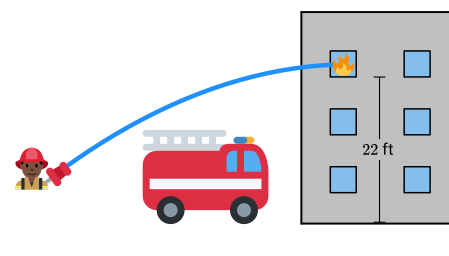
A fire nozzle attached to a hose is a device used by firefighters to extinguish fires. Consider a firefighter who is aiming water to extinguish a fire on the third floor of a building. The base of the fire is situated 22 feet above the ground.
{"type":"text","form":{"type":"math","options":{"comparison":"1","nofractofloat":false,"keypad":{"simple":true,"useShortLog":false,"variables":["x"],"constants":[]},"rendered":false},"text":" "},"formTextBefore":"x=","formTextAfter":"ft","answer":{"text":["50"]}}
Hint
What is the height of the water stream's peak? Write a quadratic equation and solve it using the Quadratic Formula.
Solution
Consider the given situation on a coordinate plane and assume that the firefighter is standing on the y-axis. 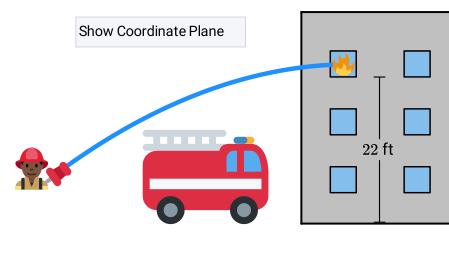 Since the water stream's peak is 2 feet above the fire's base, whose height is 22 feet, its height h(x) is 2+22= 24 feet. This height will now be substituted into the equation of the given quadratic function to calculate the desired distance.
h(x) = -0.008x(x-100) + 4 ↓ 24 = -0.008x(x-100) + 4
The obtained quadratic equation can be solved using the Quadratic Formula. To do so, the equation must first be rewritten in standard form.
Next, the coefficients a, b, and c can be identified.
-0.008x^2 + 0.8x - 20 = 0 ⇕ -0.008x^2 + 0.8x + (- 20) = 0
Finally, these values will be substituted into the Quadratic Formula to solve the equation for x.
It has been found that this equation has exactly one solution, x = 50. Therefore, it can be said that the firefighter is standing at a horizontal distance of 50 feet from the water stream's peak.
Since the water stream's peak is 2 feet above the fire's base, whose height is 22 feet, its height h(x) is 2+22= 24 feet. This height will now be substituted into the equation of the given quadratic function to calculate the desired distance.
h(x) = -0.008x(x-100) + 4 ↓ 24 = -0.008x(x-100) + 4
The obtained quadratic equation can be solved using the Quadratic Formula. To do so, the equation must first be rewritten in standard form.
Next, the coefficients a, b, and c can be identified.
-0.008x^2 + 0.8x - 20 = 0 ⇕ -0.008x^2 + 0.8x + (- 20) = 0
Finally, these values will be substituted into the Quadratic Formula to solve the equation for x.
It has been found that this equation has exactly one solution, x = 50. Therefore, it can be said that the firefighter is standing at a horizontal distance of 50 feet from the water stream's peak.
24 = -0.008x(x-100) + 4
▼
Rewrite
Distr
Distribute -0.008x
24 = -0.008x^2+0.8x + 4
SubEqn
LHS-24=RHS-24
0 = -0.008x^2+0.8x -20
RearrangeEqn
Rearrange equation
-0.008x^2 + 0.8x - 20 = 0
x=- b±sqrt(b^2-4ac)/2a
SubstituteValues
Substitute values
x=- 0.8±sqrt(0.8^2-4( -0.008)(- 20))/2( -0.008)
▼
Evaluate right-hand side
CalcPow
Calculate power
x=-0.8±sqrt(0.64-4(-0.008)(-20))/2(-0.008)
MultPosNeg
a(- b)=- a * b
x=-0.8±sqrt(0.64-(-0.032)(-20))/-0.016
MultNegNegTwoPar
(- a)(- b)=a* b
x=-0.8±sqrt(0.64-0.64)/-0.016
SubTerm
Subtract term
x=-0.8±sqrt(0)/-0.016
CalcRoot
Calculate root
x = -0.8 ± 0/-0.016
AddSubTerms
Add and subtract terms
x = -0.8/-0.016
DivNegNeg
- a/- b=a/b
x = 0.8/0.016
CalcQuot
Calculate quotient
x = 50
Pop Quiz
Share
Report error
Solving a Quadratic Equation Using the Quadratic Formula
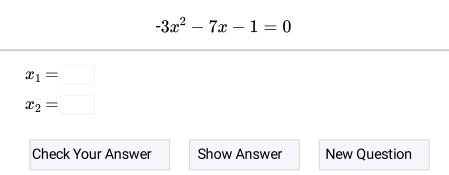
Solve the quadratic equations by using the Quadratic Formula. If necessary, round the answer to 2 decimal places.
Discussion
Share
Report error
Discriminant of a Quadratic Equation
In general, quadratic equations have two, one or no real solutions. Before solving a quadratic equation, the number of real solutions can be determined by using the discriminant.
Concept
Share
Report error
Discriminant
In the Quadratic Formula, the expression b^2 - 4ac, which is under the radical symbol, is called the discriminant.
x = - b ± sqrt(b^2-4ac)/2a
A quadratic equation can have two, one, or no real solutions. Since the discriminant is under the radical symbol, its value determines the number of real solutions of a quadratic equation.
| Value of the Discriminant | Number of Real Solutions |
|---|---|
| b^2-4ac > 0 | 2 |
| b^2-4ac = 0 | 1 |
| b^2-4ac < 0 | 0 |
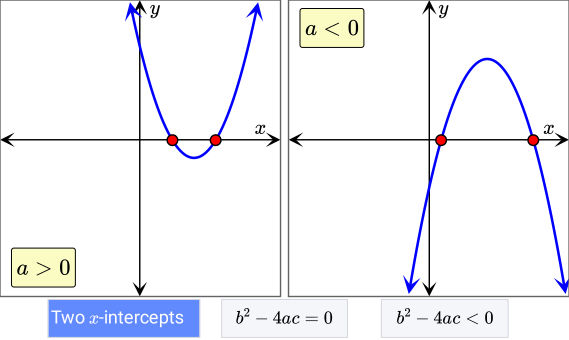
Moreover, the discriminant determines the number of x-intercepts of the graph of the related quadratic function.
Example
Share
Report error
Determining Whether There is a Solution Without Solving
A farmer wants to build a fence around a vegetable garden. To make it simple, the farmer will build it in the shape of a rectangle. The farmer has enough wood to build a fence the length of 800 feet, including the gate.
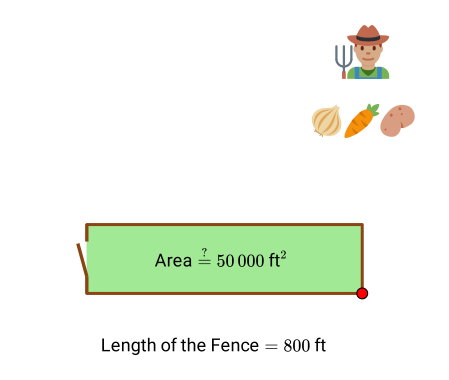 The area of the vegetable garden changes as the side lengths of the rectangle change. The farmer wants the garden's area to be at least 50 000 square feet. Will he need to buy more wood to achieve this goal?
{"type":"choice","form":{"alts":["Yes","No"],"noSort":false},"formTextBefore":"","formTextAfter":"","answer":0}
Hint
Let x denote the length of one side of the rectangle. Then, use the fact that the length of the fence represents the perimeter of the rectangle. All things considered, how can the area of the rectangle be calculated?
Solution
Let x and y be the side lengths of the rectangle that represents the vegetable garden. The length of the fence is the perimeter P of the rectangle, which is the sum of all four side lengths.
P=x+x+y+y ⇕ P = 2x + 2y
It is given that the perimeter of the rectangle — how much wood the farmer has — is 800 feet. By substituting 800 for P, the equation can be solved for one of the side lengths, such as y.
The side lengths can now be placed in the diagram. It can be arbitrarily assumed that the length of the horizontal side is x. Keep in mind that both x and 400-x are measured in feet.
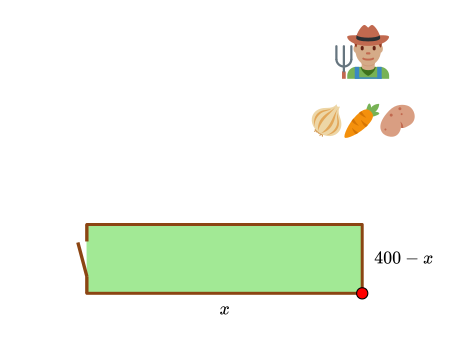 Next, the area of the rectangle will be calculated in terms of x. The area A of a rectangle is the product of the rectangle's length and width.
A = x(400-x)
The obtained formula for A is represented by a quadratic function. It is given that the farmer's desired area should be at least 50 000 square feet. Therefore, this number will be substituted for A in the formula.
A = x(400-x) ↓ 50 000 = x(400-x)
The above is a quadratic equation that is not written in standard form. Hence, the equation will be rewritten to determine the number of solutions. Determining the number of solutions will help find if a value for x exists so that the area of the rectangle is 50 000 square feet.
The equation is now in standard form. This means that the number of solutions can be determined using the discriminant. Next, the coefficients a, b, and c need to be identified. - x^2 + 400x - 50 000 = 0 ⇕ -1x^2 + 400x + (- 50 000) = 0
The variables a, b, and c can then be substituted into the discriminant b^2-4ac.
Since the discriminant is less than 0, there are no solutions to the equation. Therefore, the farmer will not be able to build a fence so that the area of the vegetable garden is 50 000 square feet. This means that he will need to buy more wood. Good thing he did the math before starting to construct the fence.
Next, the area of the rectangle will be calculated in terms of x. The area A of a rectangle is the product of the rectangle's length and width.
A = x(400-x)
The obtained formula for A is represented by a quadratic function. It is given that the farmer's desired area should be at least 50 000 square feet. Therefore, this number will be substituted for A in the formula.
A = x(400-x) ↓ 50 000 = x(400-x)
The above is a quadratic equation that is not written in standard form. Hence, the equation will be rewritten to determine the number of solutions. Determining the number of solutions will help find if a value for x exists so that the area of the rectangle is 50 000 square feet.
The equation is now in standard form. This means that the number of solutions can be determined using the discriminant. Next, the coefficients a, b, and c need to be identified. - x^2 + 400x - 50 000 = 0 ⇕ -1x^2 + 400x + (- 50 000) = 0
The variables a, b, and c can then be substituted into the discriminant b^2-4ac.
Since the discriminant is less than 0, there are no solutions to the equation. Therefore, the farmer will not be able to build a fence so that the area of the vegetable garden is 50 000 square feet. This means that he will need to buy more wood. Good thing he did the math before starting to construct the fence.
P = 2x+2y
Substitute
P= 800
800 = 2x+2y
▼
Solve for y
SubEqn
LHS-2x=RHS-2x
800 - 2x = 2y
DivEqn
.LHS /2.=.RHS /2.
800-2x/2 = y
WriteDiffFrac
Write as a difference of fractions
800/2 - 2x/2 = y
MovePartNumRight
a* b/c=a/c* b
800/2 - 2/2x = y
CalcQuot
Calculate quotient
400 - 1x = y
IdPropMult
Identity Property of Multiplication
400 - x = y
RearrangeEqn
Rearrange equation
y = 400 - x
50 000 = x(400-x)
▼
Rewrite
Distr
Distribute x
50 000 = 400x - x^2
SubEqn
LHS-50 000=RHS-50 000
0 = 400x - x^2 - 50 000
CommutativePropAdd
Commutative Property of Addition
0 = - x^2 + 400x - 50 000
RearrangeEqn
Rearrange equation
- x^2 + 400x - 50 000 = 0
b^2 - 4ac
SubstituteValues
Substitute values
400^2 - 4( -1)(- 50 000)
▼
Evaluate
CalcPow
Calculate power
160 000 - 4(-1)(-50 000)
MultPosNeg
a(- b)=- a * b
160 000 - (- 4)(-50 000)
MultNegNegOnePar
- a(- b)=a* b
160 000 - 200 000
SubTerm
Subtract term
-40 000
Pop Quiz
Share
Report error
Determining the Number of Real Solutions of a Quadratic Equation
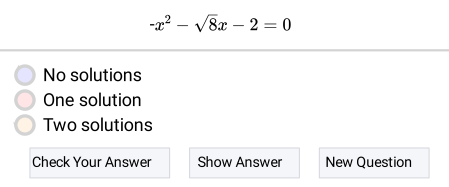
Without solving the quadratic equations, use the discriminant to determine the number of real solutions.
Closure
Share
Report error
Determining the Number of Solutions of a Quadratic Equation Without Solving
The challenge presented at the beginning of this lesson asked if the stone thrown by Diego will reach, over some point in time, a branch located 15 feet above the ground.

{"type":"choice","form":{"alts":["Yes","No"],"noSort":true},"formTextBefore":"Will the stone reach the branch?","formTextAfter":"","answer":0}
Hint
Substitute 15 for h(t) and identify the discriminant of the resulting quadratic equation.
Solution
Here, t represents the number of seconds that passed since Diego threw the stone. Since the branch is situated 15 feet above the ground, this number can be substituted for h(t) into the formula.
h(t) = 5(-3t^2 + 5t + 1) ↓ 15 = 5(-3t^2 + 5t + 1)
Although this quadratic equation can be solved using the Quadratic Formula, it is sufficient to find whether the equation has any solutions. To do so, the discriminant can be calculated. To calculate the discriminant, the equation needs to be rewritten in standard form.
Now, identify the coefficients a, b, and c in the obtained equation. -15t^2 + 25t - 10 = 0 ⇕ -15t^2 + 25t + ( -10) = 0
Finally, the values of the coefficients will be substituted into the discriminant.
Because the value of the discriminant is greater than 0, there are two solutions of the equation. Therefore, Diego and Magdalena know that the stone will reach the desired branch at two points in time.
15 = 5(-3t^2 + 5t + 1)
▼
Rewrite
Distr
Distribute 5
15 = -15t^2 + 25t + 5
SubEqn
LHS-15=RHS-15
0 = -15t^2 + 25t - 10
RearrangeEqn
Rearrange equation
-15t^2 + 25t - 10 = 0
b^2-4ac
SubstituteValues
Substitute values
25^2 - 4( -15)( -10)
▼
Evaluate
CalcPow
Calculate power
625 - 4(-15)(-10)
MultPosNeg
a(- b)=- a * b
625 - (- 60)(- 10)
MultNegNegOnePar
- a(- b)=a* b
625-600
SubTerm
Subtract term
25
Solving Quadratic Equations With the Quadratic Formula
Exercise 1.1
Solve the equation using the Quadratic Formula. If needed, round to one decimal.
{"type":"text","form":{"type":"roots","options":{"comparison":"1","nofractofloat":false,"keypad":{"simple":true,"useShortLog":false,"variables":["x"],"constants":["PI"]},"rendered":false,"hideNoSolution":false,"variable":"x"},"text":" "},"formTextBefore":null,"formTextAfter":null,"answer":{"texts":["6"]}}
{"type":"text","form":{"type":"roots","options":{"comparison":"1","nofractofloat":false,"keypad":{"simple":false,"useShortLog":false,"variables":["x"],"constants":["PI"]},"rendered":false,"hideNoSolution":false,"variable":"x"},"text":" "},"formTextBefore":null,"formTextAfter":null,"answer":{"texts":[]}}
{"type":"text","form":{"type":"roots","options":{"comparison":"1","nofractofloat":false,"keypad":{"simple":true,"useShortLog":false,"variables":["x"],"constants":["PI"]},"rendered":false,"hideNoSolution":false,"variable":"x"},"text":" "},"formTextBefore":null,"formTextAfter":null,"answer":{"texts":["4","-1"]}}
{"type":"text","form":{"type":"roots","options":{"comparison":"1","nofractofloat":false,"keypad":{"simple":true,"useShortLog":false,"variables":["x"],"constants":["PI"]},"rendered":false,"hideNoSolution":false,"variable":"x"},"text":" "},"formTextBefore":null,"formTextAfter":null,"answer":{"texts":["-0.3","-0.8"]}}
security
report
code
security
report
code
We will use the Quadratic Formula to solve the quadratic equation. The formula relates to a quadratic equation in the following way. ax^2+ bx+ c=0 ⇓ x=- b± sqrt(b^2-4 a c)/2 a Let's identify the values of a, b, and c in the given equation. x^2-12x+36=0 ⇕ 1x^2+( - 12)x+ 36=0 We see that a= 1, b= - 12, and c= 36. Let's substitute these values into the Quadratic Formula and evaluate the right-hand side.
As we did in Part A, we first need to identify the values of a, b, and c in the standard form of the quadratic equation.
x^2+7x+16=0
⇓
1x^2+ 7x+ 16=0
We see that a= 1, b= 7, and c= 16. If we substitute these values into the Quadratic Formula, we can calculate the solutions.
We cannot calculate the real square root of a negative number. Therefore, there are no real solutions to this equation.
Again, we begin by identifying the values of a, b, and c that are used in the Quadratic Formula. 2x^2-6x-8=0 ⇓ 2x^2+( -6)x+( -8)=0 Let's substitute the values into the Quadratic Formula and evaluate the right-hand side.
We found two solutions, x=4 and x=-1.
Before we can use the Quadratic Formula, we need to rewrite this equation in standard form.
Now we can identify the values of a, b, and c. 8x^2+ 9x+ 2=0 Let's substitute them into the Quadratic Formula and evaluate the right-hand side.
We found two solutions, x≈ -0.3 and x≈ -0.8.
security
report
code
Determine the number of real solutions of the following quadratic equations.
{"type":"choice","form":{"alts":["No real solutions","One real solution","Two real solutions"],"noSort":true},"formTextBefore":"","formTextAfter":"","answer":0}
{"type":"choice","form":{"alts":["No real solutions","One real solution","Two real solutions"],"noSort":true},"formTextBefore":"","formTextAfter":"","answer":2}
{"type":"choice","form":{"alts":["No real solutions","One real solution","Two real solutions"],"noSort":true},"formTextBefore":"","formTextAfter":"","answer":1}
security
report
code
security
report
code
If we only want to know the number of solutions to a quadratic equation and not the solutions themselves, we can analyze the discriminant of the equation. Let's mark the discriminant in the Quadratic Formula. x=- b±sqrt(b^2-4ac)/2a We see that the quadratic equation is already given in its standard form, we can easily identify the values of a, b, and c. x^2 -6x+10=0 ⇓ 1x^2+( - 6)x+ 10=0 Now, let's evaluate the discriminant for the given values.
Since the discriminant is negative, the quadratic equation has no real solutions.
If the discriminant is greater than zero, the equation will have two real solutions. If it is equal to zero, the equation will have one real solution. Finally, if the discriminant is less than zero, the equation will have no real solutions.
Again, we only want to know the number of solutions, so we will consider the value of the discriminant. Let's first identify the values of a, b, and c of the standard form of the given quadratic equation. x^2 -5x-3=0 ⇓ 1x^2+( - 5)x+( - 3)=0 Now, let's evaluate the discriminant for these given values.
Since the discriminant is a positive number, the quadratic equation has two real solutions.
Just as in the previous parts, we only need to consider the value of the discriminant. To find this value, we start by identifying the values of a, b, and c. However, our actual first step is to rewrite the equation in its standard form. -8x^2+8x=2 ⇓ -8x^2+ 8x+( - 2)=0 Now we can evaluate the discriminant for these values.
Since the discriminant is zero, the quadratic equation has one real solution.
security
report
code
How many x-intercepts does the graph of the function have?
{"type":"choice","form":{"alts":["Zero","One","Two"],"noSort":true},"formTextBefore":"","formTextAfter":"","answer":2}
{"type":"choice","form":{"alts":["Zero","One","Two"],"noSort":true},"formTextBefore":"","formTextAfter":"","answer":1}
{"type":"choice","form":{"alts":["Zero","One","Two"],"noSort":true},"formTextBefore":"","formTextAfter":"","answer":0}
security
report
code
security
report
code
A function reaches its x-intercept when y=0. Therefore, to find how many solutions the quadratic function has, we must first set it equal to zero and then analyze the discriminant of the Quadratic Formula. Let's start by identifying the discriminant in the Quadratic Formula. x=- b±sqrt(b^2-4ac)/2a Next, let's set the function equal to zero and identify the values of a, b, and c. x^2 +5x-1=0 ⇓ 1x^2+ 5x+( -1)=0 Now we can evaluate the discriminant for the given values.
The discriminant is positive, which means the graph has two x-intercepts.
As we did in Part A, we will set the function equal to zero and then identify the values of a, b, and c. 4x^2 +4x+1=0 ⇓ 4x^2+ 4x+ 1=0 Now, let's evaluate the discriminant of the Quadratic Formula for these values.
The discriminant is zero. This means the graph of the function has one x-intercept.
As we did in the previous parts, we will set the function equal to zero and identify the values of a, b, and c. -6x^2+3x-4=0 ⇓ -6x^2+ 3x+( - 4)=0 Let's evaluate the discriminant of the quadratic function for these values.
The discriminant is negative, which means the graph of the function has no x-intercepts.
security
report
code
Davontay is throwing a ball over a 4 meter tall wall. The ball's trajectory can be described by the following model. h(x)=2.5+2x-0.5x^2 In this model, h is the height of the ball in meters and x is the horizontal distance of the ball from Devontay, also in meters.
{"type":"text","form":{"type":"math","options":{"comparison":"1","nofractofloat":false,"keypad":{"simple":false,"useShortLog":false,"variables":["x"],"constants":["PI"]},"rendered":false},"text":" "},"formTextBefore":null,"formTextAfter":null,"answer":{"text":["0\\leq x\\leq 5","5\\geq x\\geq 0"]}}
{"type":"text","form":{"type":"math","options":{"comparison":"1","nofractofloat":false,"keypad":{"simple":false,"useShortLog":false,"variables":["h","x"],"constants":["PI"]},"rendered":false},"text":" "},"formTextBefore":null,"formTextAfter":null,"answer":{"text":["0\\leq h \\leq 4.5","0\\leq h(x)\\leq 4.5","4.5 \\geq h \\geq 0","4.5\\geq h(x)\\geq 0"]}}
{"type":"choice","form":{"alts":["Exactly 1 meter or exactly 3 meters","More than 1 meter and less than 3 meters","More than 1 meter","More than 4 meters and less than 6 meters"],"noSort":false},"formTextBefore":"","formTextAfter":"","answer":1}
security
report
code
security
report
code
The domain of a function is the set of values that we can substitute for the independent variable x. Since x measures the horizontal distance of the wall from Davontay and a distance cannot be negative, we know that negative values of x are not possible. With this information, we can write the lower part of the domain. x≥ 0 Let's find the upper part of the domain. Notice that the ball cannot go below the ground. Therefore, we have an upper restriction to the domain where the function intercepts the positive part of the x-axis.
To find this value of x, we must solve the equation when h(x)=0. Notice that we are only interested in the positive x-intercept as we have already established that x must be greater than or equal to 0.
Let's identify the values of a, b, and c. - 0.5x^2+2x+2.5=0 ⇓ -0.5x^2+ 2x+ 2.5=0 We see that a= -0.5, b= 2, and c= 2.5. Let's substitute these values into the Quadratic Formula and evaluate the right-hand side.
The positive x-intercept is 5. Now we can write the domain. 0≤ x≤ 5
The range gives a function's possible output values. As we already explained in Part A, the ball cannot fall below the ground, which means that h(x) must be greater than or equal to 0. h(x)≥ 0 To find the upper limit of the range, we need to determine the function's greatest value. A parabola reaches its maximum value at the vertex. Let's find the x-coordinate of the vertex by determining the line of symmetry. This can be found by using the following formula. x_s=- b/2 a Recall that in Part A we also found that a= -0.5 and b= 2.
The axis of symmetry is given by the equation x_s=2.
To determine the greatest value of the function, or its vertex, we will substitute x=2 into the function rule and evaluate.
The function's greatest value is 4.5. Now we can write the range as below. 0≤ h ≤ 4.5
In order for the ball to make it over the wall, the ball's height must be greater than 4 meters when it reaches the wall. Let's set h(x) equal to 4 and solve for x.
Let's identify the values of a, b, and c for this new equation. - 0.5x^2+2x-1.5=0 ⇓ -0.5x^2+ 2x+( -1.5)=0 Now we can calculate the solutions to the new equation.
The ball reaches a height of 4 feet, the height of the wall, when it has traveled 1 and 3 meters away from Davontay. This means that it will hit the upper part of the wall and not make it over if he stands exactly this distance away. Therefore, when Davontay stands more than 1 meter but less than 3 meters from the wall, the ball will make it over.
This means that Davontay needs to stand more than 1 meter but less than 3 meters away from the wall in order for the ball to make it over.
security
report
code
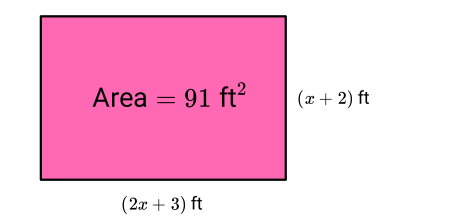
Use the given information to find the length of the rectangle's longer side.
{"type":"text","form":{"type":"math","options":{"comparison":"1","nofractofloat":false,"keypad":{"simple":true,"useShortLog":false,"variables":["x"],"constants":["PI"]},"rendered":false},"text":" "},"formTextBefore":null,"formTextAfter":"feet","answer":{"text":["13"]}}
security
report
code
security
report
code
We have been given the area of the rectangle and also expressions describing its length and width. Because both length and width must be positive, start by determining values of variable x for which these measures are positive. x+2 > 0 &⇒ x > -2 2x+3 > 0 &⇒ x > - 32 Combining these two constraints gives us that x should be greater than - 32 for both measures to be positive. Next, recall that a rectangle's area is calculated by multiplying its length and width. A= l w ⇒ A=( 2x+3)( x+2) We know that the area is 91 square feet. Let's substitute 91 for A in the formula and proceed to write the quadratic equation in standard form.
Now that we have the equation in standard form, we can use the Quadratic Formula to solve for x. Notice that we should disregard any solution that is less than or equal to - 32 because this would make at least one of the side measures negative.
Using the Quadratic Formula, we found that the solutions of the given equation are x = -7 ± 274. Let's now evaluate both positive and negative case to check if the solutions are greater than - 32.
| x=-7 ± 27/4 | |
|---|---|
| x=-7 + 27/4 | x=-7 - 27/4 |
| x=20/4 | x=-34/4 |
| x=5 ✓ | x=-17/2 * |
Now that we know that x=5, we can calculate the measurements of the sides of the rectangle by substituting x=5 into the expressions.
| Side Length | Substitute | Evaluate |
|---|---|---|
| x+2 | 5+2 | 7 |
| 2x+3 | 2(5)+3 | 13 |
Therefore, the length of the longer side is 13 feet.
security
report
code
Solving Quadratic Equations With the Quadratic Formula
Recommended exercises
To get personalized recommended exercises, please login first.
Loading content
≤
>
■2
■▢
e▢
7
8
9
×
÷■1
=
=
√▢
▢√
∫▢▢
4
5
6
+
−
≤
<
log
ln
log▢
1
2
3
()
∣
sin
cos
tan
0
.
π
x
y
Loading content