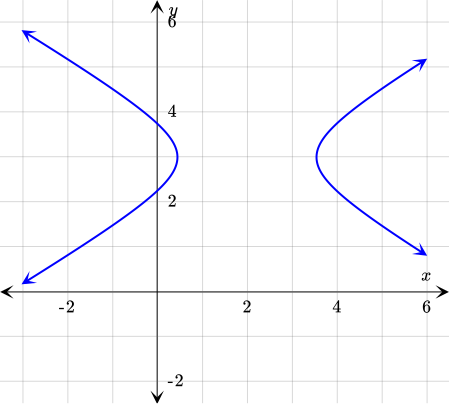
We are also given the graph of this horizontal hyperbola, which we will call the first one.
We are asked to find the difference between this graph and the graph of the following hyperbola, which we will call the second one. We will compare their equations without graphing the second hyperbola.
9(x−2)2−25(y−3)2=1⇕32(x−2)2−52(y−3)2=1
Notice that in both of the equations we have a positive sign before the expression containing the x-variable, and a negative sign before the expression that contains the y-variable. Therefore, both of them represent horizontal hyperbolas. Let's recall the main characteristics of this type of hyperbola and compare the given equations.
Formula
First Hyperbola
Second Hyperbola
Standard-Form Equation
a2(x−h)2−b2(y−k)2=1
52(x−2)2−32(y−3)2=1
32(x−2)2−52(y−3)2=1
Center
(h,k)
(2,3)
(2,3)
Vertices
(h±a,k)
(2±5,3)=(-3,3)and(7,3)
(2±3,3)=(-1,3)and(5,3)
a,b,c relationship
c2=a2+b2
342=52+32
342=32+52
Foci
(h±c,k)
(2±34,3)=(7.8,3)and(-3.8,3)
(2±34,3)=(7.8,3)and(-3.8,3)
Asymptotes
y−k=±ab(x−h)
y−3=±53(x−2)
y−3=±35(x−2)
As we can see from the table, both of the graphs have the same center, the same foci, and the same value of c. Moreover, since both of them are horizontal hyperbola, the transverse axes are horizontal. Therefore, we can eliminate options B and D. Let's now consider the asymptotes! Notice that their equations have different slopes.
FirstHyperbola53<SecondHyperbola35
Since the slope of the first hyperbola's asymptote equation is less than the second one, the asymptote of the second hyperbola is more steep. Hence, we can eliminate option A also. Finally, let's take a look their vertices.
Mathleaks uses cookies for an enhanced user experience. By using our website, you agree to the usage of cookies as described in our policy for cookies.