3. Double and Half-Angle Identities
Sign In
An error ocurred, try again later!
Chapter 7
3.
Double and Half-Angle Identities
This lesson delves into the intricacies of trigonometric identities, focusing primarily on double-angle and half-angle identities. These mathematical tools are essential for simplifying complex trigonometric equations and are widely used in various fields such as engineering, physics, and computer science. Understanding these identities can make it easier to solve problems that involve angles and lengths in triangles. For instance, they are often used in calculating distances, angles, and other dimensions in real-world applications like satellite positioning and architectural design. The lesson provides a step-by-step approach to mastering these identities, making it easier for both students and professionals to apply them in practical scenarios.
Show less Show more expand_more 


Lesson Settings & Tools
| | 12 Theory slides |
| | 9 Exercises - Grade E - A |
| | Each lesson is meant to take 1-2 classroom sessions |
Double and Half-Angle Identities
Slide of 12
This lesson will focus on introducing and practicing the trigonometric identities that relate the trigonometric values of an angle to the trigonometric values of the double-angle and half-angle.
Catch-Up and Review
Here are a few recommended readings before getting started with this lesson.
Challenge
Rules of the Quest Game and a Bonus
Zosia and her classmates entered a mathematical quest game. In this quest, there is an old leather map showing the path to various sacred mathematical sites. At each site, it is either solve the problem and move forward, or suffer the consequences of the unknown of the math universe. 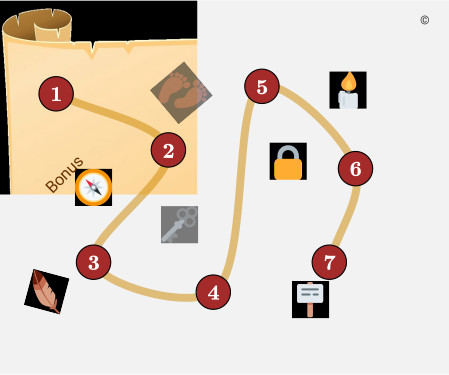 At the very beginning of the quest, they were given a bonus task, which can be solved at the end of the quest. If solved successfully, they will get a huge amount of bonus points. What is the value of DH?
External credits: @brgfx
{"type":"text","form":{"type":"math","options":{"comparison":"1","nofractofloat":false,"keypad":{"simple":false,"useShortLog":false,"variables":[],"constants":["THETA"]},"rendered":false},"text":"<span class=\"katex\"><span class=\"katex-html\" aria-hidden=\"true\"><\/span><\/span>"},"formTextBefore":"<span class=\"katex\"><span class=\"katex-html\" aria-hidden=\"true\"><span class=\"base\"><span class=\"strut\" style=\"height:2.04633em;vertical-align:-0.686em;\"><\/span><span class=\"mord\"><span class=\"mopen nulldelimiter\"><\/span><span class=\"mfrac\"><span class=\"vlist-t vlist-t2\"><span class=\"vlist-r\"><span class=\"vlist\" style=\"height:1.36033em;\"><span style=\"top:-2.314em;\"><span class=\"pstrut\" style=\"height:3em;\"><\/span><span class=\"mord\"><span class=\"mord mathdefault\" style=\"margin-right:0.02778em;\">D<\/span><\/span><\/span><span style=\"top:-3.23em;\"><span class=\"pstrut\" style=\"height:3em;\"><\/span><span class=\"frac-line\" style=\"border-bottom-width:0.04em;\"><\/span><\/span><span style=\"top:-3.677em;\"><span class=\"pstrut\" style=\"height:3em;\"><\/span><span class=\"mord\"><span class=\"mord mathdefault\" style=\"margin-right:0.08125em;\">H<\/span><\/span><\/span><\/span><span class=\"vlist-s\">\u200b<\/span><\/span><span class=\"vlist-r\"><span class=\"vlist\" style=\"height:0.686em;\"><span><\/span><\/span><\/span><\/span><\/span><span class=\"mclose nulldelimiter\"><\/span><\/span><span class=\"mspace\" style=\"margin-right:0.2777777777777778em;\"><\/span><span class=\"mrel\">=<\/span><\/span><\/span><\/span>","formTextAfter":null,"answer":{"text":["\\dfrac{1}{4}\\tan\\theta"]}}
Discussion
Presenting Double-Angle Identities
To be able to solve the tasks of the quest, the class first stopped at the infopoint to recall the Double-Angle Identities. These identities relate the trigonometric values of an angle to the trigonometric values of twice that angle.
Rule
Double-Angle Identities
The double-angle identities materialize when two angles with the same measure are substituted into the angle sum identities.
Sine:Cosine:Tangent:sin2θ=2sinθcosθcos2θ=cos2θ−sin2θcos2θ=2cos2θ−1cos2θ=1−2sin2θtan2θ=1−tan2θ2tanθ
Proof
Double-Angle IdentitiesStart by writing the Angle Sum Identity for sine and cosine.
Now, recall that, by the Pythagorean Identity, the sine square plus the cosine square of the same angle equals 1. From this identity, two different equations can be set.
That way, the second identity for the cosine has been obtained. To obtain the third cosine identity, substitute Equation (II) into the first identity for the cosine.
sin(x+y)=sinxcosy+cosxsinycos(x+y)=cosxcosy−sinxsiny
Let x=θ and y=θ. With this, x+y becomes 2θ. Then, these two formulas can be rewritten in terms of θ.
sin2θ=sinθcosθ+cosθsinθcos2θ=cosθcosθ−sinθsinθ
Sine Identity
Approaching the first equation, the Commutative Property of Multiplication can be applied to the second term of its right-hand side. Then, by adding the terms on the right-hand side of this equation, the formula for sin2θ is obtained.
sin2θ=sinθcosθ+sinθcosθ⇓sin2θ=2sinθcosθ✓
Cosine Identities
Approaching the second equation, the Product of Powers Property can be used to rewrite its right-hand side. By doing this, the first identity for the cosine of the double of an angle is obtained.
cos2θ=cosθcosθ−sinθsinθ⇓cos2θ=cos2θ−sin2θ✓
sin2θ+cos2θ=1⇓{sin2θ=1−cos2θcos2θ=1−sin2θ(I)(II)
Next, substitute Equation (I) into the first identity for the cosine.
cos2θ=cos2θ−sin2θ
▼
Substitute 1−cos2θ for sin2θ and simplify
Substitute
sin2θ=1−cos2θ
cos2θ=cos2θ−(1−cos2θ)
Distr
Distribute -1
cos2θ=cos2θ−1+cos2θ
AddTerms
Add terms
cos2θ=2cos2θ−1✓
cos2θ=cos2θ−sin2θ
▼
Substitute 1−sin2θ for cos2θ and simplify
cos2θ=1−2sin2θ✓
Tangent Identity
To prove the tangent identity, start by rewriting tan2θ in terms of sine and cosine.tan2θ=cos2θsin2θ
Next, substitute the first sine identity in the numerator and the first cosine identity in the denominator.
tan2θ=cos2θ−sin2θ2sinθcosθ
Then, divide the numerator and denominator by cos2θ.
tan2θ=cos2θcos2θ−sin2θcos2θ2sinθcosθ
Finally, simplifying the right-hand side the tangent identity will be obtained.
tan2θ=cos2θcos2θ−sin2θcos2θ2sinθcosθ
▼
Simplify right-hand side
WriteDiffFrac
Write as a difference of fractions
tan2θ=cos2θcos2θ−cos2θsin2θcos2θ2sinθcosθ
CrossCommonFac
Cross out common factors
tan2θ=cos2θcos2θ−cos2θsin2θcos2θ2sinθcosθ
CancelCommonFac
Cancel out common factors
tan2θ=1−cos2θsin2θcosθ2sinθ
bmam=(ba)m
tan2θ=1−(cosθsinθ)2cosθ2sinθ
MovePartNumLeft
ca⋅b=a⋅cb
tan2θ=1−(cosθsinθ)22⋅cosθsinθ
cos(θ)sin(θ)=tan(θ)
tan2θ=1−tan2θ2tanθ✓
Extra
Calculating cos120∘To calculate the exact value of cos120∘, these steps can be followed.
- To be able to use the double-angle identities, the angle 120∘ needs to be rewritten as 2 multiplied by another angle. Therefore, rewrite 120∘ as 2⋅60∘.
- Use the second formula for the cosine of twice an angle.
- Based on the trigonometric ratios of common angles, it is known that cos60∘=21.
Example
Searching for Clues
When the class got to the first mathematical sacred site, they were told to look for three clues. After eagerly searching the neighborhood, they found three parts to one task.
 The task says to calculate sin2θ knowing that cosθ=52 and 0∘≤θ≤90∘. What exact value should the class get to be able to move on to the next site?
External credits: @brgfx
{"type":"text","form":{"type":"math","options":{"comparison":"1","nofractofloat":false,"keypad":{"simple":false,"useShortLog":false,"variables":[],"constants":[]},"rendered":false},"text":"<span class=\"katex\"><span class=\"katex-html\" aria-hidden=\"true\"><\/span><\/span>"},"formTextBefore":"<span class=\"katex\"><span class=\"katex-html\" aria-hidden=\"true\"><span class=\"base\"><span class=\"strut\" style=\"height:0.69444em;vertical-align:0em;\"><\/span><span class=\"mop\">sin<\/span><span class=\"mspace\" style=\"margin-right:0.16666666666666666em;\"><\/span><span class=\"mord\">2<\/span><span class=\"mord mathdefault\" style=\"margin-right:0.02778em;\">\u03b8<\/span><span class=\"mspace\" style=\"margin-right:0.2777777777777778em;\"><\/span><span class=\"mrel\">=<\/span><\/span><\/span><\/span>","formTextAfter":null,"answer":{"text":["\\dfrac{4\\sqrt{21}}{25}","\\dfrac{\\sqrt{21}4}{25}","4\\dfrac{\\sqrt{21}}{25}"]}}
Hint
Find the value of sinθ by using one of the Pythagorean Identities.
Solution
In order to find the values of sin2θ, recall the Double-Angle Identity for sine.
By the definition of absolute value, sinθ can have two possible values.
Therefore, the value of sin2θ is 25421.
sin2θ=2sinθcosθ
The value of cosθ is known, but the value of sinθ is not. To find it, one of the Pythagorean Identities can be used. sin2θ+cos2θ=1
Substitute cosθ with 52 and solve for sinθ.
sin2θ+cos2θ=1
Substitute
cosθ=52
sin2θ+(52)2=1
PowQuot
(ba)m=bmam
sin2θ+5222=1
CalcPow
Calculate power
sin2θ+254=1
SubEqn
LHS−254=RHS−254
sin2θ=1−254
OneToFrac
Rewrite 1 as 2525
sin2θ=2525−254
SubFrac
Subtract fractions
sin2θ=2521
∣sinθ∣=521
∣sinθ∣=521⇓sinθ=521sinθ=-521
It is given that θ is between 0∘ and 90∘, which is the first quadrant. Sine has positive values in the first quadrant, so the negative value can be disregarded.
sinθ=521
Now that both sine and cosine of θ are known, the value of sin2θ can be calculated.
sin2θ=2sinθcosθ
SubstituteII
sinθ=521, cosθ=52
sin2θ=2(521)(52)
MultFrac
Multiply fractions
sin2θ=2(25221)
MoveLeftFacToNum
a⋅cb=ca⋅b
sin2θ=25421
Example
Finding Trigonometric Values to Determine the Password
At the second site, a steel safe awaits them. It is locked! Inside is the paper with the information needed to get to the third site. To open the safe, they must figure out the password.
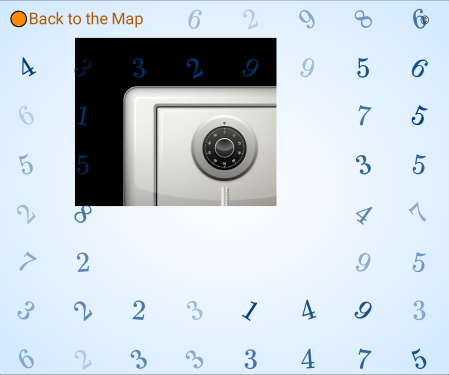 The password is decoded sequentially by the integers that appear in the answers to the three given tasks. It is known that sinθ=31 and 90∘≤θ≤180∘.
a Find the exact value of sin2θ.
{"type":"text","form":{"type":"math","options":{"comparison":"1","nofractofloat":false,"keypad":{"simple":false,"useShortLog":false,"variables":[],"constants":[]},"rendered":false},"text":"<span class=\"katex\"><span class=\"katex-html\" aria-hidden=\"true\"><\/span><\/span>"},"formTextBefore":null,"formTextAfter":null,"answer":{"text":["-\\dfrac{4\\sqrt{2}}{9}","\\dfrac{-4\\sqrt{2}}{9}"]}}
b Find the exact value of cos2θ.
{"type":"text","form":{"type":"math","options":{"comparison":"1","nofractofloat":false,"keypad":{"simple":false,"useShortLog":false,"variables":[],"constants":[]},"rendered":false},"text":"<span class=\"katex\"><span class=\"katex-html\" aria-hidden=\"true\"><\/span><\/span>"},"formTextBefore":null,"formTextAfter":null,"answer":{"text":["\\dfrac{7}{9}"]}}
c Find the exact value of tan2θ.
{"type":"text","form":{"type":"math","options":{"comparison":"1","nofractofloat":false,"keypad":{"simple":false,"useShortLog":false,"variables":[],"constants":[]},"rendered":false},"text":"<span class=\"katex\"><span class=\"katex-html\" aria-hidden=\"true\"><\/span><\/span>"},"formTextBefore":null,"formTextAfter":null,"answer":{"text":["-\\dfrac{4\\sqrt{2}}{7}","\\dfrac{-4\\sqrt{2}}{7}"]}}
Hint
a Use the Pythagorean Identity to find the value of cosθ.
b Recall the Double-Angle Identity for cosine.
c Apply the Tangent Identity.
Solution
a Start by recalling the Double-Angle Identity for sine.
sin2θ=2sinθcosθ
As can be seen, to find the value of sin2θ, the value of sinθ and cosθ should be known. It is given that sinθ=31. Substitute that value into the Pythagorean Identity to calculate the corresponding value of cosθ.
sin2θ+cos2θ=1
Substitute
sinθ=31
(31)2+cos2θ=1
PowQuot
(ba)m=bmam
3212+cos2θ=1
CalcPow
Calculate power
91+cos2θ=1
SubEqn
LHS−91=RHS−91
cos2θ=1−91
OneToFrac
Rewrite 1 as 99
cos2θ=99−91
SubFrac
Subtract fractions
cos2θ=98
SqrtEqn
LHS=RHS
∣cosθ∣=98
▼
Calculate root
SqrtQuot
ba=ba
∣cosθ∣=98
SplitIntoFactors
Split into factors
∣cosθ∣=94⋅2
CalcRoot
Calculate root
∣cosθ∣=322
∣cosθ∣=322⇓cosθ=±322
It is known that 90∘≤θ≤180∘, which indicates that θ is in the second quadrant where cosine has negative values. This way the exact value of cosθ is found.
cosθ=-322
Now, the values of sinθ and cosθ can be used to calculate the value of sin2θ.
sin2θ=2sinθcosθ
SubstituteII
sinθ=31, cosθ=-322
sin2θ=2(31)(-322)
MultPosNeg
a(-b)=-a⋅b
sin2θ=-2(31)(322)
MultFrac
Multiply fractions
sin2θ=-2(922)
MoveLeftFacToNum
a⋅cb=ca⋅b
sin2θ=-942
b In order to find the value of cos2θ, rewrite it by using the Double-Angle Identity for cosine.
cos2θ=cos2θ−sin2θ
Since the values of both sinθ and cosθ are known, substitute them into the equation and solve for cos2θ.
cos2θ=cos2θ−sin2θ
SubstituteII
sinθ=31, cosθ=-322
cos2θ=(-322)2−(31)2
NegBaseToPosBase
(-a)2=a2
cos2θ=(322)2−(31)2
PowQuot
(ba)m=bmam
cos2θ=32(22)2−3212
CalcPow
Calculate power
cos2θ=94⋅2−91
Multiply
Multiply
cos2θ=98−91
SubFrac
Subtract fractions
cos2θ=97
c Finally, to find the value of tan2θ, use the Tangent Identity.
tan2θ=cos2θsin2θ
Substitute the found values of sin2θ and cos2θ from the previous parts and then solve for tan2θ.
tan2θ=cos2θsin2θ
SubstituteII
sin2θ=-942, cos2θ=97
tan2θ=97-942
DivFracByFracSL
ba/dc=ba⋅cd
tan2θ=-942⋅79
MultFrac
Multiply fractions
tan2θ=-9⋅742⋅9
CrossCommonFac
Cross out common factors
tan2θ=-9⋅742⋅9
CancelCommonFac
Cancel out common factors
tan2θ=-742
Discussion
Presenting Half-Angle Identities
Before moving to the next station, the class stopped at another infopoint to learn about the Half-Angle Identities.
Rule
Half-Angle Identities
The half-angle identities are special cases of angle difference identities. To evaluate trigonometric functions of half an angle, the following identities can be applied.
sin2θcos2θtan2θ=±21−cosθ=±21+cosθ=±1+cosθ1−cosθ
The sign of each formula is determined by the quadrant where the angle 2θ lies.
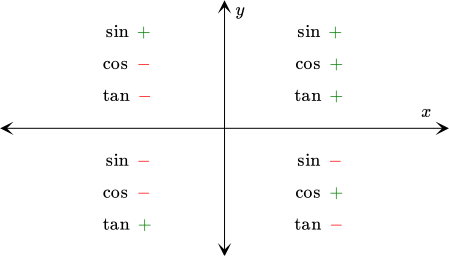
These identities are useful when finding the exact value of the sine, cosine, or tangent at a given angle.
Proof
Half-Angle IdentitiesFirst, write two of the Double-Angle Identities for cosine.
Next, substitute 2θ for x to obtain the half-angle identity for the sine.
Next, substitute 2θ for x to obtain the half-angle identity for the cosine.
cos2xcos2x=1−2sin2x=2cos2x−1
Sine Identity
Start by solving the first identity written above for sinx.cos2x=1−2sin2x
▼
Solve for sinx
SubEqn
LHS−1=RHS−1
cos2x−1=-2sin2x
DivEqn
LHS/(-2)=RHS/(-2)
-2cos2x−1=sin2x
RearrangeEqn
Rearrange equation
sin2x=-2cos2x−1
MoveNegDenomToFrac
Put minus sign in front of fraction
sin2x=-2cos2x−1
DistrNegSignSwap
-(b−a)=a−b
sin2x=21−cos2x
SqrtEqn
LHS=RHS
sinx=±21−cos2x
sin2θsin2θ=±21−cos(2⋅2θ)⇓=±21−cosθ✓
Cosine Identity
Start by solving the second identity written at the beginning for cosx.cos2x=2cos2x−1
▼
Solve for cosx
AddEqn
LHS+1=RHS+1
1+cos2x=2cos2x
DivEqn
LHS/2=RHS/2
21+cos2x=cos2x
RearrangeEqn
Rearrange equation
cos2x=21+cos2x
SqrtEqn
LHS=RHS
cosx=±21+cos2x
cos2θcos2θ=±21+cos(2⋅2θ)⇓=±21+cosθ✓
Tangent Identity
To derive the tangent identity, start by recalling the definition of the tangent ratio.tanx=cosxsinx
Next, substitute 2θ for x.
tan2θ=cos(2θ)sin(2θ)
Finally, substitute the half-identities for the sine and cosine into the equation above and simplify the right-hand side.
tan2θ=cos(2θ)sin(2θ)
SubstituteII
sin2θ=±21−cosθ, cos2θ=±21+cosθ
tan2θ=±21+cosθ±21−cosθ
▼
Simplify right-hand side
DivSqrt
ba=ba
tan2θ=±21+cosθ21−cosθ
DivFracByFracD
c/da/b=ba⋅cd
tan2θ=±21−cosθ⋅1+cosθ2
CrossCommonFac
Cross out common factors
tan2θ=±21−cosθ⋅1+cosθ2
CancelCommonFac
Cancel out common factors
tan2θ=±11−cosθ⋅1+cosθ1
MultFrac
Multiply fractions
tan2θ=±1+cosθ1−cosθ✓
Extra
Calculating cos15∘Consider the calculation of the exact value of cos15∘.
- To be able to use the half-angle identities, the angle 15∘ needs to be rewritten as a certain angle divided by 2. Therefore, rewrite 15∘ as 230∘.
- Based on the trigonometric ratios of common angles, it is known that cos30∘=23.
- According to the diagram of the quadrants, an angle that measures 15∘ is in the first quadrant. Therefore, the cosine ratio is positive.
Example
Solving the Tasks Found Inside the Balloons
Zosia and her classmates reached the third site, ready for any task. Three balloons floated steadily in mist. They caught the balloons one by one and noticed that there is something inside each one. Zosia found a needle and popped the balloons.
 Three notes fell to the ground. The classmates have been tasked with finding the values of the following trigonometric expressions by using the Half-Angle Identities. The answers must be written without any radicals in the denominators.
External credits: @brgfx
a sin15∘
{"type":"text","form":{"type":"math","options":{"comparison":"1","nofractofloat":false,"keypad":{"simple":false,"useShortLog":false,"variables":[],"constants":[]},"rendered":false},"text":"<span class=\"katex\"><span class=\"katex-html\" aria-hidden=\"true\"><\/span><\/span>"},"formTextBefore":null,"formTextAfter":null,"answer":{"text":["\\dfrac{\\sqrt{2-\\sqrt{3}}}{2}"]}}
b cos22.5∘
{"type":"text","form":{"type":"math","options":{"comparison":"1","nofractofloat":false,"keypad":{"simple":false,"useShortLog":false,"variables":[],"constants":[]},"rendered":false},"text":"<span class=\"katex\"><span class=\"katex-html\" aria-hidden=\"true\"><\/span><\/span>"},"formTextBefore":null,"formTextAfter":null,"answer":{"text":["\\dfrac{\\sqrt{2+\\sqrt{2}}}{2}"]}}
c tan(-15∘)
{"type":"text","form":{"type":"math","options":{"comparison":"1","nofractofloat":false,"keypad":{"simple":false,"useShortLog":false,"variables":[],"constants":[]},"rendered":false},"text":"<span class=\"katex\"><span class=\"katex-html\" aria-hidden=\"true\"><\/span><\/span>"},"formTextBefore":null,"formTextAfter":null,"answer":{"text":["-\\sqrt{7-4\\sqrt{3}}"]}}
Solution
a First, review the Half-Angle Identity for sine.
sin(2θ)=±21−cosθ
Note that 15 can be expressed as 230. What is more, θ=30∘ is a common angle for which trigonometric values are known. Substitute 30∘ for θ into the formula and solve for sin15∘.
sin(2θ)=±21−cosθ
Substitute
θ=30∘
sin(230∘)=±21−cos30∘
CalcQuot
Calculate quotient
sin15∘=±21−cos30∘
sin15∘=±21−23
1=aa
sin15∘=±222−23
SubFrac
Subtract fractions
sin15∘=±222−3
DivFracSL
ba/c=b⋅ca
sin15∘=±42−3
SqrtQuot
ba=ba
sin15∘=±42−3
CalcRoot
Calculate root
sin15∘=±22−3
sin15∘=22−3
b To calculate the cosine of 22.5∘, use the Half-Angle Identity for cosine.
cos(2θ)=±21+cosθ
The angle of 22.5∘ is equal to 245∘. Therefore, substitute θ with 45∘ and solve for cos22.5∘.
cos(2θ)=±21+cosθ
Substitute
θ=45∘
cos(245∘)=±21+cos45∘
CalcQuot
Calculate quotient
cos22.5∘=±21+cos45∘
cos22.5∘=±21+22
1=aa
cos22.5∘=±222+22
AddFrac
Add fractions
cos22.5∘=±222+2
DivFracSL
ba/c=b⋅ca
cos22.5∘=±42+2
SqrtQuot
ba=ba
cos22.5∘=±42+2
CalcRoot
Calculate root
cos22.5∘=±22+2
cos22.5∘=22+2
c The value of tan(-15∘) can be calculated by applying the Half-Angle Identity for tangent.
tan(2θ)=±1+cosθ1−cosθ
Note that -15∘ can be represented as 2-30∘. Therefore, substitute θ with -30∘.
tan(2-30)=±1+cos(-30∘)1−cos(-30∘)
By the Negative Angle Identity for cosine, the cosine of a negative angle equals the cosine of the positive angle. With this in mind, rewrite the obtained expression.
tan(2-30)=±1+cos30∘1−cos30∘
Simplify the equation and calculate the value of tan(-15∘).
tan(2-30)=±1+cos30∘1−cos30∘
CalcQuot
Calculate quotient
tan(-15∘)=±1+cos30∘1−cos30∘
tan(-15∘)=±1+231−23
1=aa
tan(-15∘)=±22+2322−23
AddSubFrac
Add and subtract fractions
tan(-15∘)=±22+322−3
DivFracByFracSL
ba/dc=ba⋅cd
tan(-15∘)=±22−3⋅2+32
MultFrac
Multiply fractions
tan(-15∘)=±2(2+3)(2−3)2
ReduceFrac
ba=b/2a/2
tan(-15∘)=±2+32−3
tan(-15∘)=±2+32−3
ExpandFrac
ba=b⋅(2−3)a⋅(2−3)
tan(-15∘)=±(2+3)(2−3)(2−3)(2−3)
▼
Simplify right-hand side
ExpandDiffSquares
(a+b)(a−b)=a2−b2
tan(-15∘)=±22−(3)2(2−3)(2−3)
ProdToPowTwoFac
a⋅a=a2
tan(-15∘)=±22−(3)2(2−3)2
ExpandNegPerfectSquare
(a−b)2=a2−2ab+b2
tan(-15∘)=±22−(3)222−43+(3)2
CalcPow
Calculate power
tan(-15∘)=±4−34−43+3
AddSubTerms
Add and subtract terms
tan(-15∘)=±17−43
DivByOne
1a=a
tan(-15∘)=±7−43
tan(-15∘)=-7−43
Example
Solving a Task from a Fortune Cookie
The class has successfully made it to the fourth mathematical sacred site which appears to be in a kitchen. Something seems strange. They door immediately close behind them. They are not in a kitchen at all, but an escape room! In order to get out, the class needed to find the task and solve it.
After searching for a while, someone found a fortune cookie. Inside of it, the task challenges them to find the exact value of two expressions given that sinθ=-1715 and 270∘≤θ≤360∘.

a sin2θ
{"type":"text","form":{"type":"math","options":{"comparison":"1","nofractofloat":false,"keypad":{"simple":false,"useShortLog":false,"variables":[],"constants":[]},"rendered":false},"text":"<span class=\"katex\"><span class=\"katex-html\" aria-hidden=\"true\"><\/span><\/span>"},"formTextBefore":null,"formTextAfter":null,"answer":{"text":["\\dfrac{3}{\\sqrt{34}}","\\dfrac{3\\sqrt{34}}{34}"]}}
b cos2θ
{"type":"text","form":{"type":"math","options":{"comparison":"1","nofractofloat":false,"keypad":{"simple":false,"useShortLog":false,"variables":[],"constants":[]},"rendered":false},"text":"<span class=\"katex\"><span class=\"katex-html\" aria-hidden=\"true\"><\/span><\/span>"},"formTextBefore":null,"formTextAfter":null,"answer":{"text":["-\\dfrac{5}{\\sqrt{34}}","\\dfrac{-5}{\\sqrt{34}}","\\dfrac{5}{-\\sqrt{34}}","-\\dfrac{5\\sqrt{34}}{34}"]}}
Hint
a Start by calculating cosθ by using the Pythagorean Identity.
b Use the Half-Angle Identity for cosine.
Solution
a In order to find the value of sin2θ, the Half-Angle Identity for sine can be used.
sin2θ=±21−cosθ
First, the value of the cosine of θ needs to be found. To do so, use the Pythagorean Identity.
sin2θ+cos2θ=1
Substitute
sinθ=-1715
(-1715)2+cos2θ=1
▼
Solve for cosθ
NegBaseToPosPow
(-a)2=a2
(1715)2+cos2θ=1
PowQuot
(ba)m=bmam
172152+cos2θ=1
CalcPow
Calculate power
289225+cos2θ=1
SubEqn
LHS−289225=RHS−289225
cos2θ=1−289225
OneToFrac
Rewrite 1 as 289289
cos2θ=289289−289225
SubFrac
Subtract fractions
cos2θ=28964
SqrtEqn
LHS=RHS
∣cosθ∣=28964
SqrtQuot
ba=ba
∣cosθ∣=28964
CalcRoot
Calculate root
∣cosθ∣=178
∣cosθ∣=178⇓cosθ=±178
Recall that θ is between 270∘ and 360∘, which is the fourth quadrant where the cosine is positive. This way the exact value of cosθ is found.
cosθ=178
Now, substitute this value into the identity written earlier and evaluate sin2θ.
sin2θ=±21−cosθ
Substitute
cosθ=178
sin2θ=±21−178
OneToFrac
Rewrite 1 as 1717
sin2θ=±21717−178
SubFrac
Subtract fractions
sin2θ=±2179
DivFracSL
ba/c=b⋅ca
sin2θ=±349
SqrtQuot
ba=ba
sin2θ=±349
CalcRoot
Calculate root
sin2θ=±343
sin2θ=343
b To find the value of cos2θ, recall the Half-Angle Identity for cosine.
cos2θ=±21+cosθ
From Part A, the value of cosθ is known. Substitute it into the formula and solve for cos2θ.
cos2θ=±21+cosθ
Substitute
cosθ=178
cos2θ=±21+178
OneToFrac
Rewrite 1 as 1717
cos2θ=±21717+178
AddFrac
Add fractions
cos2θ=±21725
DivFracSL
ba/c=b⋅ca
cos2θ=±3425
SqrtQuot
ba=ba
cos2θ=±3425
CalcRoot
Calculate root
cos2θ=±345
cos2θ=-345
Example
Choosing the Right Direction
The class successfully solved the task from the fortune cookie and arrived at the fifth site. There they saw two potential roads to the next site. To determine which road to choose, they need to solve the task written on the placard.
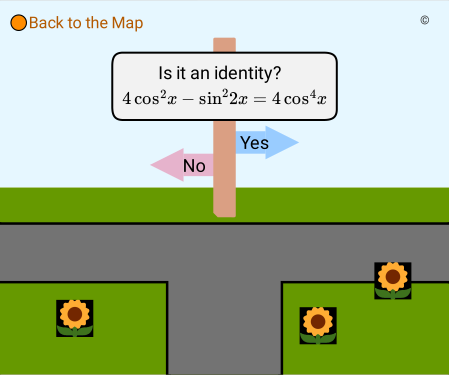 Which way should the class turn to end up at the sixth site?
External credits: @brgfx
{"type":"choice","form":{"alts":["Left","Right"],"noSort":false},"formTextBefore":"","formTextAfter":"","answer":1}
Hint
Use the Pythagorean Identity and the Double-Angle Identity for sine.
Solution
To verify the identity, rewrite its sides until they match. First, add sin22x and subtract 4cos4x from both sides of the equation. Then, factor out 4cos2x.
Recall the Pythagorean Identity and rewrite it to match the expression in the parentheses.
As can be seen, the left-hand side is the same as the right-hand side. Therefore, the identity is verified. This means that the class should turn right to end up at the sixth site.
4cos2x−sin22x=4cos4x
AddEqn
LHS+sin22x=RHS+sin22x
4cos2x=4cos4x+sin22x
SubEqn
LHS−4cos4x=RHS−4cos4x
4cos2x−4cos4x=sin22x
FactorOut
Factor out 4cos2x
4cos2x(1−cos2x)=sin22x
sin2x+cos2x=1⇓sin2x=1−cos2x
Now, substitute 1−cos2x for sin2x into the equation and simplify it. Next, use the Double-Angle Identity for sine.
4cos2x(1−cos2x)=sin22x
1−cos2(θ)=sin2(θ)
4cos2xsin2x=sin22x
sin2(θ)=(sin(θ))2
4cos2xsin2x=(sin2x)2
sin(2θ)=2sin(θ)cos(θ)
4cos2xsin2x=(2sinxcosx)2
PowProd
(a⋅b)m=am⋅bm
4cos2xsin2x=4sin2xcos2x
Example
Matching the Sides of Identities
The class made the correct turn to the right and arrived at the sixth site. They notice a rustic table with torn pieces of paper, on which the left-hand and right-hand sides of different identities were written. The task at hand is to match at least one of the identities.
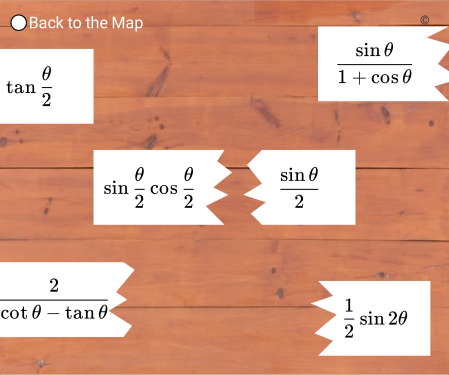 Zosia placed two random pieces in the middle of the table and started checking whether they form an identity.
sin2θcos2θ=?2sinθ
What result is she going to get? {"type":"choice","form":{"alts":["It is an identitiy.","It is not an identity."],"noSort":false},"formTextBefore":"","formTextAfter":"","answer":0}
Hint
Rewrite one or both sides of the equation by using the Half-Angle Identity or the Double-Angle Identity.
Solution
In order to check whether the equation Zosia formed is an identity, rewrite the sides until they match. There are two ways to do this — using the Half-Angle Identity or using the Double-Angle Identity. Each way will be shown one at a time.
Using the Half-Angle Identity
Start by recalling the Half-Angle Identities for sine and cosine.sin2θ=±21−cosθcos2θ=±21+cosθ
Substitute the expressions corresponding to sin2θ and cos2θ into the equation and simplify.
sin2θcos2θ=?2sinθ
SubstituteExpressions
Substitute expressions
±21−cosθ(±21+cosθ)=?2sinθ
ProdSqrt
a⋅b=a⋅b
±21−cosθ⋅21+cosθ=?2sinθ
MultFrac
Multiply fractions
±4(1−cosθ)(1+cosθ)=?2sinθ
(a−b)(a+b)=a2−b2
±412−cos2θ=?2sinθ
BaseOne
1a=1
±41−cos2θ=?2sinθ
sin2θ+cos2θ=1⇓sin2θ=1−cos2θ
Substitute sin2θ for 1−cos2θ into the obtained equation and calculate the square root on the left-hand side of the equation.
±41−cos2θ=?2sinθ
1−cos2(θ)=sin2(θ)
±4sin2θ=?2sinθ
SqrtQuot
ba=ba
±4sin2θ=?2sinθ
CalcRoot
Calculate root
±2sinθ=2sinθ✓
Using the Double-Angle Identity
Start by reviewing the Double-Angle Identity.sin2θ=2sinθcosθ
If instead of 2θ there was θ, the identity would look the following way.
sinθ=2sin2θcos2θ
Finally, by dividing both sides of the identity by 2, the equation that should have been verified can be obtained.
2sinθ=sin2θcos2θ
Therefore, the equation Zosia formed is indeed an identity. Example
Simplifying Trigonometric Expressions
The class has arrived at the seventh mathematical sacred sit — the finale. A huge board with plenty of colorful stickers lies ahead. They are told to choose two random cards.
 The classmates go through and and turn the cards. Lo and behold, two trigonometric expressions appear that need to be simplified. Once this is done, they will have completed the math quest!
External credits: @brgfx
a sin22θ−cos22θ
{"type":"text","form":{"type":"math","options":{"comparison":"1","nofractofloat":false,"keypad":{"simple":false,"useShortLog":false,"variables":[],"constants":["THETA"]},"rendered":false},"text":"<span class=\"katex\"><span class=\"katex-html\" aria-hidden=\"true\"><\/span><\/span>"},"formTextBefore":null,"formTextAfter":null,"answer":{"text":["-\\cos\\theta"]}}
b sinθ+cosθcos2θ
{"type":"text","form":{"type":"math","options":{"comparison":"1","nofractofloat":false,"keypad":{"simple":false,"useShortLog":false,"variables":[],"constants":["THETA"]},"rendered":false},"text":"<span class=\"katex\"><span class=\"katex-html\" aria-hidden=\"true\"><\/span><\/span>"},"formTextBefore":null,"formTextAfter":null,"answer":{"text":["\\cos\\theta-\\sin\\theta"]}}
Hint
a Start by factoring out -1.
b Use the Double-Angle Identity.
Solution
a Start by analyzing the first given expression.
sin22θ−cos22θ
As can be seen, the expression contains the squares of sine and cosine. Therefore, it can be simplified by using the Double-Angle Identity for cosine.
Therefore, the expression simplifies to -cosθ.
b Again, to simplify the expression, use the Double-Angle Identity for cosine.
sinθ+cosθcos2θ
cos(2θ)=cos2(θ)−sin2(θ)
sinθ+cosθcos2θ−sin2θ
FacDiffSquares
a2−b2=(a+b)(a−b)
sinθ+cosθ(cosθ+sinθ)(cosθ−sinθ)
AssociativePropAdd
Associative Property of Addition
cosθ+sinθ(cosθ+sinθ)(cosθ−sinθ)
CrossCommonFac
Cross out common factors
(cosθ+sinθ)(cosθ+sinθ)(cosθ−sinθ)
CancelCommonFac
Cancel out common factors
1cosθ−sinθ
DivByOne
1a=a
cosθ−sinθ
Closure
Solving the Task to Get the Bonus
When the math quest game for Zosia and her classmates began, they were going to face some tough tasks. After passing all the sites, the rules stated that they could try for a bonus task and get major points. Naturally, they decided try to solve it.
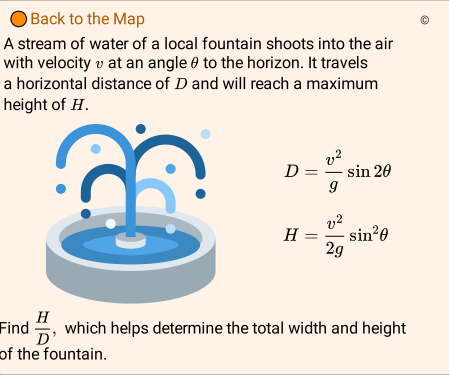 What is the value of DH?
External credits: @brgfx
{"type":"text","form":{"type":"math","options":{"comparison":"1","nofractofloat":false,"keypad":{"simple":false,"useShortLog":false,"variables":[],"constants":["THETA"]},"rendered":false},"text":"<span class=\"katex\"><span class=\"katex-html\" aria-hidden=\"true\"><\/span><\/span>"},"formTextBefore":"<span class=\"katex\"><span class=\"katex-html\" aria-hidden=\"true\"><span class=\"base\"><span class=\"strut\" style=\"height:2.04633em;vertical-align:-0.686em;\"><\/span><span class=\"mord\"><span class=\"mopen nulldelimiter\"><\/span><span class=\"mfrac\"><span class=\"vlist-t vlist-t2\"><span class=\"vlist-r\"><span class=\"vlist\" style=\"height:1.36033em;\"><span style=\"top:-2.314em;\"><span class=\"pstrut\" style=\"height:3em;\"><\/span><span class=\"mord\"><span class=\"mord mathdefault\" style=\"margin-right:0.02778em;\">D<\/span><\/span><\/span><span style=\"top:-3.23em;\"><span class=\"pstrut\" style=\"height:3em;\"><\/span><span class=\"frac-line\" style=\"border-bottom-width:0.04em;\"><\/span><\/span><span style=\"top:-3.677em;\"><span class=\"pstrut\" style=\"height:3em;\"><\/span><span class=\"mord\"><span class=\"mord mathdefault\" style=\"margin-right:0.08125em;\">H<\/span><\/span><\/span><\/span><span class=\"vlist-s\">\u200b<\/span><\/span><span class=\"vlist-r\"><span class=\"vlist\" style=\"height:0.686em;\"><span><\/span><\/span><\/span><\/span><\/span><span class=\"mclose nulldelimiter\"><\/span><\/span><span class=\"mspace\" style=\"margin-right:0.2777777777777778em;\"><\/span><span class=\"mrel\">=<\/span><\/span><\/span><\/span>","formTextAfter":null,"answer":{"text":["\\dfrac{1}{4}\\tan \\theta"]}}
Hint
Use the Double-Angle Identity for sine and the Tangent Identity.
Solution
To find the value of DH, substitute the corresponding expressions to H and D and then simplify.
Now, the Double-Angle Identity for sine can be used.
Therefore, the quotient of H and D simplifies to 41tanθ.
DH
SubstituteII
H=2gv2sin2θ, D=gv2sin2θ
gv2sin2θ2gv2sin2θ
MoveRightFacToNum
ca⋅b=ca⋅b
gv2sin2θ2gv2sin2θ
DivFracByFracD
c/da/b=ba⋅cd
2gv2sin2θ⋅v2sin2θg
MultFrac
Multiply fractions
2gv2sin2θv2sin2θg
CrossCommonFac
Cross out common factors
2gv2sin2θv2sin2θg
CancelCommonFac
Cancel out common factors
2sin2θsin2θ
2sin2θsin2θ
sin(2θ)=2sin(θ)cos(θ)
2⋅2sinθcosθsin2θ
Multiply
Multiply
4sinθcosθsin2θ
CrossCommonFac
Cross out common factors
CancelCommonFac
Cancel out common factors
4cosθsinθ
WriteProdFrac
Write as a product of fractions
41⋅cosθsinθ
tan(θ)=cos(θ)sin(θ)
41tanθ
Find the exact value of the following expressions given that cosθ=1715 and 0∘<θ<90∘.
sin2θ
{"type":"text","form":{"type":"math","options":{"comparison":"1","nofractofloat":false,"keypad":{"simple":true,"useShortLog":false,"variables":[],"constants":[]},"rendered":false},"text":"<span class=\"katex\"><span class=\"katex-html\" aria-hidden=\"true\"><\/span><\/span>"},"formTextBefore":"<span class=\"katex\"><span class=\"katex-html\" aria-hidden=\"true\"><span class=\"base\"><span class=\"strut\" style=\"height:0.69444em;vertical-align:0em;\"><\/span><span class=\"mop\">sin<\/span><span class=\"mspace\" style=\"margin-right:0.16666666666666666em;\"><\/span><span class=\"mord\">2<\/span><span class=\"mord mathdefault\" style=\"margin-right:0.02778em;\">\u03b8<\/span><span class=\"mspace\" style=\"margin-right:0.2777777777777778em;\"><\/span><span class=\"mrel\">=<\/span><\/span><\/span><\/span>","formTextAfter":null,"answer":{"text":["\\dfrac{240}{289}"]}}
tan2θ
{"type":"text","form":{"type":"math","options":{"comparison":"1","nofractofloat":false,"keypad":{"simple":true,"useShortLog":false,"variables":[],"constants":[]},"rendered":false},"text":"<span class=\"katex\"><span class=\"katex-html\" aria-hidden=\"true\"><\/span><\/span>"},"formTextBefore":"<span class=\"katex\"><span class=\"katex-html\" aria-hidden=\"true\"><span class=\"base\"><span class=\"strut\" style=\"height:0.69444em;vertical-align:0em;\"><\/span><span class=\"mop\">tan<\/span><span class=\"mspace\" style=\"margin-right:0.16666666666666666em;\"><\/span><span class=\"mord\">2<\/span><span class=\"mord mathdefault\" style=\"margin-right:0.02778em;\">\u03b8<\/span><span class=\"mspace\" style=\"margin-right:0.2777777777777778em;\"><\/span><span class=\"mrel\">=<\/span><\/span><\/span><\/span>","formTextAfter":null,"answer":{"text":["\\dfrac{240}{161}","1\\dfrac{79}{161}"]}}
security
report
code
security
report
code
We are asked to find the value of sin 2θ. To do so, let's start by recalling the Double-Angle Identity for sine. sin 2θ=2sinθcosθ We are given the value of cosθ. However, we do not know the value of sin θ. In order to find it, we can use one of the Pythagorean Identities. sin^2 θ+cos^2 θ=1 Let's substitute cosθ with 1517 and solve the equation for sinθ.
We found that sin θ =± 817. To find the sign of sin θ, recall that θ is greater than 0^(∘) and less than 90^(∘). This means that if we draw the angle θ in standard position, the terminal side will be located in Quadrant I.
We can see that sin θ is positive in Quadrant I. sin θ = 8/17 Now that we know both sinθ and cosθ, we can substitute these two values into the Double-Angle Identity and calculate sin 2θ.
We are asked to find the value of tan 2θ. First, let's recall the Double-Angle Identity for tangent.
tan 2θ=2tan θ/1-tan^2 θ
As we can see, we need to find the value of tanθ. To do so, we can use the Tangent Identity.
tanθ=sinθ/cosθ
Let's substitute 817 for sinθ and 1517 for cosθ into the equation.
Now that the value of tanθ is known, we can calculate tan2θ.
security
report
code
Find the exact value of the following expressions given that tanθ=34 and π<θ<23π.
sin2θ
{"type":"text","form":{"type":"math","options":{"comparison":"1","nofractofloat":false,"keypad":{"simple":false,"useShortLog":false,"variables":[],"constants":["PI"]},"rendered":false},"text":"<span class=\"katex\"><span class=\"katex-html\" aria-hidden=\"true\"><\/span><\/span>"},"formTextBefore":null,"formTextAfter":null,"answer":{"text":["\\dfrac{2\\sqrt{5}}{5}","\\dfrac{2}{\\sqrt{5}}"]}}
cos2θ
{"type":"text","form":{"type":"math","options":{"comparison":"1","nofractofloat":false,"keypad":{"simple":false,"useShortLog":false,"variables":[],"constants":["PI"]},"rendered":false},"text":"<span class=\"katex\"><span class=\"katex-html\" aria-hidden=\"true\"><\/span><\/span>"},"formTextBefore":null,"formTextAfter":null,"answer":{"text":["-\\dfrac{\\sqrt{5}}{5}","-\\dfrac{1}{\\sqrt{5}}"]}}
security
report
code
security
report
code
We are asked to find the value of sin θ2. To do so, let's recall the Half-Angle Identity for sine. sin θ2=± sqrt(1-cosθ/2) First, we need to find the value of cosθ. We know that tanθ= 43, so let's use this piece of information. Recall one of the Pythagorean Identities that involves tangent. 1+tan^2 θ=sec^2 θ There is also a Reciprocal Identity that describes the relationship between secant and cosine. sec θ=1/cosθ By substituting 1cosθ for secθ into the mentioned Pythagorean Identity, an equation that relates tangent and cosine can be obtained. 1+tan^2 θ=( 1/cosθ)^2 Now, we can substitute the known value of tanθ and solve the equation for cosθ.
We found that cos θ =± 35. Now, we need to determine the sign of cos θ. Recall that θ is greater than π and less than 3π2. This means that if we draw the angle θ in standard position, the terminal side will be located in Quadrant III.
We can see that cos θ is negative for θ in Quadrant III. cos θ =- 3/5 We will substitute the value of cosθ into the Half-Angle Identity and calculate sin θ2.
Finally, we need to determine the sign of sin θ2. Knowing that θ is greater than π and less than 3π2, we can find the range of values for θ2. π< θ < 3π/2 ⇔ π2 < θ/2 < 3π/4 Since θ2 is greater than π2 and less than 3π4, it is located in Quadrant II.
Therefore, sin θ2 is positive. sin θ/2= 2sqrt(5)/5
Here, we are asked to find the value of cos θ2. Let's start by recalling the Half-Angle Identity for cosine. cosθ/2=± sqrt(1+cosθ/2) In Part A, we found that cosθ=- 35. Let's substitute this value into the identity and calculate cos θ2.
Previously, we found that θ2 is located in Quadrant II, where the cosine is negative. Therefore, cos θ2 is negative. cos θ/2= - sqrt(5)/5
security
report
code
Use a Double-Angle Identity to find the exact value of each expression.
sin300∘
{"type":"text","form":{"type":"math","options":{"comparison":"1","nofractofloat":false,"keypad":{"simple":false,"useShortLog":false,"variables":[],"constants":["PI"]},"rendered":false},"text":"<span class=\"katex\"><span class=\"katex-html\" aria-hidden=\"true\"><\/span><\/span>"},"formTextBefore":null,"formTextAfter":null,"answer":{"text":["-\\dfrac{\\sqrt{3}}{2}"]}}
cos450∘
{"type":"text","form":{"type":"math","options":{"comparison":"1","nofractofloat":false,"keypad":{"simple":false,"useShortLog":false,"variables":[],"constants":[]},"rendered":false},"text":"<span class=\"katex\"><span class=\"katex-html\" aria-hidden=\"true\"><\/span><\/span>"},"formTextBefore":null,"formTextAfter":null,"answer":{"text":["0"]}}
security
report
code
security
report
code
We are asked to use a Double-Angle Identity to find the exact value of sin 300^(∘). Let's recall the Double-Angle Identity that involves sine. sin 2θ = 2 sin θ cos θ Now, we can use this formula to find the value of sin 300^(∘). We will start by rewriting 300^(∘) as a product where one of the factors is 2.
According to the table of trigonometric values of common angles, sin 150^(∘) = 12 and cos 150^(∘) = - sqrt(3)2. Therefore, we can substitute these two values into our expression.
We want to use a Double-Angle Identity to find the exact value of cos 450^(∘). Let's recall the Double-Angle Identity that involves cosine.
cos 2θ = 2 cos^2 θ - 1
To use this formula, we need to write 450^(∘) as a product where one factor is 2.
By using the table of trigonometric values of notable angles, we can recall that cos 225^(∘) = - sqrt(2)2. Let's substitute this value into our expression and evaluate it.
security
report
code
Use a Half-Angle Identity to find the exact value of each expression.
cos15∘
{"type":"text","form":{"type":"math","options":{"comparison":"1","nofractofloat":false,"keypad":{"simple":false,"useShortLog":false,"variables":[],"constants":[]},"rendered":false},"text":"<span class=\"katex\"><span class=\"katex-html\" aria-hidden=\"true\"><\/span><\/span>"},"formTextBefore":null,"formTextAfter":null,"answer":{"text":["\\dfrac{\\sqrt{2+\\sqrt{3}}}{2}"]}}
tan22.5∘
{"type":"text","form":{"type":"math","options":{"comparison":"1","nofractofloat":false,"keypad":{"simple":false,"useShortLog":false,"variables":[],"constants":[]},"rendered":false},"text":"<span class=\"katex\"><span class=\"katex-html\" aria-hidden=\"true\"><\/span><\/span>"},"formTextBefore":null,"formTextAfter":null,"answer":{"text":["\\sqrt{3-2\\sqrt{2}}"]}}
security
report
code
security
report
code
We are asked to use a Half-Angle Identity to find the exact value of cos 15^(∘). First, let's review the Half-Angle Identity that involves cosine. cos θ/2 = ± sqrt(1+cos θ/2) Next, we can use this formula to find the value of cos 15^(∘). We will start by rewriting 15^(∘) as a quotient of some number and 2.
According to the table of trigonometric values of common angles, cos 30^(∘) = sqrt(3)2. Therefore, we can substitute this value into our expression.
Finally, we need to determine the sign of the expression. To do so, let's recall the signs of sine, cosine, and tangent in the four quadrants of the coordinate plane.
Since 15^(∘) is located in Quadrant I, we know that cos 15^(∘) is positive. cos 15^(∘)= sqrt(2+sqrt(3))/2
We need to find the exact value of tan 22.5^(∘). To do so, let's recall the Half-Angle Identity for tangent. tan θ/2=± sqrt(1-cosθ/1+cosθ) First, we will express 22.5 as the quotient of some number and 2.
From the table of trigonometric values of notable angles, cos 45^(∘) = sqrt(2)2. Therefore, we can substitute this value into our expression.
Finally, we will determine the sign. To do so, let's recall the signs of sine, cosine, and tangent in the four quadrants of the coordinate plane.
Since 22.5^(∘) is located in Quadrant I, we can conclude that tan 22.5^(∘) is positive. tan 22.5^(∘)= sqrt(3 - 2sqrt(2))
security
report
code
Double and Half-Angle Identities
Recommended exercises
To get personalized recommended exercises, please login first.
Loading content
Loading content