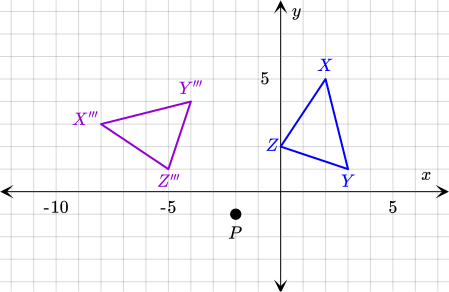
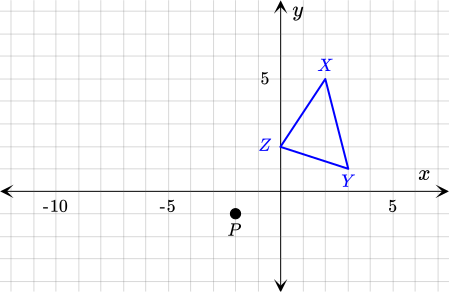
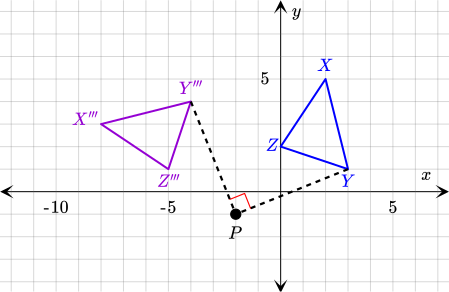
If the center of rotation was the origin, a rotation of 90^(∘) would change the coordinates of the figure in the following way.
(a,b) → (- b,a)
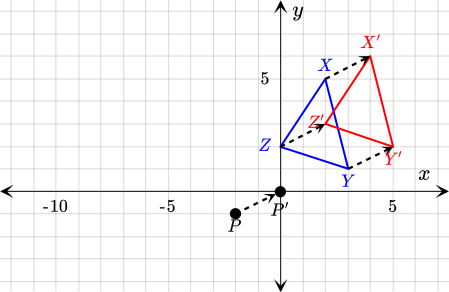
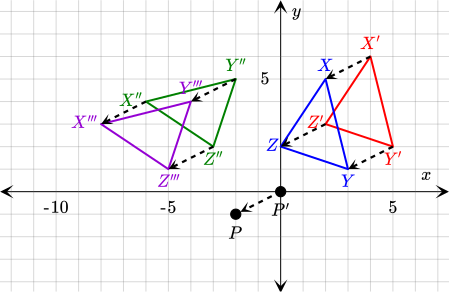
If we translate the triangle and point P by 2 units to the right and 1 unit up, we can use this formula to rotate the translated figure. We have to remember though to perform the opposite translations after having completed the rotation.
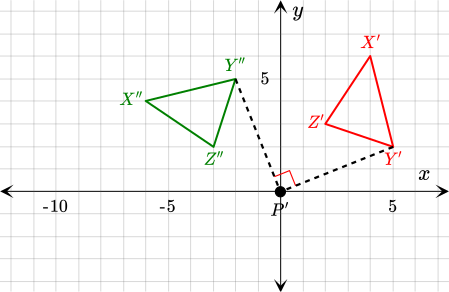
The translated triangle's vertices are Z'(2,3), X'(4,6), and Y'(5,2). Now, we will use the formula for rotating the figure by 90^(∘) counterclockwise to find the coordinates of △ X''Y''Z''.
Point
(a,b)
(- b,a)
X'
(4,6)
(- 6,4)
Y'
(5,2)
(- 2,5)
Z'
(2,3)
(- 3,2)
Let's draw △ X''Y''Z''.
Finally, we will have to undo the original translation that was performed in order to place P at the origin. Therefore, from each vertex, we subtract 2 from the x-coordinates and 1 from the y-coordinates.