A 180^(∘) rotation counterclockwise about the origin will change the coordinates of the vertices such that (a,b)→ (- a,- b).
Practice makes perfect
Let's consider each of the transformations one at a time, beginning with the rotation.
Rotation
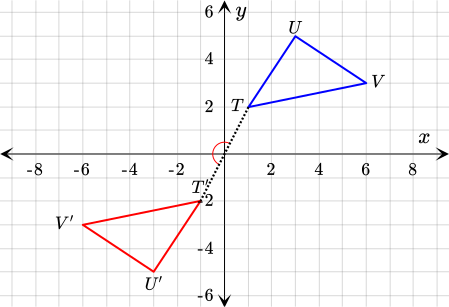
When a figure is rotated 180^(∘) counterclockwise about the origin, the coordinates of the vertices will change in the following way.
(a,b)→ (- a,- b)
Using this rule and the vertices of △ TUV, we can find the vertices T', U' and V'.
Point
(a,b)
(- a,- b)
T
(1,2)
(- 1,- 2)
U
(3,5)
(- 3,- 5)
V
(6,3)
(- 6,- 3)
Now we can graph △ TUV and △ T'U'V'
Reflection
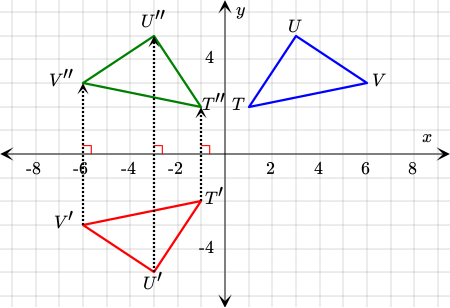
To reflect △ T'U'V' across the x-axis, we will move the vertices of this figure to the opposite side of the axis while maintaining the distance of each point from the axis.
Final Composed Image
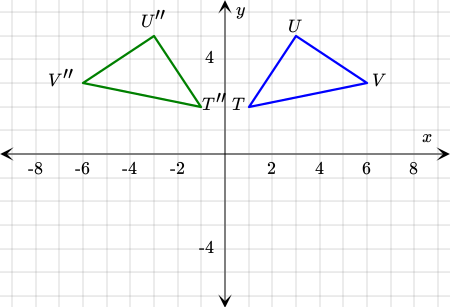
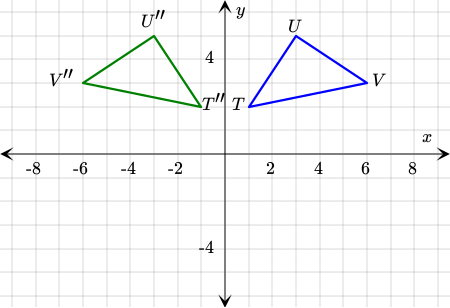
The final composed image will be the final product of both transformations.