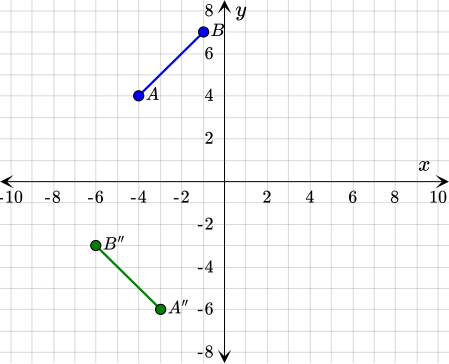
A 90^(∘) rotation counterclockwise about the origin will change the coordinates of the endpoints such that (a,b)→ (- b,a).
Practice makes perfect
Let's consider each of the given transformations one at a time, beginning with the translation.
Translation
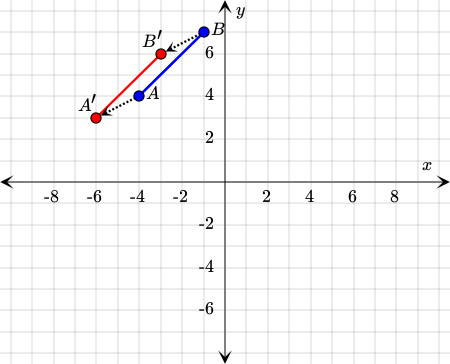
Translations tell us how many units we should add to or subtract from the given coordinates. Let's look at the given translation.
(x,y)→ (x-2,y-1)
This means that we should move each endpoint of AB 2 units to the left and 1 unit down.
From the diagram, we can determine the coordinates of the image.
A'(- 6,3) and B'(- 3,6)
Rotation
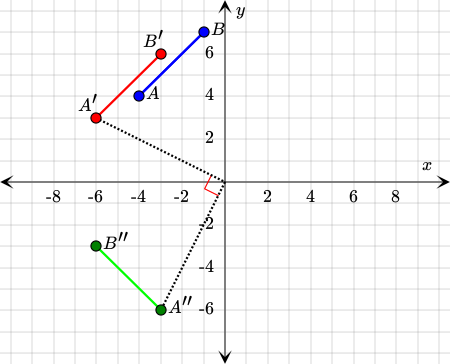
When a segment is rotated 90^(∘) counterclockwise about the origin, the coordinates of the endpoints of the image will change in the following way.
(a,b)→ (- b,a)
Using this rule with the endpoints of A'B', we can find the endpoints of A''B''.
Point
(a,b)
(- b,a)
A'
(- 6,3)
(- 3,- 6)
B'
(- 3,6)
(- 6,- 3)
Knowing the endpoints of A''B'', we can draw the image.
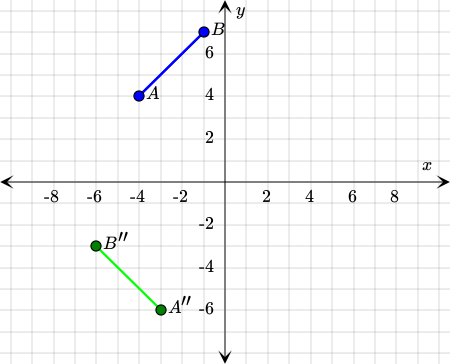
Final Composed Image
The final composed image will be the final combined product of both transformations. Let's look at the image and the preimage on the same coordinate plane.