To evaluate a function for a given value of the variable, substitute the value for the variable.
-13, -5, and 1
Practice makes perfect
Evaluating a function for a certain value of x means that we substitute the given value for every instance of x. Let's do this for the given function when x=-4.
When x=-4, the function's value is - 13.
We will evaluate this function for x=0 and x=3 in the same way using the table below.
x
2x-5
f(x)
-4
2( -4)-5
-13
0
2( 0)-5
-5
3
2( 3)-5
1
Extra
Functions
Let's recall some information about functions. A function is a relation in which each input is assigned to exactly oneoutput. The set of all possible inputs is called the domain of the function and the set of all possible outputs is called the range. If x represents the inputs and y the outputs of a function, it is often said that y is a function of x or that y depends on x.
y = f(x)
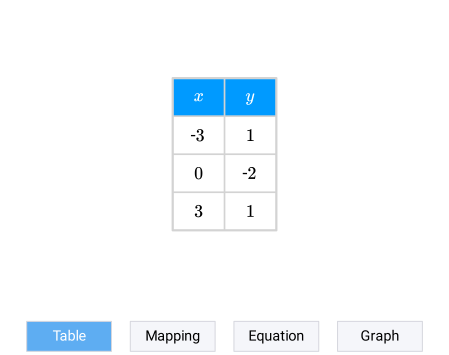
This way of representing the dependent variable is called function notation. A function can be represented using a table, a mapping diagram, an equation, or a graph.
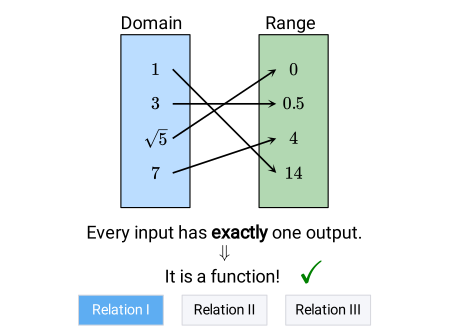
Note that every function is a relation, but not every relation is a function. In the following applet, three different relations are analyzed to determine whether they are functions.
In Relation III, although one of the outputs corresponds to two different inputs, it is still a function because each input has exactly one output. Depending on how a relation is represented, there are different methods to determine whether or not it is a function.