1. Key Features of Quadratic Functions
Sign In
An error ocurred, try again later!
Chapter 9
1.
Key Features of Quadratic Functions
Quadratic functions possess distinct characteristics that make them valuable in various applications. One of the primary features of these functions is the vertex, a point where the function reaches its maximum or minimum value. The direction in which a parabola opens (upward or downward) and its vertex (maximum or minimum) can provide insights into the behavior of the function. For instance, quadratic functions can be used to model scenarios like the motion of a ball or the design of a roller coaster. By understanding the vertex, intercepts, and other key features, one can predict and analyze the outcomes of different situations.
Show less Show more expand_more 


Lesson Settings & Tools
| | 13 Theory slides |
| | 10 Exercises - Grade E - A |
| | Each lesson is meant to take 1-2 classroom sessions |
This lesson will cover the key features of quadratic functions, how they can be represented in graphs, and how they can be used to model real-life scenarios.
Catch-Up and Review
Here are a few recommended readings before getting started with this lesson.
Explore
Share
Report error
Exploring Parabolas
The following applet shows a variety of parabolas in the same coordinate plane. Inspect and compare them. 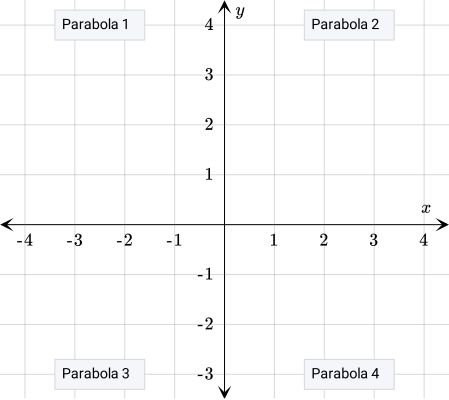 What do these parabolas have in common, and what are their differences?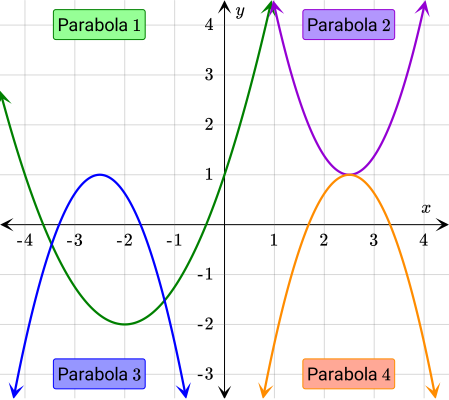
Extra
Graphs of the ParabolasThe parabolas are shown in the graph below if there is a problem loading the applet.
Discussion
Share
Report error
Domain of a Quadratic Function
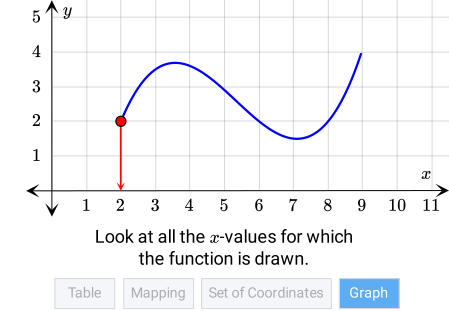
When given a function, it is not always possible to use any value as an input. Sometimes the input will not make sense in the given context of the function. It could also be that the function is not defined for such value.
The domain of a function is the set of all x-values, called inputs, for which the function is defined. As an example, consider the following functions. f(x) & = 3x [0.2cm] g(x) & = sqrt(x) [0.3em] h(x) & = 1/x Their domains can be written by analyzing the definition of each function.
| Function | Analysis | Domain |
|---|---|---|
| f(x) = 3x | Multiplying by 3 is defined for all real numbers. | All real numbers |
| g(x) = sqrt(x) | Square roots are not defined for negative numbers. | All non-negative numbers — that is, x≥ 0 |
| h(x) = 1/x | Dividing by zero is undefined. | All real numbers except 0 — that is, x≠ 0 |
Discussion
Share
Report error
Range of a Quadratic Function
Given a function and its domain it is possible to study the set of all possible outputs.
Concept
Share
Report error
Range
The range of a function is the set of all y-values, called outputs, of the function. The range depends on both the domain and the function itself. For example, consider the following functions and their defined domains.
| Function | Domain |
|---|---|
| f(x)=2x | All integers |
| g(x)=x^2 | All real numbers |
| h(x)=4 | All real numbers |
The ranges of each function can be determined by analyzing the definition of each function along with the given domains.
| Function | Domain | Analysis | Range |
|---|---|---|---|
| f(x) = 2x | All integers | The function takes any integer input and produces an output that is an even number, as each input is multiplied by 2. | All even numbers |
| g(x) = x^2 | All real numbers | The function takes any real number input and produces an output that is a non-negative number, as each input is squared. | All non-negative numbers. That is, y≥ 0 |
| h(x) = 4 | All real numbers | The function takes any real number input and sends it to 4. | Only the number 4. That is, the range is {4} |
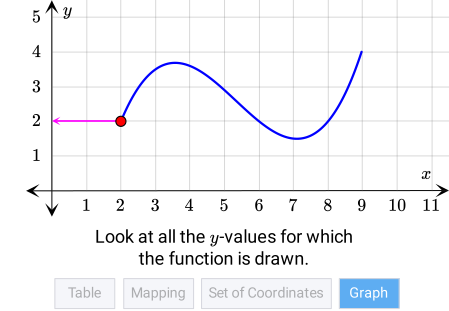
One of the characteristics of the graph of a quadratic function — a parabola — is the vertex.
Concept
Share
Report error
Vertex of a Parabola
Because a parabola either opens upward or downward, there is always one point that is the absolute maximum or absolute minimum of the function. This point is called the vertex.
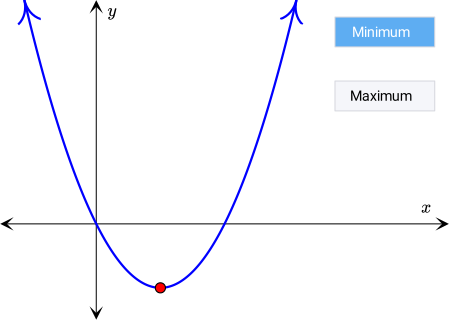 At the vertex, the function changes from increasing to decreasing, or vice versa.
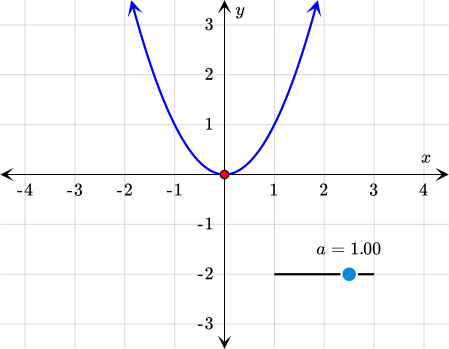
Knowing the vertex of a parabola is very helpful when looking for the range of a quadratic function. Consider the following quadratic function given in vertex form. It is assumed that this function is defined for all real numbers. y=a(x-h)^2+k The coordinates of the vertex are given by (h,k). Consider the case when a>0, meaning that the parabola opens upward. In this case k is the absolute minimum of the function, so the range will start from k and extend towards positive infinity. [k,∞) Likewise, if a<0 the parabola opens downward, meaning that k is the absolute maximum of the function, so the range will come up from negative infinity up to k. (-∞ , k]
| a-value | Range |
|---|---|
| a>0 | [k,∞) |
| a<0 | (-∞,k] |
Example
Share
Report error
Optimizing a Fence
A park asks for volunteers to put up a rectangular fence to keep deer from eating tree saplings. Each volunteer will receive a ticket to an amusement park. Dominika and her friend Emily volunteer. They are given 60 feet of wire for the fence, and are told to use all of it. They recall the formula for the area of a rectangle.
A=l w
It is possible to change the area A of the fenced region by adjusting the length l of the fence. When the length changes, the width w also changes.
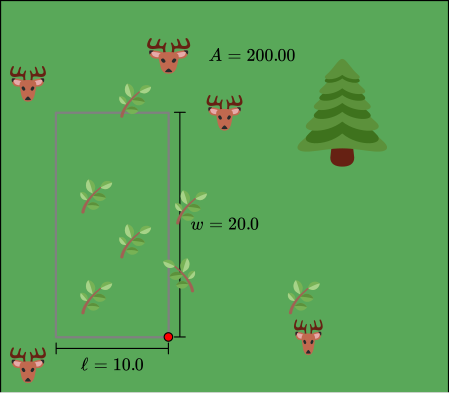 Help Dominika and Emily analyze this situation so they can do a good job putting up the fence.
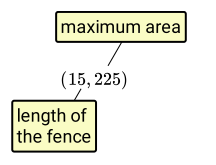
a Write a quadratic function A(l) for the area of the fenced region in terms of its length l.
b State the domain of A(l) for the fence. Write the answer in interval notation.
c Find the vertex of the quadratic function.
d State the range of A(l). Write the range in interval notation.
e Interpret the coordinates of the vertex.
Answer
a A(l)=30l-l^2
b Domain: (0,30)
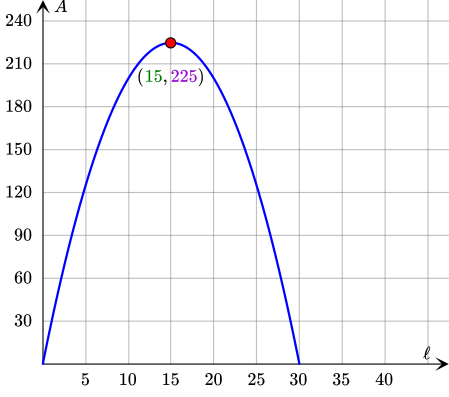
c (15,225)
d Range: (0,225]
e The length of the rectangular fence that makes the area of the fenced region the greatest is 15 feet. The area is 225 square feet.
Hint
a Use the formula for the perimeter of a rectangle to express w in terms of l.
b Is it possible to have negative dimensions?
c Write the function in vertex form.
d Is it possible to have negative areas?
e The vertex is at the absolute maximum or absolute minimum of a quadratic function.
Solution
a The formula for the area of a rectangle is already given.
A=l w
In order to write it in terms of l, then w needs to be expressed in terms of l. That means to find a method to substitute w for l. Since they want to build a rectangular fence, writing in terms of l can be done by using the formula for the perimeter of a rectangle.P=2l+2w
Substitute
P= 60
60=2l+2w
▼
Solve for w
SubEqn
LHS-2l=RHS-2l
60-2l=2w
DivEqn
.LHS /2.=.RHS /2.
60-2l/2=w
WriteDiffFrac
Write as a difference of fractions
60/2-2l/2=w
CalcQuot
Calculate quotient
30-l=w
RearrangeEqn
Rearrange equation
w=30-l
b The domain of a function depends on the formula of the function and on what the function describes. Since l represents the length of the rectangle, it is positive.
l>0 Furthermore, since there is only 60 feet of wiring, the length of each side must be less than 60. Additionally, the perimeter of a rectangle includes twice its length, so that means 2l is less than 60. 2l<60 ⇓ l<30 This is a strict inequality because having a length of exactly 30 feet would imply that the width is 0, meaning there would be no fenced area! Knowing this, the domain of the function can be written in interval notation.
Domain: (0,30) c The quadratic function for the area of the fenced region can be written in vertex form by completing the square.
A(l)=30l-l^2
▼
Write in vertex form
CommutativePropAdd
Commutative Property of Addition
A(l)=-l^2+30l
FactorOut
Factor out -1
A(l)=-(l^2-30l)
AddDiffZero
a = a+ 15^2- 15^2
A(l)=-(l^2-30l+15^2-15^2)
FacNegPerfectSquare
a^2-2ab+b^2=(a-b)^2
A(l)=-((l-15)^2-15^2)
Distr
Distribute -1
A(l)=-(l-15)^2+15^2
CalcPow
Calculate power
A(l)=-(l-15)^2+225
d In Part C, it was found that the vertex of the quadratic function is at (15, 225). Since the parabola opens downward, this means that 225 is an absolute maximum of the function. A≤ 225
Since the function describes the area of the fenced region, it has to be positive. A>0 This is enough information to write the function's range in interval notation.
Range: (0,225] e The vertex of a parabola gives information of the maximum or minimum of the function and the value of the independent variable where this maximum or minimum occurs. In this case, it has already been determined it is the maximum that is being used.
Since the vertex is at (15,225), the maximum area of the fence is 225, and this area is obtained by making a fence 15 feet long. It is not a coincidence that this is a square fence! Not every seedling can be protected from the deer, but Dominka and Emily did great.
Discussion
Share
Report error
Increasing and Decreasing Intervals of Quadratic Functions
It has been stated previously that the vertex of a parabola is either the absolute maximum or absolute minimum of the corresponding quadratic function. There is also an important characteristic of the quadratic function's graph that changes at this point.
Concept
Share
Report error
Increasing and Decreasing Intervals
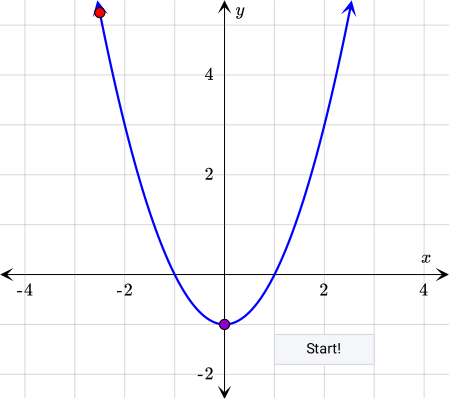
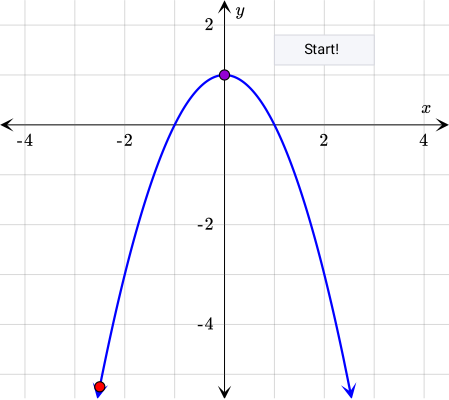
A function is said to be increasing when, as the x-values increase, the values of f(x) also increase. On the other hand, the function is considered decreasing when, as x increases, f(x) decreases. An increasing interval is an interval of the independent variable where the function is increasing. A decreasing interval is an interval of the independent variable when the function is decreasing.
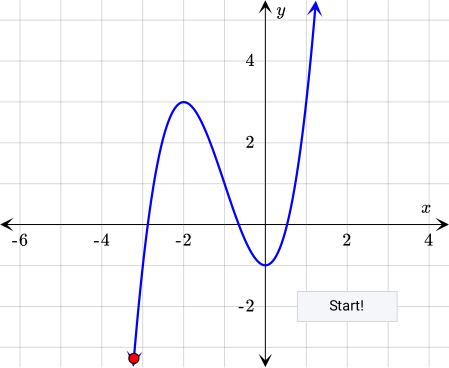
From left side to x=- 2 & → && Increasing From x=- 2 to x=0 & → && Decreasing From x=0 to right side & → && Increasing
Although the entire graph cannot be seen, it is reasonable to assume that it continues in the same manner. In that case, for all x-values less than x=- 2, f will be increasing. For all x-values greater than x=0, f will also be increasing.
Increasing Intervals: - ∞ &< x < - 2 [0.8em] 0 &< x < ∞ [0.8em]
Decreasing Interval: - 2 &< x < 0
The point where a function switches between decreasing and increasing is known as a turning point.
Example
Share
Report error
A Roller Coaster Described by Intervals
Dominika and Emily arrive to the amusement park. "Last one to the coaster is crumbs under the toaster!" exclaims Emily. Both of them race to the roller coaster. Dominka takes just a few steps before becoming mesmerized by what she sees. 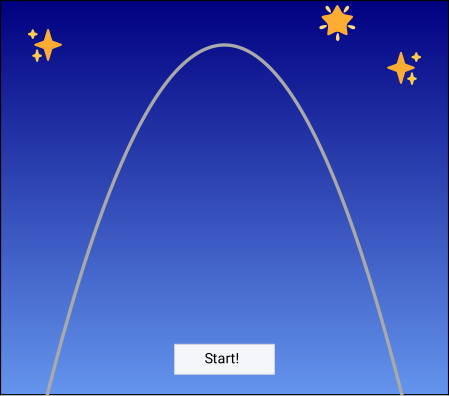 Dominika sees a section of the roller coaster shinning before the night sky. The cart uses a green light as it goes up, and it changes to a red light as it goes down. Mesmerized, Dominika wonders how this works.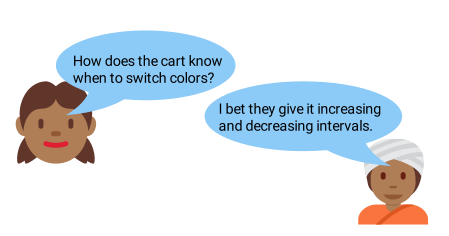
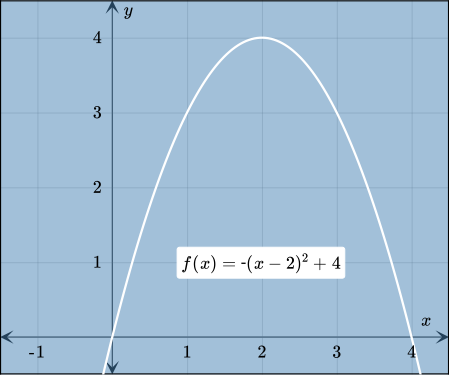 The blueprints also show the quadratic function that describes the parabolic section of the roller coaster.
f(x)= -(x-2)^2+4, if 0≤ x ≤ 4
What is the increasing interval of the function?
The blueprints also show the quadratic function that describes the parabolic section of the roller coaster.
f(x)= -(x-2)^2+4, if 0≤ x ≤ 4
What is the increasing interval of the function? What is the decreasing interval of the function?
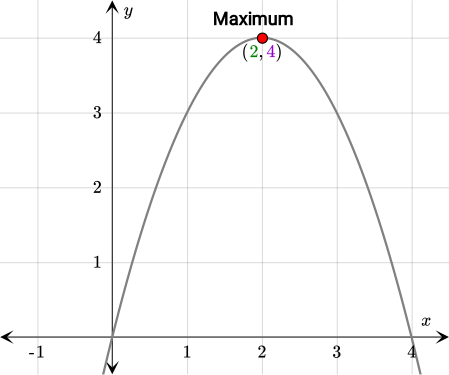
The two of them look around for the answer. They find a signboard that explains that the cart uses software that controls the lights. By knowing the function and stating the increasing and decreasing intervals, the lights can switch accordingly. The signboard shows the blueprints.
{"type":"choice","form":{"alts":["[0,4]","(2,4]","[0,2)","[0,2]","[2,4]"],"noSort":false},"formTextBefore":"","formTextAfter":"","answer":2}
{"type":"choice","form":{"alts":["[0,4]","(2,4]","[0,2)","[0,2]","[2,4]"],"noSort":false},"formTextBefore":"","formTextAfter":"","answer":1}
Solution
The function that describes the parabolic section of the roller coaster is given in vertex form. f(x)=-(x- 2)^2+ 4 The vertex is at ( 2, 4). Since the parabola opens downward, this point is an absolute maximum.
It is also given that the domain of this function is [0,4]. This means that the function increases starting from x=0 until it reaches its maximum at x= 2, which is not included in the increasing interval. [0,2) From there, the function decreases until it reaches its end at x=4. As a reminder, the maximum at x=2 is not included in the decreasing interval. (2,4]
Discussion
Share
Report error
Intercepts of Quadratic Functions
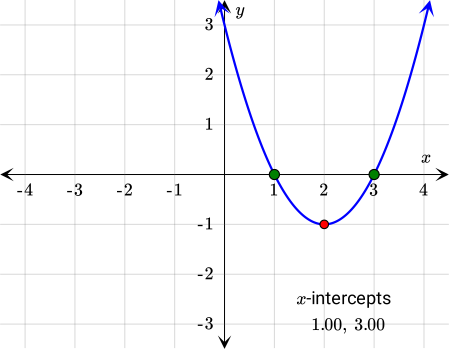
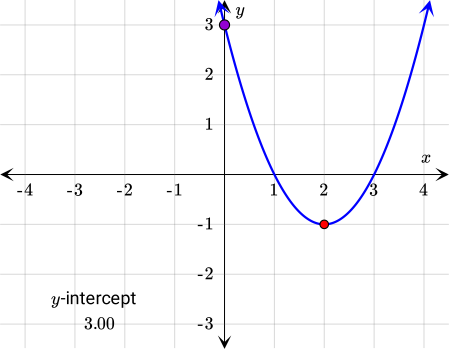
A quadratic function might cross the x- and y-axes. These points are known as intercepts.
Concept
Share
Report error
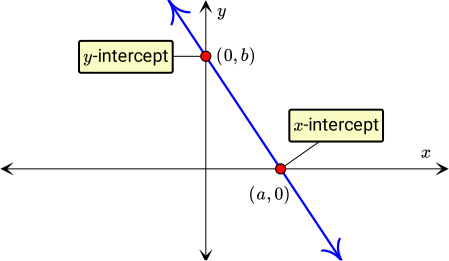
Intercept
The x-intercept of a line is the x-coordinate of the point where the line crosses the x-axis. The y-intercept of a line is the y-coordinate of the point where the line crosses the y-axis. The y-intercept of an equation is also known as its initial value.
Example
Share
Report error
The Motion of a Ball Described by a Quadratic Function
Dominika and Emily, enjoying the theme park, want to try Shoot 'N' Hoop. If they make their one shot attempt, they will win a teddy bear. As the ball goes up, Dominika imagines her shot being modeled by a quadratic function.

The function representing Dominika's shot is graphed on the following coordinate plane. Take note that the drawn path of the ball in the air in the applet versus when mapped on the graph looks slightly different.
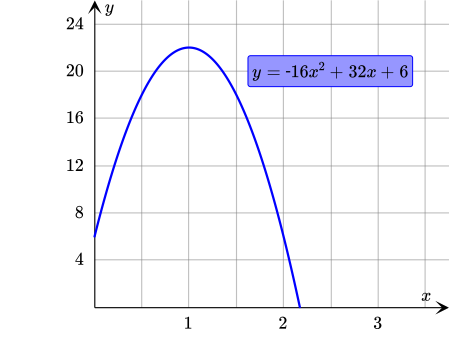
The height of the ball is represented by y, and time the ball is in the air after Dominika shoots the ball is x. The worker hosting the game tells Dominika and Emily that if they can answer the following math questions correctly, he will give them a second teddy bear.
a Find the y-intercept of the function.
b Find the x-intercept of the function. Round the answer to two decimal places.
c Interpret both intercepts.
Answer
a 6
b About 2.17
c The ball was released from 6 feet above the ground. It remained in the air for about 2.17 seconds.
Hint
a Evaluate the function at x=0.
b Set the function equal to 0 and solve using the Quadratic Formula.
c What does x and y represent in this scenario?
Solution
a The y-intercept of the function can be found by evaluating it at x=0.
b To find the x-intercepts of the function begin by setting it equal to 0.
x=- b±sqrt(b^2-4ac)/2a
SubstituteValues
Substitute values
x=- 32±sqrt(32^2-4( - 16)( 6))/2( - 16)
▼
Simplify right-hand side
CalcPow
Calculate power
x=- 32±sqrt(1024-4(- 16)(6))/2(- 16)
MultNegNegOnePar
- a(- b)=a* b
x=- 32±sqrt(1024+64(6))/2(- 16)
Multiply
Multiply
x=- 32±sqrt(1024+384)/- 32
AddTerms
Add terms
x=- 32±sqrt(1408)/- 32
MoveNegDenomToNum
Put minus sign in numerator
x=-(-32±sqrt(1408))/32
Distr
Distribute -1
x=32±sqrt(1408)/32
CalcRoot
Calculate root
x=32±37.523326.../32
c The y-intercept is the y-value at which x equals zero. Since x represents time in this scenario, the y-intercept represents the starting height of the ball. The x-intercept is the x-value at which y equals zero. Since y represents height in this scenario, the x-intercept represents the time the ball remains in the air.
Discussion
Share
Report error
Positive and Negative Intervals of Quadratic Functions
Parts of the graph of a quadratic function can be either above or below the x-axis. The intervals of x-values where this happens receive a special name.
Concept
Share
Report error
Positive and Negative Intervals
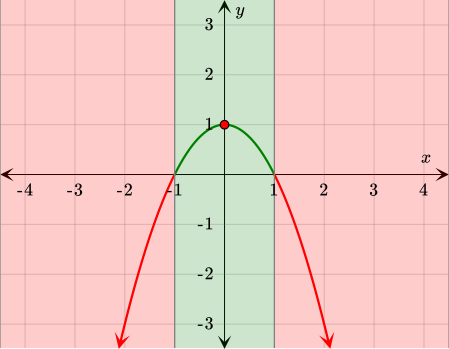
A function is said to be positive where its graph is above the x-axis and is said to be negative where its graph is below the x-axis.

A positive interval is an interval for which the function is positive. Likewise, a negative interval is an interval for which the function is negative. The graph above shows two negative intervals and two positive intervals. Each interval is described in terms of the x-values. From left side to x=- 2 & → && negative From x=- 2 to x=0 & → && positive From x=0 to x=2 & → && negative From x=2 to right side & → && positive Although the entire graph cannot be shown, it is reasonable to assume that it continues in the same manner. Thus, for all x-values less than x=- 2, f will be negative. Likewise, for all x-values greater than x=2, f will be positive. A point where the function is equal to zero is neither included in a positive nor a negative interval.
Positive Intervals: -2 &< x < 0 [0.8em] 2 &< x < ∞ [0.8em] Negative Intervals: - ∞ &< x < -2 [0.8em] 0 &< x < 2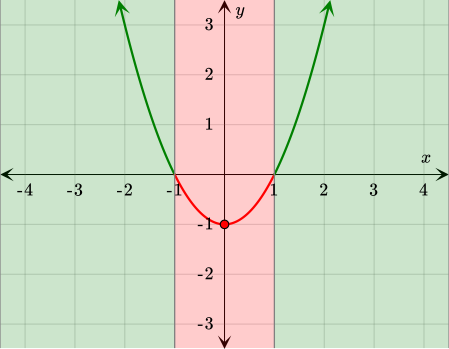
Example
Share
Report error
Filling a Birdbath
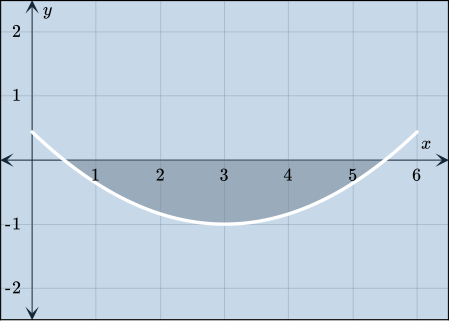
Emily and Dominika are relaxing on a bench at the theme park. Next to them, a bluebird appears in a bird bath! The bath seems to be a bit low on water, however. They look up the blueprints of similar birdbaths online and find a cross section of one that includes its quadratic function.
Answer
Positive Intervals: [0,0.5) and (5.5,6]
Negative Interval: (0.5,5.5)
Hint
The positive and negative intervals do not include the points where the function is equal to zero.
Solution
The domain of the function describing the cross section of the birdbath consists of the numbers between 0 and 6. [0,6] Note that the function graph is above the x-axis between x=0 and x=0.5, meaning that it is positive in this interval. Since the positive and negative intervals do not include the points where the function equals zero, x=0.5 is not included in this interval. [0,0.5) The function then goes below the x-axis between x=0.5 and x=5.5, meaning that it is negative in this interval. (0.5,5.5) In the last bit of the birdbath the function graph goes above the x-axis once again, meaning that the function is positive here. (5.5,6] The intervals can now be summarized. Positive Intervals: & [0,0.5) [0.8em] & (5.5,6] [0.8em] Negative Interval: & (0.5,5.5) Dominika and Emily can explain the meaning of this information to the park employees to make sure the birdbath has enough water.
Discussion
Share
Report error
End Behavior of Quadratic Functions
In general, the domain of quadratic functions consists of all real numbers. Investigating what happens to the function as the x-values increase or decrease infinitely is valuable in better understanding quadratic functions.
Concept
Share
Report error
End Behavior
The end behavior of a function is the value to which f(x) tends as x extends to the left or the right infinitely. If f(x) keeps increasing without bound, it is said to tend to positive infinity. The end behavior of this case is stated as up.
f(x) → + ∞
Conversely, if f(x) keeps decreasing without bound, it is said to tend to negative infinity. In this case, the end behavior is stated as down.
f(x) → - ∞
For example, consider the graph of a function g(x).
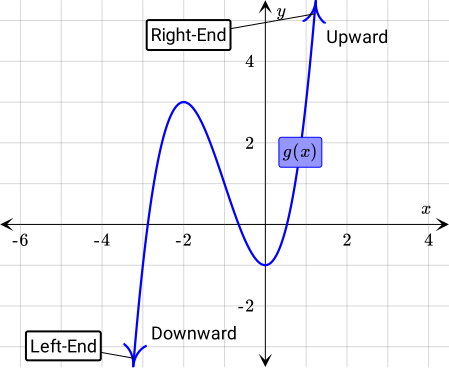
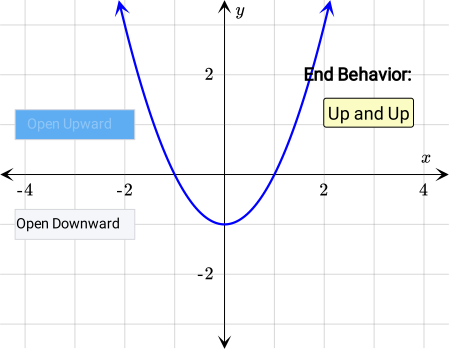
From the arrows on the graph, it can be seen that the left end of the graph extends downward, while the right end extends upward. The end behavior of g can then be expressed as follows. ll As x → - ∞, & g(x) → - ∞ As x → + ∞, & g(x) → + ∞
To state the end behavior of a function in words, begin by stating the left-end behavior, then state the right-end behavior. A dash can also be used to separate the words. For instance, the end behavior of the graph of g(x) can be written asdown and upor as
down-up.
Since quadratic functions are polynomial functions of degree 2 their end behavior is either up and up or down and down, all depending on the sign of the leading coefficient.
Closure
Share
Report error
Analyzing a Quadratic Function
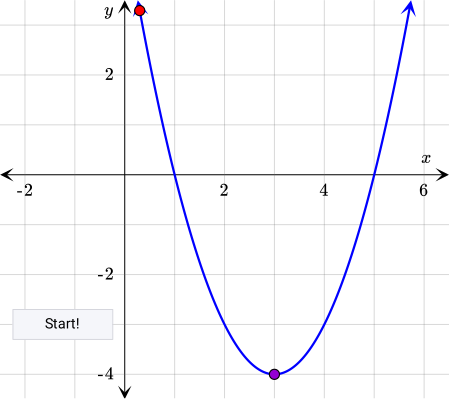
Given any quadratic function, all of its key features can be found using the tools provided in this lesson. Consider the following function. f(x)=x^2-6x+5 The graph of the function is shown below.
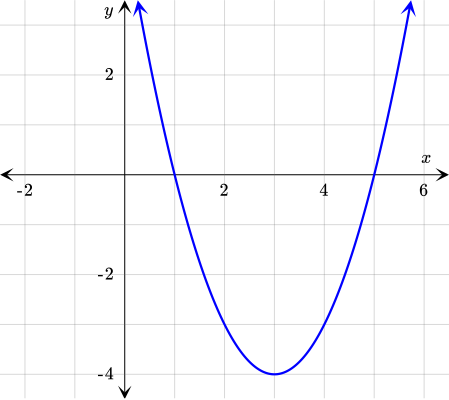
a Find its vertex. Is it a maximum or a minimum?
c Find the y-intercept and the x-intercepts, if any.
d State the decreasing and increasing intervals.
e State the positive and negative intervals.
f What is the end behavior of this function?
Answer
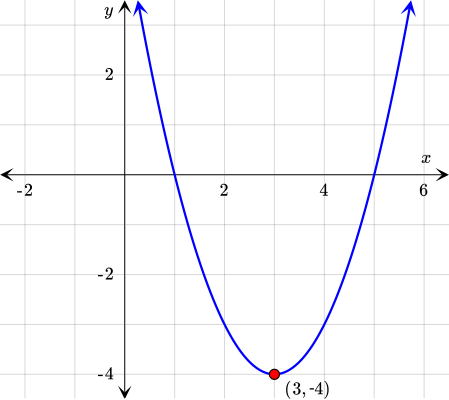
a (3,-4), minimum
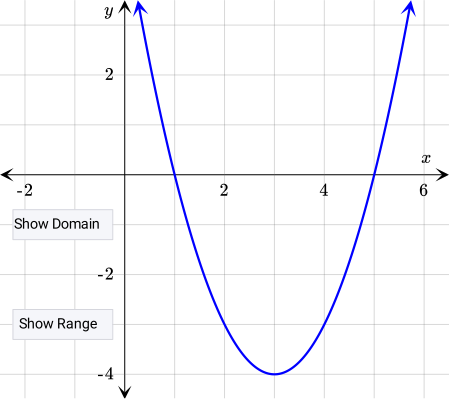
b Domain: All real numbers
Range: [-4,∞)
Range: [-4,∞)
c y-intercept: 5
x-intercepts: 1, 5
x-intercepts: 1, 5
d Decreasing Interval: (- ∞,3)
Increasing Interval: (3,∞)
Increasing Interval: (3,∞)
e Positive Intervals: (- ∞,1) and (5,∞)
Negative Interval: (1,5)
Negative Interval: (1,5)
f Up and up
Hint
a Write the function in vertex form by completing the square.
b Use the result from Part A.
c Find the y-intercept by evaluating the function at x=0. Find the x-intercepts by setting the function equal to 0 and solving for x.
d The function switches from decreasing to increasing at the vertex.
e Which part of the graph is above the x-axis? Which part is below?
f Look at both ends of the graph.
Solution
a The quadratic function is given in standard form.
f(x)=x^2-6x+5
▼
Write in vertex form
Rewrite
Rewrite 6x as 2*3x
f(x)=x^2-2*3x+5
AddDiffZero
a = a+ 3^2- 3^2
f(x)=x^2-2*3x+3^2-3^2+5
FacNegPerfectSquare
a^2-2ab+b^2=(a-b)^2
f(x)=(x-3)^2-3^2+5
CalcPow
Calculate power
f(x)=(x-3)^2-9+5
SubTerm
Subtract term
f(x)=(x-3)^2-4
b There are no given restrictions on the function, so it can be assumed that its domain consists of all real numbers.
c The y-intercept can be found by evaluating the function at x=0.
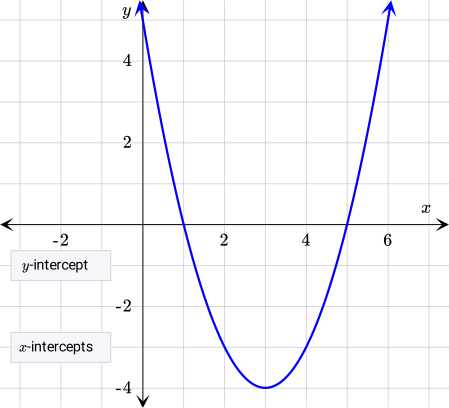
d It was found in Part A that the vertex is at ( 3,-4) and that it is a minimum. Since the domain of the function is all real numbers the function will be decreasing from negative infinity until it reaches the vertex. Then it will start increasing. Remember that the vertex is not included in decreasing or increasing intervals.
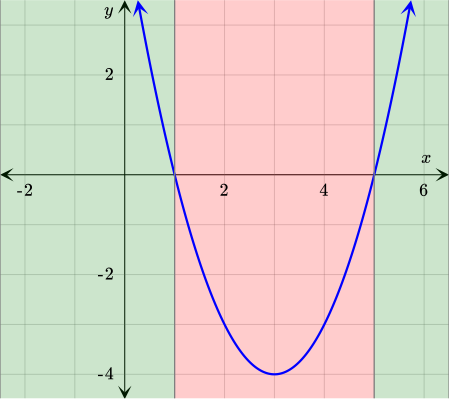
e The x-intercepts of the function were found in Part C. It can be noted that the graph is below the x-axis between these intercepts. Knowing that the points at which the function is equal to zero are not to be included, the negative interval can be stated.
Negative Interval: (1,5) The graph is above the x-axis for x-values less than 1 and greater than 5. Once again, these values are not included in the positive intervals. Positive Intervals: (- ∞,1)and(5,∞) The graph is divided into a negative interval and two positive intervals.
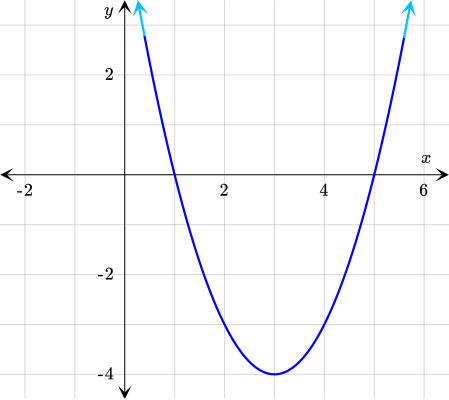
f It can be noted by taking a look at the graph that as x extends to the left or to the right infinitely the function increases in either case. Therefore, its end behavior is up and up.
Consider the following quadratic function.
f(x)=x^2+dx+4
For which positive value of d does the range of the function become y≥ -5?
{"type":"text","form":{"type":"math","options":{"comparison":"1","nofractofloat":false,"keypad":{"simple":true,"useShortLog":false,"variables":[],"constants":[]},"rendered":false},"text":" "},"formTextBefore":"d=","formTextAfter":null,"answer":{"text":["6"]}}
security
report
code
security
report
code
One way of finding the range of a quadratic function is by determining its vertex. The vertex can be found by writing the function into its vertex form. Let's perform the calculations!
The function is now in its vertex form. f(x)=a(x-h)+k [0.5em] ⇓ [0.5em] f(x)=(x-( -d/2))+ 4-d^2/4 The vertex of this function is at ( - d2, 4- d^24). Since a>0, this is a minimum, so the range of this function is given by the following inequality. y≥ 4-d^2/4 Since we are asked to find the range when all real numbers are greater than -5, we will set the right-hand side of the inequality equal to -5, and then we can solve it for d. Let's go for it!
We found that either d=6 or d=-6 will give us the requested range. Since the solution asks for the positive value, the answer is d=6.
security
report
code
Key Features of Quadratic Functions
Recommended exercises
To get personalized recommended exercises, please login first.
Loading content
Loading content