Sign In
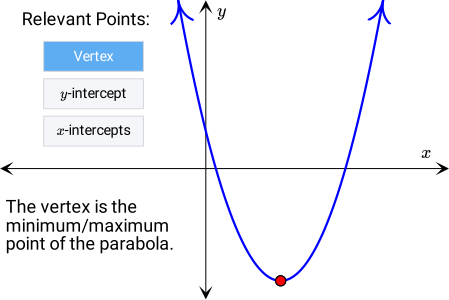
| Name | Equation | Characteristics |
|---|---|---|
| Standard Form | y=ax2+bx+c | a, b, and c are real numbers, a=0, and c is the y-intercept of the parabola. |
| Vertex Form | y=a(x−h)2+k | a, h, and k are real numbers, a=0, and (h,k) is the vertex of the parabola. |
| Intercept Form (also called Factored Form) |
y=a(x−x1)(x−x2) | a, x1, and x2 are real numbers, a=0, and x1 and x2 are the x-intercepts of the parabola. |