Solving Quadratic Equations by Completing the Square

Method

Completing the Square

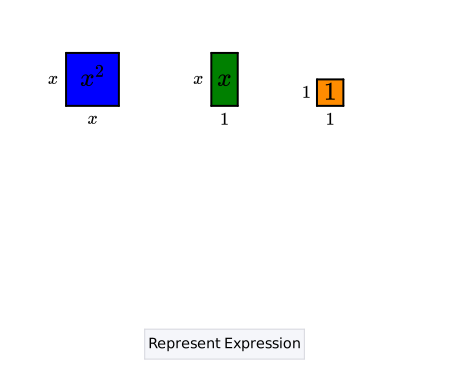
In a perfect square trinomial, there is a relationship between the coefficient of the x-term and the constant term — the constant term is equal to the square of half the coefficient of the x-term. x^2+bx+(b/2)^2 This relationship can be used to form a perfect square trinomial by adding a constant c to any expression in the form x^2+bx. x^2+bx ⇒ x^2+bx+c The process of finding the constant c can be visualized by using algebraic tiles. Consider the following expression. x^2+6x The expression is represented using algebraic tiles. Then, a square is created by rearranging the existing tiles and adding more tiles. The following applet summarizes this process.

Showing the process of completing the square by using algebraic tiles

This process is called completing the square. To complete the square for an expression algebraically, these steps can be followed.

1
Identify the Coefficient of the x-Term
expand_more
For the given expression, the value of b is 6. x^2+ 6x
2
Calculate ( b2)^2
expand_more
Once the value of b is identified, calculate the square of half of the value of b.

(b/2)^2
(6/2)^2
3^2
9

3
Add ( b2)^2 to the Initial Expression
expand_more
Add ( b2)^2 to the expression to obtain a perfect square trinomial. x^2+bx ⇒ x^2+bx+ (b/2)^2 In this case, 9 should be added to x^2+6x. x^2+6x ⇒ x^2+6x+ 9
4
Factor the Perfect Square Trinomial
expand_more
The expression obtained in the previous step can be now factored as the square of a binomial. x^2+bx+(b/2)^2=(x+b/2)^2 This will be applied to the expression x^2+6x+9.

x^2+6x+9
x^2+2*3x+9
x^2+2x*3+9
(x+3)^2

Therefore, a perfect square trinomial is obtained by adding a constant c=( b2)^2 to the initial expression in the form x^2+bx.

Exercises
Edit Lesson