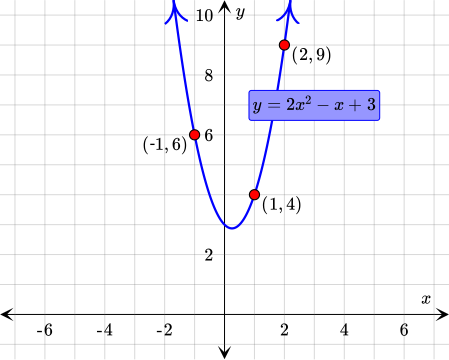
Let's start by recalling the standard form of a quadratic function.
y=ax^2+bx+c
To find the equation of a parabola that includes the given points, we will substitute their coordinates into the above equation and simplify. With the resulting equations, we will write a system of equations. Then, we will solve it to find the coefficients a, b, and c.
y=ax^2+bx+c
Point
Substitute
Simplify
( - 1, 6)
6=a( - 1)^2+b( - 1)+c
a-b+c=6
( 1, 4)
4=a( 1)^2+b( 1)+c
a+b+c=4
( 2, 9)
9=a( 2)^2+b( 2)+c
4a+2b+c=9
We can now write a system of three equations.
a-b+c=6 & (I) a+b+c=4 & (II) 4a+2b+c=9 & (III)
Let's solve this system using the Elimination Method. We will start by subtracting Equation (II) from Equation (I).
We found our first value, allowing us to write a partial equation.
y=ax^2+( - 1)x+c ⇕ y=ax^2-x+c
We can now substitute - 1 for b in Equation (II) and Equation (III).
Now, neither Equation (II) nor Equation (III) contains b. These equations form a system in terms of only a and c. Let's solve this system by using the Elimination Method again.
Now that we have all three values, we can complete the equation of the parabola that passes through the given points.
y=2x^2-x+ 3
To help visualize this situation, we can plot the given points and sketch the curve.