3. Applications of Quadratic Functions
Sign In
An error ocurred, try again later!
Chapter 9
3.
Applications of Quadratic Functions
Quadratic functions play a pivotal role in the universe of mathematics. This lesson accentuates the significance of these functions in multiple real-life contexts. From modeling the trajectory of a thrown object to understanding the dynamics of certain economic models, the applications of quadratic functions are vast. The quadratic formula acts as a key tool in solving and interpreting these functions, further broadening the scope of their impact. With a foundation in these principles, one can not only decipher the mathematical intricacies but also develop a profound appreciation for the patterns and behaviors observed in various domains of life.
Show less Show more expand_more 


Lesson Settings & Tools
| | 7 Theory slides |
| | 9 Exercises - Grade E - A |
| | Each lesson is meant to take 1-2 classroom sessions |
Applications of Quadratic Functions
Slide of 7
Quadratic functions are often applied in real life. For example, they are used to describe movements of objects, dimensions of regions, profit, and prices. In this lesson, some of these applications will be analyzed and better understood.
Catch-Up and Review
Here are a few recommended readings before getting started with this lesson.
Challenge
Share
Report error
Investigating the Price of a Car
When Fantastic Car 1
was released in 1970, the price of the car was about $ 3500. Since then, the way its market value changed over the years can be described by the following graph.
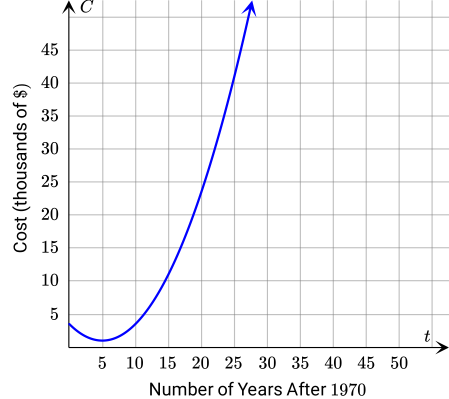
Here, C represents the price of the car in thousands of dollars and t the number of years since 1970. In 1985, it has been reported that the Fantastic Car 1 was being sold for $11 000.
{"type":"choice","form":{"alts":["The price of the car in 1995 was $ 41 000.","The price of the in 1990 was $ 41 000.","The price of the car in 2011 was $25 000.","The price of the car in 2011 was 25 million dollars."],"noSort":false},"formTextBefore":"","formTextAfter":"","answer":0}
b What was the lowest price of the car?
{"type":"text","form":{"type":"math","options":{"comparison":"1","nofractofloat":false,"keypad":{"simple":true,"useShortLog":false,"variables":[],"constants":[]},"rendered":false},"text":" "},"formTextBefore":"$","formTextAfter":null,"answer":{"text":["1000"]}}
{"type":"text","form":{"type":"math","options":{"comparison":"1","nofractofloat":false,"keypad":{"simple":true,"useShortLog":false,"variables":[],"constants":[]},"rendered":false},"text":" "},"formTextBefore":null,"formTextAfter":null,"answer":{"text":["1975"]}}
c What was the price of the car in 2020?
{"type":"text","form":{"type":"math","options":{"comparison":"1","nofractofloat":false,"keypad":{"simple":true,"useShortLog":false,"variables":[],"constants":[]},"rendered":false},"text":" "},"formTextBefore":"$","formTextAfter":null,"answer":{"text":["2035000"]}}
Example
Share
Report error
Analyzing a Swimmer's Dive
Zosia and her classmates were given a half-day from school on one condition — the students try out at a local sports club. Zosia chooses to go to the swim club. She gets to dive from a springboard for the first time! 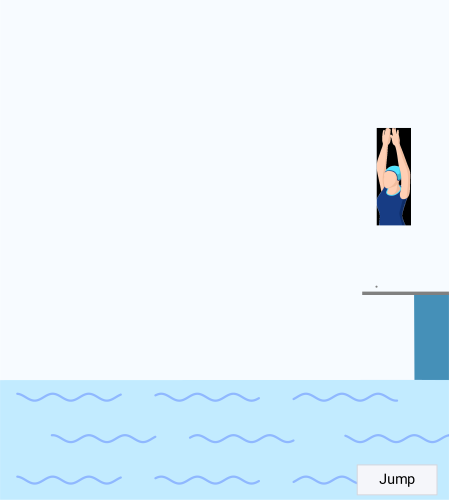 Her height above the water in feet can be described by the following quadratic function.
f(x)=- 4x^2+9x+5
Here, x represents the number of seconds since the dive is made.
Her height above the water in feet can be described by the following quadratic function.
f(x)=- 4x^2+9x+5
Here, x represents the number of seconds since the dive is made.
What will her height be at that moment? Round the height to one decimal place.
External credits: @macrovector
a What is the height of the springboard above the water?
{"type":"text","form":{"type":"math","options":{"comparison":"1","nofractofloat":false,"keypad":{"simple":true,"useShortLog":false,"variables":[],"constants":[]},"rendered":false},"text":" "},"formTextBefore":null,"formTextAfter":"feet","answer":{"text":["5"]}}
{"type":"text","form":{"type":"math","options":{"comparison":"1","nofractofloat":false,"keypad":{"simple":true,"useShortLog":false,"variables":[],"constants":[]},"rendered":false},"text":" "},"formTextBefore":null,"formTextAfter":"seconds","answer":{"text":["2.7"]}}
c After how many seconds will Zosia reach the highest point of her jump? Give the exact time.
{"type":"text","form":{"type":"math","options":{"comparison":"1","nofractofloat":false,"keypad":{"simple":true,"useShortLog":false,"variables":[],"constants":[]},"rendered":false},"text":" "},"formTextBefore":null,"formTextAfter":"seconds","answer":{"text":["1.125"]}}
{"type":"text","form":{"type":"math","options":{"comparison":"1","nofractofloat":false,"keypad":{"simple":true,"useShortLog":false,"variables":[],"constants":[]},"rendered":false},"text":" "},"formTextBefore":null,"formTextAfter":"feet","answer":{"text":["10.1"]}}
Hint
a When x=0, Zosia's height above the water is the same as the springboard's height.
b When Zosia hits the surface of the water, her height above the water is 0 feet.
c The x-coordinate of the vertex of a parabola can be found by the formula x_v=- b2a.
Solution
a When Zosia is standing on the springboard right before taking her dive, her height above the water is the same as the springboard's height. Because x represents the number of seconds since jumping off the board, by substituting x=0 in the given function the height of the springboard can be calculated.
f(x)=- 4x^2+9x+5
Substitute
x= 0
f( 0)=- 4( 0)^2+9( 0)+5
▼
Evaluate right-hand side
CalcPow
Calculate power
f(0)=- 4(0)+9(0)+5
ZeroPropMult
Zero Property of Multiplication
f(0)=0+0+5
IdPropAdd
Identity Property of Addition
f(0)=5
b At the moment of hitting the surface of the water, Zosia is 0 feet above it. That means 0 can be substituted for f(x), then the corresponding time in seconds can be found.
f(x)=- 4x^2+9x+5
Substitute
f(x)= 0
0=- 4x^2+9x+5
▼
Solve for x
UseQuadForm
Use the Quadratic Formula: a = - 4, b= 9, c= 5
x=- 9±sqrt(( - 9)^2-4 ( - 4)( 5))/2( - 4)
CalcPow
Calculate power
x=- 9±sqrt(81-4(- 4)(5))/2(- 4)
MultPosNeg
a(- b)=- a * b
x=- 9±sqrt(81-(- 16)(5))/- 8
MultNegPos
(- a)b = - ab
x=- 9±sqrt(81-(- 80))/- 8
SubNeg
a-(- b)=a+b
x=- 9±sqrt(161)/- 8
StateSol
State solutions
lcx_1= - 9+ sqrt(161)- 8 & (I) x_2= - 9- sqrt(161)- 8 & (II)
(I), (II): Use a calculator
lx_1= - 9+ 12.688577...- 8 x_2= - 9- 12.688577...- 8
(I), (II): Add and subtract terms
lx_1= 3.688577...- 8 x_2= - 21.688577...- 8
(I), (II): Use a calculator
lx_1=- 0.461072... x_2=2.711072...
(I), (II): Round to 1 decimal place(s)
lx_1≈ - 0.5 x_2≈ 2.7
c The highest point Zosia will reach is the vertex of the parabola. The function is given in the standard form, so the x-coordinate of the vertex can be found by the following formula.
x_v=- b/2a
SubstituteII
a= - 4, b= 9
x_v=- 9/2( - 4)
▼
Evaluate right-hand side
MultPosNeg
a(- b)=- a * b
x_v=- 9/- 8
RemoveNegFracAndDenom
- a/- b= a/b
x_v=9/8
CalcQuot
Calculate quotient
x_v=1.125
f(x)=- 4x^2+9x+5
Substitute
x= 1.125
f( 1.125)=- 4( 1.125)^2+9( 1.125)+5
f(1.125)=10.0625
RoundDec
Round to 1 decimal place(s)
f(1.125)≈ 10.1
Example
Share
Report error
Comparing the Heights of a Football
Zosia's classmates, Mark and Tearrik, take their half-day off from school to try out the football club. Here they are practicing throwing the ball to each other.  When Mark throws the ball, its height is represented by the following quadratic function.
M(x)=- 16x^2+48x+5
For the function representing Mark's throw, x is the number of seconds since Mark throws the ball, and M is the height of the ball in feet. Tearrik also throws the ball back to Mark. The height of the football when Tearrik throws it is modeled by the following graph.
When Mark throws the ball, its height is represented by the following quadratic function.
M(x)=- 16x^2+48x+5
For the function representing Mark's throw, x is the number of seconds since Mark throws the ball, and M is the height of the ball in feet. Tearrik also throws the ball back to Mark. The height of the football when Tearrik throws it is modeled by the following graph. 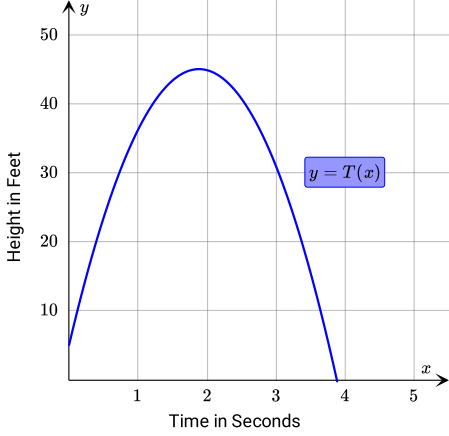
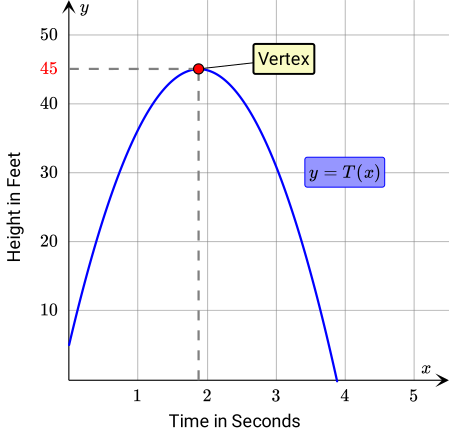 The quadratic equation has two solutions. Since the time the ball is in the air cannot be negative, Mark's ball hits the ground about 3.1 seconds after it is thrown. In other words, it is airborne for about 3.1 seconds. To find how long Tearrik's ball is airborne, analyze the given graph.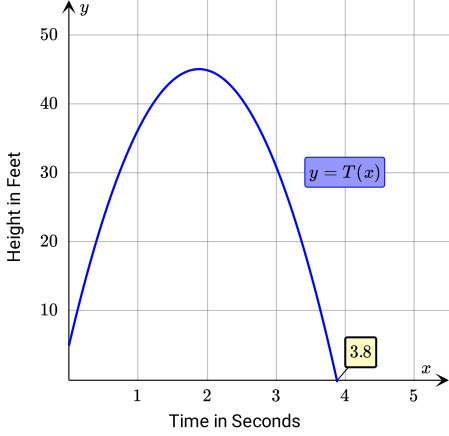
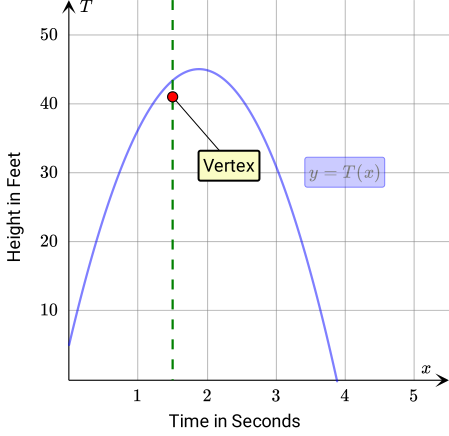 Next, the y-intercept should be determined. For the y-intercept, the x-coordinate is 0. Therefore, it can be found by substituting x=0 into the equation.
The y-intercept of the parabola occurs at (0,5). This point and its reflection across the axis of symmetry can be added to the graph.
Next, the y-intercept should be determined. For the y-intercept, the x-coordinate is 0. Therefore, it can be found by substituting x=0 into the equation.
The y-intercept of the parabola occurs at (0,5). This point and its reflection across the axis of symmetry can be added to the graph. 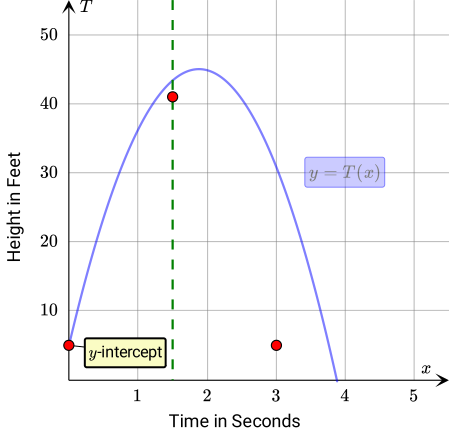
External credits: @freepik
a Of Mark and Tearrik, who throws the ball higher?
b If the person who is supposed to catch the ball misses and the ball lands on the floor, how long will the football be airborne? Find the answer for both Mark and Tearrik's throws, then approximate the times to the nearest second.
c In the same coordinate plane that shows the Tearrik's throw, graph the function that describes the height of the ball thrown by Mark.
Answer
a Tearrik
b Mark's ball: about 3 seconds
Tearrik's ball: about 4 seconds
c 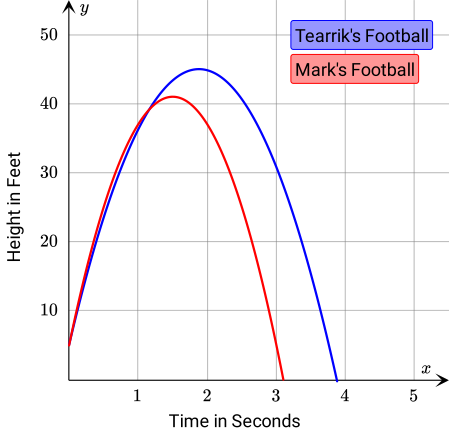
Solution
a When Mark throws the ball, its height is represented by a quadratic function.
M(x)=- 16x^2+48x+5
▼
Rewrite
SplitIntoFactors
Split into factors
M(x)=- 16x^2+16(3)x+5
FactorOut
Factor out - 16
M(x)=- 16(x^2-3x-5/16)
AddDiffZero
a = a+ (3/2)^2- (3/2)^2
M(x)=- 16(x^2-3x+ (3/2)^2- (3/2)^2-5/16)
NumberToFrac
a = 2* a/2
M(x)=- 16(x^2-6/2x+(3/2)^2-(3/2)^2-5/16)
SplitIntoFactors
Split into factors
M(x)=- 16(x^2-2(3)/2x+(3/2)^2-(3/2)^2-5/16)
MovePartNumLeft
a* b/c=a*b/c
M(x)=- 16(x^2-2(3/2)x+(3/2)^2-(3/2)^2-5/16)
CommutativePropMult
Commutative Property of Multiplication
M(x)=- 16(x^2-2x(3/2)+(3/2)^2-(3/2)^2-5/16)
ExpandNegPerfectSquare
(a-b)^2=a^2-2ab+b^2
M(x)=- 16((x-3/2)^2-(3/2)^2-5/16)
Distr
Distribute - 16
M(x)=- 16(x-3/2)^2+16(3/2)^2+16(5/16)
PowQuot
(a/b)^m=a^m/b^m
M(x)=- 16(x-3/2)^2+16(9/4)+16(5/16)
MoveLeftFacToNum
a*b/c= a* b/c
M(x)=- 16(x-3/2)^2+144/4+16(5/16)
CalcQuot
Calculate quotient
M(x)=- 16(x-3/2)^2+36+16(5/16)
DenomMultFracToNumber
16 * a/16= a
M(x)=- 16(x-3/2)^2+36+5
AddTerms
Add terms
M(x)=- 16(x-3/2)^2+41
FracToDiv
a/b=a÷ b
M(x)=- 16(x-1.5)^2+41
First, follow the x-coordinate to about 1.8 seconds after Tearrik throws the ball, and note the y-coordinate. The ball reaches a maximum height of 45 feet. Tearrik's football: 45 feet Tearrik throws the ball higher than Mark.
b Both Mark and Tearrik release the ball at x=0 seconds. To determine how long Mark's ball is airborne, the number of seconds till the ball reaches a height of 0 feet above the ground should be found. To do so, 0 will be substituted for M(x).
M(x)=- 16x^2+48x+5
Substitute
M(x)= 0
0=- 16x^2+48x+5
▼
Solve for x
UseQuadForm
Use the Quadratic Formula: a = - 16, b= 48, c= 5
x=- 48±sqrt(48^2-4( - 16)( 5))/2( - 16)
CalcPow
Calculate power
x=- 48±sqrt(2304-4(- 16)(5))/2(- 16)
MultPosNeg
a(- b)=- a * b
x=- 48±sqrt(2304-(- 64)5)/- 32
MultNegPos
(- a)b = - ab
x=- 48±sqrt(2304-(- 320))/- 32
SubNeg
a-(- b)=a+b
x=- 48±sqrt(2624)/- 32
CalcRoot
Calculate root
x=- 48± 51.224993.../- 32
StateSol
State solutions
lcx_1= - 48+ 51.224993...- 32 & (I) x_2= - 48- 51.224993...- 32 & (II)
(I), (II): Add and subtract terms
lx_1= 3.224993...- 32 x_2= - 99.224993...- 32
MoveNegDenomToFrac
(I): Put minus sign in front of fraction
lx_1=- 3.224993...32 x_2= - 99.224993...- 32
DivNegNeg
(II): - a/- b=a/b
lx_1=- 3.224993...32 x_2= 99.224993...32
(I), (II): Use a calculator
lx_1=- 0.100781... x_2=3.100781...
(I), (II): Round to 1 decimal place(s)
lx_1≈ - 0.1 x_2≈ 3.1
The ball will reach a height of 0 feet after around 3.8. Rounded to the nearest integer, this value approximates to 4. Therefore, Tearrik's ball is airborne for about 4 seconds, while Mark's ball is airborne for about 3 seconds.
c To draw the graph of the function that represents the height of the ball when Mark throws it, the vertex form found in Part A will be used.
M(x)=- 16(x-1.5)^2+41 Here, (1.5,41) are the coordinates of the parabola's vertex. Since the axis of symmetry is a vertical line that passes through the vertex, its equation is x=1.5.
M(x)=- 16(x-1.5)^2+41
Substitute
x= 0
M( 0)=- 16( 0-1.5)^2+41
▼
Evaluate right-hand side
SubTerm
Subtract term
M(0)=- 16(- 1.5)^2+41
CalcPow
Calculate power
M(0)=- 16(2.25)+41
MultNegPos
(- a)b = - ab
M(0)=- 36+41
AddTerms
Add terms
M(0)=5
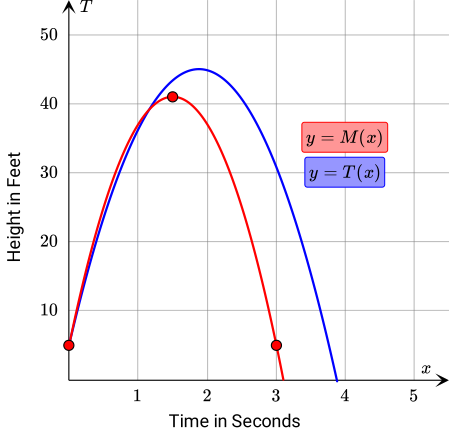
Finally, by connecting the three plotted points with a smooth curve, the parabola can be drawn.
As stated in Part A, it can be seen that Tearrik throws the ball higher than Mark.
Example
Share
Report error
Making Conclusions About Different Forms of a Quadratic Function
Zosia's friend Emily takes her half-day off from school to visit the furniture club. A speaker from a local furniture company comes to teach the club about their business.

External credits: @freepic
The company's largest profit comes from the sale of baby chairs. It can be described by any of the following equivalent functions. P(x)&=- 3x^2+852x-37 260 P(x)&=- 3(x-54)(x-230) P(x)&=- 3(x-142)^2+23 232 Here, x is the price of a baby chair in dollars, while P is the profit made in dollars. Without changing or rewriting any equation, answer the following questions.
a Which of the given equations reveals the price that produces a profit of zero dollars?
{"type":"choice","form":{"alts":["P(x)=- 3x^2+852x-37 260","P(x)=- 3(x-54)(x-230)","P(x)=- 3(x-142)^2+23 232"],"noSort":true},"formTextBefore":"","formTextAfter":"","answer":1}
{"type":"text","form":{"type":"math","options":{"comparison":"1","nofractofloat":false,"keypad":{"simple":true,"useShortLog":false,"variables":[],"constants":[]},"rendered":false},"text":" "},"formTextBefore":"$","formTextAfter":null,"answer":{"text":["54","230"]}}
b Which of the given equations reveals the profit when the price is $0?
{"type":"choice","form":{"alts":["P(x)=- 3x^2+852x-37 260","P(x)=- 3(x-54)(x-230)","P(x)=- 3(x-142)^2+23 232"],"noSort":true},"formTextBefore":"","formTextAfter":"","answer":0}
{"type":"text","form":{"type":"math","options":{"comparison":"1","nofractofloat":false,"keypad":{"simple":true,"useShortLog":false,"variables":[],"constants":[]},"rendered":false},"text":" "},"formTextBefore":"$","formTextAfter":null,"answer":{"text":["-37260"]}}
c Which of the given equations reveals the price that produces the highest possible profit?
{"type":"choice","form":{"alts":["P(x)=- 3x^2+852x-37 260","P(x)=- 3(x-54)(x-230)","P(x)=- 3(x-142)^2+23 232"],"noSort":true},"formTextBefore":"","formTextAfter":"","answer":2}
{"type":"text","form":{"type":"math","options":{"comparison":"1","nofractofloat":false,"keypad":{"simple":true,"useShortLog":false,"variables":[],"constants":[]},"rendered":false},"text":" "},"formTextBefore":"$","formTextAfter":null,"answer":{"text":["142"]}}
{"type":"text","form":{"type":"math","options":{"comparison":"1","nofractofloat":false,"keypad":{"simple":true,"useShortLog":false,"variables":[],"constants":[]},"rendered":false},"text":" "},"formTextBefore":"$","formTextAfter":null,"answer":{"text":["23232"]}}
Hint
a Look for the quadratic function written in a form that reveals its zeros.
b After substituting x=0, in which equation only a constant will be left on the right-hand side?
c Analyze the value of the coefficient before the x^2-term. What does it say about the direction of the parabola and its highest point?
Solution
a The equation that reveals the price that produces a profit of $ 0 is the equation that gives the value of x for which P(x)=0. In other words, it is the equation written in a form that its zeros can be immediately identified. Recall the meaning of the constants p and q in the factored form of a quadratic function.
y=a(x- p)(x- q) Here, because p and q are the zeros of the parabola, the second equation — written in factored form — reveals the zeros of the parabola. P(x)=- 3(x- 54)(x- 230) For x=54 and x=230, the value of P is 0. These values mean that the prices of $54 and $230 result in a profit of zero dollars.
b To determine which equation reveals the profit when the price is $0, substitute 0 for x in each equation and see if the value of P can be found without any calculations.
P( 0)&=- 3( 0)^2+852( 0)-37 260 P( 0)&=- 3( 0-54)( 0-230) P( 0)&=- 3( 0-142)^2+23 232 The second and third equations require further calculations. Conversely, in the first equation after substituting 0 for x, the first two terms are equal to 0, according to the Zero Property of Multiplication. Because of this, the value of P is equal to the constant term of the equation's right-hand side. P(0)&=- 3(0)^2+852(0)-37 260 P(0)&=0+0-37 260 P(0)&=- 37 260 Therefore, the first equation — written in standard form — reveals that if the price of the item is $0, the profit will be - $37 260. This means that if the company gives away the product for free, they will lose $37 260.
c Since the company's profit is given by a quadratic function, its graph is a parabola. Additionally, the coefficient a has a negative value of - 3, which indicates that the parabola opens downward. In this case, the highest point of the graph is its vertex.
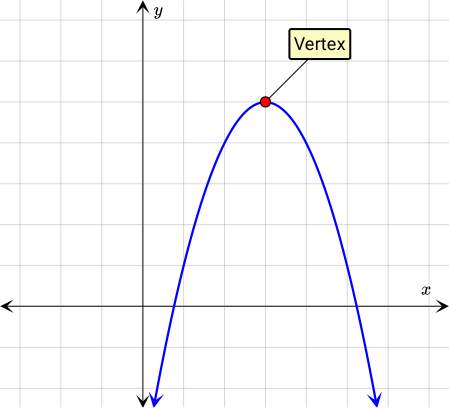
Out of the three given equations, only the third equation is written in vertex form. Therefore, it reveals the coordinates of the vertex without having to do any calculations. f(x)&= a(x - p)^2 + q P(x)&=- 3(x- 142)^2+ 23 232 In the vertex form, (p,q) are the coordinates of the vertex, and the given situation has its vertex at (142,23 232). This means that by setting the baby chair's price at $142, the company makes its highest possible profit of $23 232.
Example
Share
Report error
Calculating the Width of a Sidewalk
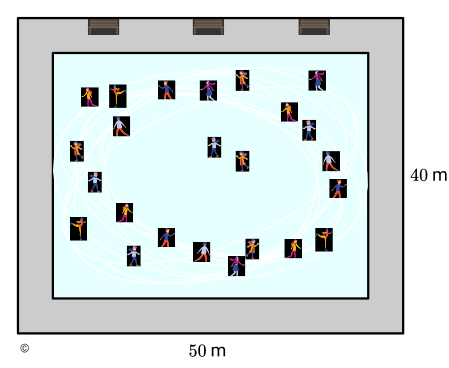
Tadeo takes a half-day off from school to visit the ice skating club. The rink is under construction! Tadeo, interested, reads the plan posted on the closed entrance doors. It will be a rectangular ice rink with dimensions 40 by 50 meters. According to the plan, there should be a sidewalk around the rink.
External credits: @pikisuperstar
{"type":"text","form":{"type":"math","options":{"comparison":"1","nofractofloat":false,"keypad":{"simple":true,"useShortLog":false,"variables":[],"constants":[]},"rendered":false},"text":" "},"formTextBefore":null,"formTextAfter":"meters","answer":{"text":["2.5"]}}
Hint
Use a variable to denote the width of the sidewalk and write the expressions for the dimensions of the rink. Then solve the quadratic equation for the area of the rink.
Solution
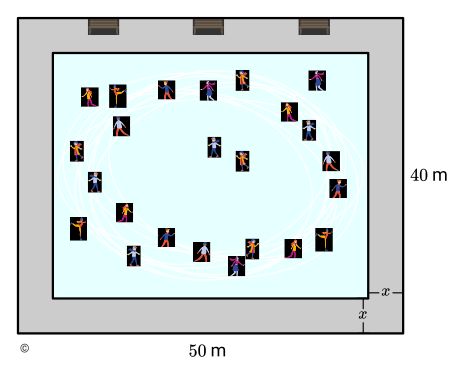
Let x be the width of the sidewalk around the ice skating rink.
External credits: @pikisuperstar
A=(40-2x)(50-2x)
Substitute
A= 1575
1575=(40-2x)(50-2x)
▼
Multiply parentheses
Distr
Distribute (40-2x)
1575=(40-2x)(50)-(40-2x)(2x)
Distr
Distribute 50 & 2x
1575=2000-100x-80x+4x^2
SubTerm
Subtract term
1575=2000-180x+4x^2
CommutativePropAdd
Commutative Property of Addition
1575=4x^2-180x+2000
SubEqn
LHS-1575=RHS-1575
0=4x^2-180x+425
0=4x^2-180x+425
▼
Solve for x
UseQuadForm
Use the Quadratic Formula: a = 4, b= - 180, c= 425
x=- ( - 180)±sqrt(( - 180)^2-4( 4)( 425))/2( 4)
NegNeg
- (- a)=a
x=180±sqrt((- 180)^2-4(4)(425))/2(4)
CalcPow
Calculate power
x=180±sqrt(32 400-4(4)(425))/2(4)
Multiply
Multiply
x=180±sqrt(32 400-6800)/8
SubTerm
Subtract term
x=180±sqrt(25600)/8
CalcRoot
Calculate root
x=180± 160/8
Closure
Share
Report error
Analyzing the Price of a Car
Finally, the challenge presented at the beginning of the lesson can be solved. When the Fantastic Car 1
was released in 1970, the price of the car was about $ 3500. Since then the way its market value changed over the years can be described by the following graph.
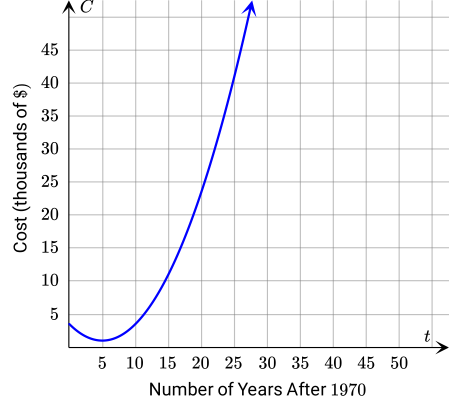
Here, C represents the price of the car in thousands of dollars and t the number of years since 1970. In 1985, it has been reported that the Fantastic Car 1 was being sold for $11 000.
a Interpret the meaning of the point (25,41) that lies on the parabola.
{"type":"choice","form":{"alts":["The price of the car in 1995 was $ 41 000.","The price of the in 1990 was $ 41 000.","The price of the car in 2011 was $25 000.","The price of the car in 2011 was 25 million dollars."],"noSort":false},"formTextBefore":"","formTextAfter":"","answer":0}
b What was the lowest price of the car?
{"type":"text","form":{"type":"math","options":{"comparison":"1","nofractofloat":false,"keypad":{"simple":true,"useShortLog":false,"variables":[],"constants":[]},"rendered":false},"text":" "},"formTextBefore":"$","formTextAfter":null,"answer":{"text":["1000"]}}
{"type":"text","form":{"type":"math","options":{"comparison":"1","nofractofloat":false,"keypad":{"simple":true,"useShortLog":false,"variables":[],"constants":[]},"rendered":false},"text":" "},"formTextBefore":null,"formTextAfter":null,"answer":{"text":["1975"]}}
c What was the price of the car in 2020?
{"type":"text","form":{"type":"math","options":{"comparison":"1","nofractofloat":false,"keypad":{"simple":true,"useShortLog":false,"variables":[],"constants":[]},"rendered":false},"text":" "},"formTextBefore":"$","formTextAfter":null,"answer":{"text":["2035000"]}}
Hint
a Recall what the axes of the coordinate plane represent.
b Use the given information about the car price in different years to find the values of a, b, and c and write the quadratic function of the given parabola.
c Calculate the number of years that have passed between 1970 and 2020 and substitute that value for x into the equation found in Part B.
Solution
a Start by recalling what the axes of the coordinate plane represent. The horizontal axis denotes the number of years since 1970, while the vertical axis represents the price of the car at a particular year.
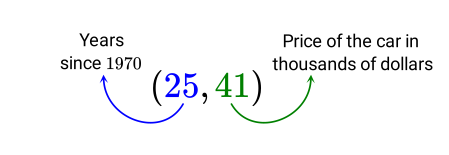
This means that 25 years after 1970 — in the year 1995 — the car had a price of $ 41 000.
b Since the function's graph is a parabola facing upwards, its minimum is located at the vertex of the parabola. Analyzing the graph, the first coordinate of the vertex appears to be 5. However, it is hard to determine the exact value of its second coordinate.
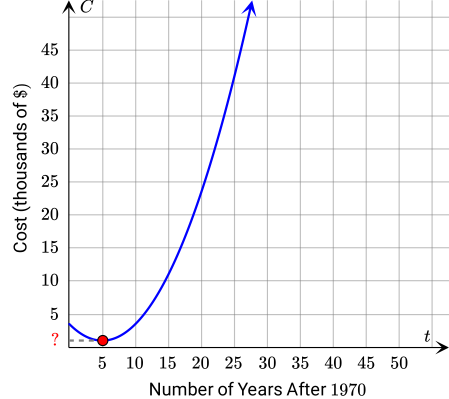
41=a(25)^2+b(25)+3.5 11=a(15)^2+b(15)+3.5
▼
(I), (II): Simplify
(I), (II): Calculate power
41=a(625)+b(25)+3.5 11=a(225)+b(15)+3.5
(I), (II): LHS-3.5=RHS-3.5
37.5=a(625)+b(25) 7.5=a(225)+b(15)
(I), (II): Multiply
37.5=625a+25b 7.5=225a+15b
▼
(I): Solve for b
SubEqn
(I): LHS-625a=RHS-625a
37.5-625a=25b 7.5=225a+15b
DivEqn
(I): .LHS /25.=.RHS /25.
37.5-625a25=b 7.5=225a+15b
WriteDiffFrac
(I): Write as a difference of fractions
37.525- 625a25=b 7.5=225a+15b
MovePartNumRight
(I): a* b/c=a/c* b
37.525- 62525a=b 7.5=225a+15b
CalcQuot
(I): Calculate quotient
1.5-25a=b 7.5=225a+15b
RearrangeEqn
(I): Rearrange equation
b=1.5-25a 7.5=225a+15b
Substitute
(II): b= 1.5-25a
b=1.5-25a 7.5=225a+15( 1.5-25a)
▼
(II): Solve for a
Distr
(II): Distribute 15
b=1.5-25a 7.5=225a+22.5-375a
SubTerm
(II): Subtract term
b=1.5-25a 7.5=- 150a+22.5
SubEqn
(II): LHS-22.5=RHS-22.5
b=1.5-25a - 15=- 150a
DivEqn
(II): .LHS /(- 150).=.RHS /(- 150).
b=1.5-25a 0.1=a
RearrangeEqn
(II): Rearrange equation
b=1.5-25a a=0.1
Substitute
(I): a= 0.1
b=1.5-25( 0.1) a=0.1
b= - 1 a= 0.1
c In order to determine the price of the car in 2020, first the number of years since 1970 should be found.
y=0.1x^2-x+3.5
Substitute
x= 50
y=0.1( 50)^2- 50+3.5
▼
Evaluate right-hand side
CalcPow
Calculate power
y=0.1(2500)-50+3.5
Multiply
Multiply
y=250-50+3.5
AddSubTerms
Add and subtract terms
y=203.5
Applications of Quadratic Functions
Exercise 1.1
Izabella and Kevin want to buy a new car for their business. Because they want to make the best decision, they researched how the value of two example cars will decrease over time. The value of the first car is described by a quadratic function. V(t)=40t^2-1600t+18 000 Here, t is the time in years after the purchase of the car and V(t) is the corresponding value of the car in dollars. On the other hand, the value of the second car is modeled by a linear function. W(t)=20 000 - 1400t Similarly, t is the time in years since the purchase of the car and W(t) is the corresponding value of the car.
{"type":"text","form":{"type":"math","options":{"comparison":"1","nofractofloat":false,"keypad":{"simple":true,"useShortLog":false,"variables":[],"constants":[]},"rendered":false},"text":" "},"formTextBefore":"$","formTextAfter":null,"answer":{"text":["18000"]}}
{"type":"text","form":{"type":"math","options":{"comparison":"1","nofractofloat":false,"keypad":{"simple":true,"useShortLog":false,"variables":[],"constants":[]},"rendered":false},"text":" "},"formTextBefore":null,"formTextAfter":"years","answer":{"text":["10"]}}
security
report
code
security
report
code
The model of the first car's value is a quadratic function. It gives the price V(t) of the car t years after the purchase. V(t)=40t^2-1600t+18 000 When they buy the car, 0 years have passed. This means that we can evaluate the function rule when t= 0 to determine the initial value of the vehicle.
According to the given model, the purchase value of the first car is $18 000.
To find after how many years the value of the cars will be the same, we will equate both functions and find the solutions to the resulting equation.
We have obtained a quadratic equation in standard form. We can solve this equation using the Quadratic Formula. To do so, let's first identify the values of the coefficients a, b, and c in the equation. 40t^2-200t-2000=0 ⇕ 40t^2+( -200)t+( -2000)=0 We have that a = 40, b = -200, and c = -2000. Let's substitute these values into the Quadratic Formula and solve for t.
The solutions to the equation are t= 200± 60080. Let's separate them into the positive and negative cases.
| t=200± 600/80 | |
|---|---|
| t_1=200 + 600/80 | t_2=200 - 600/80 |
| t_1=800/80 | t_2=-400/80 |
| t_1=10 | t_2=-5 |
Using the Quadratic Formula, we obtained that the models agree on the value of the cars at t=10 and t=-5. Because we are asked to determine the number of years after the purchase, we only consider t=10. Therefore, after 10 years the value of both cars will be the same.
security
report
code
Kevin's family is planning to build a corral for their horses. They have already bought enough materials to build a corral with a perimeter of 28 meters. What is the maximum area of the corral?
{"type":"text","form":{"type":"math","options":{"comparison":"1","nofractofloat":false,"keypad":{"simple":true,"useShortLog":false,"variables":[],"constants":[]},"rendered":false},"text":" "},"formTextBefore":"Maximum Area =","formTextAfter":"square meters","answer":{"text":["49"]}}
security
report
code
security
report
code
We will determine the maximum area of the rectangular corral. Consider that the area A of a rectangle is given by the product of its length and its width. Let x be the length and y the width of the rectangle. A=xy This means we need to determine the side lengths of the rectangle to find its area. Additionally, we are told that the rectangle has a perimeter of 28 square meters. We can substitute this information into the formula for the perimeter of a rectangle to find an expression for the width y in terms of the length x.
We have obtained that if the length of the corral is x, the width will be 14-x.
We can substitute the expression for y into the formula for the area and simplify to get an expression for the area of the corral.
This function will be modeled with a parabola. Since the leading coefficient is negative, the parabola opens downward and reaches its maximum at its vertex. This means that we can find the value of x that maximizes the area by determining the axis of symmetry of the parabola. Consider the formula for the axis of symmetry. Axis of Symmetry [0.5em] x=-b/2a In our quadratic function, a= -1 and b= 14. Let's find the value of x.
We have obtained that the axis of symmetry is x= 7. This means that the length of the corral must be 7 and the width 14- 7= 7 to maximize its area. Let's substitute these values into the formula for the area to determine the maximum area of the rectangle.
Therefore, the maximum area of the corral is 49 square meters.
security
report
code
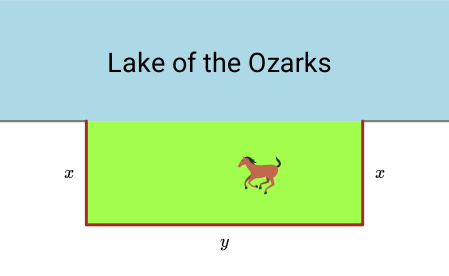
Kevin plans to build a rectangular paddock for his horses in the meadows bordering Lake of the Ozarks. He has bought enough fence material to build 180 meters of fence. The materials must be sufficient for the three sides because the fourth side will be the lakeshore, as the figure shows.
{"type":"text","form":{"type":"math","options":{"comparison":"1","nofractofloat":false,"keypad":{"simple":false,"useShortLog":false,"variables":["x"],"constants":[]},"rendered":false},"text":" "},"formTextBefore":"A(x)=","formTextAfter":null,"answer":{"text":["-2x^2+180x"]}}
{"type":"text","form":{"type":"math","options":{"comparison":"1","nofractofloat":false,"keypad":{"simple":true,"useShortLog":false,"variables":[],"constants":[]},"rendered":false},"text":" "},"formTextBefore":"y=","formTextAfter":"meters","answer":{"text":["90"]}}
security
report
code
security
report
code
Since the paddock forms a rectangle, its area is calculated by multiplying its width and its length. A = xy We want to write this expression as a function of x. To do so, we need to rewrite the y-variable in terms of x. We can do this by writing an expression for the perimeter using the given lengths. Keep in mind that we only need to consider three sides of the rectangle. P = 2x + y Recall that the perimeter is 180 meters. Let's substitute P= 180 into the obtained expression and solve it for y.
The dimensions of the rectangle are x meters and (180-2x) meters. We can now write the area as a function of x. Let's also distribute x to rewrite the quadratic function in standard form.
In Part A, we found that the area of the paddock is A(x) = -2x^2+180x. Because the leading coefficient is negative, the quadratic function reaches a maximum value at its vertex. The maximum point lies on the axis of symmetry of the parabola. To find it, consider the area written in the initial form and factor out -2.
A(x) = x(180-2x)
⇕
A(x) = -2x(x-90)
Notice that the area is now written in the intercept form. This form gives us that the zeros of the function are x_1=0 and x_2=90. The axis of symmetry is the vertical line with equation x= x_1+x_22.
Therefore, the axis of symmetry is given by x=45. This means that the area of the rectangle is the largest when x=45. In Part A, we obtained that y=180-2x. Let's substitute x= 45 into the expression to find the corresponding y.
Finally, we obtained that the area of the rectangle is the largest when y is equal to 90 meters.
security
report
code
A water fountain in the center of New York shoots water whose trajectory can be modeled by the graph of the following quadratic function. y = -0.01x^2 + x + 5 Here, x is the horizontal distance from the fountain and y is the height above the lawn. Both x and y are measured in feet.
{"type":"choice","form":{"alts":["Yes","No"],"noSort":true},"formTextBefore":"","formTextAfter":"","answer":1}
{"type":"text","form":{"type":"roots","options":{"comparison":"1","nofractofloat":false,"keypad":{"simple":true,"useShortLog":false,"variables":[],"constants":[]},"rendered":false,"hideNoSolution":false,"variable":"x"},"text":" "},"formTextBefore":null,"formTextAfter":null,"answer":{"texts":["27.64","72.36"]}}
security
report
code
security
report
code
Consider the given quadratic function. y = -0.01x^2 + x + 5 We are asked whether the water can reach a height of 40 feet. Since y represents the height above the lawn, start by substituting y= 40 into the given equation. Then, we will rewrite it in standard form to check if there are any solutions.
Now, because the equation is in standard form ax^2+bx+c, we can find the discriminant to check if there are any real solutions to the equation. The discriminant is given by the expression b^2-4ac. Let's substitute a= -0.01, b= 1, and c= -35 into the expression.
Because the discriminant is negative, there are no solutions to the given equation. This means that the water does not reach a height of 40 feet.
We want to find the horizontal distance from the fountain where the water arc is 25 feet above the lawn. Similar to Part A, let's substitute y=25 into the given equation and rewrite it in standard form.
To find the horizontal distance, we will use the Quadratic Formula. Let's now identify the values of a, b, and c in the standard form we just obtained. -0.01x^2+x-20 = 0 ⇕ -0.01x^2+ 1x+( -20) = 0 We will substitute a= -0.01, b= 1, and c = -20 into the Quadratic Formula and solve for x.
Using the Quadratic Formula, we found that the solutions of the equation are x= -1± sqrt(0.2)-0.02. Let's separate the two cases and use a calculator to find the horizontal distances.
| x = -1 ± sqrt(0.2)/-0.02 | |
|---|---|
| x_1 = -1 + sqrt(0.2)/-0.02 | x_2 = -1 - sqrt(0.2)/-0.02 |
| x_1 ≈ 27.64 | x_2 ≈ 72.36 |
Therefore, the water reaches a height of 25 feet twice — at distances of about 27.64 and 72.36 feet from the fountain.
security
report
code
Applications of Quadratic Functions
Recommended exercises
To get personalized recommended exercises, please login first.
Loading content
≤
>
■2
■▢
e▢
7
8
9
×
÷■1
=
=
√▢
▢√
∫▢▢
4
5
6
+
−
≤
<
log
ln
log▢
1
2
3
()
∣
sin
cos
tan
0
.
π
x
y
Loading content