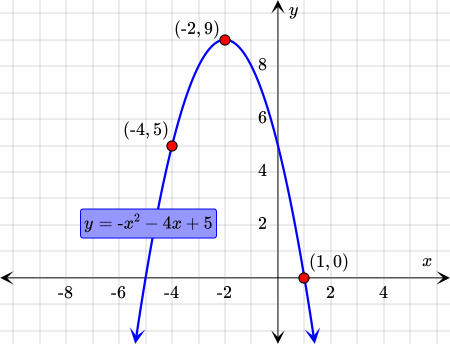
Before we try to write the equation of a specific parabola that passes through some given points, let's make sure we have enough points. We will need at least three.
(1,0),(- 2,9),(- 4,5)
To use the given points, we need to substitute their ( x, y) coordinate pairs into the standard form of a quadratic equation.
y=a x^2+b x+c, a≠ 0
Doing so will create a system of equations that we can solve for the values of a, b, and c. Let's start with (1,0).
We now have a system of three equations.
a+b+c=0 & (I) 4a-2b+c=9 & (II) 16a-4b+c=5 & (III)
Let's solve this system using the Elimination Method.
We will start by subtracting Equation (I) from Equation (II) to eliminate the c-variable.
Now, neither Equation (II) nor Equation (III) includes the c-variable. These equations form a system with only two variables, a and b. Let's solve this system by using the Elimination Method again.
Since neither variable has the same or opposite coefficients, we will need to multiply one equation by a number first.
We found our first value, allowing us to form a partial equation.
y=ax^2+(- 4)x+c ⇔ y=ax^2-4x+c
Let's substitute - 4 for b in Equation (III) to find the value of a.
With our second value, we can continue forming the partial equation.
y=(- 1)x^2+(-4)x+c ⇔ y=- x^2-4x+c
Finally, to find the value of c, we will substitute a=- 1 and b=- 4 into Equation (I).
Now that we have all three values, we can complete the standard form equation of the parabola that passes through the given points.
y=(-1)x^2+(-4)x+5 ⇔ y=- x^2-4x+5
To help visualize this graph, we have plotted the given points and sketched the curve below.