To determine the x- and y-intercepts of a line, we need to substitute 0 for one variable, solve, then repeat for the other variable.
In this case, we haven't been given an equation, so we will need to use the given points to write one.
Writing the Equation
The quickest way to write an equation, given two points, is by using the point-slope form. An equation in point-slope form follows a specific format.
y- y_1= m(x- x_1)
In this form, m is the slope and the point ( x_1, y_1) lies on the graph of the line. To create our equation, we can use either of the given points for x_1 and y_1 as well as the slope. To calculate the slope, we will use the Slope Formula.
Using the point ( 3, -8) as our point and the slope -3, we have everything needed to form a point-slope form equation.
y-( -8)= -3(x- 3)
⇕
y+8=-3(x-3)
Note that there are infinitely many correct ways to write this equation in point-slope form, as long as we use a point that lies on the line.
Finding the x-intercept
Think of the point where the graph of an equation crosses the x-axis. The y-value of that ( x, y) coordinate pair is 0, and the x-value is the x-intercept. To find the x-intercept of the equation, we should substitute 0 for y and solve for x.
An x-intercept of 13 means that the graph passes through the x-axis at the point ( 13,0).
Finding the y-intercept
Let's use the same concept to find the y-intercept. Consider the point where the graph of the equation crosses the y-axis. The x-value of the ( x, y) coordinate pair at the y-intercept is 0. Therefore, substituting 0 for x will give us the y-intercept.
A y-intercept of 1 means that the graph passes through the y-axis at the point (0, 1).
Alternative Solution
Solve by Graphing
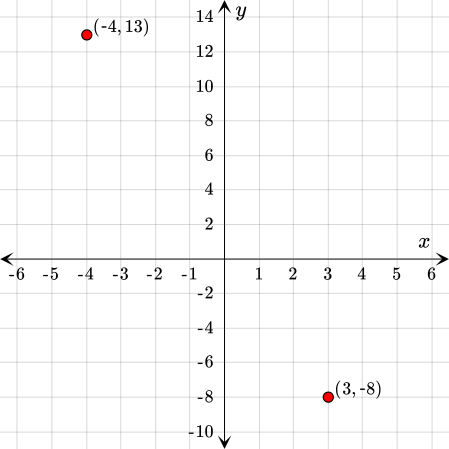
Another way to find the x- and y-intercepts, when given two points, is to plot the points and graph the line. Let's begin by plotting the given points.
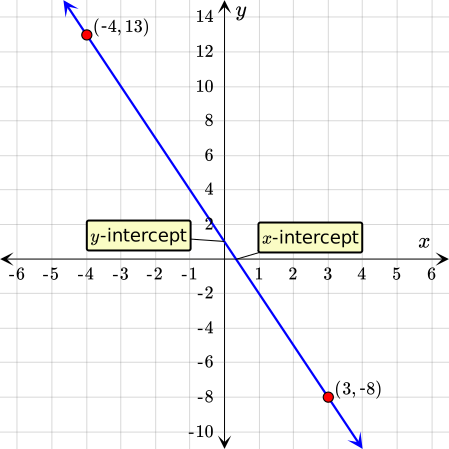
Next, we can draw a line to connect those points. That line is the graph of our function.
Looking at the graph, we can see the function crosses the x-axis at ( 13,0) and it crosses the y-axis at (0,1).