6. Writing and Graphing Equations in Standard Form
Sign In
An error ocurred, try again later!
Chapter 2
6.
Writing and Graphing Equations in Standard Form
This lesson delves into the intricacies of two key mathematical topics: rewriting equations into standard form and understanding what the standard form of a linear equation means. It serves as a step-by-step guide, enriched with practical examples, to help you navigate these complex subjects. Ideal for students aiming to excel in algebra or geometry, as well as teachers looking for instructional lessons, this content is a valuable educational asset. The use cases extend beyond academics to fields like engineering, computer science, and economics, where understanding linear equations is essential.
Show less Show more expand_more 


Lesson Settings & Tools
| | 11 Theory slides |
| | 13 Exercises - Grade E - A |
| | Each lesson is meant to take 1-2 classroom sessions |
Writing and Graphing Equations in Standard Form
Slide of 11
In this lesson, a new form of linear equations will be introduced. Given a linear function in this form, its key components such as x- and y-intercepts will be identified and used to draw its graph. Additionally, converting between the forms of linear equations will be discussed.
Catch-Up and Review
Here are a few recommended readings before getting started with this lesson.
Discussion
Share
Report error
Standard Form of a Line
In the standard form of a line all x- and y-terms are on one side of the linear equation or function and the constant is on the other side.
Ax+By=C
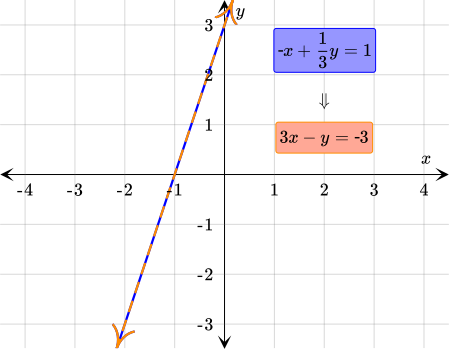
In this form, A, B, and C are real numbers. It is important to know that A and B cannot both be 0. Different combinations of A, B, and C can represent the same line on a graph. It is preferred to use the smallest possible whole numbers for A, B, and C and it is also better if A is a positive number.
Pop Quiz
Share
Report error
Identifying the Standard Form of a Linear Equation
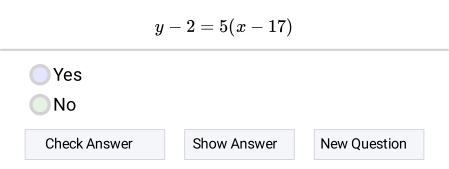
Consider the given linear equation that shows the relationship between the variables x and y. Determine whether the equation is written in standard form or not.
Discussion
Share
Report error
Graphing a Linear Function in Standard Form
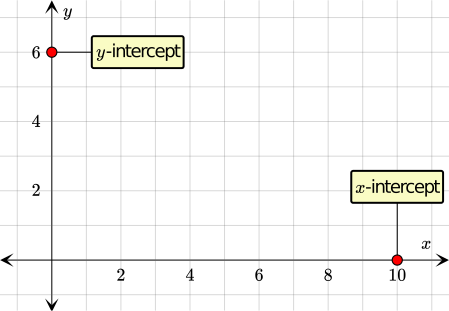
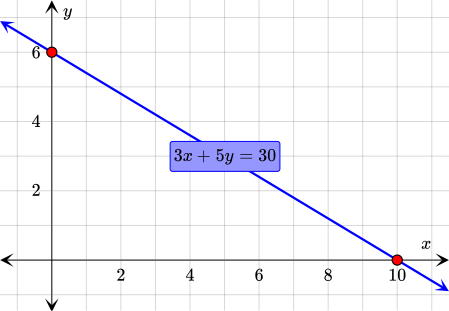
A linear function written in standard form has quickly identifiable x- and y-intercepts. Since two points determine a line, this provides enough information to graph the function. Consider the following linear equation written in standard form.
3x+5y=30
The graph of this function can be drawn in two steps.
1
Find the Intercepts
expand_more Begin by substituting y= 0 to find the x-intercept of the equation.
The x-intercept is (10,0). The y-intercept can be found in a similar way. Substitute x= 0 into the equation and solve for y.
The y-intercept is (0,6).
rc
Equation: & 3x+5y = 30 x-intercept: & (10,0) y-intercept: & (0,6)
3x+5y=30
Substitute
y= 0
3x+5( 0)=30
▼
Solve for x
ZeroPropMult
Zero Property of Multiplication
3x+0=30
IdPropAdd
Identity Property of Addition
3x = 30
DivEqn
.LHS /3.=.RHS /3.
x = 10
3x+5y=30
Substitute
x= 0
3( 0)+5y=30
▼
Solve for y
ZeroPropMult
Zero Property of Multiplication
0+5y=30
IdPropAdd
Identity Property of Addition
5y = 30
DivEqn
.LHS /5.=.RHS /5.
y = 6
2
Plot the Intercepts
expand_more Now it is time to plot the intercepts in a coordinate plane.
3
Draw the Line Passing Through the Intercepts
expand_more Lastly, draw a line passing through these points.
Extra
General Formulas for the Intercepts of an Equation in Standard FormNote that general formulas for the intercepts can be derived for any linear function written in standard form Ax+ By= C.
| Assumption | x-intercept | y-intercept |
|---|---|---|
| A≠ 0, B≠ 0 | (C/A,0) | (0,C/B) |
| A= 0, B≠ 0 | The line is horizontal, y= C B, so it does not cross the x-axis. | (0,C/B) |
| A≠ 0, B= 0 | (C/A,0) | The line is vertical, x= C A, so it does not cross the y-axis. |
Example
Share
Report error
Using Intercepts to Graph a Linear Equation
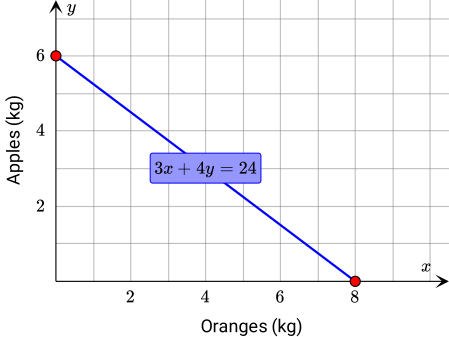
On his way home from school, Ignacio stops to buy fruit at a market in his neighborhood. Oranges cost $3 per kilogram and apples cost $4 per kilogram. He has $24 to spend. The following linear equation models this situation. 3x+4y = 24 Here, x represents the number of kilograms of oranges and y represents the number of kilograms of apples.
a Find and interpret the intercepts of the linear equation.
b Graph the equation.
Answer
a x-intercept: (8,0)
y-intercept: (0,6)
b
Hint
a To find the intercepts, substitute 0 for one of the variables and solve the equation for the other variable.
b Plot the intercepts and connect them with a line segment. Recall that the number of kilograms cannot be negative.
Solution
a The given equation models the total cost of the fruit, where x is the number of kilograms of oranges purchased and y is the number of kilograms of apples purchased.
3x+4y=24
Substitute
y= 0
3x+4( 0)=24
▼
Solve for x
ZeroPropMult
Zero Property of Multiplication
3x+0=24
IdPropAdd
Identity Property of Addition
3x=24
DivEqn
.LHS /3.=.RHS /3.
x=8
3x+4y=24
Substitute
x= 0
3( 0)+4y=24
▼
Solve for y
ZeroPropMult
Zero Property of Multiplication
0+4y=24
IdPropAdd
Identity Property of Addition
4y=24
DivEqn
.LHS /4.=.RHS /4.
y=6
b In order to graph the equation, the intercepts found in the previous part can be used.
rc Equation: & 3x+4y = 24 x-intercept: & (8,0) y-intercept: & (0,6) Plot them on a coordinate plane and connect them with a line.
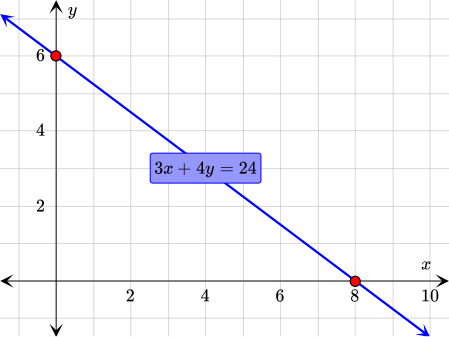
Since the number of kilograms of fruit purchased cannot be negative, only positive values of x and y make sense in this context.
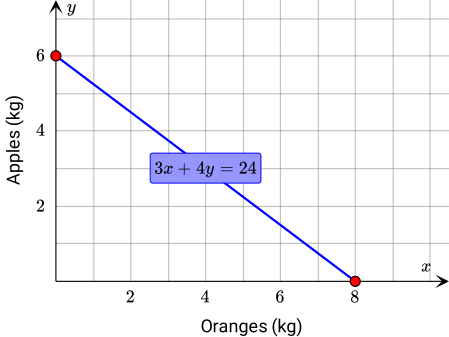
Example
Share
Report error
Using the Standard Form of a Linear Equation to Model a Real-Life Situation
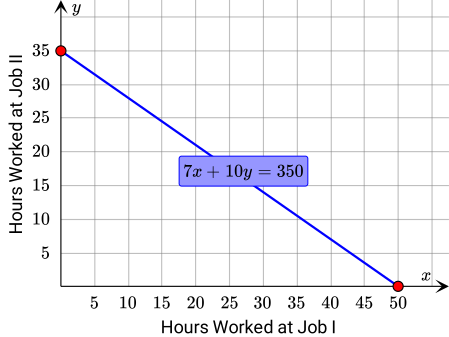
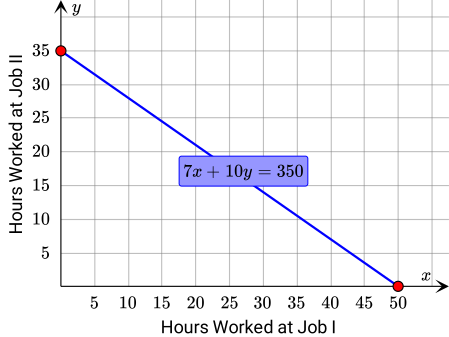
LaShay has one part-time job that she works at after school and a second part-time job that she works at on weekends. One pays $7 per hour and the other pays $10 per hour. She wants to make $350 per week. Amount Paid Per Hour [-0.9em] Job I: $7 Job II: $10
a Write a linear equation in standard form that describes this situation and draw its graph.
b If LaShay is allowed to work only 21 hours per week at the $10 per hour job, how many hours does she have to work per week at the other job in order to make $350?
Answer
a Equation: 7x+10y=350
Graph:
Graph:
b 20 hours per week
Hint
a To find the intercepts, substitute 0 for one of the variables and solve the equation for the other variable.
b Substitute the given value into the equation from Part A.
Solution
a Let x be the number of hours worked at Job I and y be the number of hours worked at Job II. Then, the amount of money LaShay can make from each part-time job can be written in terms of x and y.
| Job | Amount Paid Per Hour ($) | Amount LaShay Makes ($) |
|---|---|---|
| I | 7 | 7 x |
| II | 10 | 10 y |
Since LaShay wants to make $350 per week, the sum of 7x and 10y should be equal to 350. 7 x+10 y =350 To graph this equation, its intercepts will be found. Substitute y=0 to find the x-intercept and x=0 to find the y-intercept.
| 7x+10y=350 | ||
|---|---|---|
| Operation | x-intercept | y-intercept |
| Substitution | 7x+10( 0)=350 | 7( 0)+10y=350 |
| Calculation | x=50 | y=35 |
| Point | (50,0) | (0,35) |
Now, plot the intercepts on a coordinate plane and connect them with a line segment. Since the number of hours worked cannot be negative, only positive values of x and y make sense.
b Recall that the variable y in the equation written in Part A represents the number of hours worked at Job II. Therefore, by substituting 21 for y into the equation, the number of hours that LaShay needs to work per week at Job I can be found.
Discussion
Share
Report error
Writing a Linear Equation in Standard Form
Any linear equation can be rewritten in standard form. Consider the following linear equation that is written in slope-intercept form.
y = 4/5x + 2/3
Using the Properties of Equality, the equation can be rewritten in standard form.
Ax+By=C
Here, A, B, and C are real numbers and A and B cannot both be equal to 0. It can be noted that representing A, B, and C with the smallest possible integers is preferred, as well as A being positive.
1
Remove All Fractions
expand_more When a linear equation contains fractions, the first step is to remove all fractions. The equation is multiplied by the least common denominator of the fractions. In this case, it is the product of 5 and 3, which is 15. Using the Multiplication Property of Equality, the equation can be written as follows.
y= 4/5x + 2/3
MultEqn
LHS * 15=RHS* 15
15y=(4/5x+2/3)15
▼
Simplify right-hand side
Distr
Distribute 15
15y=4/5x* 15+2/3* 15
CommutativePropMult
Commutative Property of Multiplication
15y=4/5* 15* x+2/3* 15
MoveRightFacToNum
a/c* b = a* b/c
15y=4* 15/5x+2* 15/3
ReduceFrac
a/b=.a /5./.b /5.
15y=4* 3/1x+2* 15/3
ReduceFrac
a/b=.a /3./.b /3.
15y=4* 3/1x+2* 5/1
DivByOne
a/1=a
15y=4* 3x+2* 5
Multiply
Multiply
15 y = 12x + 10
2
Rearrange the Terms of the Equation
expand_more Now, move the terms containing variables to the left-hand side of the equation. In addition to this, move the constant to the right-hand side using the Subtraction Property of Equality.
Since a positive coefficient for x is preferable, the equation can be multiplied by - 1.
This equation is now in the standard form. Note that the values of A, B, and C are in their smallest possible integer forms.
Example
Share
Report error
Writing a Linear Equation in Standard Form From a Graph
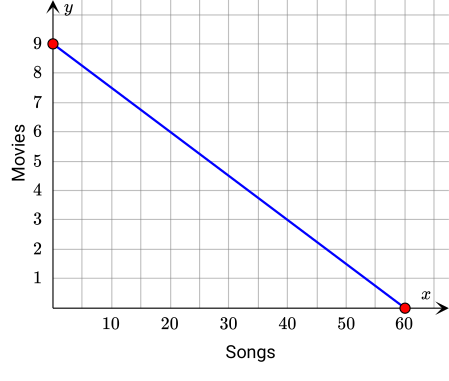
Jordan wants to buy some songs and movies online to enjoy after school. She can buy songs for $0.75 each and movies for $5 each. The graph represents the relationship between the number of songs purchased x and the number of movies purchased y.
{"type":"text","form":{"type":"math","options":{"comparison":"1","nofractofloat":false,"keypad":{"simple":false,"useShortLog":false,"variables":["x","y"],"constants":["PI"]},"rendered":false},"text":" "},"formTextBefore":null,"formTextAfter":null,"answer":{"text":["3x+20y=180"]}}
Hint
Start by writing the equation of the line in point-slope form. Then, convert it into the standard form.
Solution
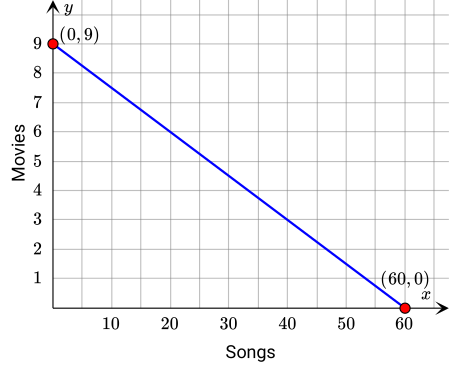
From the given graph, the x- and y-intercepts can be identified.
m = y_2-y_1/x_2-x_1
SubstitutePoints
Substitute ( 60,0) & ( 0,9)
m=9- 0/0- 60
▼
Simplify
SubTerms
Subtract terms
m=9/- 60
ReduceFrac
a/b=.a /3./.b /3.
m=3/- 20
MoveNegDenomToFrac
Put minus sign in front of fraction
m=- 3/20
Alternative Solution
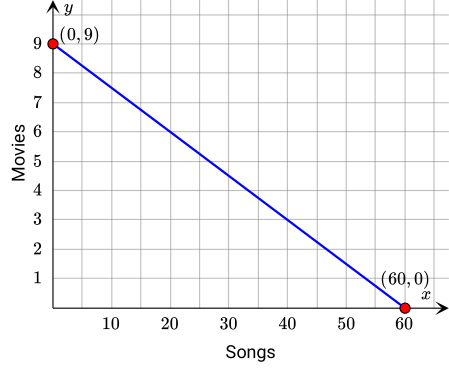
Recall the standard form of a linear equation. Ax+By=C In the context of the problem, x is the number of songs Jordan can purchase and y is the number of movies she can purchase. If the values of A and B are considered as the costs of a song and a movie, respectively, then the equation shows the amount of money Jordan spends. Ax+By=C ⇓ 0.75x+5y = C Now, the value of C can be calculated by using one of the intercepts.
0.75x+5y = C
SubstituteII
x= 0, y= 9
0.75( 0) + 5 ( 9) = C
▼
Solve for C
ZeroPropMult
Zero Property of Multiplication
0+5(9) =C
Multiply
Multiply
0+45=C
IdPropAdd
Identity Property of Addition
45 = C
RearrangeEqn
Rearrange equation
C=45
Example
Share
Report error
Converting Between the Forms of a Linear Equation
Dominika and Ali are working on an extra credit assignment after school. They have been given a linear equation written in standard form to solve. 3x+4y=- 33 They converted the equation into alternative forms of a linear equation.
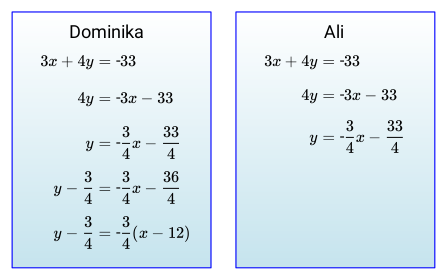
a What linear equation forms did Dominika and Ali write?
b Are their calculations correct? If not, describe and correct any mistakes.
Answer
a Dominika: Point-Slope Form
Ali: Slope-Intercept Form
Ali: Slope-Intercept Form
b Are Ali's calculations right? Yes.
Are Dominika's calculations right? No, see solution
Are Dominika's calculations right? No, see solution
Hint
a A linear equation in slope-intercept form has the form y=mx+b. A linear equation in point-slope form has the form y-y_1=m(x-x_1).
b Pay close attention when factoring out a negative number.
Solution
a Consider the last lines of the steps.
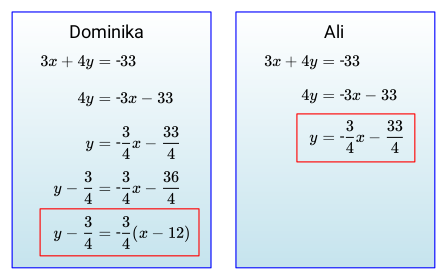
The equation found by Dominika is written in point-slope form and the other equation is written in slope-intercept form.
| Point-Slope Form | Slope-Intercept Form |
|---|---|
| y- y_1 = m(x- x_1) | y = mx+ b |
| Dominika's Equation [-0.7em] y- 3/4= -3/4(x- 12) | Ali's Equation [-0.7em] y = -3/4x+ ( -33/4) |
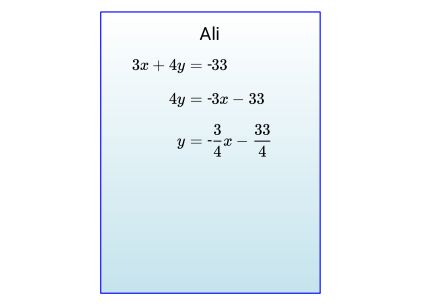
b It can be seen that Ali wrote the given equation in slope-intercept form correctly. He started by subtracting 3x from both sides of the equation. Then, he applied the Division Property of Equality without making a mistake.
However, Dominika's calculations are not entirely correct. Until the last step everything is correct. However, she made a mistake when factoring out - 34.
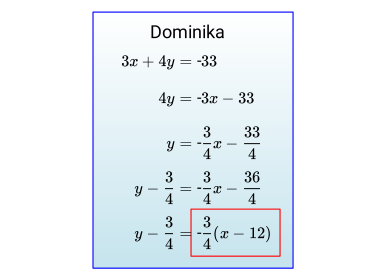
y-3/4=-3/4x-36/4
▼
Factor out -3/4
Rewrite
Rewrite 36 as 3* 12
y-3/4=-3/4x-3* 12/4
MovePartNumRight
a* b/c=a/c* b
y-3/4=-3/4x-3/4* 12
FactorOut
Factor out -3/4
y-3/4=-3/4(x+12)
Pop Quiz
Share
Report error
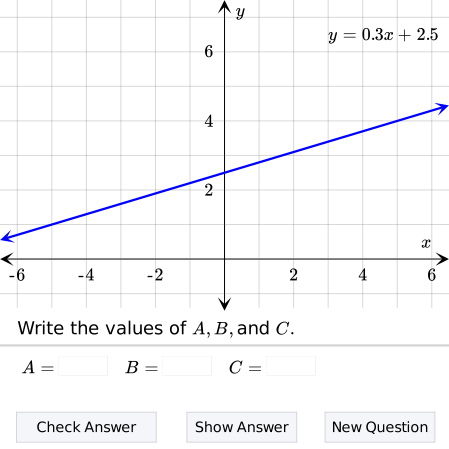
Finding the Values of A, B, and C
Consider the standard form of a linear equation. Ax+By= C In general, A, B, and C are real numbers. However, it is preferred for A, B, and C to be the smallest possible integers and for A to be positive. With this information in mind, write the values of A, B, and C by finding the equation of the given line in standard form. Give the answers such that A, B, and C are the smallest possible integers and A is positive.
Closure
Share
Report error
Exploring the Standard Form of a Linear Equation
Throughout the lesson, the standard form of a linear equation has been discussed. Ax+By=C In general, A, B, and C are real numbers. However, it was previously noted that there are preferred properties for these numbers.
- A, B, and C are the smallest possible integers. In other words, the greatest common factor of these three numbers is 1.
- A is positive or 0.
- A and B cannot both equal 0.
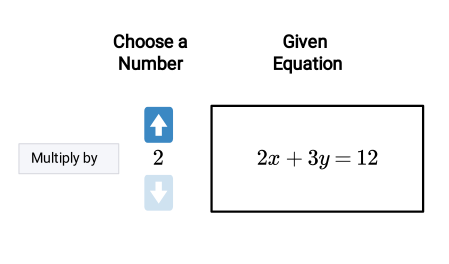
For each line there is exactly one equation in standard form that meets these properties. However, infinitely many equivalent linear equations in standard form can be obtained by using the Multiplication Property of Equality. Linear equations are equivalent if they describe the same line.
Writing and Graphing Equations in Standard Form
Exercise 2.1
Consider a linear equation in standard form. Ax+By = C
{"type":"text","form":{"type":"math","options":{"comparison":"1","nofractofloat":false,"keypad":{"simple":false,"useShortLog":false,"variables":["A","B"],"constants":[]},"rendered":false},"text":" "},"formTextBefore":null,"formTextAfter":null,"answer":{"text":["-\\dfrac{A}{B}"]}}
{"type":"text","form":{"type":"math","options":{"comparison":"1","nofractofloat":false,"keypad":{"simple":false,"useShortLog":false,"variables":["B","C"],"constants":[]},"rendered":false},"text":" "},"formTextBefore":null,"formTextAfter":null,"answer":{"text":["\\dfrac{C}{B}"]}}
security
report
code
security
report
code
We will transform the equation in standard form into the slope-intercept form. Ax+By=C ? y=mx+b Note that we can isolate the y-variable to get the equation in slope-intercept form. Let's do it!
The equation is now in slope-intercept form. y= -A/Bx+C/B In this equation, the coefficient of x represents the slope of its graph. Therefore, - AB is the slope of the line whose equation is Ax+By=C.
We have written the given equation in slope-intercept form.
| Standard Form | Ax+By=C |
|---|---|
| Slope-Intercept Form | y= -A/Bx+ C/B |
The constant term in the slope-intercept form represents the y-intercept. Therefore, - CB is the y-intercept of the line.
security
report
code
Dominika plays a video game, where each gold is 50 points and each diamond is 75 points.

{"type":"text","form":{"type":"math","options":{"comparison":"1","nofractofloat":false,"keypad":{"simple":false,"useShortLog":false,"variables":["x","y"],"constants":[]},"rendered":false},"text":" "},"formTextBefore":null,"formTextAfter":null,"answer":{"text":["50x+75y = 1500"]}}
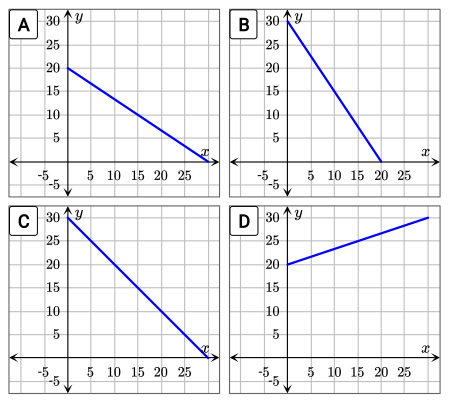
Which graph represents the solution set of the equation?
{"type":"choice","form":{"alts":["A","B","C","D"],"noSort":true},"formTextBefore":"","formTextAfter":"","answer":0}
{"type":"multichoice","form":{"alts":["I","II","III","IV"],"noSort":true},"formTextBefore":"","formTextAfter":"","answer":[0,2,3]}
security
report
code
security
report
code
We are asked to write a linear equation in standard form. If x and y represent the number of gold and diamonds respectively, we can write an expression for the points Dominika can get in terms of x and y.
| Item | Points Per Item | Total Points |
|---|---|---|
| Gold | 50 | 50 x |
| Diamond | 75 | 75 y |
Since 1500 points are needed, the sum of 50x and 75y must be equal to 1500. 50 x+75 y =1500
To graph the equation written in Part A, we will first find its intercepts. To do so, we substitute y=0 to find the x-intercept and x=0 to find the y-intercept.
| 50x+75y=1500 | ||
|---|---|---|
| Operation | x-intercept | y-intercept |
| Substitute | 50x+75( 0)=1500 | 50( 0)+75y=1500 |
| Calculate | x=30 | y=20 |
| Point | (30,0) | (0,20) |
Let's plot the intercepts on a coordinate plane and connect them with a line segment. In this context, we can only consider the values in the first quadrant
This graph corresponds to choice A.
To determine which of the statements are true, we need to check if the ordered pairs lie on the graph. (6,16), (8,14), (15,10), (12,12) Let's now consider the graph of the equation on a coordinate plane where grid lines represent integers.
Looking at the graph, the points (6,16), (12,12), and (15,10) appear to lie on the graph. Let's check!
| Point | 50x+75y=1500 | Simplified |
|---|---|---|
| ( 6, 16) | 50( 6)+75( 16)? = 1500 | 1500=1500 |
| ( 8, 14) | 50( 8)+75( 14)? = 1500 | 1450=1500 |
| ( 12, 12) | 50( 6)+75( 16)? = 1500 | 1500=1500 |
| ( 15, 10) | 50( 15)+75( 10)? = 1500 | 1500=1500 |
We see that only (8,14) does not satisfy the equation. Therefore, the statements I, III, and IV are correct.
security
report
code
Complete the equation so that the x-intercept of the graph is 8 and the y-intercept of the graph is - 6.
x+ y= 24
{"type":"text","form":{"type":"math","options":{"comparison":"1","nofractofloat":false,"keypad":{"simple":false,"useShortLog":false,"variables":["x","y"],"constants":[]},"rendered":false},"text":" "},"formTextBefore":null,"formTextAfter":null,"answer":{"text":["3x-4y=24","3x+(-4)y=24"]}}
security
report
code
security
report
code
The given equation represents a straight line and it crosses both axes at some point. We were given the following equation. x+ y=24 Let's use the intercepts to find the values that should be written inside the boxes.
Finding a Value for the First Box
We are given that the x-intercept is 8. This corresponds with the point ( 8, 0). We can substitute this point into the given equation to solve for the coefficient of x.
This means that the coefficient for x is 3. We can write 3 into the first box. 3 x+ y= 24
Finding a Value for the Second Box
To find the coefficient of y, we will go through a similar process. We know that the y-intercept is the point ( 0, - 6). We can substitute this point into the equation and solve.
We can write - 4 in the second box. 3x+ - 4 y=24 ⇓ 3x -4y=24 The equation is now complete.
security
report
code
The x- and y-intercepts of the graph of an equation in standard form are integers.
Ax+By=C
If A and B are distinct positive integers less than 15 and C=15, write an equation that satisfies these conditions.
{"type":"text","form":{"type":"math","options":{"comparison":"1","nofractofloat":false,"keypad":{"simple":false,"useShortLog":false,"variables":["x","y"],"constants":[]},"rendered":false},"text":" "},"formTextBefore":null,"formTextAfter":null,"answer":{"text":["x+3y = 15","x+5y=15","3x+y=15","5x+y=15","3x+5y=15","5x+3y =15"]}}
security
report
code
security
report
code
We want to write an equation in standard form so that its intercepts are integers. Ax+By=C To do so, let's check if we can find a relation between the intercepts and the constant term. When we want to find the x-intercept, we substitute y with 0 and solve for x.
Similarly, finding the y-intercept means we have to substitute x with 0 and solve for y.
We have found an expression for the x- and y-intercepts of any line. x=C/A and y=C/B Here, we notice that in order to have integer values for the intercepts, both A and B must divide by C. In the simplest case, C must be equal to the product of A and B. C=A * B We know that C=15 and that A and B are distinct positive integers. Therefore, we can choose A=3 and B=5. Then, we can write an equation satisfying given conditions. 3x+5y = 15 Note that this is an example equation, and there are several possible equations that satisfy the given conditions.
security
report
code
Writing and Graphing Equations in Standard Form
Recommended exercises
To get personalized recommended exercises, please login first.
Loading content
≤
>
■2
■▢
e▢
7
8
9
×
÷■1
=
=
√▢
▢√
∫▢▢
4
5
6
+
−
≤
<
log
ln
log▢
1
2
3
()
∣
sin
cos
tan
0
.
π
x
y
Loading content