2. Inverses of Quadratic Functions
Sign In
An error ocurred, try again later!
Chapter 9
2.
Inverses of Quadratic Functions
Understanding the inverse of quadratic functions is pivotal in algebra. The lesson delves into the relationship between quadratic and square root functions, highlighting their ability to undo each other. A significant feature of a quadratic function is its rule involving raising the input value to the second power. To ensure a function's invertibility, it must pass the Horizontal Line Test. However, due to the symmetry of quadratic functions, inputs equidistant from the vertex get the same output. This symmetry necessitates domain restrictions to ensure unique outputs. The inverse operation of squaring is taking its square root, and this interplay between squaring and square root operations is a central theme. The lesson also provides practical examples, like determining a rocket's trajectory, to illustrate the application of these mathematical concepts.
Show less Show more expand_more 


Lesson Settings & Tools
| | 11 Theory slides |
| | 8 Exercises - Grade E - A |
| | Each lesson is meant to take 1-2 classroom sessions |
Inverses of Quadratic Functions
Slide of 11
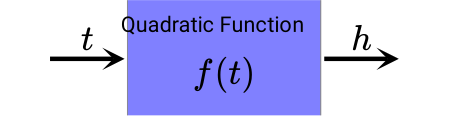
There are many applications of quadratic functions in real life. For example, the height of a projectile changes according to the time squared. A model using a quadratic function receives a time value t and returns the height h of the projectile at that time.
 What if a person wants to know the time it takes the projectile to reach a specific height? The function could be used to set up a quadratic equation to find that time. However, if many predictions were needed, it would not be practical to solve multiple equations. It would be very convenient to have a function that takes the height and returns the corresponding time.
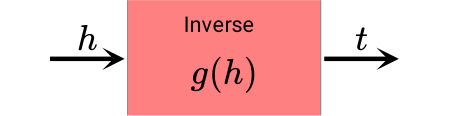 That convenient function is the inverse of a quadratic function. This lesson will begin by describing the relation between quadratic and square root functions. Then, how and why these functions can define inverses for each other will be understood.
Catch-Up and Review
Here are a few recommended readings before getting started with this lesson.
Explore
Share
Report error
Are Quadratic and Square Root Functions Related?
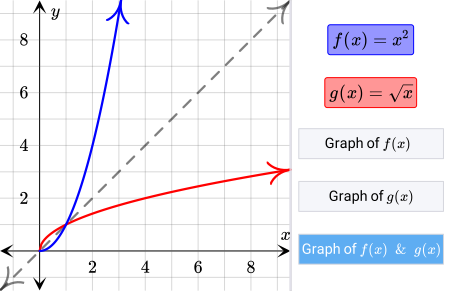
The following applet shows two graphs, one representing the quadratic function f(x)= x^2 and the other is the square root function g(x) = sqrt(x). In the applet, both functions have their domains defined as values of x greater than or equal to zero.
 Can one graph be derived from the other? If so, how? Based on this exploration, is there any particular relationship between quadratic and square root functions?
Discussion
Share
Report error
Inverse Functions
Every function has an inverse relation. If this inverse relation is also a function, then it is called an inverse function. In other words, the inverse of a function f is another function f^(- 1) such that they undo each other.
f(f^(- 1)(x))=x and f^(- 1)(f(x))=x
Therefore, f and f^(-1) are inverses of each other. Also, if x is the input of a function f and y its corresponding output, then y is the input of f^(- 1) and x its corresponding output.
f(x)=y ⇔ f^(- 1)(y)=x
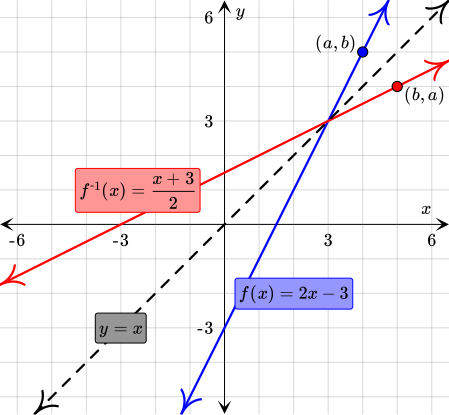
Consider a function f and its inverse f^(- 1). f(x)=2x-3 and f^(-1)(x)= x+32
Why
Showing That the Functions Are Inverse.The functions f(x)=2x-3 and f^(-1)(x)= x+32 will be shown to undo each other. To do so, it needs to be proven that f(f^(- 1)(x))=x and that f^(- 1)(f(x))=x. To start, the first equality will be proven. First, the definition of f will be used.
f(f^(- 1)(x))? =x ⇕ 2f^(- 1)(x)-3? =x
Now, in the above equation, x+32 will be substituted for f^(- 1)(x).
A similar procedure can be performed to show that f^(- 1)(f(x))=x.
2f^(- 1)(x)-3? =x
Substitute
f^(- 1)(x)= x+3/2
2( x+3/2)-3? =x
▼
Simplify left-hand side
DenomMultFracToNumber
2 * a/2= a
(x+3)-3? =x
RemovePar
Remove parentheses
x+3-3? =x
SubTerm
Subtract term
x=x ✓
| Definition of First Function | Substitute Second Function | Simplify | |
|---|---|---|---|
| f(f^(- 1)(x))? =x | 2f^(- 1)(x)-3? =x | 2( x+3/2)-3? =x | x=x ✓ |
| f^(- 1)(f(x))? =x | f(x)+3/2? =x | 2x-3+3/2? =x | x=x ✓ |
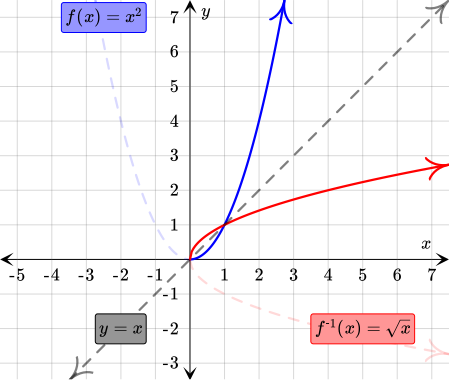
Therefore, f and f^(- 1) undo each other. The graphs of these functions are each other's reflection across the line y=x. This means that the points on the graph of f^(- 1) are the reversed points on the graph of f.
The characteristic feature of a quadratic function is that the function rule involves raising the input value to the second power. This feature is especially clear for the quadratic parent function. f(x) = x^2 The inverse operation of raising a value to the second power is taking its square root. In other words, squaring a number and calculating its square root are operations that undo each other. The following example demonstrates this concept. 8^2 = 64 sqrt(64)=8 For this reason, square root functions can be used to define the inverse of quadratic functions. There is something else to consider, however. There is another possibility for the previous example. (- 8)^2 = 64 sqrt(64)=8 The fact that the square of two different numbers can have the same value complicates defining an inverse for a quadratic function. In this case, the existence of an inverse operation is not enough for a function to be invertible. Before exploring the conditions a function must meet to be invertible, the definition of an invertible function will be given.
Concept
Share
Report error
Invertible Function
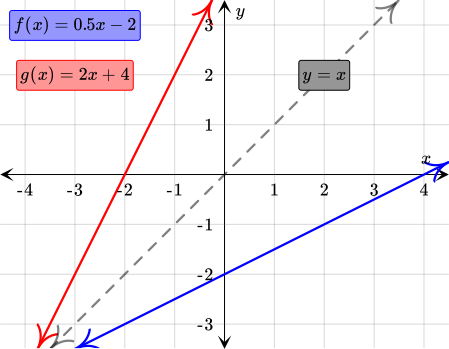
A function is invertible if its inverse relation is also a function. For example, consider the following linear function. f(x) =0.5x-2 The graph of its inverse relation can be found by reflecting the graph of f(x) across the line y=x.
Discussion
Share
Report error
Condition for Invertibility of a Function
There is a condition that a function must satisfy in order to be invertible.
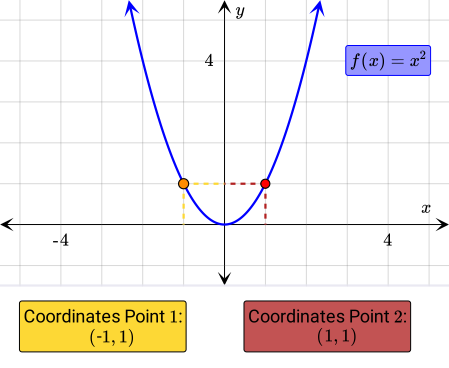
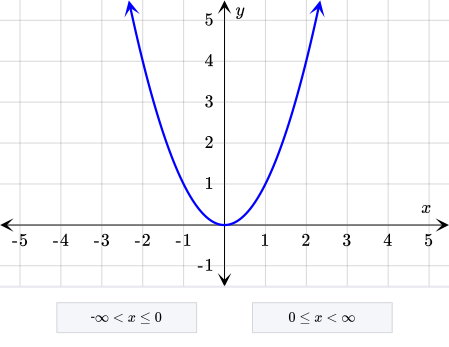
This condition implies that if a function fails the Horizontal Line Test, then it is not invertible. However, some functions do not satisfy this condition for invertibility but can become invertible by restricting their domain. For example, consider the quadratic parent function f(x)=x^2.
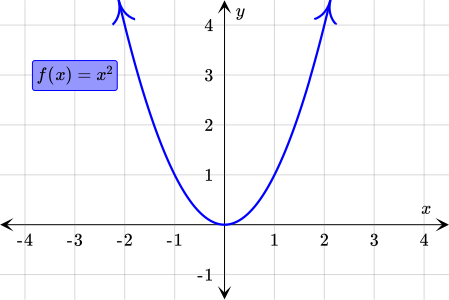
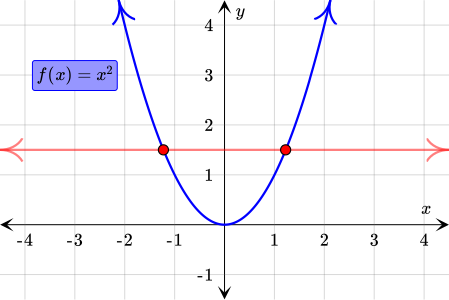
This function has different x-values where the same y-value is assigned. The foll how the function fails the Horizontal Line Test.
Now, the graph of f(x) will be reflected across the line y=x to visualize its inverse relation.
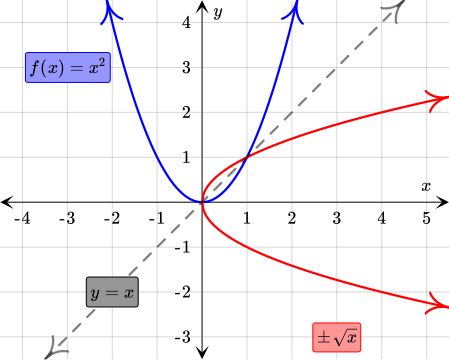
The inverse is not a function because it has input values with two different outputs assigned. The following graph further confirms this relation by showing how it fails the Vertical Line Test.
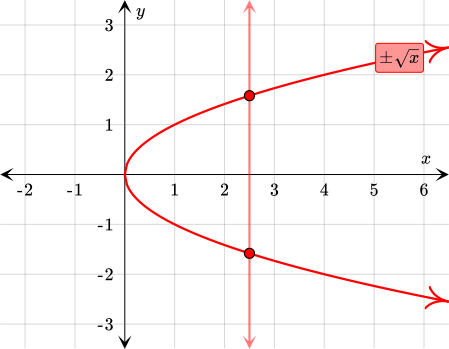
Therefore, f(x)=x^2 is not invertible because its inverse is not a function. Now, consider if the domain of f(x) is restricted to x≥ 0. In that case, every x-value gets assigned a unique y-value. With the domain of f(x) defined this way, f^(- 1)(x)=sqrt(x) is a valid inverse function.
Proof
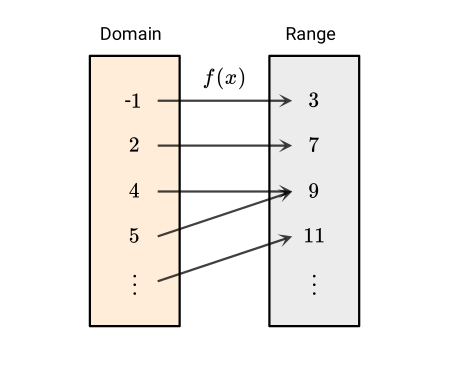
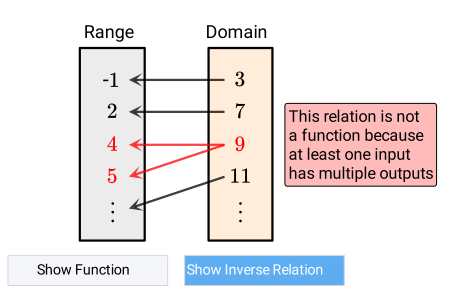
Consider a function f(x) that assigns the same output to multiple inputs.
Example
Share
Report error
Restricting the Domain of a Quadratic Function to Guarantee Invertibility
Heichi is so fascinated about the invertibility of quadratic functions, that he started a study group.

He brought the following function rule.
f(x) = 1/2(x-2)^2+8 Heichi asks his friends to help him identify in which intervals the function is invertible. Select all the options that correspond to these intervals.{"type":"multichoice","form":{"alts":["- \u221e < x \u2264 2","- \u221e < x \u2264 8","2 \u2264 x < \u221e","- 4 \u2264 x < \u221e","- \u221e < x \u2264 - 2"],"noSort":false},"formTextBefore":"","formTextAfter":"","answer":[0,2,4]}
Solution
It is a necessary condition for invertibility that the function assigns a unique output to every input. That being said, because of the symmetry of quadratic functions, inputs with the same distance from the vertex are assigned the same output.
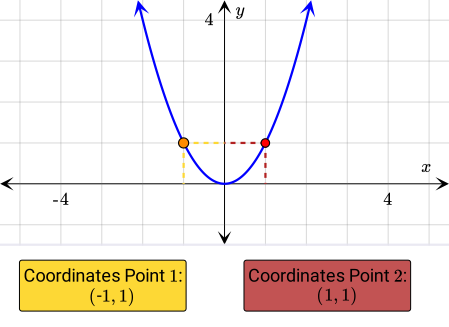 To avoid having repeated output values, the domain needs to be restricted to values either equal or less than or equal or greater than the x-coordinate of the vertex. Since the given quadratic function is in vertex form, the vertex will be located by comparing the function with the general form. cc
Quatratic Function& Vertex f(x) = a(x- h)^2+ k & ( h, k) [1em] Quatratic Function & Vertex f(x) = 1/2(x- 2)^2+ 8 & ( 2, 8)
Because the x-coordinate of the vertex is 2, the following intervals ensure that the function satisfies the invertibility condition.
I.& - ∞ < x ≤ 2 II.& 2 ≤ x < ∞ Three of the five given options are contained in these intervals.
To avoid having repeated output values, the domain needs to be restricted to values either equal or less than or equal or greater than the x-coordinate of the vertex. Since the given quadratic function is in vertex form, the vertex will be located by comparing the function with the general form. cc
Quatratic Function& Vertex f(x) = a(x- h)^2+ k & ( h, k) [1em] Quatratic Function & Vertex f(x) = 1/2(x- 2)^2+ 8 & ( 2, 8)
Because the x-coordinate of the vertex is 2, the following intervals ensure that the function satisfies the invertibility condition.
I.& - ∞ < x ≤ 2 II.& 2 ≤ x < ∞ Three of the five given options are contained in these intervals. 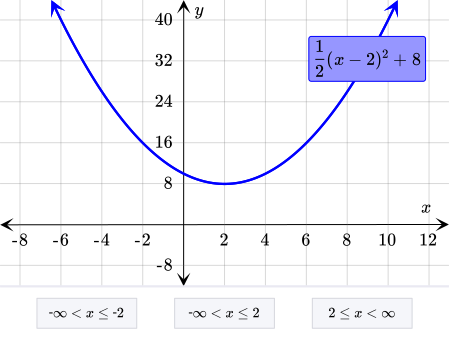 The remaining two options are intervals where the function does not satisfy the invertibility condition. This can be verified by using the Horizontal Line Test.
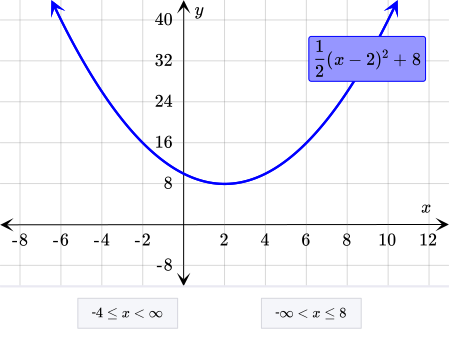
- - ∞ < x ≤ - 2
- - ∞ < x ≤ 2
- 2 ≤ x < ∞
Pop Quiz
Share
Report error
Identifying Invertible Functions
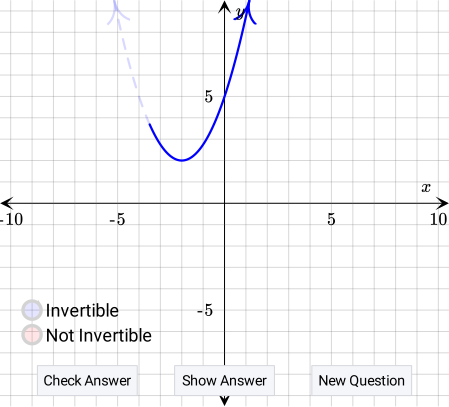
The following applet shows different quadratic functions. The representation of these functions alternates between showing their graph and stating their function rule. Determine whether or not the given function is invertible in the indicated domain.
Discussion
Share
Report error
Finding the Inverse of a Quadratic Function
A function can be represented by a table of values, a graph, a mapping diagram, or a function rule, among other ways. Depending on how the function is presented, finding its inverse can be done in different ways. When a function rule is given, finding the inverse algebraically is advantageous. Consider the following example function.
f(x)= 2x-1/3
There is a series of steps to follow in order to find the inverse function f^(- 1)(x).
1
Replace f(x) With y
expand_more To begin, since f(x)=y describes the input-output relationship of the function, replace f(x) with y in the function rule. f(x)= 2x-1/3 → y= 2x-1/3
2
Switch x and y
expand_more Because the inverse of a function reverses x and y, the variables can be switched. Notice that every other piece in the function rule remains the same. y= 2 x-1/3 switch x= 2 y-1/3
3
Solve for y
expand_more Solve the resulting equation from the previous step for y. This will involve using the inverse operations.
x=2y-1/3
▼
Solve for y
MultEqn
LHS * 3=RHS* 3
3x=2y-1
AddEqn
LHS+1=RHS+1
3x+1=2y
DivEqn
.LHS /2.=.RHS /2.
3x+1/2=y
RearrangeEqn
Rearrange equation
y=3x+1/2
4
Replace y With f^(- 1)(x)
expand_more Just as f(x)=y shows the input-output relationship of f, so does f^(- 1)(x)=y. Therefore, replacing y with f^(- 1)(x) gives the rule for the inverse of f. y=3x+1/2 → f^(- 1)(x)=3x+1/2 Notice that in f, the input is multiplied by 2, decreased by 1, and divided by 3. From the rule of f^(- 1), it can be seen that x undergoes the inverse of these operations in the reverse order. Specifically, x is multiplied by 3, increased by 1, and divided by 2.
x = a(y-h)^2+k
▼
Solve for y
SubEqn
LHS-k=RHS-k
x - k = a(y-h)^2
DivEqn
.LHS /a.=.RHS /a.
x - k/a = (y-h)^2
SqrtEqn
sqrt(LHS)=sqrt(RHS)
± sqrt(x - k/a) = y-h
AddEqn
LHS+h=RHS+h
± sqrt(x - k/a) + h = y
RearrangeEqn
Rearrange equation
y = ± sqrt(x - k/a) + h
Rewrite
Rewrite y as f^(- 1)(x)
f^(- 1)(x) = ± sqrt(x - k/a) + h
Example
Share
Report error
Modeling Falling Objects
Heichi took a few members from his study group named Ignacio and Kevin to try something cool in their apartment building. In their physics class, they learned that the height of an object that falls from an initial height h can be modeled using a quadratic function. They then adapted the function using the height of their building — 45 meters.
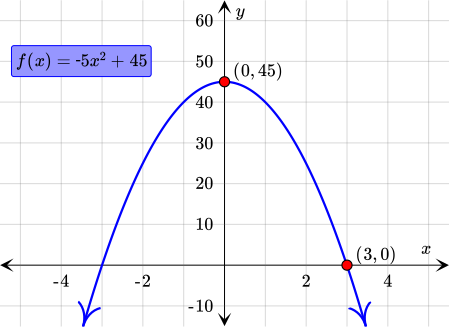
f(x) = - 5x^2 + h ⇓ f(x) = - 5x^2 + 45
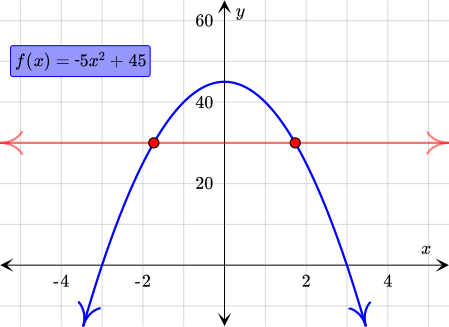
Here x is the time in seconds and f(x) represents the height of the falling object, in meters. To test this model, Heichi goes to the top of the building and prepares to drop a tennis ball. Meanwhile, Ignacio and Kevin look attentive through their respective windows holding a chronometer as they wait for Heichi's signal. 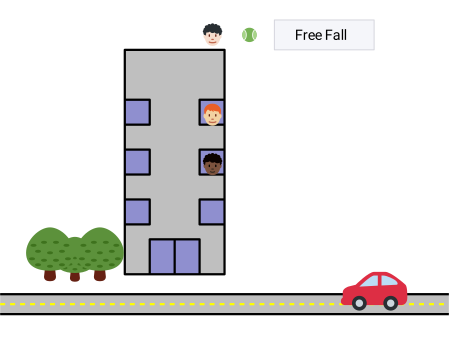
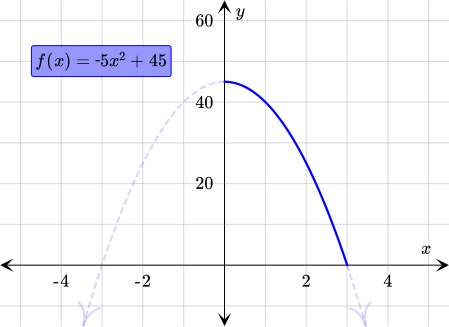
 Now, the function will be restricted to the time interval where the ball starts falling until it reaches the ground. The following graph represents the resulting piece of the quadratic function after being restricted.
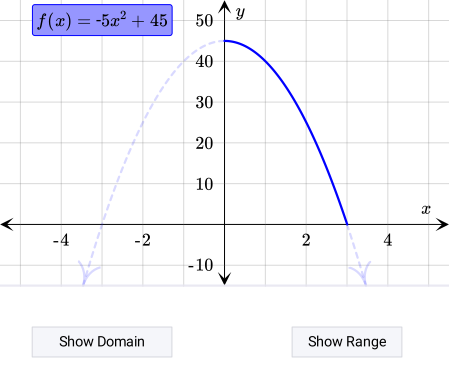 The graph shows that the domain of the restricted function is 0 ≤ x ≤ 3 and the range is 0 ≤ y ≤ 45.
 y= -5 x^2+45 switch x= -5 y^2+45
Next, the resulting equation will be solved for y.
Finally, y will be replaced with f^(- 1)(x).
y= ± sqrt(45 - x/5) ↓ f^(- 1)(x)= ± sqrt(45 - x/5)
Recall that inverse functions are reflectionally symmetric with respect to y=x. The domain of f^(- 1)(x) must be equal to the range of f(x), which is 0 ≤ y ≤ 45. And the range f^(- 1)(x) must be equal to the domain of f(x), which is 0 ≤ x ≤ 3. cc
Domain off^(- 1)(x):& 0 ≤ x ≤ 45 [1em]
Range off^(- 1)(x):& 0 ≤ y ≤ 3
Choosing the negative sign for the square root allows f^(- 1)(x) to assign negative outputs. Therefore, f^(- 1)(x) will only have the domain and range stated above if the positive sign is chosen. f^(- 1)(x)= sqrt(45 - x/5)
Graphing the restricted quadratic function and the found inverse together shows how their graphs are reflections of each other across the line y=x. This confirms that the found inverse function is correct.
y= -5 x^2+45 switch x= -5 y^2+45
Next, the resulting equation will be solved for y.
Finally, y will be replaced with f^(- 1)(x).
y= ± sqrt(45 - x/5) ↓ f^(- 1)(x)= ± sqrt(45 - x/5)
Recall that inverse functions are reflectionally symmetric with respect to y=x. The domain of f^(- 1)(x) must be equal to the range of f(x), which is 0 ≤ y ≤ 45. And the range f^(- 1)(x) must be equal to the domain of f(x), which is 0 ≤ x ≤ 3. cc
Domain off^(- 1)(x):& 0 ≤ x ≤ 45 [1em]
Range off^(- 1)(x):& 0 ≤ y ≤ 3
Choosing the negative sign for the square root allows f^(- 1)(x) to assign negative outputs. Therefore, f^(- 1)(x) will only have the domain and range stated above if the positive sign is chosen. f^(- 1)(x)= sqrt(45 - x/5)
Graphing the restricted quadratic function and the found inverse together shows how their graphs are reflections of each other across the line y=x. This confirms that the found inverse function is correct. 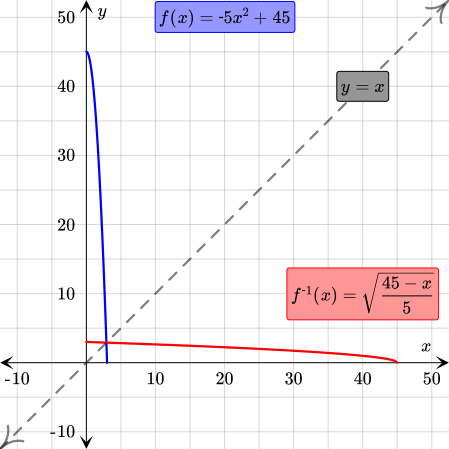 Therefore, the ball will reach Ignacio's window 1.7 seconds after being dropped. Similarly, since Kevin's window is at a height of 20 meters, the time that the ball takes to reach it will be found by evaluating the inverse for x=20.
Hence, ball will reach Kevin's window after 2.2 seconds.
Therefore, the ball will reach Ignacio's window 1.7 seconds after being dropped. Similarly, since Kevin's window is at a height of 20 meters, the time that the ball takes to reach it will be found by evaluating the inverse for x=20.
Hence, ball will reach Kevin's window after 2.2 seconds.
b Does the domain restriction indicated in Part A make the given function invertible? Justify the answer.
c What should be the inverse function's domain and range? Find the inverse function.
d Ignacio's window is 30 meters above the ground, and Kevin's window is 20 meters above the ground. Use the inverse function found in Part C to find the x-values corresponding to when the ball is in front of Ignacio's and Kevin's windows, respectively. Round the times to one decimal place.
Answer
a Graph:
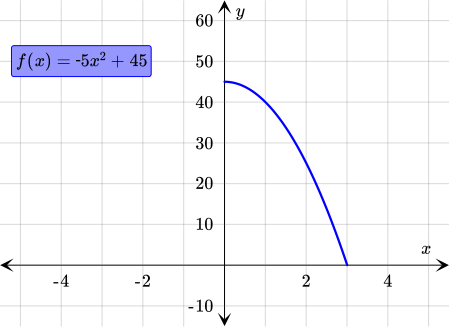
Domain: 0 ≤ x ≤ 3
b Is the Function Invertible? Yes
Explanation: See solution.
Explanation: See solution.
c Domain: 0 ≤ x ≤ 45
Range: 0 ≤ y ≤ 3
d Time to Reach Ignacio's Window: 1.7 s
Time to Reach Kevin's Window: 2.2 s
Time to Reach Kevin's Window: 2.2 s
Hint
a The domain is the set of all the possible input values of a function, while the range is the set of all possible output values.
b For a function to be invertible, it must assign a unique output to every input.
c The inverse of a function reverses inputs and outputs.
d The inverse function f^(-1)(x) receives as input the height of the ball with respect to the ground and returns as output the corresponding time that the ball takes to reach said height.
Solution
a First, the graph of the given quadratic function will be drawn. 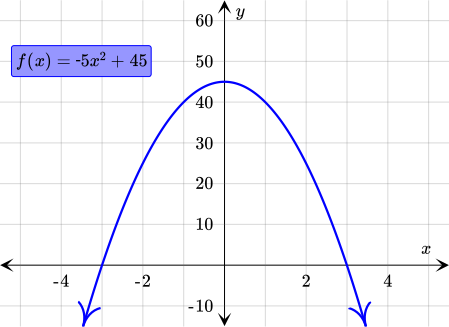 The ball starts falling at x=0 from a height of 45 meters. This corresponds to the vertex of the graph (0,45). On the other hand, the graph intersects the x-axis at (3,0). This means that the ball reaches the ground after 3 seconds. Note that - 3 is another x-intercept but it is discarded because it represents a negative time.
b For a function to be invertible, it must assign a unique output value to every input. When considering the domain to be all real numbers, the function fails the Horizontal Line Test. This means that there are repeating outputs and, consequently, the function is not invertible.
However, all the x-values in the interval 0 ≤ x ≤ 3 have unique y-values associated. This is why restricting the function's domain to the interval 0 ≤ x ≤ 3 makes the function invertible.
c First the inverse will be found algebraically. Then, it will be explained what its domain and range must be and why. Since f(x)= y describes the input-output relationship of the function, f(x) will be replaced with y in the function rule.
f(x)= - 5x^2+45 → y= - 5x^2+45
Now, the variables y and x will be switched because the inverse of a function reverses inputs and outputs.x = -5 y^2 + 45
▼
Solve for y
SubEqn
LHS-45=RHS-45
x - 45 = -5 y^2
DivEqn
.LHS /(-5).=.RHS /(-5).
x - 45/- 5 = y^2
MoveNegDenomToNum
Put minus sign in numerator
- (x - 45)/5 = y^2
Distr
Distribute - 1
-x + 45/5 = y^2
CommutativePropAdd
Commutative Property of Addition
45 - x/5 = y^2
SqrtEqn
sqrt(LHS)=sqrt(RHS)
± sqrt(45 - x/5) = y
RearrangeEqn
Rearrange equation
y = ± sqrt(45 - x/5)
d To find the time it takes the ball to reach Igancio's window, which is at a height of 30 meters, the inverse function will be evaluated for x=30.
f^(- 1)(x) = sqrt(45-x/5)
▼
Substitute 30 for x and evaluate
Substitute
x= 30
f^(- 1)(x) = sqrt(45- 30/5)
SubTerm
Subtract term
f^(- 1)(x) = sqrt(15/5)
CalcQuot
Calculate quotient
f^(- 1)(x) = sqrt(3)
CalcRoot
Calculate root
f^(- 1)(x) = 1.732050 ...
RoundDec
Round to 1 decimal place(s)
f^(- 1)(x) = 1.7
f^(- 1)(x) = sqrt(45 - x/5)
▼
Substitute 20 for x and evaluate
Substitute
x= 20
f^(- 1)(x) = sqrt(45 - 20/5)
SubTerm
Subtract term
f^(- 1)(x) = sqrt(25/5)
CalcQuot
Calculate quotient
f^(- 1)(x) = sqrt(5)
CalcRoot
Calculate root
f^(- 1)(x) = 2.236067 ...
RoundDec
Round to 1 decimal place(s)
f^(- 1)(x) = 2.2
Pop Quiz
Share
Report error
Practice Finding a Point on the Inverse Function
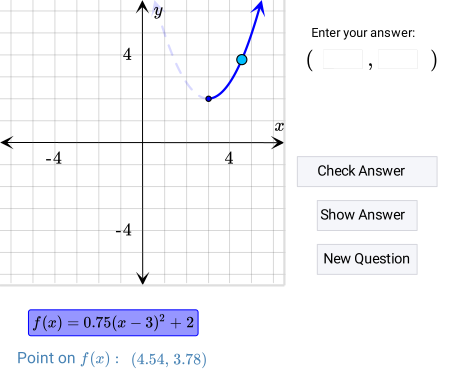
The following applet shows a quadratic function and a specific point on its graph. The domain of the given function is restricted and the function is invertible. Find the coordinates of the corresponding point on the graph of its inverse function. Write the answer rounding to two decimal places.
Example
Share
Report error
Analyzing and Predicting the Trajectory of a Projectile
Heichi, Ignacio, and Kevin want to try another experiment. They bought a rocket model and found a website that predicts a projectile's trajectory. After inputting their building's height and the launching angle on the website, the calculations indicated that the following quadratic function would describe the trajectory of the rocket.
f(x) = x -x^2/160+50
The variable x represents the horizontal displacement from the building while f(x) represents the height from the ground, both measured in meters. The kids want the rocket to land inside a bucket that they plan to place on the top of a wooden ladder. Help them do the calculations needed to succeed. 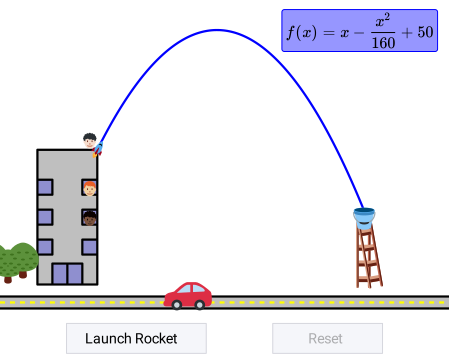
What is the range of the restricted function?
a Write the given quadratic function in vertex form and choose the corresponding option.
{"type":"choice","form":{"alts":["f(x) = - 1\/160(x-80)^2+90","f(x) = 1\/160(x-120)^2+80","f(x) = - 1\/160(x-80)^2+120","f(x) = 1\/160(x-90)^2+80"],"noSort":false},"formTextBefore":"","formTextAfter":"","answer":0}
b The domain needs to be restricted for the function to be invertible. Keeping in mind that x represents the horizontal displacement from the building and f(x) represents the height from the ground, which of the following options represents the appropriate domain restriction?
{"type":"choice","form":{"alts":["80 \u2264 x < \u221e","- \u221e < x \u2264 80","- 40 \u2264 x \u2264 80","80 \u2264 x \u2264 200"],"noSort":false},"formTextBefore":"","formTextAfter":"","answer":3}
{"type":"choice","form":{"alts":["- \u221e < y \u2264 90","0 \u2264 y \u2264 90","- \u221e < y \u2264 160","0 \u2264 y \u2264 160"],"noSort":false},"formTextBefore":"","formTextAfter":"","answer":1}
c What is the inverse function of f(x) in the domain specified in Part B?
{"type":"choice","form":{"alts":["f^(- 1)(x) = - sqrt(14 400 - 160x) + 90","f^(- 1)(x) = sqrt(14 400 - 160x) + 80","f^(- 1)(x) = sqrt(14 400 - 160x) + 90","f^(- 1)(x) = - sqrt(14 400 - 160x) + 80"],"noSort":false},"formTextBefore":"","formTextAfter":"","answer":1}
d Use the inverse function to determine the horizontal distance from the building the ladder needs to be so the rocket lands inside the bucket on top of it. The ladder the kids are using is 3 meters tall. Give the distance rounded to two decimal places.
{"type":"text","form":{"type":"math","options":{"comparison":"1","nofractofloat":false,"keypad":{"simple":true,"useShortLog":false,"variables":["x"],"constants":["PI"]},"rendered":false},"text":" "},"formTextBefore":null,"formTextAfter":"meters","answer":{"text":["197.98"]}}
Hint
a Complete the square for the quadratic expression of the function rule. Then, rewrite the expression as the square of a binomial plus a constant term.
b The format for a quadratic function in vertex form is f(x)= (x-h)^2+k, where h and k are the x- and y-coordinates of the vertex, respectively.
d Evaluate the inverse function for x=3 to find the horizontal distance of the rocket when its height is 3 meters.
Solution
a Complete the square of the quadratic expression involved to write the function in vertex form. The first step in doing so is to factor out the coefficient of the x^2-term.
( b/2 )^2
▼
Substitute - 160 for b and evaluate
6400
x^2 - 160x - 8000
▼
Rewrite
AddDiffZero
a = a+ 6400- 6400
x^2 - 160x - 8000 + 6400 - 6400
CommutativePropAdd
Commutative Property of Addition
x^2 - 160x + 6400 - 6400 - 8000
SubTerm
Subtract term
x^2 - 160x + 6400 - 14 400
a^2± 2ab+b^2=(a± b)^2
(x-80)^2 - 14 400
f(x) = - 1/160( x^2 - 160x - 8000)
f(x) = - 1/160(x-80)^2 + 90
b A quadratic function has to have its domain restricted to be invertible. And, to ensure invertibility, the coordinates of the vertex must be known. Since the function is already in vertex form, it will be compared to the general format of the vertex form to identify the vertex location.
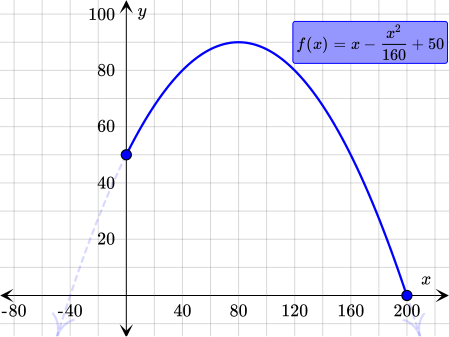 This graph shows the whole trajectory of the rocket if it were to land on the ground. Note that this function does not pass the Horizontal Line Test, so it is not invertible. The domain has to be further restricted. If the values of x greater than or equal to 80 and less than or equal to 200 are considered, the function will become invertible.
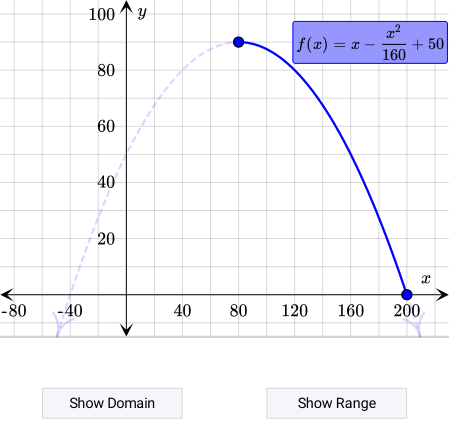 The graph shows the domain and the range of the restricted quadratic function.
Domain: & 80 ≤ x ≤ 200 Range: & 0 ≤ y ≤ 90 This graph represents the part of the trajectory after the projectile reaches its highest point and starts falling. Remember that the kids want the rocket to land in a bucket placed on a ladder. That makes this part of the trajectory very useful.
The graph shows the domain and the range of the restricted quadratic function.
Domain: & 80 ≤ x ≤ 200 Range: & 0 ≤ y ≤ 90 This graph represents the part of the trajectory after the projectile reaches its highest point and starts falling. Remember that the kids want the rocket to land in a bucket placed on a ladder. That makes this part of the trajectory very useful.
cc Quatratic Function& Vertex f(x) = a(x- h)^2+ k & ( h, k) [1em] Quatratic Function & Vertex f(x) = - 1/160(x- 80)^2+ 90 & ( 80, 90) Note that x represents horizontal displacement and f(x) represents height. That means in this situation they both only make sense if they are non-negative. x≥ 0 and f(x)≥ 0 The following graph of f(x)=x- x^2160+50 is shown bounded with these restrictions.
c To invert the function, first, f(x) will be replaced with y in the function rule.
f(x)= - 1/160(x-80)^2+90 ↓ y= - 1/160(x-80)^2+90
Next, the variables y and x will be switched because the inverse of a function reverses inputs and outputs.x = - 1/160(y-80)^2+90
▼
Solve for y
SubEqn
LHS-90=RHS-90
x - 90 = - 1/160(y-80)^2
MultEqn
LHS * (- 160)=RHS* (- 160)
- 160(x - 90) = (y-80)^2
Distr
Distribute - 160
- 160x + 14 400= (y-80)^2
CommutativePropAdd
Commutative Property of Addition
14 400 - 160x= (y-80)^2
SqrtEqn
sqrt(LHS)=sqrt(RHS)
sqrt(14 400-160x) = y-80
AddEqn
LHS+80=RHS+80
± sqrt(14 400-160x) = y-80
RearrangeEqn
Rearrange equation
y = ± sqrt(14 400-160x) + 80
d To find the horizontal distance of the rocket when its height is 3 meters, the inverse function will be evaluated for x=3.
f^(- 1)(x)= sqrt(14 400-160x) + 80
Substitute
x= 3
f^(- 1)( 3)= sqrt(14 400-160( 3)) + 80
f^(- 1)(3) ≈ 197.98
Closure
Share
Report error
The Relation Between Quadratic and Radical Functions
At the beginning of this lesson, a graph showing a quadratic and a square root function was presented. Both functions had their domains defined as 0 ≤ x. Using the information from this lesson, it can be stated that these functions are in fact, inverse functions because f(x)=x^2 and g(x)=sqrt(x) are reflections of each other across the line y=x.
 Additionally, depending on how the domain of function f(x) is defined, it can have two different inverse functions.
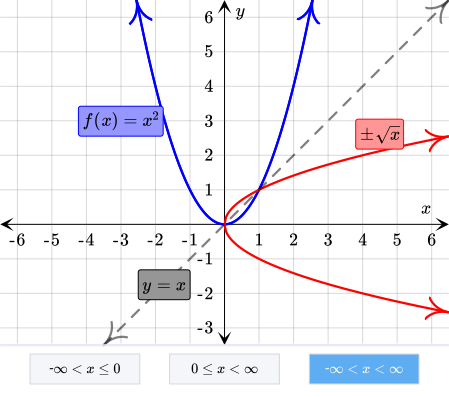
| Domain of f(x) | Inverse Function |
|---|---|
| 0 ≤ x < ∞ | f^(- 1)(x)=sqrt(x) |
| - ∞ < x ≤ 0 | f^(- 1)(x)=- sqrt(x) |
A great method to explore this is by using the following interactive graph. The graph gives various choices of domains for f(x) = x^2. The function's corresponding inverse relation is shown by reflecting f(x) across y=x.
Inverses of Quadratic Functions
Exercise 1.1
Consider the following quadratic function. f(x)=4x^2-9
{"type":"text","form":{"type":"math","options":{"comparison":"1","nofractofloat":false,"keypad":{"simple":false,"useShortLog":false,"variables":["y"],"constants":[]},"rendered":false},"text":" "},"formTextBefore":"x=","formTextAfter":null,"answer":{"text":["\\dfrac{\\sqrt{y+9}}{2}","\\sqrt{\\dfrac{y+9}{4}}"]}}
{"type":"text","form":{"type":"math","options":{"comparison":"1","nofractofloat":false,"keypad":{"simple":true,"useShortLog":false,"variables":[],"constants":[]},"rendered":false},"text":" "},"formTextBefore":null,"formTextAfter":null,"answer":{"text":["-2"]}}
security
report
code
security
report
code
We want to solve the equation y=f(x) for x. Let's consider the given function rule. f(x)=4x^2-9 We will now substitute the given expression for f(x) in y=f(x) and then solve for x.
Since we are asked to find the positive solution, the answer is x=sqrt(y+94) or x= sqrt(y+9)2.
Note that the input is represented by the x-variable, and the output is represented by the y-variable. As we found in Part A, two inputs — one positive and one negative — can give us one output. We are asked to find the negative input when the output is 7. To do so, we will use the equation that gives the negative x-values. x=-sqrt(y+9)/2 Now, we will substitute 7 for y into the above equation.
security
report
code
Consider the following graph.
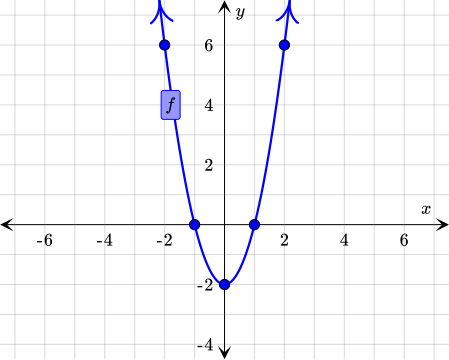
Which graph represents the reflection of f across the line y=x?
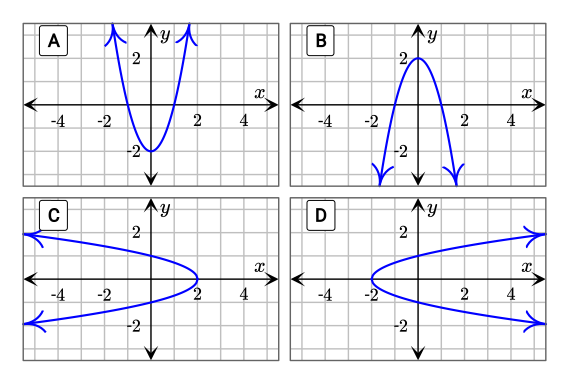
{"type":"choice","form":{"alts":["A","B","C","D"],"noSort":true},"formTextBefore":"","formTextAfter":"","answer":3}
security
report
code
security
report
code
We will reflect the graph of f across the line y=x. Let's start by drawing y=x. Since it is already in the slope-intercept form, we can easily identify its slope and y-intercept. y=x ⇔ y= 1x+ 0 Our line will pass through the origin with a slope of 1.
Next, we will reflect the points of the given function across y=x. Remember that when a point (x,y) is reflected across the line y=x, the coordinates of the reflected point will be (y,x). With this in mind, let's make a table to identify the coordinates of five reflected points.
| Given Points | Reflected Points |
|---|---|
| (-2,6) | (6,-2) |
| (-1,0) | (0,-1) |
| (0,-2) | (-2,0) |
| (1,0) | (0,1) |
| (2,6) | (6,2) |
Let's now connect the reflected points in a smooth curve.
By removing the other elements, let's focus solely on the reflected graph g.
According to what we graphed, the correct answer is option D.
security
report
code
Consider the following quadratic function. f(x)=1/2x^2-6
{"type":"choice","form":{"alts":["A","B","C","D"],"noSort":true},"formTextBefore":"","formTextAfter":"","answer":1}
{"type":"text","form":{"type":"math","options":{"comparison":"1","nofractofloat":false,"keypad":{"simple":false,"useShortLog":false,"variables":["x"],"constants":[]},"rendered":false},"text":" "},"formTextBefore":"g(x)=","formTextAfter":null,"answer":{"text":["\\sqrt{2x+12}"]}}
security
report
code
security
report
code
We want to find an interval on which we can define the inverse of the given function. Since the function is quadratic, we have to restrict the domain to avoid having repeated output values. To do so, let's identify the vertex of the function. cc Quadratic Function& Vertex f(x) = a(x- h)^2+ k & ( h, k) [1em] Quadratic Function & Vertex f(x) = 1/2(x- 0)^2+( -6) & ( 0, -6) We can restrict the domain to values either equal or less than or equal or greater than the x-coordinate of the vertex. x ≤ 0 or 0 ≤ x Notice that any smaller interval included in the above intervals can be considered a solution. However, in the domains that include both positive and negative numbers, our function is not invertible. Therefore, the answer is option B.
We will now find the inverse of our function. To do so, we will first replace f(x) with y.
f(x)=1/2x^2-6 ⇔ y=1/2x^2-6
To algebraically determine the inverse of the given relation, we exchange x and y and solve for y.
ccc
Given Equation& & Inverse Equation
y=1/2 x^2-6 & & x=1/2 y^2-6
The result of isolating y in the new equation will be the inverse of the given function.
Let's now use function notation and replace y with g(x). y=± sqrt(2x+12) ⇕ g(x)=± sqrt(2x+12) Notice that we ended with two expressions — one non-negative and one non-positive. Since the domain of f(x) chosen in Part A is 0≤ x, all its input values are non-negative. Inputs of f(x) are the outputs of its inverse g(x). Therefore, the inverse function's rule should be the non-negative expression. g(x)=sqrt(2x+12)
security
report
code
Consider the following graph.
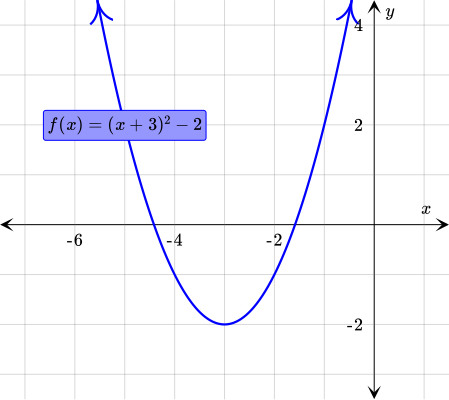
{"type":"choice","form":{"alts":["Yes","No"],"noSort":true},"formTextBefore":"","formTextAfter":"","answer":1}
security
report
code
security
report
code
We are given the following function and its graph. We want to determine whether the inverse of this function is also a function or not.
We will use the Horizontal Line Test. If the horizontal lines intersect the graph once, then the inverse is also a function. Conversely, if there is even one horizontal line that intersects the graph more than once, then the inverse is not a function. With this in mind, we will draw several horizontal lines across the given graph of a function.
We can see above that there are horizontal lines that intersect the curve at more than one point. Therefore, the inverse of the given function is not a function.
security
report
code
Inverses of Quadratic Functions
Recommended exercises
To get personalized recommended exercises, please login first.
Loading content
≤
>
■2
■▢
e▢
7
8
9
×
÷■1
=
=
√▢
▢√
∫▢▢
4
5
6
+
−
≤
<
log
ln
log▢
1
2
3
()
∣
sin
cos
tan
0
.
π
x
y
Loading content