6. Solving Quadratic Equations by Factoring
Sign In
An error ocurred, try again later!
Chapter 8
6.
Solving Quadratic Equations by Factoring
This lesson delves into the method of solving quadratic equations by factoring. It emphasizes the importance of understanding the Zero Product Property, which states that if a product is equal to zero, at least one of the factors must also be zero. The lesson provides real-world scenarios, like calculating the height of a jumping dolphin or determining the dimensions of a rectangle, to illustrate the application of this mathematical concept. By using factoring, one can break down complex equations into simpler ones, making them easier to solve. The lesson also touches upon the challenges one might face, such as when a quadratic trinomial cannot be factored using integers. Overall, the lesson offers a comprehensive guide to mastering the technique of factoring to solve quadratic equations.
Show less Show more expand_more 


Lesson Settings & Tools
| | 11 Theory slides |
| | 9 Exercises - Grade E - A |
| | Each lesson is meant to take 1-2 classroom sessions |
Solving Quadratic Equations by Factoring
Slide of 11
Quadratic equations can be solved using square roots. Sometimes this method might be inconvenient to use for equations of the form ax2+bx+c=0. The following lesson introduces another method of solving such equations.
Catch-Up and Review
Here are a few recommended readings before getting started with this lesson.
Challenge
Solve a Quadratic Equation
Consider the following quadratic equation for x.
2x2+2x−4=0
Can this equation be solved by taking square roots? If not, how can it be solved algebraically — without graphing?Discussion
Solving an Equation Using the Zero Product Property
An expression written in factored form and set equal to 0 can be solved using the Zero Product Property. When the product of two or more factors is 0, at least one of the factors must equal 0. Consider the following equation.
(3x−9)(x+5)=0
Since the left-hand side of the equation is in factored form, there are two steps to solve it.
1
Set Each Factor Equal to 0
expand_more By the Zero Product Property, at least one of the factors must equal 0. Therefore, each of the factors can be set equal to 0.
3x−9=0orx+5=0
Note that the word connecting the equations is or. By setting the factors equal to 0, new equations are created. There are as many equations as there were factors — in this case there are two. 2
Solve the Obtained Equations
expand_more Now, inverse operations will be used to solve the new equations.
The solutions to the new equations both solve the original equation. Therefore, x=3 and x=-5 are the solutions to (3x−9)(x+5)=0.
Pop Quiz
Practice Solving Equations Using the Zero Product Property
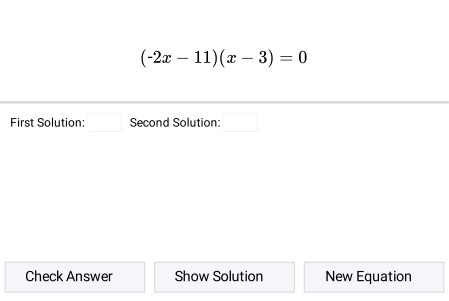
The following applet shows a quadratic equation whose left-hand side is written in factored form. Using the Zero Product Property find the solutions of the equation. Round to the nearest tenth if necessary.
Discussion
Solving a Quadratic Equation of the Form ax2+bx=0
A quadratic equation in the form ax2+bx=0 is obtained when the constant term c is equal to 0. Such quadratic equations can be solved using the Zero Product Property. Consider the following equation.
3x2−12x=0
There are three steps to solve it.
1
Factor Out the GCF
expand_more First, the greatest common factor (GCF) of ax2 and bx has to be factored out. In the considered case, ax2=3x2 and bx=-12x. The factors of these two terms will be now listed.
3x2=-12x= 3⋅x⋅x -4⋅3⋅x
The GCF is 3⋅x=3x. Finally, it can be factored out.
2
Set Each Factor Equal to 0
expand_more After factoring out the GCF, the left-hand side of the equation is in factored form. Now, the steps of solving an equation using the Zero Product Property will be followed. By the Zero Product Property each of the factors can be set equal to 0.
3x(x−4)=0⇒3x=0x−4=0(I)(II)
3
Solve the Obtained Equations
expand_more The two linear equations obtained in the previous step will be now solved using inverse operations.
The solutions to the original equation are x=0 and x=4. Please note that x=0 makes the expression ax2+bx equal to 0 for any values of a and b. Therefore, it is a solution to any equation of the form ax2+bx=0.
Example
Jumping Dolphins
Dolphins jump out of the water to improve their navigation and to see the surface of the ocean. They also do it for fun.

h=-5t2+8t
After how many seconds is the dolphin back in the water? Write and solve by factoring the appropriate quadratic equation. {"type":"text","form":{"type":"math","options":{"comparison":"1","nofractofloat":false,"keypad":{"simple":true,"useShortLog":false,"variables":["x"],"constants":["PI"]},"rendered":false},"text":"<span class=\"katex\"><span class=\"katex-html\" aria-hidden=\"true\"><\/span><\/span>"},"formTextBefore":"The dolphin is back in the water after","formTextAfter":"seconds.","answer":{"text":["1.6","\\dfrac{16}{10}","\\dfrac{8}{5}","1\\dfrac{6}{10}","1\\dfrac{3}{5}"]}}
Hint
The dolphin is in the water when h=0.
Solution
When h=0, the dolphin is in the water. An equation for t can be written by substituting 0 for h in the given equation.
The left-hand side of the equation is written in factored form and the right-hand side is equal to 0. Therefore, this equation can be solved using the Zero Product Property.
The solutions are t=0 and t=1.6. It is known that at t=0 the dolphin is still in the water. Therefore, it must be back in the water after 1.6 seconds.
0=-5t2+8t
The solutions of the above equation represent the time when the dolphin leaves the water and the time when the dolphin is back in the water. The equation will be now solved. First, it will be rearranged, as it is usually preferred to have the variable terms on the left-hand side.
0=-5t2+8t⇔-5t2+8t=0
Next, the greatest common factor (GCF) of the terms on the left-hand side will be factored out. The factors of -5t2 and 8t are listed below.
-5t2=8t= -1⋅5⋅t⋅t 2⋅2⋅2⋅t
The two terms have only one common factor t. Therefore, the GCF of -5t2 and 8t is t.
-5t2+8t=0
Rewrite
Rewrite -5t2 as t(-5t)
t(-5t)+8t=0
CommutativePropMult
Commutative Property of Multiplication
t(-5t)+t⋅8=0
FactorOut
Factor out t
t(-5t+8)=0
Discussion
Factoring and Solving Quadratic Equations
Method
Factoring a Quadratic Trinomial
When trying to factor a quadratic trinomial of the form ax2+bx+c, it can be difficult to
seeits factors. Consider the following expression.
8x2+26x+6
Here, a=8, b=26, and c=6. There are six steps to factor this trinomial.
1
Factor Out the GCF of a, b, and c
expand_more To fully factor a quadratic trinomial, the Greatest Common Factor (GCF) of a, b, and c has to be factored out first. To identify the GCF of these numbers, their prime factors will be listed.
8=26=6= 2⋅2⋅2 2⋅13 2⋅3
It can be seen that 8, 26, and 6 share exactly one factor, 2.
GCF(8,26,6)=2
Now, 2 can be factored out.
In the remaining steps, the factored coefficient 2 before the parentheses can be ignored. The new considered quadratic trinomial is 4x2+13x+3. Therefore, the current values of a, b, and c, are 4, 13, and 3, respectively. If the GCF of the coefficients is 1, this step can be ignored. 2
Find the Factor Pair of ac Whose Sum Is b
expand_more It is known that a=4 and c=3, so ac=12>0. Therefore, the factors must have the same sign. Also, b=13. Since the sum of the factors is positive and they must have the same sign, both factors must be positive. All positive factor pairs of 12 can now be listed and their sums checked.
| Factors of ac | Sum of Factors |
|---|---|
| 1 and 12 | 1+12=13 ✓ |
| 2 and 6 | 2+6=8 × |
| 3 and 4 | 3+4=7 × |
In this case, the correct factor pair is 1 and 12. The following table sums up how to determine the signs of the factors based on the values of ac and b.
| ac | b | Factors |
|---|---|---|
| Positive | Positive | Both positive |
| Positive | Negative | Both negative |
| Negative | Positive | One positive and one negative. The absolute value of the positive factor is greater. |
| Negative | Negative | One positive and one negative. The absolute value of the negative factor is greater. |
Such analysis makes the list of possible factor pairs shorter.
3
Write bx as a Sum
expand_more The factor pair obtained in the previous step will be used to rewrite the x-term — the linear term — of the quadratic trinomial as a sum. Remember that the factors are 1 and 12.
The linear term 13x can be rewritten in the original expression as 12x+x.
4x2+13x+3⇕4x2+12x+x+3
4
Factor Out the GCF of the First Two Terms
expand_more The expression has four terms, which can be grouped into the first two and the last two terms. Then, the GCF of each group can be factored out.
4x2+12x+x+3
The first two terms, 4x2 and 12x, can be factored.
4x2=12x= 2⋅2⋅x⋅x 2⋅2⋅3⋅x
The GCF of 4x2 and 12x is 2⋅2⋅x=4x.
5
Factor Out the GCF of the Last Two Terms
expand_more 6
Factor Out the Common Factor
expand_more If all the previous steps have been performed correctly, there should now be two terms with a common factor.
4x(x+3)+1(x+3)
The common factor will be factored out.
The factored form of 4x2+13x+3 is (4x+1)(x+3). Remember that the original trinomial was 8x2+26x+6 and that the GCF 2 was factored out in Step 1. This GCF has to be included in the final result.
8x2+26x+6=2(4x+1)(x+3)
The above method can be used to factor any quadratic trinomial. It is particularly useful for trinomials in the forms ax2+bx or ax2+c. However, in these two cases there are other approaches that might be used as well.
- A quadratic trinomial is of the form ax2+bx when the constant term c is equal to 0. To write this expression in factored form, the GCF of ax2 and bx has to be factored out.
- A quadratic trinomial is of the form ax2+c when b is equal to 0. Sometimes such expressions can be factored using the Difference of Squares formula.
Please note that not every quadratic trinomial can be factored. When a pair of integers whose product is equal to a⋅c and whose sum is b cannot be found, the trinomial cannot be factored using the described method.
| x2−x+1, a⋅c=1, b=-1 | |
|---|---|
| Product of Factors | Sum of Factors |
| 1⋅1=1 | 1+1=2 × |
| -1(-1)=1 | -1+(-1)=-2 × |
Solving a Quadratic Equation by Factoring
Think of a quadratic equation in standard form.ax2+bx+c=0
If its left-hand side is factorable, the equation can be solved using the Zero Product Property.Example
Finding Unknown Dimensions
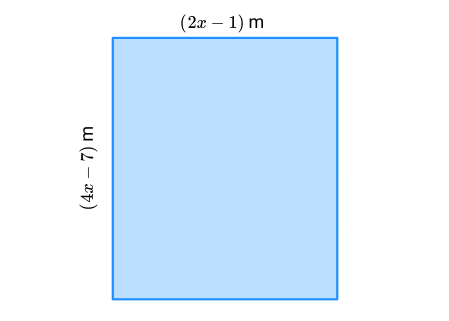
Zosia is a student studying how many Dolphins swim past a certain area of cove. She marks off a rectangle using rope where she will count how many dolphins pass through in any given day. The study area's rectangle is equal to 42 square meters. However, the dimensions of the rectangle are unknown.
{"type":"text","form":{"type":"math","options":{"comparison":"1","nofractofloat":false,"keypad":{"simple":true,"useShortLog":false,"variables":["x"],"constants":["PI"]},"rendered":false},"text":"<span class=\"katex\"><span class=\"katex-html\" aria-hidden=\"true\"><\/span><\/span>"},"formTextBefore":"Width:","formTextAfter":null,"answer":{"text":["6"]}}
{"type":"text","form":{"type":"math","options":{"comparison":"1","nofractofloat":false,"keypad":{"simple":true,"useShortLog":false,"variables":["x"],"constants":["PI"]},"rendered":false},"text":"<span class=\"katex\"><span class=\"katex-html\" aria-hidden=\"true\"><\/span><\/span>"},"formTextBefore":"Length:","formTextAfter":null,"answer":{"text":["7"]}}
Hint
Based on the given information, write and solve a quadratic equation for x.
Solution
It is known that the area of the given rectangle is 42 m2.
The equation is written in the form ax2+bx+c=0. The values of a, b, and c can be identified.
The pair of factors whose product is equal to -280 and whose sum is -18 is 10 and -28. Now, the linear term can be rewritten as a difference.
Next, the GCF of the first two terms and the last two terms will be factored out. For more information on this process, read about finding the GCF.
Note that for the factorization of the polynomial to work, -7 and not the GCF 7 has to be factored out from the last two terms. Finally, the common factor 4x+5 will be factored out.
Since the left-hand side of the equation is written in factored form and the right-hand side is 0, the equation can be solved using the Zero Product Property.
Two solutions to the quadratic equation have been found. They will now be substituted into the expressions for the width and length of the rectangle.
Area=42 m2
The area of a rectangle can be calculated by multiplying its dimensions — width and length. In this case, the width and the length of the rectangle are given as algebraic expressions. The product of 2x−1 and 4x−7 represents the area of the rectangle.
(2x−1)(4x−7)=42
Note that both dimensions of the rectangle are given in meters, so there is no need to change the units. The actual dimensions of the rectangle can be determined by solving the above equation. First, the equation will be rewritten in standard form by using the Distributive Property and Subtraction Property of Equality.
(2x−1)(4x−7)=42
Distr
Distribute (4x−7)
2x(4x−7)−1(4x−7)=42
Distr
Distribute 2x & -1
8x2−14x−4x+7=42
SubTerm
Subtract term
8x2−18x+7=42
SubEqn
LHS−42=RHS−42
8x2−18x−35=0
8x2−18x−35=0⇕8x2+(-18)x+(-35)=0
It can be seen that a=8, b=-18, and c=-35. Next, the quadratic trinomial on the left-hand side will be written in factored form following the general method. Note that a, b, and c have a greatest common factor (GCF) of 1. Next, the product of a and c will be found so that all pairs of integers whose product is equal to a⋅c can be listed.
a⋅c=8(-35)=-280
The product a⋅c=-280 and b=-18 are both negative. Therefore, one of the factors has to be positive and one negative. Additionally, the absolute value of the negative factor has to be greater than the absolute value of the positive factor. The sum of the factors should be -18. | Pair of Factors | Sum of Factors |
|---|---|
| 1 and -280 | 1+(-280)=-279 × |
| 2 and -140 | 2+(-140)=-138 × |
| 4 and -70 | 4+(-70)=-66 × |
| 5 and -56 | 5+(-56)=-51 × |
| 7 and -40 | 7+(-40)=-33 × |
| 8 and -35 | 8+(-35)=-27 × |
| 10 and -28 | 10+(-28)=-18 ✓ |
| 14 and -20 | 14+(-20)=-6 × |
8x2+10x−28x−35=0
▼
Factor out 2x & -7
SplitIntoFactors
Split into factors
2x⋅4x+2x⋅5−7⋅4x−7⋅5=0
FactorOut
Factor out 2x
2x(4x+5)−7⋅4x−7⋅5=0
FactorOut
Factor out -7
2x(4x+5)−7(4x+5)=0
(4x+5)(2x−7)=0
ZeroProdProp
Use the Zero Product Property
4x+5=02x−7=0(I)(II)
▼
(I): Solve for x
SubEqn
(I): LHS−5=RHS−5
4x=-52x−7=0
DivEqn
(I): LHS/4=RHS/4
x=4-52x−7=0
MoveNegNumToFrac
(I): Put minus sign in front of fraction
x=-452x−7=0
CalcQuot
(I): Calculate quotient
x=-1.252x−7=0
x=-1.25x=3.5
| 2x−1 | 4x−7 | |
|---|---|---|
| x=-1.25 | 2(-1.25)−1=-3.5 × | 4(-1.25)−7=-12 × |
| x=3.5 | 2(3.5)−1=6 ✓ | 4(3.5)−7=7 ✓ |
It can be seen that x=-1.25 results in a negative width and length, which is not logical for the dimensions of a rectangle. Therefore, the only valid solution is x=3.5. The width of the rectangle is 6 meters and the length is 7 meters.
Example
Who Is Correct?
Magdalena came to help Zosia in her study. Both were trying to figure out the following quadratic equation.
9x2−30x+30=5
They want to solve the equation by factoring. Magdalena found that the equation has one solution. Zosia determined that it has no solutions. Who is correct? {"type":"choice","form":{"alts":["Magdalena","Zosia"],"noSort":true},"formTextBefore":"","formTextAfter":"","answer":0}
Hint
Rewrite the equation in standard form. Factor the left-hand side of the rewritten equation.
Solution
To decide which girl is correct, the given equation will be solved by factoring. First, it will be rewritten in standard form.
In this case a=9, b=-30, and c=25. The greatest common factor (GCF) of these numbers is 1. Now, all pairs of integer factors whose product is equal to a⋅c=225 will be listed. Since a⋅c is positive and b is negative, both factors have to be negative. Their sum will be also calculated in the table, it should be equal to -30.
It can be noted that the pair of factors whose product is equal to a⋅c=225 and whose sum is b=-30 is -15 and -15. The linear term on the left-hand side will be rewritten as a difference and then the trinomial will be factored.
Note that 9x2−30x+25 is a perfect square trinomial, so it could also be factored using the method described here. Since the left-hand side of the equation is written in factored form and the right-hand side is 0, the equation can be solved using the Zero Product Property.
Note that Equation (I) and (II) are the same. Therefore, they have the same solution.
The given quadratic equation has one solution, so Magdalena is correct.
| Pair of Factors | Sum of Factors |
|---|---|
| -1 and -225 | -1+(-225)=-226 × |
| -3 and -75 | -3+(-75)=-78 × |
| -5 and -45 | -5+(-45)=-50 × |
| -9 and -25 | -9+(-25)=-34 × |
| -15 and -15 | -15+(-15)=-30 ✓ |
9x2−30x+25=0
Rewrite
Rewrite -30x as -15x−15x
9x2−15x−15x+25=0
▼
Factor out 3x
3x(3x−5)−15x+25=0
▼
Factor out -5
SplitIntoFactors
Split into factors
3x(3x−5)−5⋅3x+25=0
Rewrite
Rewrite 25 as -5(-5)
3x(3x−5)−5⋅3x−5(-5)=0
FactorOut
Factor out -5
3x(3x−5)−5(3x−5)=0
FactorOut
Factor out (3x−5)
(3x−5)(3x−5)=0
Example
Throwing a Pebble
Zosia, waiting for dolphins to swim by, decides to throw a pebble from an 18-foot cliff into the sea. The following quadratic function describes the height of the pebble y above water x seconds after the it was thrown.
y=-18x2+27x+18
The height y is expressed in feet. a When does the pebble hit the water?
{"type":"text","form":{"type":"math","options":{"comparison":"1","nofractofloat":false,"keypad":{"simple":true,"useShortLog":false,"variables":["x"],"constants":["PI"]},"rendered":false},"text":"<span class=\"katex\"><span class=\"katex-html\" aria-hidden=\"true\"><\/span><\/span>"},"formTextBefore":"After","formTextAfter":"seconds","answer":{"text":["2"]}}
b Can the pebble reach the height of 30 feet? Write a quadratic equation describing the situation. Solve it by factoring.
{"type":"choice","form":{"alts":["No","Yes"],"noSort":false},"formTextBefore":"","formTextAfter":"","answer":0}
Hint
a Substitute 0 for y in the given function.
b Substitute 30 for y in the given function.
Solution
a The pebble hits the water when its height y is equal to 0. By substituting 0 for y in the given function the quadratic equation corresponding to this situation is obtained.
The new values of a, b, and c are -2, 3, and 2, respectively. Now a pair of integer factors whose product is equal to a⋅c and whose sum is b has to be found. Note that a⋅c=-4 and b=3. Since the product is negative and b is positive the two factors must have different signs. Also, the positive factor must have greater absolute value.
The pair of factors which meets the desired conditions is -1 and 4. Using these factors, 3x can be rewritten. Then, the expression on the left-hand side of the equation will be fully factored.
Finally, the Zero Product Property can be applied.
Two solutions to the equation have been obtained. Remember that x represents the number of seconds since the pebble was thrown, so negative values of x do not make sense. Therefore, the only valid solution is x=2. The pebble hits the water 2 seconds after it was thrown.
0=-18x2+27x+18
The above equation can be solved by factoring. First, it will be rearranged so that its right-hand side is 0.
0=-18x2+27x+18⇕-18x2+27x+18=0
The equation is written in standard form. In this case a=-18, b=27, and c=18. The greatest common factor (GCF) of these numbers will be now identified and factored out to simplify further calculations.
-18x2+27x+18=0
SplitIntoPrimeFactors
Split into prime factors
-2⋅3⋅3⋅x⋅x+3⋅3⋅3⋅x+2⋅3⋅3=0
▼
Factor out 9
CommutativePropMult
Commutative Property of Multiplication
3⋅3⋅(-2)⋅x⋅x+3⋅3⋅3⋅x+3⋅3⋅2=0
Multiply
Multiply
9⋅(-2x2)+9⋅3x+9⋅2=0
FactorOut
Factor out 9
9(-2x2+3x+2)=0
DivEqn
LHS/9=RHS/9
-2x2+3x+2=0
| Pair of Factors | Sum of Factors |
|---|---|
| -1 and 4 | -1+4=3 ✓ |
| -2 and 2 | -2+2=0 × |
-2x2+3x+2=0
WriteSum
Write as a sum
-2x2−x+4x+2=0
-x(2x+1)+2(2x+1)=0
FactorOut
Factor out (2x+1)
(2x+1)(-x+2)=0
(2x+1)(-x+2)=0
ZeroProdProp
Use the Zero Product Property
2x+1=0-x+2=0(I)(II)
x=-0.5-x+2=0
▼
(II): Solve for x
x=-0.5x=2
b By substituting 30 for y, an equation corresponding to the given situation will be obtained.
As seen above none of the pairs adds up to 9. Therefore, the equation cannot be factored using integers. This might mean that the equation has no solutions. To confirm, the function corresponding to the equation will be graphed.
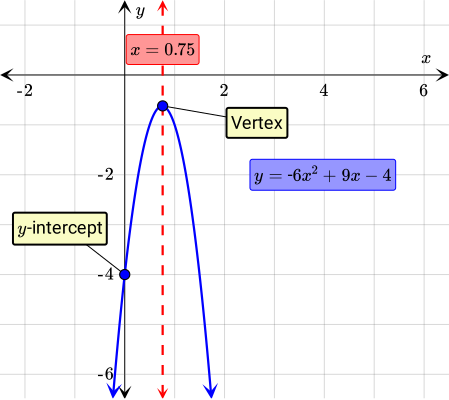 As seen above, the function corresponding to the equation has no zeros. Therefore, the equation has no solutions, meaning that the pebble cannot reach a height of 30 feet.
30=-18x2+27x+18
The solution to this equation, if there is one, represents the time that the pebble reaches 30 feet in height. The equation should be solved by factoring. To do this, it will be first rewritten in standard form.
Now, the same steps as in Part A will be followed. Let the GCF be factored and canceled out.
The values of a, b, and c are -6, 9, and -4, respectively. Now all pairs of integer factors whose product is a⋅c=24 will be listed and their sum calculated. The sum should be 9. Note that since a⋅c and b are both positive, the two factors should be positive as well. | Pair of Factors | Sum of Factors |
|---|---|
| 1 and 24 | 1+24=25 × |
| 2 and 12 | 2+12=14 × |
| 3 and 8 | 3+8=11 × |
| 4 and 6 | 4+6=10 × |
Equation: Function: -6x2+9x−4=0y=-6x2+9x−4
The quadratic function in standard form will be now graphed. Recall the definitions of the axis of symmetry, the vertex, and the y-intercept. Closure
Usefulness of Factoring
This lesson showed how to use factoring and the Zero Product Property to solve quadratic equations. The factoring method can be also used to solve other types of equations, particularly cubic equations of the following form.
ax3+bx2+cx=0
Since the constant term d is equal to 0, x can be factored out in the equation.
ax3+bx2+cx=0⇕x(ax2+bc+c)=0
Next, two equations are obtained by the Zero Product Property.
x(ax2+bc+c)=0⇓x=0ax2+bx+c=0(I)(II)
Equation (I) is already solved. Equation (II) is a quadratic equation that can be solved by factoring or by using some other known method. In general, factoring allows the splitting of a more complicated equation into simpler ones.
Solving Quadratic Equations by Factoring
Exercise 1.1
Use the Zero Product Property to solve the following quadratic equations.
(x+1)(x−2)=0
{"type":"text","form":{"type":"roots","options":{"comparison":"1","nofractofloat":false,"keypad":{"simple":true,"useShortLog":false,"variables":[],"constants":[]},"rendered":false,"hideNoSolution":true,"variable":"x"},"text":"<span class=\"katex\"><span class=\"katex-html\" aria-hidden=\"true\"><\/span><\/span>"},"formTextBefore":null,"formTextAfter":null,"answer":{"texts":["-1","2"]}}
(x−13)(x+5)=0
{"type":"text","form":{"type":"roots","options":{"comparison":"1","nofractofloat":false,"keypad":{"simple":true,"useShortLog":false,"variables":[],"constants":[]},"rendered":false,"hideNoSolution":true,"variable":"x"},"text":"<span class=\"katex\"><span class=\"katex-html\" aria-hidden=\"true\"><\/span><\/span>"},"formTextBefore":null,"formTextAfter":null,"answer":{"texts":["13","-5"]}}
security
report
code
security
report
code
The Zero Product Property tells us that if a product is equal to 0, at least one of the factors must also equal 0. Knowing this, we will inspect the given equation and look for which values of x each factor becomes 0.
The solutions to the equation are x=-1 and x=2.
We will solve this equation in a similar way how it was done in Part A.
The solutions to the equation are x=13 and x=-5.
security
report
code
Use the Zero Product Property to solve the following quadratic equations.
(2x+3)(5x−10)=0
{"type":"text","form":{"type":"roots","options":{"comparison":"1","nofractofloat":false,"keypad":{"simple":true,"useShortLog":false,"variables":[],"constants":[]},"rendered":false,"hideNoSolution":true,"variable":"x"},"text":"<span class=\"katex\"><span class=\"katex-html\" aria-hidden=\"true\"><\/span><\/span>"},"formTextBefore":null,"formTextAfter":null,"answer":{"texts":["-\\dfrac{3}{2}","2"]}}
(3x+1)(10x−7)=0
{"type":"text","form":{"type":"roots","options":{"comparison":"1","nofractofloat":false,"keypad":{"simple":true,"useShortLog":false,"variables":[],"constants":[]},"rendered":false,"hideNoSolution":true,"variable":"x"},"text":"<span class=\"katex\"><span class=\"katex-html\" aria-hidden=\"true\"><\/span><\/span>"},"formTextBefore":null,"formTextAfter":null,"answer":{"texts":["-\\dfrac{1}{3}","\\dfrac{7}{10}"]}}
security
report
code
security
report
code
Recall that the Zero Product Property tells us that if a product is equal to 0, at least one of the factors must be equal to 0. Knowing this, we inspect the given equation and look for which values of x each factor becomes 0.
After a close inspection, the solutions to the equation are x=- 32 and x=2.
We will solve this equation in a similar way to that in Part A.
We have determined that the solutions to the equation are x=- 13 and x= 710.
security
report
code
Solve the following equations.
x2−2x=0
{"type":"text","form":{"type":"roots","options":{"comparison":"1","nofractofloat":false,"keypad":{"simple":true,"useShortLog":false,"variables":[],"constants":[]},"rendered":false,"hideNoSolution":true,"variable":"x"},"text":"<span class=\"katex\"><span class=\"katex-html\" aria-hidden=\"true\"><\/span><\/span>"},"formTextBefore":null,"formTextAfter":null,"answer":{"texts":["0","2"]}}
x2+9x=0
{"type":"text","form":{"type":"roots","options":{"comparison":"1","nofractofloat":false,"keypad":{"simple":true,"useShortLog":false,"variables":[],"constants":[]},"rendered":false,"hideNoSolution":true,"variable":"x"},"text":"<span class=\"katex\"><span class=\"katex-html\" aria-hidden=\"true\"><\/span><\/span>"},"formTextBefore":null,"formTextAfter":null,"answer":{"texts":["0","-9"]}}
security
report
code
security
report
code
We begin by noticing that x is present in both terms on the left-hand side of the equation, so we can factor it out. Then, we can use the Zero Product Property to solve the equation. Let's do it!
We have found that the solutions to the equation are x=0 and x=2.
We will solve this equation in a similar way to that in Part A.
The solutions to the equation are x=0 and x=-9.
security
report
code
Solve the following equations.
x(x−1)+2(x−1)=0
{"type":"text","form":{"type":"roots","options":{"comparison":"1","nofractofloat":false,"keypad":{"simple":true,"useShortLog":false,"variables":[],"constants":[]},"rendered":false,"hideNoSolution":true,"variable":"x"},"text":"<span class=\"katex\"><span class=\"katex-html\" aria-hidden=\"true\"><\/span><\/span>"},"formTextBefore":null,"formTextAfter":null,"answer":{"texts":["1","-2"]}}
2x(x+5)−4(x+5)=0
{"type":"text","form":{"type":"roots","options":{"comparison":"1","nofractofloat":false,"keypad":{"simple":true,"useShortLog":false,"variables":[],"constants":[]},"rendered":false,"hideNoSolution":true,"variable":"x"},"text":"<span class=\"katex\"><span class=\"katex-html\" aria-hidden=\"true\"><\/span><\/span>"},"formTextBefore":null,"formTextAfter":null,"answer":{"texts":["2","-5"]}}
security
report
code
security
report
code
Let's begin by checking both terms on the left-hand side of the equation. We see that they have (x-1) as a common factor, so we can factor it out. Then, we can use the Zero Product Property to solve the equation.
Our work shows that the solutions to the equation are x=-2 and x=1.
Note that (x+5) is a factor of both terms on the left-hand side of the equation. Let's solve this equation by factoring as well.
The solutions to the equation are x=2 and x=-5.
security
report
code
Solving Quadratic Equations by Factoring
Recommended exercises
To get personalized recommended exercises, please login first.
Loading content
≤
>
■2
■▢
e▢
7
8
9
×
÷■1
=
=
√▢
▢√
∫▢▢
4
5
6
+
−
≤
<
log
ln
log▢
1
2
3
()
∣
sin
cos
tan
0
.
π
x
y
Loading content