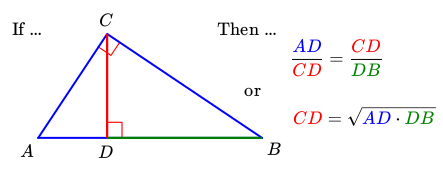
We want to compare the theorem to the expressions in our figure. In our case, x is the length of the altitude, and 3 and 12 are the lengths of the partial segments of the hypotenuse.
CD = sqrt(AD * DB)
⇔ x=sqrt(3* 12)
Now, we can evaluate the right-hand side to find the value of x.
Since we know the lengths of the partial segments of the hypotenuse divided by the altitude, we will use the Geometric Mean (Leg) Theorem to find the values of y and z.
We will start by finding the value of y, which corresponds to AC on this figure.
AC=sqrt(AD * AB)
⇔ y=sqrt(3(12+3))
Now we can evaluate the right-hand side to find y.
Using a calculator, we can express y as about 6.7. Following the same reasoning, we can find z, which corresponds to CB.
CB = sqrt(DB * AB)
⇔ z=sqrt(12(12+3))
Finally, we can evaluate the right-hand side to find the value of z.