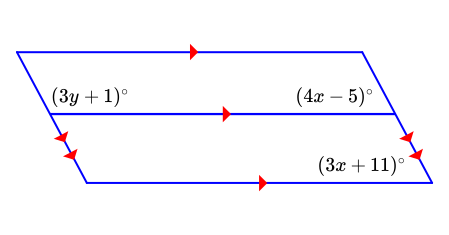
Let's start by finding the value of x. Then we will use it to calculate the value of y.
Value of x
In order to calculate the value of x, we will need to analyze the given diagram. What is the relationship between the angles measuring (4x-5)^(∘) and (3x+11)^(∘)?
Notice that these are corresponding angles. The Corresponding Angles Postulate tells us that if parallel lines are cut by a transversal, then each pair of corresponding angles is congruent. Therefore, the angles measuring (4x-5)^(∘) and (3x+11)^(∘) are congruent and their measures are equal.
4x-5=3x+11
We can solve the above equation to find the value of x.
Before we find the value of y, we will first find the measures of the corresponding angles. To do so, we will substitute the value of x into either one of the given expressions with x-terms. Let's use the expression 4x-5.
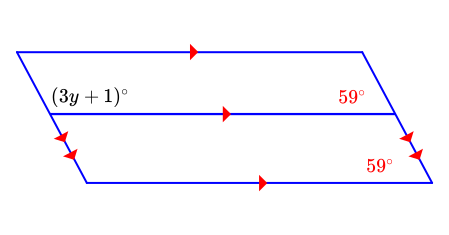
We found that the measures of the corresponding angles are 59^(∘). Let's mark this value on the diagram.
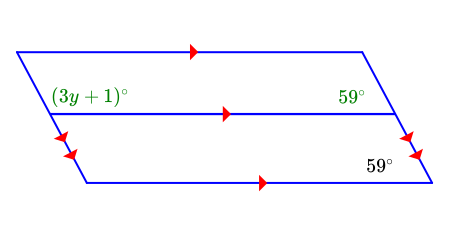
To find the value of y, we need to find the relationship between the angle measuring (3y+1)^(∘) and one of the other angles. Let's analyze the diagram once more.