4. Graphing Rational Functions
Sign In
An error ocurred, try again later!
Chapter 4
4.
Graphing Rational Functions
Rational functions are mathematical expressions that represent the ratio of two polynomials. These functions can exhibit various behaviors on a graph, such as discontinuities, which can be in the form of holes, jumps, or asymptotes. Asymptotes can be vertical, horizontal, or even oblique. The graph of a rational function can provide insights into real-world scenarios, such as modeling the annual income per capita or understanding the dynamics of road maintenance. Additionally, the graph can depict the behavior of medication in the bloodstream over time or the cost dynamics of producing items in a factory. Understanding how to graph these functions is crucial for interpreting and predicting real-world phenomena.
Show less Show more expand_more Lesson Settings & Tools
| | 14 Theory slides |
| | 10 Exercises - Grade E - A |
| | Each lesson is meant to take 1-2 classroom sessions |
Graphing Rational Functions
Slide of 14
A reciprocal function can be considered as the quotient where the denominator is a polynomial with a degree of 1. In other words, there is a variable in the denominator. In this lesson, rational functions in which the numerator and the denominator have a degree of at least 1 will be graphed.
Catch-Up and Review
Here are a few recommended readings before getting started with this lesson.
Challenge
Average Cost Function
LaShay's school, Jeffereson High, visits a local pencil factory. The average cost, in thousand dollars, of producing x thousand pencils is given by the following function.
A(x)=x0.2x2+50x+500
a Graph the average cost function.
Discussion
Rational Functions
A rational function is a function that contains a rational expression. Any function that can be written as the quotient of two polynomial functions p(x) and q(x) is a rational function.
f(x)=q(x)p(x),q(x)=0
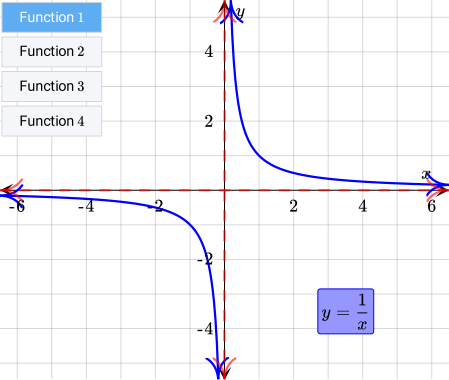
f(x)=x1
This function has two asymptotes, the x-axis and the y-axis. The applet shows the graph of the reciprocal function and some other rational functions.
Discussion
Discontinuity of Rational Functions
The graph of a rational function can be a smooth continuous curve, or it can have jumps, breaks, or holes. By looking at the graph of a function, functions can be categorized into two groups: continuous or discontinuous.
Concept
Discontinuous - Function
A function is said to be continuous if its graph can be drawn without lifting the pencil. Otherwise, the function is said to be discontinuous. 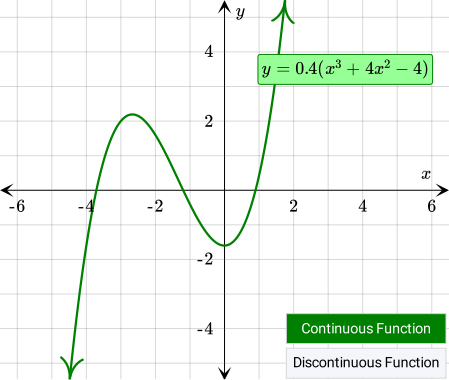 A discontinuous function can have holes, jumps, or asymptotes throughout its graph.
 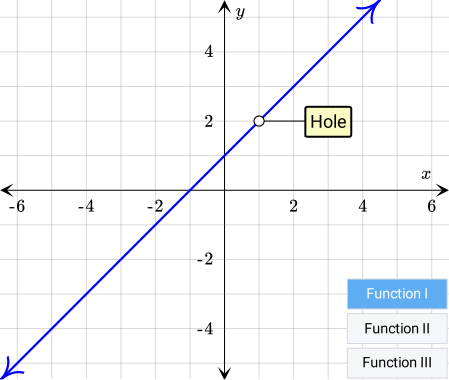 A point where a function is discontinuous is called a discontinuity. Function I has a point of discontinuity at x=1, Function II has a point of discontinuity at x=2, and Function III has a point of discontinuity at x=0.
Concept
Point of Discontinuity
A point of discontinuity of a function is a point with the x-coordinate that makes the function value undefined. A point of discontinuity can also be considered as an excluded value of the function rule.
Removable Discontinuity
If a function can be redefined so that its point of discontinuity is removed, it is called a removable discontinuity. A removable discontinuity may occur when there is a rational expression with common factors in the numerator and denominator. Consider the following rational function.f(x)=x−2x2−4
For this function, x=2 is a point of discontinuity because its denominator is 0 when x=2. Next, notice that the function can be simplified using a difference of squares.
f(x)=x−2x2−4
▼
Simplify right-hand side
WritePow
Write as a power
f(x)=x−2x2−22
FacDiffSquares
a2−b2=(a+b)(a−b)
f(x)=x−2(x+2)(x−2)
SimpQuot
Simplify quotient
f(x)=x+2,x=2
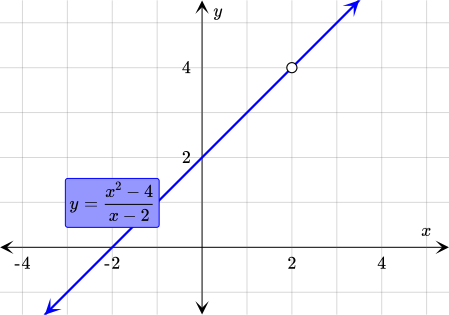
g(x)=⎩⎪⎪⎨⎪⎪⎧x−2x2−4,4,if x=2if x=2
This means that x=2 is a removable discontinuity. Note that a removable discontinuity is typically a holein the graph.
Non-Removable Discontinuity
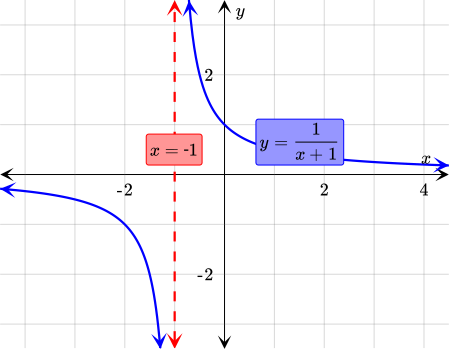
When a function cannot be redefined so that the point of discontinuity becomes a valid input, it is called a non-removable discontinuity. Consider, for example, y=x+11. Since x=-1 is not in the domain of the function, there is a point of discontinuity at x=-1.
Example
Modeling Annual Income Per Capita
LaShay lives in Des Moines, where the total annual amount of personal income I in millions dollars, and the population P in millions, are modeled by the following functions.
In order to write a function for the annual income per person C(t), the total annual income I(t) must be divided by the population P(t). This will give the annual income of a person.
The binomials in the denominator can be multiplied.
This means that t=-50 and t=-30000 are excluded values.
I(t)P(t)=0.02t+15000t+100000=0.36t+10800
In these functions, t represents the number of years that have passed since 1990. a Write a function C(t) modeling the annual income per capita in Des Moines.
{"type":"text","form":{"type":"math","options":{"comparison":"1","nofractofloat":false,"keypad":{"simple":false,"useShortLog":false,"variables":["t"],"constants":["PI"]},"rendered":false},"text":"<span class=\"katex\"><span class=\"katex-html\" aria-hidden=\"true\"><\/span><\/span>"},"formTextBefore":"<span class=\"katex\"><span class=\"katex-html\" aria-hidden=\"true\"><span class=\"base\"><span class=\"strut\" style=\"height:1em;vertical-align:-0.25em;\"><\/span><span class=\"mord mathdefault\" style=\"margin-right:0.07153em;\">C<\/span><span class=\"mopen\">(<\/span><span class=\"mord mathdefault\">t<\/span><span class=\"mclose\">)<\/span><span class=\"mspace\" style=\"margin-right:0.2777777777777778em;\"><\/span><span class=\"mrel\">=<\/span><\/span><\/span><\/span>","formTextAfter":null,"answer":{"text":["\\dfrac{5000t+100000}{0.0072t^2+216.36t+10800}"]}}
b Identify the points of discontinuity of C(t), if any.
{"type":"text","form":{"type":"roots","options":{"comparison":"1","nofractofloat":false,"keypad":{"simple":true,"useShortLog":false,"variables":["x"],"constants":["PI"]},"rendered":false,"hideNoSolution":true,"variable":"t"},"text":"<span class=\"katex\"><span class=\"katex-html\" aria-hidden=\"true\"><\/span><\/span>"},"formTextBefore":null,"formTextAfter":null,"answer":{"texts":["-50","-30000"]}}
Hint
a Divide the total amount of personal income by the population. Recall how to divide rational expressions.
b For which values of t is the function C(t) undefined?
Solution
a Take a look at what the given equations represent.
| Total Annual Income | Population |
|---|---|
| I(t)=0.02t+15000t+100000 | P(t)=0.36t+10800 |
C(t)=I(t)÷P(t)
SubstituteExpressions
Substitute expressions
C(t)=(0.02t+15000t+100000)÷(0.36t+10800)
DivFracSL
ba/c=b⋅ca
C(t)=(0.02t+1)(0.36t+10800)5000t+100000
C(t)=(0.02t+1)(0.36t+10800)5000t+100000
MultPar
Multiply parentheses
C(t)=0.0072t2+216t+0.36t+108005000t+100000
AddTerms
Add terms
C(t)=0.0072t2+216.36t+108005000t+100000
b Consider the function C(t) written in Part A.
C(t)=(0.02t+1)(0.36t+10800)5000t+100000
Recall that division by zero is not defined. Therefore, the rational function is undefined when either of the parentheses equals zero. | C(t) is undefined | |
|---|---|
| 0.02t+1=0 | 0.36t+10800=0 |
| t=-50 | t=-30000 |
DomainAll real numbers except t=-50 and t=-30000
If a real number a is not in the domain of a function, then the function has a point of discontinuity at x=a. Since the domain is all real numbers except t=-50 and t=-30000, there are two points of discontinuity of the function.
Points of Discontinuityt=-50andt=-30000
Example
Finding Point of Discontinuity
On the way to the pencil factory, LaShay noticed that road maintenance work is being carried out to fill a hole
on the road.

R(x)=x3+x2+x+13x2+3x
a Find the x-coordinate of the point where the road maintenance is being completed.
b The municipality of Des Moines plans to build a new road, which is modeled by the following function.
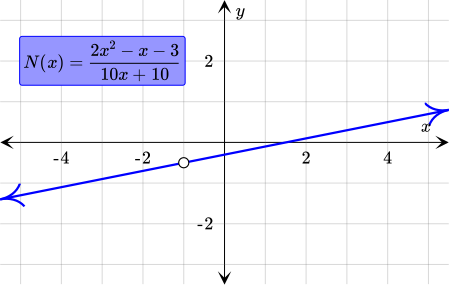
N(x)=10x+102x2−x−3
Graph the function.
Answer
a x=-1
b Graph:
Hint
a Start by factoring the numerator and the denominator of the function. Find the point of discontinuity of the graph.
b Check if the numerator and the denominator have a common factor.
Solution
a The terms in the numerator of the function have a common factor of 3x. Also, the denominator can be factored by grouping.
R(x)=x3+x2+x+13x2+3x
FactorOut
Factor out 3x
R(x)=x3+x2+x+13x(x+1)
FactorOut
Factor out x2
R(x)=x2(x+1)+x+13x(x+1)
FactorOut
Factor out (x+1)
R(x)=(x2+1)(x+1)3x(x+1)
DomainAll real numbers except x=-1
Recall that the point of discontinuity occurs at x=a when a is not in the domain of a function. Consequently, there is a point of discontinuity at x=-1.
Point of Discontinuityx=-1
In the context of the problem, this is the x-coordinate of the point where the road is being repaired. 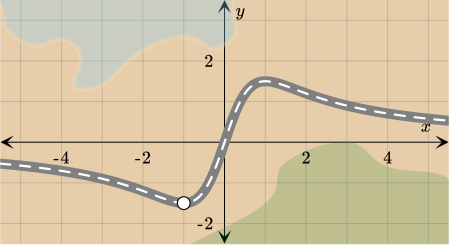
Notice that it is also a removable discontinuity because x+1 is the common factor in the numerator and denominator.
b Start by factoring the numerator and denominator to see if the function can be simplified.
N(x)=10x+102x2−x−3
N(x)=10(x+1)(2x−3)(x+1)
N(x)=10(x+1)(2x−3)(x+1)=102x−3, x=-1
Note that 102x−3=102x−103. Therefore, the graph of the given function is the graph of the function y=102x−103 with a hole at x=-1. 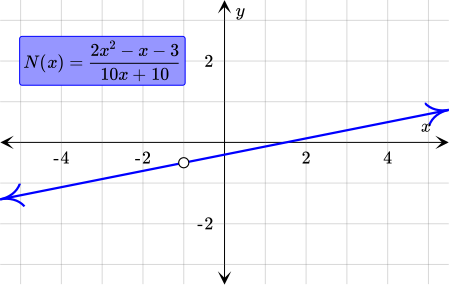
This graph also has a removable discontinuity at x=-1 because x+1 is the common factor in the numerator and denominator of the rational function.
Discussion
Asymptotes of Rational Functions
An asymptote of a graph is an imaginary line that the graph gets close to as x goes to plus or minus infinity or a particular number. For example, the graph of the rational function f(x)=x1 has two asymptotes — the x-axis and the y-axis.
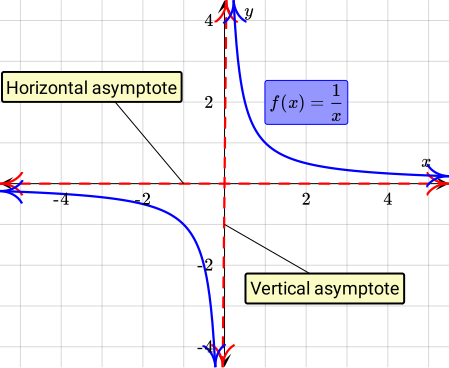
Analyzing the diagram, the following can be observed.
- As x approaches infinity and as x approaches negative infinity, the value of the function approaches 0. Therefore, y=0, or the x-axis, is a horizontal asymptote of the graph of f.
- As x approaches 0, the value of the function approaches either positive or negative infinity. Therefore, x=0, or the y-axis, is a vertical asymptote of the graph of f.
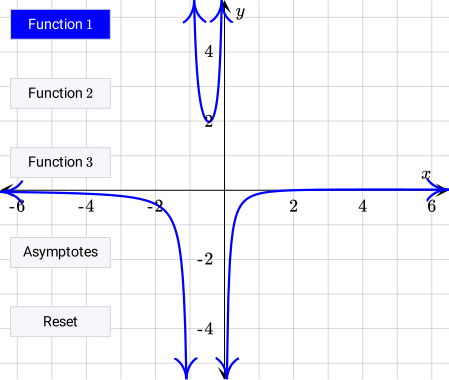
f(x)=q(x)p(x)=bxn+…axm+…
To determine the asymptotes of the function, the denominator and the degrees of the polynomials in the numerator and denominator must be analyzed. Identifying Vertical Asymptotes
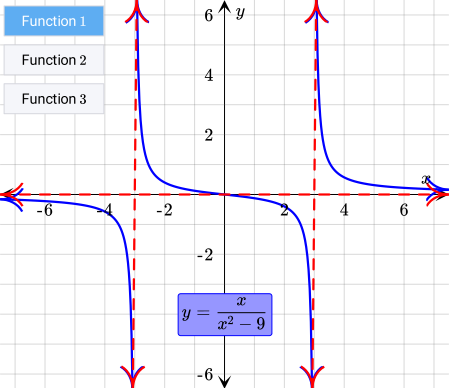
To identify the vertical asymptotes, the function should be in its simplest form. That is, if p(x) and q(x) have common factors, the function should be simplified first. The vertical asymptotes will occur at the zeros of the denominator. Check out the following examples.

Identifying Horizontal Asymptotes
The degrees of polynomials in the numerator and denominator of a rational function will determine if the graph has a horizontal asymptote.
| f(x)=q(x)p(x)=bxn+…axm+… | |
|---|---|
| Horizontal Asymptote | If m>n, there is no horizontal asymptote. |
| If m<n, the horizontal asymptote is y=0. | |
| If m=n, the horizontal asymptote is y=ba. |
Example
Identifying Asymptotes
LaShay takes a travel-sickness pill about 45 minutes before the school bus leaves for the field trip. The amount A in milligrams of the medication in her bloodstream is modeled by the following rational function.
A(t)=t3−t2−10t−86t2−24t
Here, t represents the time in hours after one pill is taken. Identify the asymptotes of the function.
Answer
Vertical Asymptotes: t=-2 and t=-1
Horizontal Asymptote: y=0
Hint
Factor the numerator. What does the Factor Theorem state?
Solution
To identify the asymptotes, the numerator and denominator of the function A(t) need to be factored. Notice that the terms in the numerator have a common factor of 6t.
To factor the polynomial in the denominator, use the Factor Theorem.
Three roots for p(t) were found, so there is no need for further investigation. In conclusion, -1, -2, and 4 are all the real roots of t3−t2−10t−8. Next, apply the Factor Theorem to write its factored form.
Since the numerator and the denominator share the factor t−4, there is a hole at t=4. Also, the denominator becomes zero when t=-1 and t=-2. These values make the function undefined. Therefore, the function has two vertical asymptotes.
Look at the degrees of the numerator and denominator of the function.
|
Factor Theorem |
|
The expression x−a is a factor of a polynomial if and only if the value a is a zero of the related polynomial function. |
p(t)=t3−t2−10t−8
It is a polynomial with a degree of 3. Subsequently, by the Fundamental Theorem of Algebra, it is known know that p(t) has exactly three roots. Additionally, by the Rational Root Theorem, integer roots must be factors of the constant term. Since the constant term of p(t) is -8, the possible integer roots are ±1, ±2, ±4, and ±8. | t | t3−t2−10t−8 | p(t)=t3−t2−10t−8 |
|---|---|---|
| 1 | 13−(1)2−10(1)−8 | -18 |
| -1 | -13−(-1)2−10(-1)−8 | 0 |
| 2 | 23−(2)2−10(2)−8 | -24 |
| -2 | -23−(-2)2−10(-2)−8 | 0 |
| 4 | 43−6(4)2−7(4)+60 | 0 |
t3−t2−10t−8=(t+1)(t+2)(t−4)
Now that the factored form of the denominator has been found, the given function can be simplified.
A(t)=t3−t2−10t−86t(t−4)
Substitute
t3−t2−10t−8=(t+1)(t+2)(t−4)
A(t)=(t+1)(t+2)(t−4)6t(t−4)
CrossCommonFac
Cross out common factors
A(t)=(t+1)(t+2)(t−4)6t(t−4)
CancelCommonFac
Cancel out common factors
A(t)=(t+1)(t+2)6t
Vertical Asymptotest=-1 and t=-2
To find the horizontal asymptote, compare the degrees of the polynomials in the numerator and denominator. | y=bxnaxm | Asymptote |
|---|---|
| m<n | y=0 |
| m>n | none |
| m=n | y=ba |
A(t)=t3−t2−10t−86t2−24t
The degree of the denominator is greater than the degree of the numerator, m<n. Therefore, the horizontal asymptote is y=0.
Horizontal Asymptotesy=0
Discussion
Oblique Asymptote
An asymptote can be neither vertical nor horizontal. It can be a slanted line. In such cases, it is called an oblique asymptote or slant asymptote.
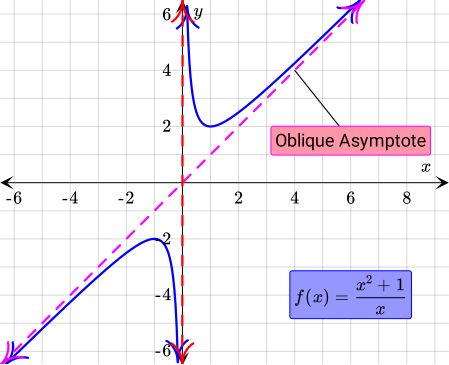
f(x)=q(x)p(x)⇓f(x)=ax+b+r(x)
The equation of the oblique asymptote is of the form y=ax+b, where a is a non-zero real number. Example
To illustrate how the technique is used, the asymptotes of the following function will be found.f(x)=4x2−1x3+2x
The difference between the degrees of the numerator and denominator is 1. This means that its graph does not have a horizontal asymptote but an oblique asymptote. To find the oblique asymptote, polynomial long division will be used.
4x2−1x3+2x
▼
Divide
4x2x3=4x
4x 4x2−1x3+2x
Multiply term by divisor
4x 4x2−1x3+2x x3−4x
Subtract down
4x4x2−1 49x
f(x)=4x2−1x3+2x⇓f(x)=4x+4x2−149x
Therefore, y=4x is the oblique asymptote of the rational function. 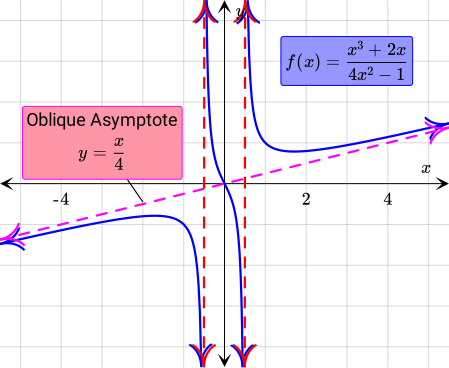
Example
Modeling Interest in The Trip
The students spent about 3 hours at the factory. At the end of this period, LaShay's teacher made a survey about the trip and drew a graph relating the students' interest in the trip and the time elapsed at the factory. The greater the S(t) value, the greater the interest of the students.
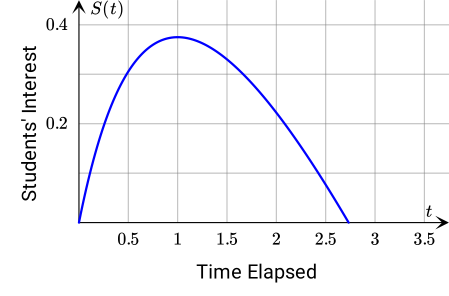
S(t)=t+1t−2(t+1)2t3
Identify the asymptotes of the function.
Answer
Vertical Asymptotes: t=-1
Oblique Asymptote: O(t)=-2t+2
Hint
Start by subtracting the rational expressions on the right-hand side of the function.
Solution
First, the rational expressions on the right-hand side will be subtracted. The least common denominator of the expressions is 2(t+1)2. Therefore, the first expression needs to be multiplied by 2(t+1)2(t+1) so that both have the same denominator.
The numerator and the denominator do not have any common factors. Therefore, the function does not have a point of discontinuity, or hole, in its graph. However, it has a vertical asymptote at t=-1 because the function is undefined at that value.
The given function can be rewritten as follows.
S(t)=t+1t−2(t+1)2t3
▼
Simplify right-hand side
ExpandFrac
ba=b⋅2(t+1)a⋅2(t+1)
S(t)=(t+1)⋅2(t+1)t⋅2(t+1)−2(t+1)2t3
Multiply
Multiply
S(t)=2(t+1)22t(t+1)−2(t+1)2t3
SubFrac
Subtract fractions
S(t)=2(t+1)22t(t+1)−t3
Distr
Distribute 2t
S(t)=2(t+1)22t2+2t−t3
CommutativePropAdd
Commutative Property of Addition
S(t)=2(t+1)2-t3+2t2+2t
▼
Rewrite the denominator
S(t)=2t2+4t+2-t3+2t2+2t
Vertical Asymptotet=-1
Now, to determine if the given rational function has a horizontal or oblique asymptote, the degrees of the polynomials in the numerator and the denominator will be compared.
S(t)=2(t+1)2-t3+2t2+2t⇕S(t)=2t2+4t+2-t3+2t2+2t
The degree of the numerator is greater than the degree of the denominator, so the graph has no horizontal asymptotes. However, since the degree of the numerator is 1 more than that of the denominator, the graph has an oblique asymptote. Its equation is found by dividing the numerator by the denominator. Use long division to do this.
2t2+4t+2-t3+2t2+2t
▼
Divide
2t2-t3=-2t
-2t2t2+4t+2-t3+2t2+2t
Multiply term by divisor
-2t2t2+4t+2-t3+2t2+2t -t3−2t2−t
Subtract down
-2t2t2+4t+24t2+3t
▼
Divide
2t24t2=2
-2t+22t2+4t+24t2+3t
Multiply term by divisor
-2t+2 2t2+4t+24t2+3t 4t2+8t+4
Subtract down
-2t+22t2+4t+2-5t−4
S(t)=-2t+2+2t2+4t+2-5t−4
Therefore, the equation of the oblique asymptote is O(t)=-2t+2.
Discussion
Graphing Rational Functions
Rational functions may have more than one vertical asymptote, which can make graphing them a bit more difficult than graphing reciprocal functions. However, the asymptotes are useful when graphing a rational function because they can describe the end behavior. Consider graphing the following function.
f(x)=x2−7x+12(x2+5x−6)(x−3)
To graph the rational function, these four steps can be followed.
1
Draw the Asymptotes
expand_more First, the vertical asymptote(s) of the function will be found. If the numerator and the denominator of a rational function have no common factors, then the vertical asymptote is the x-value that makes the denominator zero. Start by factoring the denominator to see candidates for asymptotes.
The rational function is undefined where x−4=0 and x−3=0. This means that x=4 and x=3 are not included in the domain. Notice that x−3 is a common factor between the numerator and the denominator. Next, check if there are any other common factors and cancel them.
Since the factor x−3 was canceled, the graph has a
Now consider the degrees of the numerator and denominator for the given function. The simplified form of the function can also be considered at this point because both have the same graph.
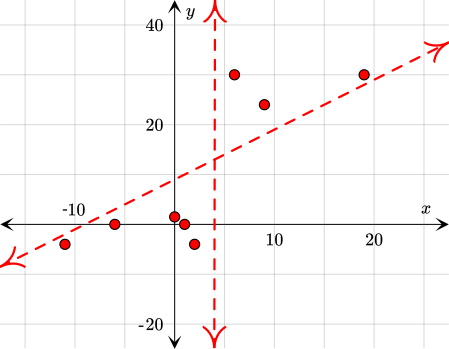
The equation of the oblique asymptote is y=x+9. Finally, draw the asymptotes on a coordinate plane. 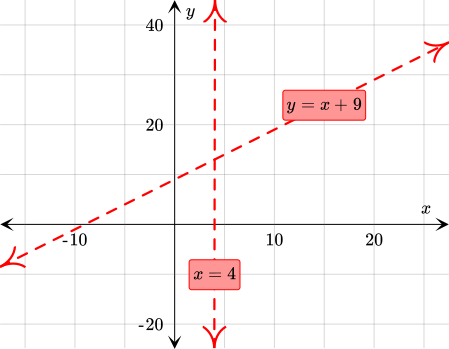
f(x)=x2−7x+12(x2+5x−6)(x−3)
f(x)=(x−4)(x−3)(x2+5x−6)(x−3)
f(x)=(x−4)(x−3)(x2+5x−6)(x−3)
f(x)=(x−4)(x−3)(x−1)(x+6)(x−3)
▼
Simplify
CrossCommonFac
Cross out common factors
f(x)=(x−4)(x−3)(x−1)(x+6)(x−3)
CancelCommonFac
Cancel out common factors
f(x)=x−4(x−1)(x+6), x=3
holeat x=3. Also, the graph has a vertical asymptote at x=4 because 4 is not included in the domain.
Hole: Vertical Asymptote: x=3x=4
The degrees of the polynomials in the numerator and denominator determine whether the function has a horizontal or oblique asymptote. In the following table, m and n are the degrees of the polynomials in the numerator and denominator, and a and b are their respective leading coefficients. | y=bxn+…axm+… | Asymptote | Asymptote Type |
|---|---|---|
| m<n | y=0 | Horizontal |
| m>n | None | None |
| m=n | y=ba | Horizontal |
| m−n=1 | y= the quotient of the polynomials with no remainder | Oblique |
f(x)=x−4(x−1)(x+6), x=3⇓f(x)=x1−4x2+5x−6, x=3
The degree of the numerator minus the degree of the denominator equals 1. Therefore, the function has an oblique asymptote. The equation of the oblique asymptote is found by dividing the numerator by the denominator without considering the remainder. To divide the polynomials, long division will be used.
x−4x2+5x−6
▼
Divide
xx2=x
x x−4x2+5x−6
Multiply term by divisor
x x−4x2+5x−6 x2−4x
Subtract down
x x−49x−6
▼
Divide
x9x=9
x+9x−49x−6
Multiply term by divisor
x+9x−49x − 6 9x−36
Subtract down
x+9x−4 30
The given function has one vertical asymptote. Therefore, its graph will consist of two parts, one to the left and the other to the right of the vertical asymptote. These parts may lie above or below the oblique asymptote.
2
Find the Intercepts
expand_more The x-intercepts are the points where the graph intersects the x-axis. The value of the y-coordinate is zero at these points. Substitute 0 for f(x) in the given function and solve for x. The simplified function can be used to find the zeros.
The graph has two x-intercepts. The y-intercept is the point where the graph intersects the y-axis. At this point, the value of the x-coordinate is zero.
There is a y-intercept at (0,1.5). Show the intercepts on the same coordinate plane. 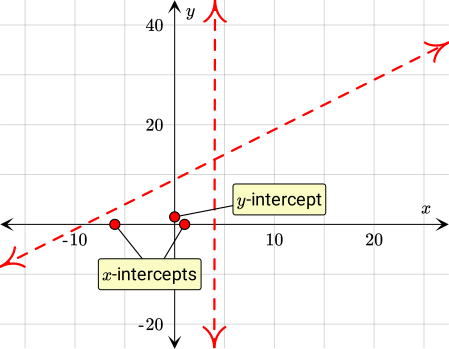
f(x)=x−4(x−1)(x+6)
Substitute
f(x)=0
0=x−4(x−1)(x+6)
▼
Solve for x
MultEqn
LHS⋅(x−4)=RHS⋅(x−4)
0=(x−1)(x+6)
ZeroProdProp
Use the Zero Product Property
x−1=0x+6=0(I)(II)
AddEqn
(I): LHS+1=RHS+1
x=1x+6=0
SubEqn
(II): LHS−6=RHS−6
x=1x=-6
3
Make a Table of Values
expand_more Some additional points are needed to get a good sense of the shape of the graph. Make sure to only use values included in the domain of the function.
| x | x−4(x−1)(x+6) | f(x)=x−4(x−1)(x+6) |
|---|---|---|
| -11 | -11−4(-11−1)(-11+6) | -4 |
| 2 | 2−4(2−1)(2+6) | -4 |
| 6 | 6−4(6−1)(6+6) | 30 |
| 9 | 9−4(9−1)(9+6) | 24 |
| 19 | 19−4(19−1)(19+6) | 30 |
It is almost done. Plot the points and imagine how the shape of the graph should look!
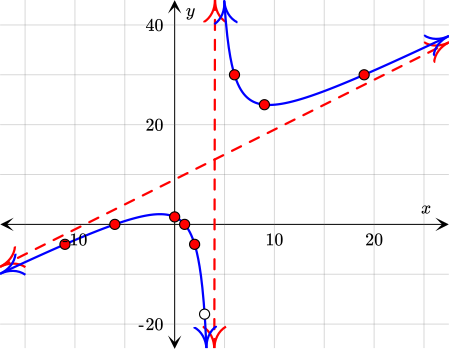
As can be seen, one part of the graph will lie to the left of the vertical asymptote and below the oblique asymptote. The other part of the graph will be to the right of the vertical asymptote and above the oblique asymptote.
4
Draw the Graph
expand_more The graph can now be drawn by connecting the points with a smooth curve. It must approach the asymptotes. Do not forget to plot the hole at x=3!
Example
Graphing the Function for the Surface Area to Volume Ratio of a Box
The factory sells 6 pencils in a rectangular box. The dimensions of the box are shown in the diagram.
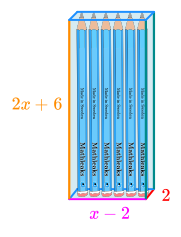
a Write a function of the form E(x)=V(x)S(x), where S(x) and V(x) are the surface area and volume of the box, respectively.
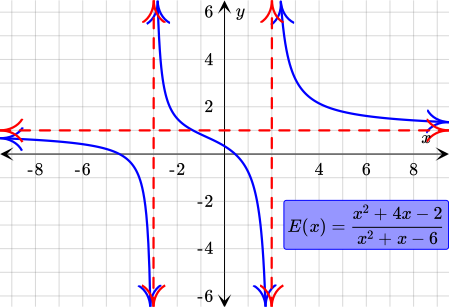
b Graph the function E(x).
Answer
a E(x)=x2+x−6x2+4x−2
b Graph:
Hint
a The surface area of a prism is the sum of the areas of its surfaces. The volume of a prism is the product of its dimensions.
b Start by determining the vertical and horizontal asymptotes. Then, make a table of values.
Solution
a First, the surface area and volume of the given box will be found.
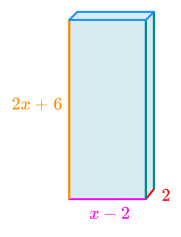
S(x)=2(2)(x−2)+2(2x+6)(x−2)+2(2)(2x+6)
▼
Simplify right-hand side
Multiply
Multiply
S(x)=4(x−2)+2(2x+6)(x−2)+4(2x+6)
Distr
Distribute 4
S(x)=4x−8+2(2x+6)(x−2)+8x+24
Distr
Distribute 2
S(x)=4x−8+(4x+12)(x−2)+8x+24
MultPar
Multiply parentheses
S(x)=4x−8+4x2−8x+12x−24+8x+24
AddSubTerms
Add and subtract terms
S(x)=4x2+16x−8
V(x)=(2x+6)(x−2)(2)
V(x)=4x2+4x−24
E(x)=V(x)S(x)
SubstituteExpressions
Substitute expressions
E(x)=4x2+4x−244x2+16x−8
▼
Simplify right-hand side
E(x)=x2+x−6x2+4x−2
b To graph the given rational function, its asymptotes and intercepts will be found. A table of values will then be used to draw the graph.
Asymptotes
Consider the function written in the previous part.E(x)=x2+x−6x2+4x−2
First, factor the denominator of this function to identify its domain. E(x)=x2+x−6x2+4x−2
WriteDiff
Write as a difference
E(x)=x2+3x−2x−6x2+4x−2
E(x)=x(x+3)−2(x+3)x2+4x−2
FactorOut
Factor out (x+3)
E(x)=(x−2)(x+3)x2+4x−2
DomainAll real numbers except x=-3 and x=2
Asymptotes can be vertical, horizontal, or slanted lines. Once again, consider the function.
E(x)=(x−2)(x+3)x2+4x−2
It seems that the denominator and the numerator do not have a common factor. To find the factors of the numerator, its zeros can be found using the Quadratic Formula.
E(x)=(x−2)(x+3)(x+2+6)(x+2−6)
As shown, they do not have common factors. Therefore, there are no holesin the graph. Recall that if the real number a is not included in the domain, there is a vertical asymptote at x=a. In this case, there are two vertical asymptotes, one at x=-3 and the other at x=2.
Vertical Asymptotesx=-3 and x=2
To find whether the graph has a horizontal or oblique asymptote, review how its type is determined using the degrees of the polynomials in the numerator and the denominator. | y=bxn+…axm+… | Asymptote |
|---|---|
| m<n | y=0 |
| m>n | none |
| m=n | y=ba |
| m−n=1 | y= the quotient of the polynomials with no remainder |
E(x)=1x2+x−61x2+4x−2
The degree of the denominator is equal to the degree of the numerator. Therefore, the line y=11=1 is the horizontal asymptote of the function. 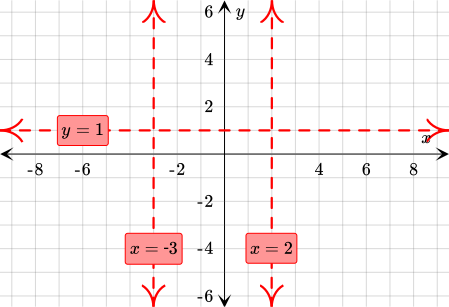
Intercepts
To find the x-intercepts, 0 is substituted for E(x) into the function. It will be better to use the form in which the numerator and the denominator are factored.E(x)=(x−2)(x+3)(x+2+6)(x+2−6)
Substitute
E(x)=0
0=(x−2)(x+3)(x+2+6)(x+2−6)
▼
Solve for x
x≈-4.4x≈0.4
E(x)=x2+x−6x2+4x−2
Substitute
x=0
E(0)=02+0−602+4(0)−2
▼
Solve for E(0)
CalcPow
Calculate power
E(0)=0+0−60+4⋅0−2
ZeroPropMult
Zero Property of Multiplication
E(0)=0+0−60+0−2
IdPropAdd
Identity Property of Addition
y=-6-2
ReduceFrac
ba=b/(-2)a/(-2)
y=31
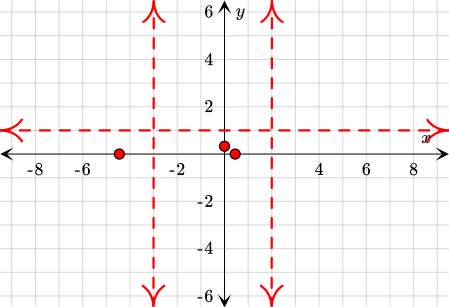
Table of Values
Now, make a table of values to graph the given function.
| x | x2+x−6x2+4x−2 | E(x)=x2+x−6x2+4x−2 |
|---|---|---|
| -6 | (-6)2+(-6)−6(-6)2+4(-6)−2 | ≈0.417 |
| -3.5 | (-3.5)2+(-3.5)−6(-3.5)2+4(-3.5)−2 | ≈-1.364 |
| -2 | (-2)2+(-2)−6(-2)2+4(-2)−2 | 1.5 |
| -1 | (-1)2+(-1)−6(-1)2+4(-1)−2 | ≈0.833 |
| 1 | (1)2+(1)−6(1)2+4(1)−2 | -0.75 |
| 3 | (3)2+(3)−6(3)2+4(3)−2 | ≈3.167 |
| 4 | (4)2+(4)−6(4)2+4(4)−2 | ≈2.143 |
| 5 | (5)2+(5)−6(5)2+4(5)−2 | ≈1.792 |
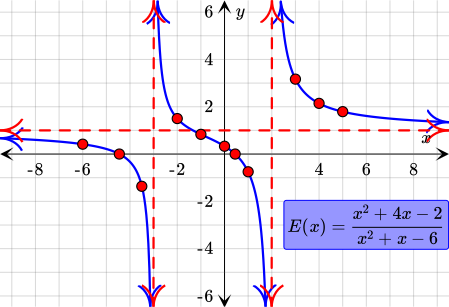
Finally, the graph of the function can be drawn by plotting the found points and connecting them with a smooth curve. Recall that a rational function can cross the horizontal asymptote but cannot cross the vertical asymptotes. In this case, the horizontal asymptote is crossed.
Extra
Factoring The Numerator of E(x)Recall the Factor Theorem.
|
p(x) has a factor (x−a) if and only if p(a)=0. |
E(x)=x2+x−6x2+4x−2
The values of a, b, and c of the numerator are 1, 4, and -2, respectively. Substitute these values into the formula.
x=2a-b±b2−4ac
SubstituteValues
Substitute values
x=2(1)-4±42−4(1)(-2)
▼
Evaluate right-hand side
IdPropMult
Identity Property of Multiplication
x=2-4±42−4(-2)
CalcPow
Calculate power
x=2-4±16−4(-2)
MultNegNegOnePar
-a(-b)=a⋅b
x=2-4±16+8
AddTerms
Add terms
x=2-4±24
SplitIntoFactors
Split into factors
x=2-4±4⋅6
SqrtProd
a⋅b=a⋅b
x=2-4±4⋅6
CalcRoot
Calculate root
x=2-4±2⋅6
FactorOut
Factor out 2
x=22(-2±6)
SimpQuot
Simplify quotient
x=-2±6
x2+4x−2⇕(x+2+6)(x+2−6)
Example
Modeling the Amount of Water Pumped Into the Factory
Factory managers plan to pump water into the factory from a pond near the factory. The managers modeled the amount of water pumped in thousands of barrels per year x years after pumping starts to be as follows.


Now, compare the degrees of the numerator and denominator of the given function.
The given function can be rewritten as follows.
W(x)=15x2+150x-x3+140x2+1500x+5250
a Use a graphing calculator to find the x-intercepts rounded to the nearest integer. Interpret the x-intercepts.
b Determine if the graph has horizontal or oblique asymptotes. If the graph has an oblique asymptote, find its equation.
Answer
a x-intercept: (150,0)
Interpretation: In about 150 years, there will be no water left in the pond.
b The graph has an oblique asymptote because the difference between the degrees of the numerator and the denominator is 1.
Equation: y=-15x+10
Hint
a Use the zero option in the calculator. It may be necessary to re-size the viewing window in order to see the entire graph.
b Compare the degrees of the numerator and the denominator.
Solution
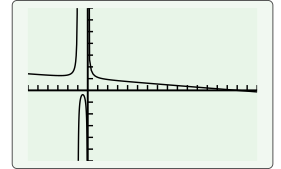
Now, push GRAPH to draw the function.
It appears that only one part of the graph is shown, but it is not possible to know that until the size of the viewing window is changed.
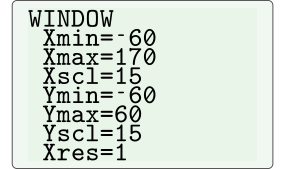
The graph does not seem to have any zeros. However, note that as x increases in the first quadrant, the graph gets closer to the x-axis and could cross it. To check this, zoom in on this part by changing the window settings. Push WINDOW and change the settings as shown below. Then push GRAPH once more to draw the equation with these new settings.
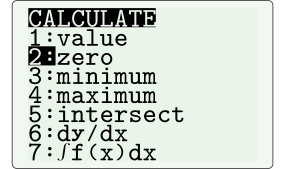
Now it can be seen that the graph intersects the x-axis and there is a zero. To find it, use the zero option in the calculator. It can be found by pressing 2ND and then CALC.
After selecting the zero
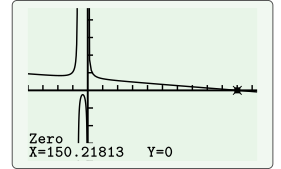
option, choose left and right boundaries for the zero. Finally, the calculator asks for a guess where the zero might be. After that, it will calculate the exact point.
The function intersects the x-axis at about (150,0). Since x represents the numbers of years that have passed since pumping starts, the x-intercept means that in about 150 years, there will be no water left in the pond.
b Recall the table used to determine what type of asymptote a rational function can have.
| y=bxn+…axm+… | Asymptote | Asymptote Type |
|---|---|---|
| m<n | y=0 | Horizontal |
| m>n | None | None |
| m=n | y=ba | Horizontal |
| m−n=1 | y= the quotient of the polynomials with no remainder | Oblique |
W(x)=15x2+150x-x3+140x2+1500x+5250
The degree of the numerator minus the degree of the denominator equals 1. Therefore, the function has an oblique asymptote. The equation of this asymptote is found by dividing the numerator by the denominator and disregarding any remainder. To divide the polynomials, use long division.
15x2+150x-x3+140x2+1500x+5250
▼
Divide
15x2-x3=-15x
-15x15x2+150x-x3+140x2+1500x+5250
Multiply term by divisor
-15x15x2+150x-x3+140x2+1500x+5250 -x3−10x2
Subtract down
-15x15x2+150x150x2+1500x+5250
▼
Divide
15x2150x2=10
-15x + 1015x2+150x150x2+1500x+5250
Multiply term by divisor
-10x + 1015x2+150x150x2+1500x+5250 150x2+1500x
Subtract down
-15x+1015x2+150x 5250
W(x)=-15x+10+15x2+150x5250
Therefore, the equation of the oblique asymptote is y=-15x+10.
Closure
Graphing the Average Cost Function
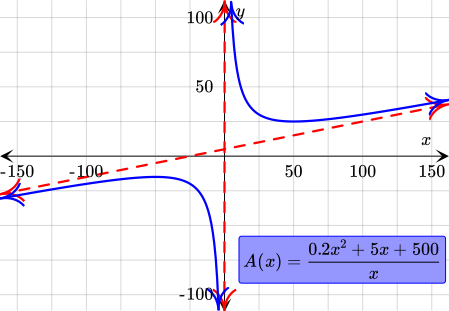
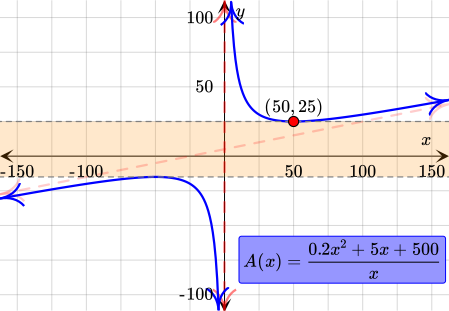
Rational functions can have more than one vertical asymptote but at most one horizontal or oblique asymptote. Also, if the numerator and denominator have a common factor (x−a), then there is a hole at x=a. With these tips in mind, the graph of the function that LaShay wrote at the beginning of the lesson can now be graphed.
Examine the degrees of the numerator and denominator.
The equation of the oblique asymptote is y=0.2x+5. 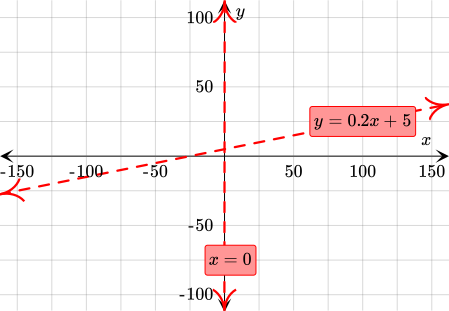 Notice that there is a negative number under the radical symbol. Therefore, the function has no real solutions. In other words, its graph does not cross the x-axis. Furthermore, the graph has no y-intercept as the domain does not contain 0.
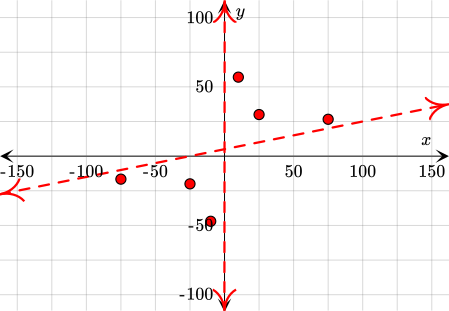
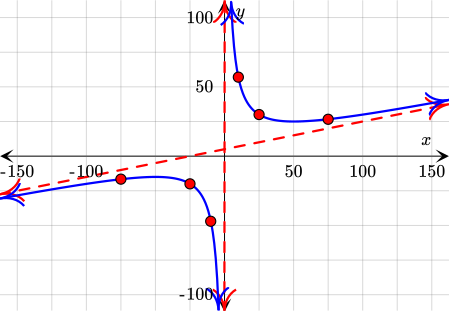
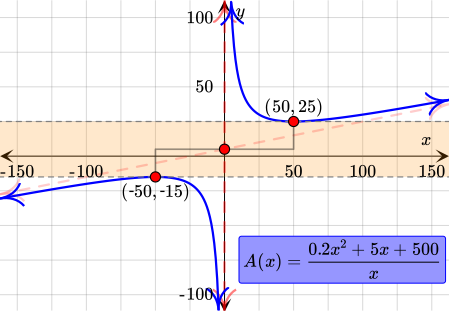 It is the point (-50,-15). Therefore, the range is all the y-values less than or equal to -15 and greater than or equal to 25.


A(x)=x0.2x2+5x+500
The function gives the average cost A(x) in thousands dollars for producing x thousand pencils. a Graph the average cost function.
Answer
a Graph:
b Domain: (-∞,0)∪(0,∞)
Range: (-∞,-15]∪[25,∞)
Range: (-∞,-15]∪[25,∞)
Hint
a Start by identifying asymptotes. Then, make a table of values using values that are around the vertical asymptote.
b Examine the graph and see if the graph is symmetric about the point of intersection of the asymptotes. Determine all the y-values for which the function is graphed.
Solution
a The steps to draw a rational function can be listed as follows.
- Draw the asymptotes.
- Find any intercepts.
- Make a table of values.
- Draw the graph.
Drawing the Asymptotes
The vertical asymptotes of a rational function are the x-values where the denominator of the function is zero.A(x)=x0.2x2+5x+500
The denominator is 0 when x=0. This means that this value is not included in the domain.
DomainAll real numbers except x=0
Since the numerator and denominator do not share a common factor, the graph does not contain any holes. Additionally, the graph has a vertical asymptote at the x-value excluded from the domain.
Vertical Asymptotex=0
Next, recall the table for determining the other asymptotes. | y=bxn+…axm+… | Asymptote | Asymptote Type |
|---|---|---|
| m<n | y=0 | Horizontal |
| m>n | None | None |
| m=n | y=ba | Horizontal |
| m−n=1 | y= the quotient of the polynomials with no remainder | Oblique |
A(x)=x10.2x2+5x+500
The degree of the numerator minus the degree of the denominator equals 1. Therefore, the function has an oblique asymptote. To find its equation, divide the numerator by the denominator using long division.
x0.2x2+5x+500
▼
Divide
x0.2x2=0.2x
0.2x x0.2x2+5x+500
Multiply term by divisor
0.2x x0.2x2+5x+500 0.2x2
Subtract down
0.2x x 5x+500
▼
Divide
x5x=5
0.2x + 5 x 5x+500
Multiply term by divisor
0.2x + 5 x 5x+500 5x
Subtract down
0.2x+5x 500
Oblique Asymptotey=0.2x+5
The asymptotes can be drawn on a coordinate plane. Finding the Intercepts
The x-intercept and y-intercept are the points where a graph crosses the x- and y-axes, respectively. Subsequently, the x-intercepts occurs when A(x)=0.A(x)=x0.2x2+5x+500
Substitute
A(x)=0
0=x0.2x2+5x+500
MultEqn
LHS⋅x=RHS⋅x
0=0.2x2+5x+500
▼
Solve using the quadratic formula
UseQuadForm
Use the Quadratic Formula: a=0.2,b=5,c=500
x=2(0.2)-5±52−4(0.2)(500)
CalcPowProd
Calculate power and product
x=0.4-5±25−400
SubTerm
Subtract term
x=0.4-5±-375
Making a Table of Values
A table of values will be used to get a rough idea of the shape of the graph.
| x | x0.2x2+5x+500 | A(x)=x0.2x2+5x+500 |
|---|---|---|
| -75 | -750.2(-75)2+5(-75)+500 | ≈-16.7 |
| -25 | -250.2(-25)2+5(-25)+500 | -20 |
| -10 | -100.2(-10)2+5(-10)+500 | -47 |
| 10 | 100.2(10)2+5(10)+500 | 57 |
| 25 | 250.2(25)2+5(25)+500 | 30 |
| 75 | 750.2(75)2+5(75)+500 | ≈26.7 |
Plot the points and imagine how the shape of the graph should look!
Finally, draw the graph by connecting the points. It must approach, but not cross, the asymptotes.
b The domain of the function was identified when graphing the function.
Domain: (-∞,0)∪(0,∞)
To identify the range of the function, take a look at its graph. As shown, the range does not contain all real numbers. It appears that the minimum point of the part of the graph in the first quadrant is (50,25). Notice also that the graph is symmetric about the point of intersection of the asymptotes, (0,5). Using this fact, the maximum point of the other part can be identified.
Range: (∞,-15]∪[25,∞)
Checking Our Answer
Use a Graphing CalculatorA graphing calculator can be used to check the answers. The graph of the function will be drawn first. Press the Y= button and type the equation in the first row.
By pushing GRAPH, the calculator will draw the equation. For this function to be visible on the screen, re-size the standard window by pushing the WINDOW button. Change the settings to a more appropriate size and then push GRAPH.
Next, the local maximum and local minimum will be found. To do so, push 2nd, then TRACE, and choose the maximum
option.
When using the maximum
feature, choose the left and right bounds. The calculator will then provide a best guess as to where the maximum might be.
The maximum point of the graph in the third quadrant is (-50,-15). To find the minimum, repeat the same process but choose the minimum
option.
The minimum point of the part in the first quadrant is (50,25). As a result, the range is (∞,-15]∪[25,∞), and the domain is all real numbers except 0.
Graphing Rational Functions
Exercises
Which of the following functions have a vertical asymptote?
A. C. y=x−9x−9y=x2+9x−9B. y=(x−9)2(x−9)4D. y=(x−9)4(x−9)2
{"type":"choice","form":{"alts":["<span class=\"katex\"><span class=\"katex-html\" aria-hidden=\"true\"><span class=\"base\"><span class=\"strut\" style=\"height:0.7109375em;vertical-align:0em;\"><\/span><span class=\"mord text\"><span class=\"mord Roboto-Bold textbf\">A<\/span><\/span><\/span><\/span><\/span>","<span class=\"katex\"><span class=\"katex-html\" aria-hidden=\"true\"><span class=\"base\"><span class=\"strut\" style=\"height:0.7109375em;vertical-align:0em;\"><\/span><span class=\"mord text\"><span class=\"mord Roboto-Bold textbf\">B<\/span><\/span><\/span><\/span><\/span>","<span class=\"katex\"><span class=\"katex-html\" aria-hidden=\"true\"><span class=\"base\"><span class=\"strut\" style=\"height:0.73046875em;vertical-align:-0.009765625em;\"><\/span><span class=\"mord text\"><span class=\"mord Roboto-Bold textbf\">C<\/span><\/span><\/span><\/span><\/span>","<span class=\"katex\"><span class=\"katex-html\" aria-hidden=\"true\"><span class=\"base\"><span class=\"strut\" style=\"height:0.7109375em;vertical-align:0em;\"><\/span><span class=\"mord text\"><span class=\"mord Roboto-Bold textbf\">D<\/span><\/span><\/span><\/span><\/span>"],"noSort":true},"formTextBefore":"","formTextAfter":"","answer":3}
security
report
code
security
report
code
Let's start by reviewing what a rational function is and its main characteristics.
| Rational Function | |
|---|---|
| Form | f(x)=P(x)/Q(x), where P(x) and Q(x) are polynomial functions |
| Domain | All real numbers for which Q(x) ≠ 0 |
| Point of Discontinuity | x=a if Q(a)=0 |
In a rational function, vertical asymptotes occur at the points of discontinuity. Also, if Q(x) has no real zeros, we can guarantee that f(x) will not have a vertical asymptote. Additionally, if Q(x) has a real zero that is a removable discontinuity, it will not have a vertical asymptote either. Let's review what these are and when they happen.
| f(x) = P(x)/Q(x) | ||
|---|---|---|
| Assumptions | Let (x-a)^m and p(x) be factors of P(x) and (x-a)^n and q(x) factors of Q(x) with m ≥ n. Additionally, p(x) and q(x) do not have any common factors. | |
| Factored Form | f(x) = (x-a)^m p(x)/(x-a)^n q(x), where m ≥ n | |
| Removable Discontinuity | x = a | |
| Example | g(x) = (x-3)^1(x+3)/(x-3)^1(x+5) ⇓ Removable Discontinuity x = 3 because 1≥ 1 | |
This is because we can be simplify the quotient by canceling out common factors, which returns an equivalent expression that is not undetermined at x=a. However, the function would still have the gap in the value for which x =a. With this information, we will examine the given functions one by one.
Option A
We are given the following rational function. y = x- 9x- 9 In this case P( 9)=0 and Q( 9)=0. Since they have a common zero, this function has a removable discontinuity at x= 9. We can confirm this by looking at its graph.
We can cancel out common factors to redefine the given function. y = x-9/x-9 ⇔ y = 1 , x ≠ 9 As we can see, we could make the function continuous by defining y(9) = 1. This means that the function has no vertical asymptotes.
Option B
Now, we will analyze a function where m>n. y = (x- 9)^4/(x- 9)^2 In this case, both P( 9)=0 and Q( 9)=0. However, the factor causing this zero has an exponent with a greater value in the numerator. As we can see from its graph, there is a removable discontinuity at x=9 and the graph has no vertical asymptotes.
Again, we can write the function by removing common factors. y = (x-9)^2(x-9)^2/(x-9)^2 [0.5em] ⇕ [0.5em] y = (x-9)^2, x ≠ 9 As we can see, we can redefined y(9) = 0 to make the function continuous. Therefore, the function has no vertical asymptotes.
Option C
Now, consider the function given in option C. y = 9x/x^2+9 We are given a function where Q(x) has no real zeros. Its zeros are x = ± 3i. Since there are no x-values that make the denominator zero, it guarantees that the function will not have a vertical asymptote.
Option D
Finally, we will analyze the last function. y = (x-9)^2/(x-9)^4 In this function, n > m and both P( 9)=0 and Q( 9)=0. However, the factor causing this zero has a lower exponent in the numerator. Therefore, there will be a non-removable discontinuity at x=9.
Although the function can be simplified a bit by removing common factors, the obtained function is not continuous at x=9. y = (x-9)^2/(x-9)^2(x-9)^2 [0.5em] ⇕ [0.5em] y = 1/(x-9)^2, x ≠ 9 The function has vertical asymptote at x=9. Therefore, the answer is D.
Conclusion
Following the ideas discussed above, we can conclude that a rational function will have no vertical asymptotes when the denominator has no real zeros. Or, if it has them, whenever the factors causing them can be divided out with a similar factor from the numerator polynomial.
security
report
code
Graphing Rational Functions
Recommended exercises
To get personalized recommended exercises, please login first.
Loading content
Loading content