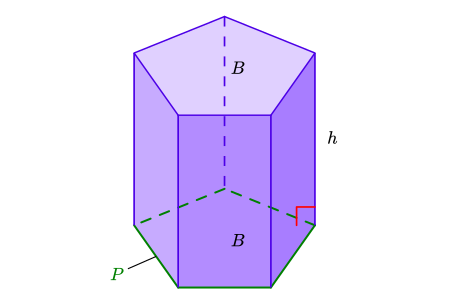
The surface area of the prism can be seen as the sum of two separate parts: the lateral area and the combined area of the two identical bases.
Surface Area=Lateral Area+2⋅Base
The base area, often symbolized as
B, can be substituted into the equation.
Surface Area=Lateral Area+2B
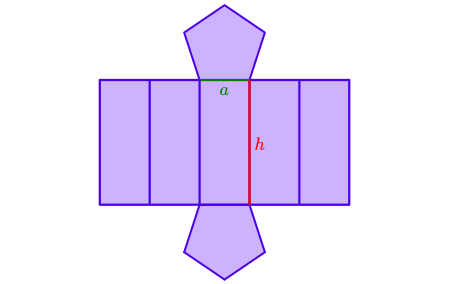
To determine the lateral area of the prism, consider a of the given prism. Let
a be the length of the side of the base, assuming that it is a .
Notice that the lateral surface consists of equal to the number of sides in the base. The pentagonal prism shown here has five lateral faces because a pentagon has five sides. The area of each rectangular lateral face is the product of its sides
a and
h. One Lateral FaceA=ah
If there are
n rectangular lateral faces in a prism, then the total lateral area is the product of
n and the area of one lateral face.
Lateral Areanah
Notice that
na is the perimeter of the base, which is often denoted by
P. Then, the lateral area can be expressed as follows.
Lateral Area=Ph
Therefore, the formula for the surface area is obtained.
Surface AreaSA==Lateral AreaPh++2⋅Base2B
Note that although this proof is written for a regular prism, it is also true for a non-regular prism.