6. Factoring Any Quadratic Expression
Sign In
An error ocurred, try again later!
Chapter 7
6.
Factoring Any Quadratic Expression
This lesson delves into the techniques for breaking down quadratic expressions into simpler forms. It emphasizes the role of the greatest common factor (GCF) and the Zero Product Property in this process. Understanding these methods can be incredibly useful in various scenarios, such as calculating areas or determining the dimensions of objects. For instance, if you're planning a garden layout or trying to figure out the dimensions of a room, these techniques can help you find the most efficient arrangement. The lesson aims to make these mathematical concepts accessible and practical, helping you make informed decisions in both academic and everyday settings.
Show less Show more expand_more 


Lesson Settings & Tools
| | 10 Theory slides |
| | 8 Exercises - Grade E - A |
| | Each lesson is meant to take 1-2 classroom sessions |
Factoring Any Quadratic Expression
Slide of 10
Some of the easiest quadratic expressions to factor are those with a leading coefficient of 1. This lesson will explain how to factor quadratic expressions with leading coefficients other than 1.
Catch-Up and Review
Here are a few recommended readings before getting started with this lesson.
Challenge
Share
Report error
Finding a Pair of Numbers
Consider the numbers a=2, b=12, and c=10. Find two numbers p and q such that the following conditions are satisfied.
cc Condition1 & Condition2 [1em] pq=b/a & p+q=c/aDiscussion
Share
Report error
Factoring a Quadratic Trinomial
If the greatest common factor (GCF) of a quadratic trinomial of the form ax^2+bx+c is a, then it can be rewritten by factoring out a. In this case, since a is a factor of both b and c, these two coefficients can be written in terms of a.
b&=a* b_1, for some numberb_1 c&=a* c_1, for some numberc_1
With this information in mind, the expression ax^2+bx+c can be factored.
The leading coefficient of the quadratic expression in the parentheses is 1. Therefore, it can be factored by finding two numbers p and q such that p+q=b_1 and pq=c_1. a(x^2+b_1x+c_1 ) = a(x+p)(x+q) ⇕ ax^2+bx+c = a(x+p)(x+q)
ax^2+bx+c
SubstituteII
b= a* b_1, c= a* c_1
ax^2+ a* b_1x+ a* c_1
FactorOut
Factor out a
a(x^2+b_1x+c_1 )
Example
Share
Report error
Factoring the Face Area
Magdalena's class is planning a camping trip. Magdalena volunteered to research tents to purchase. When she asked her teacher what size they would buy, he instead told her that the base area of the tent should be 3x^2+12x+9 square feet and its width w is x+3 feet.
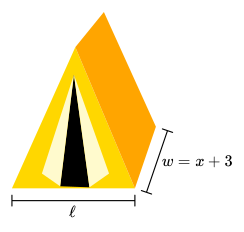
To choose a suitable tent, Magdalena needs to know the dimensions of the tent's base.
{"type":"text","form":{"type":"math","options":{"comparison":"1","nofractofloat":false,"keypad":{"simple":false,"useShortLog":false,"variables":["x"],"constants":[]},"rendered":false},"text":" "},"formTextBefore":"Length:","formTextAfter":"inches","answer":{"text":["3x+3","3(x+1)","3+3x","(x+1)3","3(1+x)","(1+x)3"]}}
b What will be the dimensions of the tent when x=1 foot?
{"type":"text","form":{"type":"math","options":{"comparison":"1","nofractofloat":false,"keypad":{"simple":true,"useShortLog":false,"variables":["x"],"constants":["PI"]},"rendered":false},"text":" "},"formTextBefore":"Width:","formTextAfter":"feet","answer":{"text":["4"]}}
{"type":"text","form":{"type":"math","options":{"comparison":"1","nofractofloat":false,"keypad":{"simple":true,"useShortLog":false,"variables":["x"],"constants":["PI"]},"rendered":false},"text":" "},"formTextBefore":"Length:","formTextAfter":"feet","answer":{"text":["6"]}}
Hint
a Think about the greatest common factor of the given quadratic trinomial.
b Substitute the given value into the expressions that represent the width and length of the tent.
Solution
A= w l ⇓ 3x^2+12x+9= (x+3) l
To find an expression for the length l, the quadratic trinomial that represents the area will be factored. The first step to factoring the polynomial is to find its greatest common factor (GCF), if there is one. Note that the GCF of this expression is 3.
The simplified quadratic trinomial in parentheses now has a leading coefficient of 1. Therefore, it can be factored accordingly. The expression x^2+ 4x+ 3 can be written as (x+ p)(x+ q), where p and q are factor pairs of 3 whose sum is 4.
The table shows that p= 1 and q= 3. With this information in mind, the expression can be fully factored.
3(x^2+4x+3) ⇕ 3(x+ 1)(x+ 3)
This expression represents the area of a tent's base.
A= w l ⇓ 3(x+1)(x+3)=(x+3)l
The expression (x+3) on the right-hand side of the equation represents the width of the tent's base. A measurement for a width cannot be zero, which means that both sides of the equation can be divided by (x+3).
The length of the tent's base is 3x+3 inches.
3x^2+12x+9
SplitIntoFactors
Split into factors
3 x^2+ 3(4) x+ 3(3)
FactorOut
Factor out 3
3 (x^2+ 4x+ 3)
| Factors of 3 | Sum of the Factors |
|---|---|
| -1 and -3 | -1+(-3)=-4 * |
| 1 and 3 | 1+3=4 ✓ |
3(x+1)(x+3)=(x+3)l
DivEqn
.LHS /(x+3).=.RHS /(x+3).
3(x+1)(x+3)/x+3=(x+3)l/x+3
CancelCommonFac
Cancel out common factors
3(x+1)(x+3)/x+3=(x+3)l/x+3
SimpQuot
Simplify quotient
3(x+1)=l
RearrangeEqn
Rearrange equation
l=3(x+1)
Distr
Distribute 3
l=3x+3
b Now that the equations for the width and length of the tent, substitute x= 1 into each binomial to find the corresponding values.
| Substitution | Calculation | |
|---|---|---|
| w=x+3 | w= 1+3 | w=4 feet |
| l=3x+3 | l=3 * 1+3 | l=6 feet |
The class will buy tents that are 4 feet wide and 6 feet long.
Discussion
Share
Report error
Factoring a Quadratic Trinomial
When trying to factor a quadratic trinomial of the form ax^2+ bx+ c, it can be difficult to
seeits factors. Consider the following expression. 8x^2+ 26x+ 6 Here, a= 8, b= 26, and c= 6. There are six steps to factor this trinomial.
1
Factor Out the GCF of a, b, and c
expand_more To fully factor a quadratic trinomial, the Greatest Common Factor (GCF) of a, b, and c has to be factored out first. To identify the GCF of these numbers, their prime factors will be listed.
8 = & 2* 2* 2 26 = & 2* 13 6 = & 2* 3
It can be seen that 8, 26, and 6 share exactly one factor, 2.
GCF( 8, 26, 6)= 2
Now, 2 can be factored out.
In the remaining steps, the factored coefficient 2 before the parentheses can be ignored. The new considered quadratic trinomial is 4x^2+ 13x+ 3. Therefore, the current values of a, b, and c, are 4, 13, and 3, respectively. If the GCF of the coefficients is 1, this step can be ignored.
2
Find the Factor Pair of ac Whose Sum Is b
expand_more It is known that a= 4 and c= 3, so a c=12>0. Therefore, the factors must have the same sign. Also, b= 13. Since the sum of the factors is positive and they must have the same sign, both factors must be positive. All positive factor pairs of 12 can now be listed and their sums checked.
| Factors of a c | Sum of Factors |
|---|---|
| 1 and 12 | 1+12=13 ✓ |
| 2 and 6 | 2+6=8 * |
| 3 and 4 | 3+4=7 * |
In this case, the correct factor pair is 1 and 12. The following table sums up how to determine the signs of the factors based on the values of ac and b.
| ac | b | Factors |
|---|---|---|
| Positive | Positive | Both positive |
| Positive | Negative | Both negative |
| Negative | Positive | One positive and one negative. The absolute value of the positive factor is greater. |
| Negative | Negative | One positive and one negative. The absolute value of the negative factor is greater. |
Such analysis makes the list of possible factor pairs shorter.
3
Write bx as a Sum
expand_more The factor pair obtained in the previous step will be used to rewrite the x-term — the linear term — of the quadratic trinomial as a sum. Remember that the factors are 1 and 12.
The linear term 13x can be rewritten in the original expression as 12x+x.
4x^2+ 13x+3 ⇕ 4x^2+ 12x+x+3
4
Factor Out the GCF of the First Two Terms
expand_more The expression has four terms, which can be grouped into the first two and the last two terms. Then, the GCF of each group can be factored out. 4x^2+12x+ x+ 3
The first two terms, 4x^2 and 12x, can be factored.
4x^2 = & 2* 2* x* x 12x = & 2* 2* 3* x
The GCF of 4x^2 and 12x is 2* 2*x=4x.
5
Factor Out the GCF of the Last Two Terms
expand_more 6
Factor Out the Common Factor
expand_more If all the previous steps have been performed correctly, there should now be two terms with a common factor.
4x (x+3)+1 (x+3)
The common factor will be factored out.
The factored form of 4x^2+13x+3 is (4x+1)(x+3). Remember that the original trinomial was 8x^2+26x+6 and that the GCF 2 was factored out in Step 1. This GCF has to be included in the final result.
8x^2+26x+6 = 2(4x+1)(x+3)
Example
Share
Report error
Factoring ax^2+bx+c When ac is Positive
Heichi and Maya are reading a pamphlet about local campsites. They volunteered to find a suitable campground for their class field trip. Their math teacher, who goes camping often, gives them a challenge to help them decide where to go. If they answer his questions about the pamphlet correctly, he will tell them about his favorite local campsite.
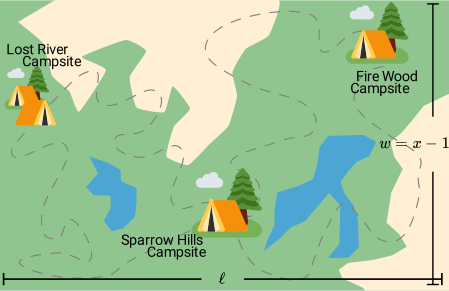
Their teacher tells them that the area of the pamphlet is 3x^2-5x+2 square inches and that it has a width of x-1 inches.
a Write a binomial that represents the length of the pamphlet.
{"type":"text","form":{"type":"math","options":{"comparison":"1","nofractofloat":false,"keypad":{"simple":false,"useShortLog":false,"variables":["x"],"constants":[]},"rendered":false},"text":" "},"formTextBefore":"Length:","formTextAfter":"inches","answer":{"text":["3x-2","-2+3x","(3x-2)","(-2+3x)"]}}
b Find the perimeter of the pamphlet if the width is 4 inches.
{"type":"text","form":{"type":"math","options":{"comparison":"1","nofractofloat":false,"keypad":{"simple":true,"useShortLog":false,"variables":["x"],"constants":[]},"rendered":false},"text":" "},"formTextBefore":"Perimeter:","formTextAfter":"inches","answer":{"text":["34"]}}
Solution
A= w l ⇓ 3x^2-5x+2=(x-1)l To find an expression for the length l, the trinomial that represents the area will be factored. First, the values of a, b, and c for the trinomial will be determined. 3x^2-5x+2 ⇕ 3x^2+( -5)x+ 2 Here, a= 3, b= -5, and c= 2. With this in mind, the following conclusions can be made.
- The Greatest Common Factor (GCF) of a, b, and c is 1.
- Since a c=6, which is greater than zero, the factors must have the same sign.
- Since b= -5, which is negative, the sum of the factors will be negative. Therefore, both of the factors must be negative.
Now, all the negative factor pairs of 6 will be listed and checked whether their sum is -5.
| Factors of ac=6 | Sum of Factors |
|---|---|
| -1 and -6 | - 1+(- 6)=-7 |
| -2 and -3 | - 2+(- 3)=- 5 |
3x^2-2x-3x+2
CommutativePropAdd
Commutative Property of Addition
3x^2-3x-2x+2
3x* x-3x* 1-2x+2
FactorOut
Factor out 3x
3x(x-1)-2x+2
Rewrite
Rewrite 2 as 2 * 1
3x(x-1)-2x+2* 1
FactorOut
Factor out - 2
3x(x-1)-2(x-1)
FactorOut
Factor out (x-1)
(3x-2)(x-1)
b To find the perimeter of a rectangle, all four side lengths must be added. The width of the pamphlet is given as 4 inches. Since the binomial x-1 represents the width, the value of x can be found from here.
Example
Share
Report error
Factoring ax^2+bx+c When ac is Negative
At the campsite, each camper is assigned a rectangular area of 28 square feet for their tent. Dominika wants to place a tarp on the ground below her tent to make sure it stays dry underneath. She does not remember the size of the tarp she has, but she knows that its length is 1 inch less than twice its width. 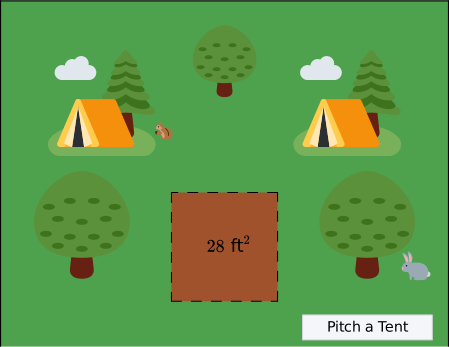 Dominika finds that the tarp fits exactly in the allocated area. Help her find the length and width of the tarp.
 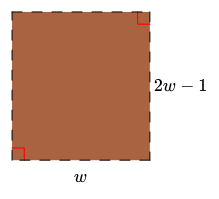 Since the base is a rectangle, its area is equal to the product of its width and length.
Now, the obtained quadratic expression will be factored. First, its coefficients will be identified.
2w^2-w-28=0 ⇕ 2w^2+( -1)w+( -28)=0
Here, a= 2, b= -1, and c= -28. With this in mind, the following conclusions can be made.
Since the base is a rectangle, its area is equal to the product of its width and length.
Now, the obtained quadratic expression will be factored. First, its coefficients will be identified.
2w^2-w-28=0 ⇕ 2w^2+( -1)w+( -28)=0
Here, a= 2, b= -1, and c= -28. With this in mind, the following conclusions can be made.
Of these factors, -8 and 7 satisfy the conditions. Therefore, the x-term of the trinomial on the left-hand side of the equation will be rewritten by using these numbers as a sum.
2w^2 - w-28=0 ⇓ 2w^2 - 8w+7w-28=0
Then, the obtained expression will be factored by grouping.
Since the product of the two binomials is zero, at least one binomial must equal zero. With this in mind, the Zero Product Property will be applied.
The solutions to the equation are 4 and - 3.5. Since a negative length does not make sense, w cannot be negative. This means that the value of the width is 4 feet. With this information and knowing that the length is 1 foot less than twice the width, the length can be found.
The base of the tarp has a length and a width of 7 and 4 feet, respectively.
rc
Width:& 4feet Length:& 7 feet
{"type":"text","form":{"type":"math","options":{"comparison":"1","nofractofloat":false,"keypad":{"simple":true,"useShortLog":false,"variables":[],"constants":[]},"rendered":false},"text":" "},"formTextBefore":"Length:","formTextAfter":"feet","answer":{"text":["7"]}}
{"type":"text","form":{"type":"math","options":{"comparison":"1","nofractofloat":false,"keypad":{"simple":true,"useShortLog":false,"variables":[],"constants":[]},"rendered":false},"text":" "},"formTextBefore":"Width:","formTextAfter":"feet","answer":{"text":["4"]}}
Hint
Start by writing a quadratic expression for the area of the tarp. Then, factor the obtained expression.
Solution
An expression for the area of the tarp can be written by using the expressions for its length and width. Let w be the width of the tarp. Since the length is 1 inch less than twice the width, it can be expressed as 2w-1.
- The Greatest Common Factor (GCF) of a, b, and c is 1.
- Since a c=-56, which is less than zero, the factors must have the different signs. Therefore, there is a positive factor and a negative factor.
- Since b= -1, the sum of the factors is negative. This means that the absolute value of the negative factor is greater than the absolute value of the positive factor.
Now, the factor pairs of -56 with opposite signs and where the absolute value of the negative factor is greater than the absolute value of the positive number will be listed. Also, their sum will be calculated to see if it is - 1.
| Factors of ac=- 56 | Sum of Factors |
|---|---|
| -56 and 1 | - 56+1=-55 |
| -28 and 2 | - 28+2=-26 |
| -14 and 4 | - 14+4=-10 |
| -8 and 7 | - 8+7=-1 |
2w^2-8w+7w-28=0
2w * w-2w* 4+7w-28=0
FactorOut
Factor out 2w
2w(w-4)+7w-28=0
SplitIntoFactors
Split into factors
2w(w-4)+7w-7* 4=0
FactorOut
Factor out 7
2w(w-4)+7(w-4)=0
FactorOut
Factor out (w-4)
(2w+7)(w-4)=0
(w-4)(2w+7)=0
▼
Solve using the Zero Product Property
ZeroProdProp
Use the Zero Product Property
lcw-4=0 & (I) 2w+7=0 & (II)
AddEqn
(I): LHS+4=RHS+4
lw=4 2w+7=0
SubEqn
(II): LHS-7=RHS-7
lw=4 2w=-7
DivEqn
(II): .LHS /2.=.RHS /2.
lw=4 w=-3.5
Example
Share
Report error
Factoring ax^2+bx+c When a is Negative
Dylan is practicing on the basketball court at the campground. For the ball to fall through the hoop without hitting the rim or backboard, it needs to follow a specific path after being thrown at a 45^(∘) angle.
 This path can be modeled with a quadratic function.
h(t)=-5t^2+13t+6 Here, h is the height of the ball in feet t seconds after it has been thrown. Using this model, find the time it takes for the ball to hit the ground after Dylan throws it.
This path can be modeled with a quadratic function.
h(t)=-5t^2+13t+6 Here, h is the height of the ball in feet t seconds after it has been thrown. Using this model, find the time it takes for the ball to hit the ground after Dylan throws it.
The factors of - 30 whose sum is 13 are -2 and 15. The t-term of the right-hand side can be rewritten as a subtraction of these numbers.
0=-5t^2+ 13t+6 ⇓ 0=-5t^2+ 15t-2t+6
Now, the obtained expression will be factored by grouping.
The factoring process is finally done. Now, the Zero Product Property can be used to find the t-values.
Since a negative time does not make sense, t=3 is the only solution that satisfies the conditions. This means that the ball will hit the ground 3 seconds after it is thrown.
{"type":"text","form":{"type":"math","options":{"comparison":"1","nofractofloat":false,"keypad":{"simple":true,"useShortLog":false,"variables":[],"constants":[]},"rendered":false},"text":" "},"formTextBefore":"Time:","formTextAfter":"seconds","answer":{"text":["3"]}}
Hint
The value of h is zero when the ball hits the ground.
Solution
The height of the ball is zero when the it hits the ground. Therefore, to find the total time it takes for the ball to hit the ground, 0 will be substituted for h(t) in the given equation. h(t)=-5t^2+13t+6 ⇓ 0=-5t^2+13t+6 Now, the trinomial will be factored. First, its coefficients will be identified. -5t^2+ 13t+ 6 Here, a= -5, b= 13, and c= 6. With this information in mind, the following conclusions can be made.
- The Greatest Common Factor (GCF) of a, b, and c is 1.
- Since a c=-30, which is less than zero, the factors must have different signs. Therefore, one of the factors is positive and one of the factors is negative.
- Since b= 13, the sum of the factors is positive. Therefore, the absolute value of the positive factor is greater than the absolute value of the negative factor.
Now, the factor pairs of -30 with opposite signs and where the absolute value of the positive factor is greater than the absolute value of the negative factor will be listed. Also, their sum will be calculated to see whether it is 13.
| Factors of ac=- 30 | Sum of Factors |
|---|---|
| -1 and 30 | 29 |
| -2 and 15 | 13 |
| -3 and 10 | 7 |
| -5 and 6 | 1 |
0=-5t^2+15t-2t+6
RearrangeEqn
Rearrange equation
-5t^2+15t-2t+6=0
-5t * t +5t* 3-2t+6=0
FactorOut
Factor out -5t
-5t(t-3)-2t+6=0
Rewrite
Rewrite 6 as 2 * 3
-5t(t-3)-2t+2 * 3=0
FactorOut
Factor out -2
-5t(t-3)+(-2)(t-3)=0
AddNeg
a+(- b)=a-b
-5t(t-3)-2(t-3)=0
FactorOut
Factor out (t-3)
(-5t-2)(t-3)=0
(-5t-2)(t-3)=0
▼
Solve using the Zero Product Property
ZeroProdProp
Use the Zero Product Property
lc-5t-2=0 & (I) t-3=0 & (II)
AddEqn
(I): LHS+2=RHS+2
l-5t=2 t-3=0
DivEqn
(I): .LHS /(- 5).=.RHS /(- 5).
lt= 2- 5 t-3=0
MoveNegDenomToFrac
(I): Put minus sign in front of fraction
lt=- 25 t-3=0
CalcQuot
(I): Calculate quotient
lt=- 0.4 t-3=0
AddEqn
(II): LHS+3=RHS+3
lt=- 0.4 t=3
Example
Share
Report error
The Width of a Path
There is a jogging track around the campground with the same width on every side. It is known that the campground has a rectangular shape with a width of 30 meters and a length of 50 meters.

a Write a trinomial that represents the total area of the campground and the jogging track.
{"type":"text","form":{"type":"math","options":{"comparison":"1","nofractofloat":false,"keypad":{"simple":false,"useShortLog":false,"variables":["x"],"constants":[]},"rendered":false},"text":" "},"formTextBefore":"Area:","formTextAfter":"square meters","answer":{"text":["4x^2+160x+1500","4x^2+1500+160x","160x+1500+4x^2","160x+4x^2+1500","1500+4x^2+160x","1500+160x+4x^2"]}}
b The total area for the campground and the jogging track altogether is 2204 square meters. What is the width of the jogging track?
{"type":"text","form":{"type":"math","options":{"comparison":"1","nofractofloat":false,"keypad":{"simple":true,"useShortLog":false,"variables":[],"constants":[]},"rendered":false},"text":" "},"formTextBefore":"Width:","formTextAfter":"meters","answer":{"text":["4"]}}
Solution
a Let x be the width of the track. The dimensions of the figure can be shown on the diagram.
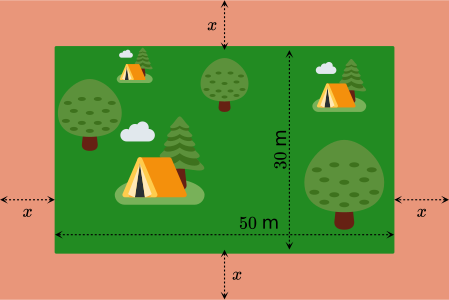
A=(2x+30)(2x+50)
A=4x^2+160x+1500
b To find the width of the jogging track x, the trinomial found in Part A will be set equal to the total area of the jogging track and campground, 2204 square meters.
2204=4x^2+160x+1500
SubEqn
LHS-2204=RHS-2204
0=4x^2+160x-704
RearrangeEqn
Rearrange equation
4x^2+160x-704=0
4x^2+160x-704=0
SplitIntoFactors
Split into factors
4 * x^2 + 4 * 40x- 4 * 176=0
FactorOut
Factor out 4
4(x^2+40x-176)=0
| Factors of -176 | Sum of Factors |
|---|---|
| -1 and 176 | - 1+176=175 |
| -2 and 88 | - 2+88=86 |
| -4 and 44 | - 4+44=40 |
| -8 and 22 | - 8+22=14 |
| -11 and 16 | - 11+16=5 |
| -16 and 11 | - 16+11=-5 |
| -22 and 8 | - 22+8=-14 |
| -44 and 4 | - 44+4=-40 |
| -88 and 2 | - 88+2=-86 |
| -176 and 1 | - 176+1=-175 |
4(x-4)(x+44)=0
DivEqn
.LHS /4.=.RHS /4.
(x-4)(x+44)=0
▼
Solve using the Zero Product Property
ZeroProdProp
Use the Zero Product Property
lcx-4=0 & (I) x+44=0 & (II)
AddEqn
(I): LHS+4=RHS+4
lx=4 x+44=0
SubEqn
(II): LHS-44=RHS-44
lx=4 x=-44
Closure
Share
Report error
Finding a Pair of Numbers
The topics learned in this lesson can be applied to the challenge presented at the beginning. Three numbers a=2, b=10, and c=12 are given. The challenge is to find two numbers p and q that satisfy the following conditions.
cc
Condition1 & Condition2 [1em] pq=c/a & p+q=b/a
If p is less than q, find these two values.
{"type":"text","form":{"type":"math","options":{"comparison":"1","nofractofloat":false,"keypad":{"simple":true,"useShortLog":false,"variables":[],"constants":[]},"rendered":false},"text":" "},"formTextBefore":"p=","formTextAfter":null,"answer":{"text":["2"]}}
{"type":"text","form":{"type":"math","options":{"comparison":"1","nofractofloat":false,"keypad":{"simple":true,"useShortLog":false,"variables":[],"constants":[]},"rendered":false},"text":" "},"formTextBefore":"q=","formTextAfter":null,"answer":{"text":["3"]}}
Hint
Substitute the given numbers a, b, and c into the equations of the conditions.
Solution
Start by substituting the given numbers a= 2, b= 10, and c= 12 into the equations of the conditions. cc Condition1 & Condition2 [1em] p* q=12/2 & p+ q=10/2 ⇓ & ⇓ p* q=6 & p+ q=5 In this case, p and q are factors of 6 and they have a positive sum. To find these numbers, all positive factor pairs of 6 will be listed and their sum will be calculated.
| Factors of 6 | Sum of Factors |
|---|---|
| 1 and 6 | 7 |
| 2 and 3 | 5 |
The table shows that 2 and 3 satisfy the conditions. Since p is less than q, p= 2 and q= 3. If the given numbers a= 2, b= 10, and c= 12 are the coefficients of a quadratic expression, then this trinomial can be factored by considering the methods and examples already discussed. ax^2+ bx+ c ⇓ 2x^2+ 10x+ 12 First, the Greatest Common Factor of all therms, 2, must be factored out. 2x^2+ 10x+ 12 ⇕ 2(x^2+5x+6) The leading coefficient of the trinomial in parentheses is 1. Therefore, it can be factored as (x+ p)(x+ q) where p and q are factor pairs of 6 whose sum is 5. These values are already known and are p= 2 and q= 3. 2x^2+ 10x+ 12 ⇕ 2(x+ 2)(x+ 3)
Factoring Any Quadratic Expression
Exercise 1.1
Factor the following trinomial.
2x^2+2x-12
{"type":"text","form":{"type":"math","options":{"comparison":"1","nofractofloat":false,"keypad":{"simple":false,"useShortLog":false,"variables":["x"],"constants":[]},"rendered":false},"text":" "},"formTextBefore":null,"formTextAfter":null,"answer":{"text":["2(x+3)(x-2)","2(x-2)(x+3)","2(3+x)(x-2)","2(x+3)(-2+x)","2(3+x)(-2+x)","(x+3)(x-2)2"]}}
security
report
code
security
report
code
We will factor the given trinomial. To do so, we first need to check the greatest common factor (GCF) between the terms of the expression. To identify the GCF, we will split each term into its factors.
After factoring out the GCF, we obtained a trinomial with a leading coefficient of 1 in the parentheses. Now let's consider the coefficient of the linear term. x^2+x-6 ⇕ x^2+ 1x+( -6) Next, we will factor this expression into the form (x+ p)(x+ q), where p and q are factor pairs of -6 whose sum is 1. Let's list all factors of -6 and calculate their sums in a table.
| Factors of -6 | Sum of Factors |
|---|---|
| 1 and -6 | -5 |
| 2 and -3 | -1 |
| 3 and -2 | 1 |
| 6 and -1 | 5 |
According to the table, 3 and -2 satisfy the conditions. Therefore, we will substitute p= 3 and q= -2 into the product (x+ p)(x+ q).
Finally, we can complete the factorization. Don't forget the 2 that we factored out at the beginning! 2x^2+2x-12 ⇕ 2(x+ 3)(x -2)
security
report
code
Factor the following trinomial.
6m^2+17m+5
{"type":"text","form":{"type":"math","options":{"comparison":"1","nofractofloat":false,"keypad":{"simple":false,"useShortLog":false,"variables":["m"],"constants":[]},"rendered":false},"text":" "},"formTextBefore":null,"formTextAfter":null,"answer":{"text":["(3m+1)(2m+5)","(2m+5)(3m+1)","(1+3m)(5+2m)","(5+2m)(1+3m)"]}}
security
report
code
security
report
code
We are given a quadratic trinomial in the form am^2+bm+c, where |a|≠1 and there are no common factors between its terms. To factor this expression, we will rewrite the middle term, bm, as a sum of two terms. The coefficients of these two terms will be factors of ac whose sum must be b. 6m^2+ 17m+ 5 In this case, a= 6, b= 17, and c= 5. To rewrite the expression, we need to follow these three steps.
- First, find a c. Since a= 6 and c= 5, the value of a c is 6* 5=30.
- Second, find the factors of a c. Since a c=30, which is positive, we need the factors of a c to have the same sign — both positive or both negative — in order for the product to be positive. Because b= 17 is also positive, those factors will need to be positive so that their sum is positive.
| Factors of ac=30 | Sum of Factors |
|---|---|
| 1 and 30 | 31 |
| 2 and 15 | 17 |
| 3 and 10 | 13 |
| 5 and 6 | 11 |
- Lastly, rewrite bm as the sum of two terms. Now that we know which factor pair to use, we can rewrite bm as the sum of two terms.
6m^2 + 17m+5 ⇕ 6m^2 + 2m + 15m+5 Now we can factor this expression by grouping.
security
report
code
Factor the following trinomial.
-4y^2-8y+21
{"type":"text","form":{"type":"math","options":{"comparison":"1","nofractofloat":false,"keypad":{"simple":false,"useShortLog":false,"variables":["y"],"constants":[]},"rendered":false},"text":" "},"formTextBefore":null,"formTextAfter":null,"answer":{"text":["-(2y-3)(2y+7)","-(2y+7)(2y-3)","(3-2y)(2y+7)","(2y-3)(-2y-7)","(2y+7)(3-2y)","(-2y-7)(2y-3)"]}}
security
report
code
security
report
code
We will find the factored form of the given trinomial. To do so, we will begin by factoring out -1 from the quadratic expression to make its leading coefficient positive. -4y^2-8y+21 ⇔ - (4y^2+8y-21 ) We now have a quadratic trinomial in the form ay^2+by+c, where |a| ≠ 1 and the greatest common factor of the terms is 1. To factor this expression, we will rewrite the middle term, by, as the sum of two terms. The coefficients of these two terms will be factors of ac whose sum must be b. - ( 4y^2+8y-21 ) ⇔ - ( 4y^2+ 8y+( -21) ) In this expression, a= 4, b= 8, and c= -21. There are now three steps we need to follow to rewrite this expression.
- First, find a c. Since we have that a= 4 and c= -21, the value of a c is 4( -21)=-84.
- Second, find the factors of a c. Since 4( -21)=-84, which is negative, we need factors of a c to have the different signs — one positive and one negative — for the product to be negative. Since b= 8, which is positive, the absolute value of the positive factor will need to be greater than the absolute value of the negative factor.
| Factors of ac=-84 | Sum of Factors |
|---|---|
| -1 and 84 | 83 |
| -2 and -42 | 40 |
| -3 and 28 | 25 |
| -4 and 21 | 17 |
| -6 and 14 | 8 |
| -7 and 12 | 5 |
- Lastly, rewrite by as the sum of two terms. Now that we know which factor pair to use, we can rewrite by as the sum of two terms.
- (4y^2 + 8y-21 ) ⇕ - ( 4y^2 - 6y + 14y-21 ) Now, we can factor this obtained expression by grouping.
security
report
code
Solve the following equation by factoring.
2k^2+k-15=0
{"type":"text","form":{"type":"roots","options":{"comparison":"1","nofractofloat":false,"keypad":{"simple":true,"useShortLog":false,"variables":["x"],"constants":["PI"]},"rendered":false,"hideNoSolution":true,"variable":"k"},"text":" "},"formTextBefore":null,"formTextAfter":null,"answer":{"texts":["\\dfrac{5}{2}","-3"]}}
security
report
code
security
report
code
We want to solve the given equation by factoring. Let's write an outline of our plan.
- Determine if anything can be factored from the original equation.
- Find the product of the coefficients a and c.
- Determine which factor pair can be used.
- Write the the pair as the sum of two terms and determine what can be factored.
- Apply the Zero Product Property.
To get things started, notice that the greatest common factor of the terms is 1. That means we do not need to factor anything out of the original equation. We are working with a trinomial. Let's then identify the equation's coefficients. 2k^2+k-15=0 ⇕ 2k^2+ 1k+( -15)=0 Here, a= 2, b= 1, and c= -15. Let's use this information find the value of a c. 2( -15)=-30 Now, let's find the factors of a c by analyzing -30, the product of 2 by -15. Because -30 is a negative value, we need the factors of a c to have different signs — one positive and one negative. a + times a - equals a - Recall that b= 1, which is positive. That means the absolute value of the positive factor will need to be greater than the absolute value of the negative factor.
| Factors of ac=- 30 | Sum of Factors |
|---|---|
| -1 and 30 | - 1+30=29 |
| -2 and 15 | - 2+15=13 |
| -3 and 10 | - 3+10=7 |
| -5 and 6 | - 5+6=1 |
The factor pair of 6 and ¬5. We can now rewrite bk as the sum of two terms. 2k^2+ 1k-15=0 ⇕ 2k^2 - 5k + 6k-15=0 Next, we will factor the expression on the left-hand side of the equation by grouping.
Finally, we will apply the Zero Product Property to find the solutions to the given equation.
The solutions to the equation are k= 52 and k=-3.
security
report
code
Factoring Any Quadratic Expression
Recommended exercises
To get personalized recommended exercises, please login first.
Loading content
≤
>
■2
■▢
e▢
7
8
9
×
÷■1
=
=
√▢
▢√
∫▢▢
4
5
6
+
−
≤
<
log
ln
log▢
1
2
3
()
∣
sin
cos
tan
0
.
π
x
y
Loading content