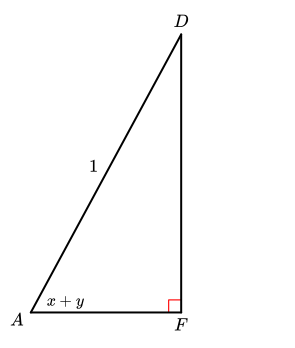
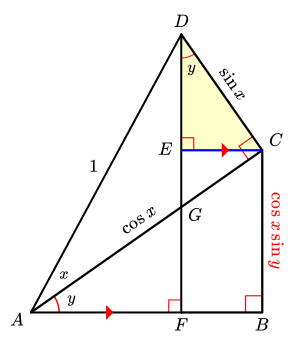
Let △AFD be a with 1 and an with measure x+y.
By definition, the sine of an angle is the between the lengths of the opposite side and the hypotenuse.
sin(x+y)=1DF⇓DF=sin(x+y)
The idea now is to rewrite
DF in terms of
sinx, siny, cosx, and
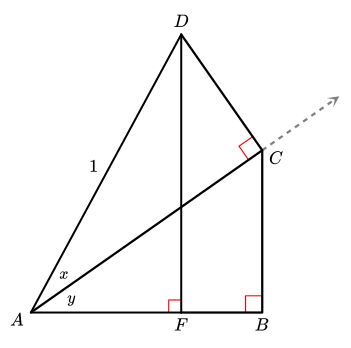
cosy. To do it, draw a ray so that
∠A is divided into two angles with measures
x and
y. Let
C be a point on this ray such that
△ACD and
△ABC are right triangles.
Consider
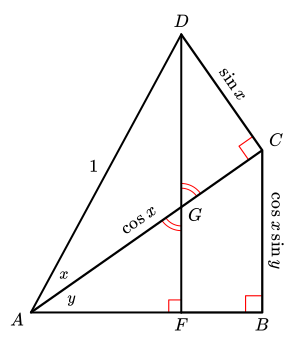
△ACD. By calculating the sine and cosine of
x, the legs of this triangle can be rewritten.
sinx=1DC⇒DC=sinxcosx=1AC⇒AC=cosx
Now consider
△ABC. Knowing that
AC=cosx, the sine of
y can be used to write
BC in terms of
x and
y.
Let
G be the between
FD and
AC. Notice that
∠AGF≅∠DGC by the .
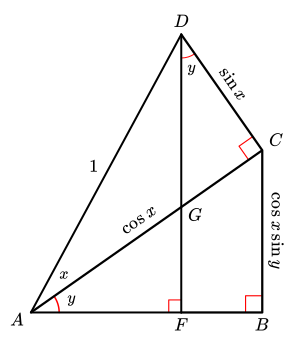
By the , it is known that ∠GAF≅∠GDC. Therefore, m∠GDC=y.
Since the purpose is to rewrite DF, plot a point E on DF such that EC∥AB. This way a rectangle ECBF is formed. The opposite sides of a rectangle have the same length, so EF and CB are equal. Also, CE⊥DF makes △CED a right triangle.
Consequently,
EF=cosxsiny and
DE can be written in terms of
sinx and
cosy using the cosine ratio.
cosy=sinxDE⇓DE=sinxcosy
Finally, by the ,
DF is equal to the sum of
DE and
EF. All these lengths have been rewritten in terms of the sine and cosine of
x and
y.
DF=DE+EF⇓sin(x+y)=sinxcosy+cosxsiny
This concludes the proof of the first identity. The other identities can be proven using similar reasoning.