Did you notice that the expression on the left-hand side of the equation is a difference of two perfect squares? This can be factored using the difference of squares method.
a^2 - b^2 ⇔ (a+b)(a-b)
To do so, we first need to express each term as a perfect square.
ax^2+ bx+ c=0 ⇕ x=- b± sqrt(b^2-4 a c)/2 aLet's start by rewriting the equation so all of the terms are on the left-hand side and then simplify as much as possible.
Now we can identify the values of a, b, and c.
9x^2+34x-8=0 ⇕ 9x^2+ 34x+( - 8)=0
We see that a= 9, b= 34, and c= - 8. Let's substitute these values into the Quadratic Formula.
The solutions for this equation are x= - 17± 199. Let's separate them into the positive and negative cases.
x=- 17± 19/9
x_1=- 17+ 19/9
x_2=- 17- 19/9
x_1=2/9
x_2=- 36/9
x_1=2/9
x_2=- 4
Using the Quadratic Formula, we found that the solutions of the given equation are x_1= 29 and x_2=- 4.
c We will use the Quadratic Formula to solve the given quadratic equation.
ax^2+ bx+ c=0 ⇕ x=- b± sqrt(b^2-4 a c)/2 aWe first need to identify the values of a, b, and c.
2x^2-4x+7=0 ⇕ 2x^2+( - 4)x+ 7=0
We see that a= 2, b= - 4, and c= 7. Let's substitute these values into the Quadratic Formula.
Oops! The square root of a negative number is undefined for real numbers! As we can see, using the Quadratic Formula for the given equation resulted in contradiction. Thus, there are no real solutions.
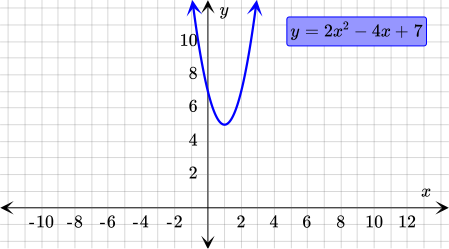
For further explanation, notice that the left-hand side of the equation is a quadratic function. Let's graph it.
The solutions of the given equation are x-intercepts of this function. Notice that this parabola lies above the x-axis, thus it does not have x-intercepts. Therefore there are no real solutions of the given equation.
d We will use the Quadratic Formula to solve the given quadratic equation.
ax^2+ bx+ c=0 ⇕ x=- b± sqrt(b^2-4 a c)/2 a
Let's start by rearranging terms of the equation using Commutative Property of Addition. We will also multiply both sides of the equation by 5 to avoid decimals.
Now we can identify the values of a, b, and c.
x^2+16x-25=0 ⇕ 1x^2+ 16x+( - 25)=0
We see that a= 1, b= 16, and c= - 25. Let's substitute these values into the Quadratic Formula.
Using the Quadratic Formula, we found that the solutions of the given equation are x=- 8± sqrt(89). Therefore, the solutions are x_1=- 8+sqrt(89) and x_2=- 8-sqrt(89).