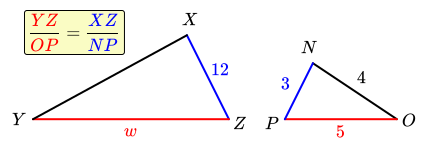
b Like in Part A, we will identify corresponding sides of the triangles and set up a proportion. Notice that the way the similarity statement is written tells us which vertices are corresponding.
△ NOP ~ △ XYZ
This must mean that OP~ YZ and NP~ XZ. With this information, we can set up our proportion.
Let's substitute the side lengths in our proportion and solve for x.
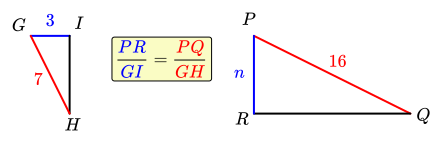
c Like in Part B, we will identify corresponding sides of the triangles and set up a proportiona. Again, the way the similarity statement is written tells us which vertices are corresponding.
△ GHI ~ △ PQR
This must mean that GI~ PR and GH~ PQ. With this information, we can set up our proportion.
Let's substitute the side lengths in our proportion and solve for x.
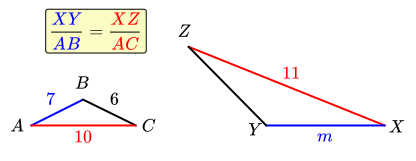
d Like in Part B, we will identify corresponding sides of the triangles and set up a proportion. Again, the way the similarity statement is written tells us which vertices are corresponding.
△ ABC ~ △ XYZ
This must mean that AB~ XY and AC~ XZ. With this information, we can set up our proportion.
Let's substitute the side lengths in our proportion and solve for x.