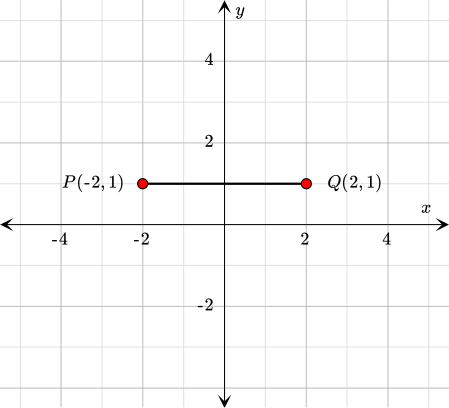
Let PQ be the length. What possibilities are there then for the width?
C
Practice makes perfect
We have two points, P(- 2, 1) and Q(2,1), which will create a rectangle with a perimeter of 14 units when combined with two more points. Therefore, PQ will be one of the sides.
Recall the formula for the perimeter of a rectangle.
P=2l+2wHere, l is the length and w the width of the rectangle. We can let PQ be l. Since P and Q have the same y-coordinate, PQ it is parallel to the x-axis. Let's calculate the distance between P and Q using the Ruler Postulate.
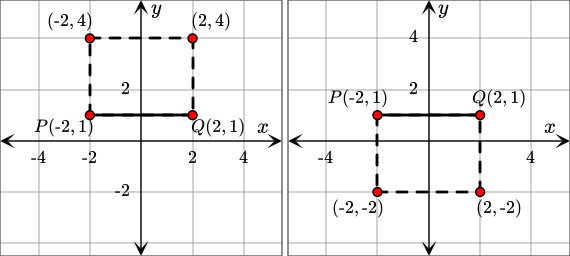
The width must be 3 units for the perimeter of the rectangle to be 14 units. Since the length is parallel with the x-axis, the width must be parallel with the y-axis. There are only two ways for us to create this rectangle.
Since there are only two possible solutions to the problem, there are only two pairs of points that can make up the last two vertices.
(- 2,4) and (2,4)
or
(- 2,- 2) and (2,- 2)
The only choice that matches one of the above is choice C.