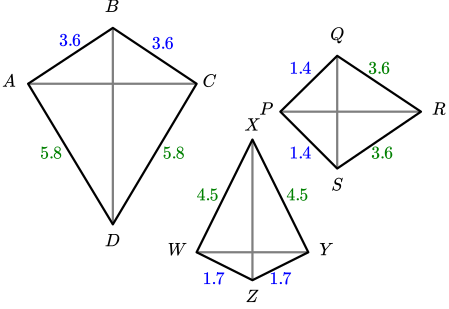
Follow the instructions you are given in the book.
B
b
Use a ruler to measure the given side lengths of quadrilaterals you drew in Part A.
C
c
What can you say about the side lengths of each quadrilateral, looking at the table you made in Part B?
A
a
See solution.
B
b
See solution.
C
c
If a quadrilateral has non-congruent diagonals that are perpendicular and if exactly one diagonal is bisected, then the quadrilateral is a kite.
Practice makes perfect
a
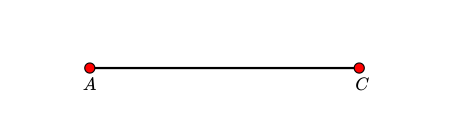
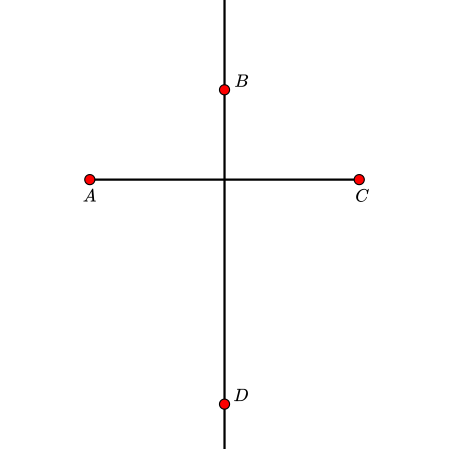
Let's start with drawing three quadrilaterals using the given instructions. Let's start with the first diagonal and name it AC.
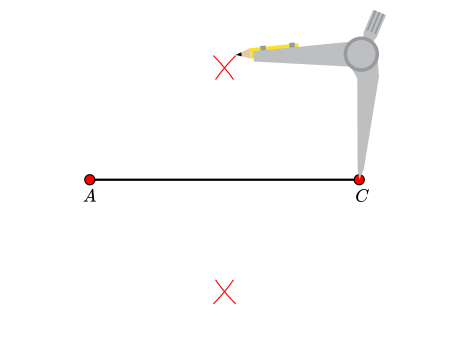
Now, we will construct a line perpendicular to this segment and passing through its midpoint. To do this, we will place the compass at each of the endpoints of this segment and draw arcs above and below this segment using a setting greater than a half the segment's length.
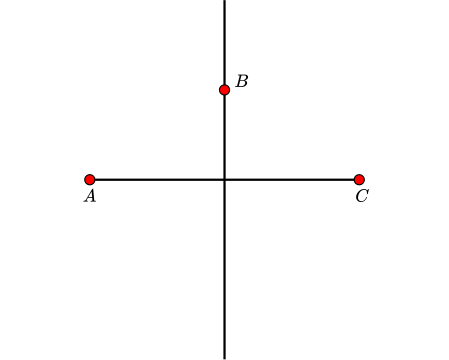
Next, we will connect the points of intersection of the arcs with a line. This line is perpendicular to the drawn diagonal and bisects it.
With this, we can choose any point that lies on this line to be the third vertex of this quadrilateral. Let's label it B.
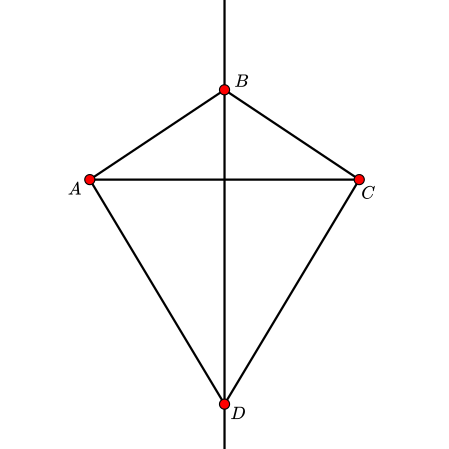
Now, we will find the fourth vertex, D. To do this, let's choose a point that lies below AC and has a different distance from this segment than point B.
Finally we will connect the points to form a quadrilateral.
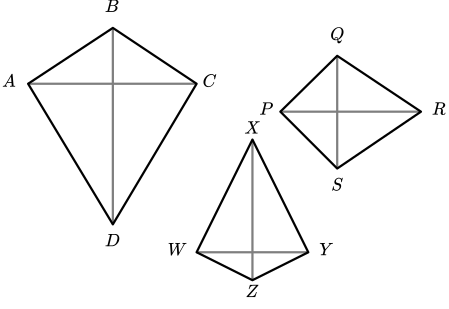
We can draw the quadrilaterals PQRS and WXYZ in the same way.
b
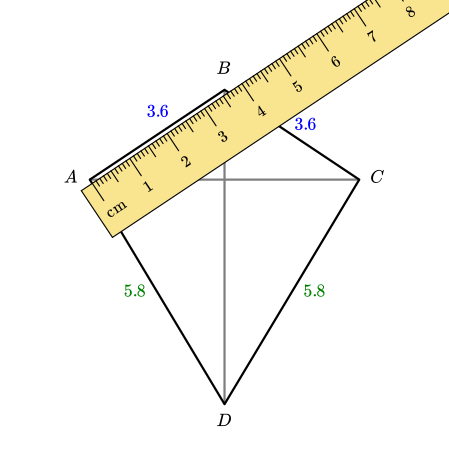
In this part, we are asked to complete the given table. Let's use a ruler to do this.
Now, we will measure the sides of the rest of the quadrilaterals.
As we know the measures of the appropriate side lengths, we can complete the given table.
Figure
Side
Length
Side
Length
Side
Length
Side
Length
ABCD
AB
3.6
BC
3.6
CD
5.8
DA
5.8
PQRS
PQ
1.4
QR
3.6
RS
3.6
SP
1.4
WXYZ
WX
4.5
XY
4.5
YZ
1.7
ZW
1.7
c
As we can see from the table we made in Part B, we have exactly two pairs of congruent segments in each quadrilateral. This is the definition of a kite. Therefore, we can assume that if a quadrilateral has non-congruent diagonals that are perpendicular and if exactly one diagonal is bisected, then the quadrilateral is a kite.