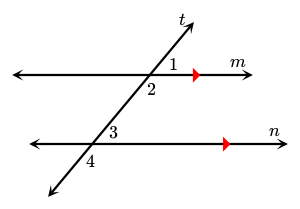
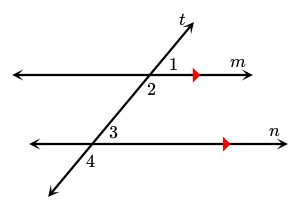
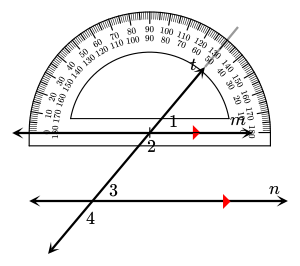
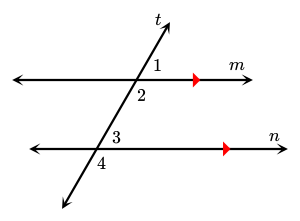
Now, we can use a protractor to measure the four angles on one side of t. Let's measure ∠ 1 first.
The measure of ∠ 1 is 50, m ∠ 1=50. After measuring the remaining three angles, we get the following results.
m ∠ 2 = 130
m ∠ 3 = 50
m ∠ 4 = 130
Now, we can repeat this for the other four pairs of parallel lines.
b
Let's record the measures we found in Part A in a table.
Lines
m ∠ 1
m ∠ 2
m ∠ 3
m ∠ 4
m and n
50
130
50
130
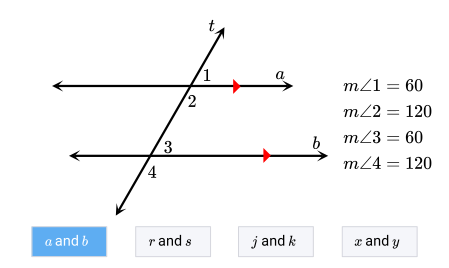
a and b
60
120
60
120
r and s
45
135
45
135
j and k
90
90
90
90
x and y
105
75
105
75
c
We want to make a conjecture about the relationship between the pair of angles formed on the exterior of parallel lines and on the same side of the transversal. This means that we want to make a conjecture about ∠ 1 and ∠ 4. Let's analyze their measures in our table from Part B.
Lines
m ∠ 1
m ∠ 2
m ∠ 3
m ∠ 4
m and n
50
130
50
130
a and b
60
120
60
120
r and s
45
135
45
135
j and k
90
90
90
90
x and y
105
75
105
75
Notice that the sum of m ∠ 1 and m ∠ 4 is 180 in each case.
50+130= 180
60+120= 180
45+135= 180
90+90= 180
105+75= 180
Recall that two angles with measures that have a sum of 180 are supplementary angles. Therefore, we can make a conjecture that the angles formed on the exterior of parallel lines and on the same side of a transversal are supplementary angles.
d
Let's begin by reviewing the types of reasoning we know.
Inductive reasoning is reasoning that uses a number of specific examples to arrive to a conclusion.
Deductive reasoning uses facts, rules, definitions, or properties to reach logical conclusions from given statements.
We reached our conjecture by analyzing five pairs of parallel lines. These are specific examples that we used, so we can conclude that we used inductive reasoning to form our conjecture.
e
Let's begin by looking at the given information and the desired outcome of the proof. Then we can prove our conjecture.
Given:& Parallel linesm and n cut & by a transversalt.
Prove:& ∠ 1 and ∠ 4 are supplementary
We are given that parallel lines m and n are cut by a transversal t. This is how we will begin our proof.
Statement 1)& Parallel linesm and n cut & by a transversalt.
Reason 1)& Given
Notice that ∠ 1 and ∠ 2 form a linear pair. Therefore, by the Supplement Theorem they are supplementary, and hence m ∠ 1 + m ∠ 2=180.
Statement 2)& m ∠ 1+ m ∠ 2 = 180
Reason 2)& Supplement Theorem
Next, we can tell that ∠ 2 and ∠ 4 are corresponding angles. Therefore, by the Corresponding Angles Theorem, ∠ 2 ≅ ∠ 4.
Statement 3)& ∠ 2 ≅ ∠ 4
Reason 3)& Corresponding Angles Theorem
By the definition of congruent angles, we can conclude that m ∠ 2 = m ∠ 4.
Statement 4)& m ∠ 2 = m ∠ 4
Reason 4)& Definition of congruent angles
Notice that now we can substitute m ∠ 4 for m ∠ 2 in the equation m ∠ 1+ m ∠ 2 = 180. This gives us m ∠ 1+ m ∠ 4 = 180.
Statement 5)& m ∠ 1 + m ∠ 4 =180
Reason 5)& Substitution Prop. of Equality
Two angles with measures that have a sum of 180 are supplementary angles. Therefore, we can conclude that ∠ 1 and ∠ 4 are supplementary. This is what we wanted to prove!
Statement 6)& ∠ 1 and ∠ 4 are supplementary
Reason 6)& Definition of supplementary & angles
Finally, we can complete our proof.