If two parallel lines are cut by a transversal, then each pair of alternate exterior angles is congruent.
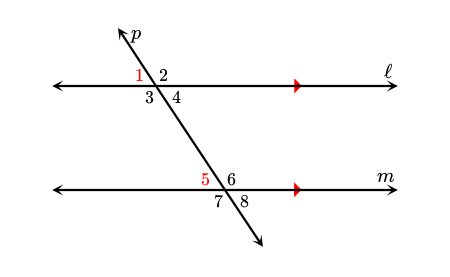
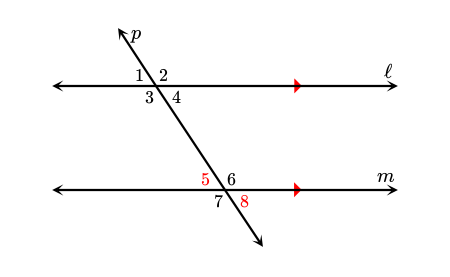
In order to provide the proof, we need to take two arbitrary parallel lines, l and m, and the transversal intersecting them, p. We will name all the angles created by these lines.
On this diagram, there are two pairs of alternate exterior angles: ∠ 1 and ∠ 8, and ∠ 2 and ∠ 7. According to the theorem, each of these pairs of angles must be congruent. Let's prove it for the first pair, ∠ 1 and ∠ 8. To do so, we will use an intermediate angle, ∠ 5.
If two angles are vertical angles, then they are congruent.
We conclude that ∠ 5 and ∠ 8 are congruent angles.
∠ 1 and ∠ 8
Let's gather the information we have found so far.
∠ 1 ≅ ∠ 5 and ∠ 5 ≅ ∠ 8
Using the Transitive Property of Congruence, we can come to the conclusion that ∠ 1 ≅ ∠ 8. This way we managed to prove that one pair of alternate exterior angles is congruent.
Two-Column Proof
Let's now use all these explanations to write a two-column proof of the theorem.
Statement heading
Reason heading
1.
l∥ m
1.
Given
2.
∠ 1 ≅ ∠ 5
2.
Corresponding Angles Postulate
3.
∠ 5 ≅ ∠ 8
3.
Vertical Angles Theorem
4.
∠ 1 ≅ ∠ 8
4.
Transitive Property of Congruence
Using the same reasoning and the intermediate angle of ∠ 6, we can also prove that ∠ 2≅ ∠ 7.