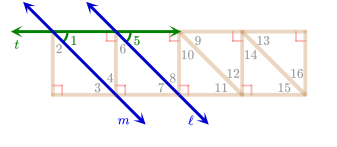
Choose three even-numbered angles and analyze their relationship. Use the Alternate Interior Angles Theorem.
C
c
Use the right angles given on the diagram and the Perpendicular Transversal Theorem.
D
d
Which geometric object does a road represent? Do the roads intersect?
A
a
They are equal.
B
b
They are equal.
C
c
They are complementary angles.
D
d
Parallel planes.
Practice makes perfect
a
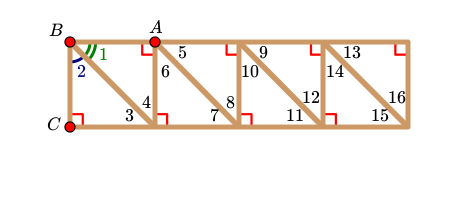
In order to identify the relationship between the odd-numbered angles, let's consider two pairs of the given angles: ∠ 1 and ∠ 5, and ∠ 1 and ∠ 3.
Relationship between ∠ 1 and ∠ 5
We are going to analyze ∠ 1 and ∠ 5. Let's find these angles and the lines they are formed by on the given diagram.
As we can see, ∠ 1 and ∠ 5 are formed by the parallel lines m and l and the transversal t. These are corresponding angles. Thus, to find the relationship between them, we can use the Corresponding Angles Postulate.
If two parallel lines are cut by a transversal,
then each pair of corresponding angles
is congruent.
We conclude that ∠ 1 and ∠ 5 are congruent angles and their measures are the same. Note that the using the same method we can prove the following congruency statements.
∠ 5 ≅ ∠ 9 ≅ ∠ 13
∠ 3 ≅ ∠ 7 ≅ ∠ 11 ≅ ∠ 15
Relationship between ∠ 1 and ∠ 3
Let's now take a look at the angles ∠ 1 and ∠ 3.
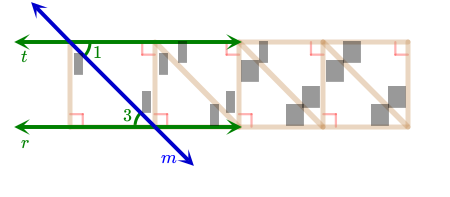
From the diagram we can see that ∠ 1 and ∠ 3 are formed by the parallel lines t and r and the transversal m. They are called alternate interior angles. Let's recall what the Alternate Interior Angles Theorem states.
If two parallel lines are cut by a transversal,
then each pair of alternate interior angles
is congruent.
According to the theorem, these angles are congruent.
Conclusion
Let's gather the information we have found so far.
l ∠ 1 ≅ ∠ 5 ≅ ∠ 9 ≅ ∠ 13 ∠ 1 ≅ ∠ 3 ∠ 3 ≅ ∠ 7 ≅ ∠ 11 ≅ ∠ 15
Using the Transitive Property of Congruence, we can write the following congruency statement.
∠ 13 ≅ ∠ 9 ≅ ∠ 5 ≅ ∠ 1 ≅ ∠ 3 ≅ ∠ 7 ≅ ∠ 11 ≅ ∠ 15
Therefore, all the odd-numbered angles are congruent and their measures are equal.
b
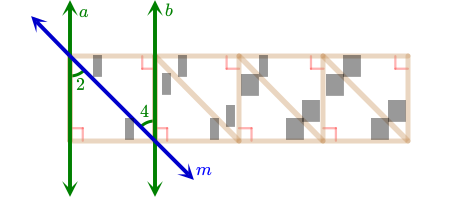
Let's now consider the even-numbered angles. Let's look at ∠ 2 and ∠ 4, and ∠ 4 and ∠ 6.
Relationship between ∠ 2 and ∠ 4
We need to find angles ∠ 2 and ∠ 4 on the given diagram and identify the lines these angles are formed by.
As we can see, angles ∠ 2 and ∠ 4 are formed by the parallel lines a and b and the transversal m. These are alternate interior angles. From the Alternate Interior Angles Theorem, which we have quoted in Part A, we know the angles are congruent. This means we can prove that the following congruency statements are also true.
∠ 6 ≅ ∠ 8
∠ 10≅ ∠ 12
∠ 14 ≅ ∠ 16
Relationship between ∠ 4 and ∠ 6
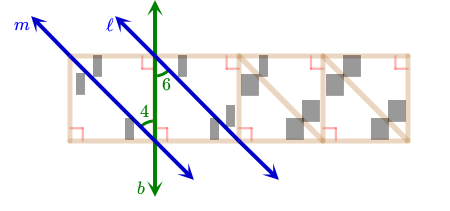
Let's now consider angles ∠ 4 and ∠ 6.
These angles are formed by the parallel lines m and l and the transversal b. These are also alternate interior angles, and by the Alternate Interior Angles Theorem we know they are congruent. This same way, we can prove the following congruency statements.
∠ 8 ≅ ∠ 10
∠ 12 ≅ ∠ 14
Conclusion
Now, we are going to analyze all the information that we have found. Let's use a table.
Congruences From First Subheader
Congruences From Second Subheader
∠ 2 ≅ ∠ 4
∠ 4 ≅ ∠ 6
∠ 6 ≅ ∠ 8
∠ 8 ≅ ∠ 10
∠ 10 ≅ ∠ 12
∠ 12 ≅ ∠ 14
∠ 14 ≅ ∠ 16
Using the Transitive Property of Congruence, we can conclude that all the even-numbered angles are congruent.
∠ 2 ≅ ∠ 4 ≅ ∠ 6 ≅ ∠ 8 ≅ ∠ 10 ≅ ∠ 12 ≅ ∠ 14 ≅ ∠ 16
Therefore, the measures of these angles are all the same.
c
In order to find how the odd and even angles are related, let's examine angles ∠ 1 and ∠ 2.
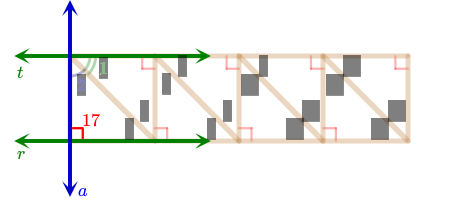
As we can see, the sum of the angles ∠ 1 and ∠ 2 is the angle ∠ ABC. What is the measure of this angle? Let's analyze the highlighted lines on the diagram below.
The lines t and r are parallel, and a is a transversal that intersects them. Notice that angle ∠ 17, which the bottom line and the transversal form, is a right angle. This means that the transversal is perpendicular to line r. Let's now recall the Perpendicular Transversal Theorem.
In a plane, if a line is perpendicular
to one of two parallel lines,
then it is perpendicular to the other.
We conclude that a is also perpendicular to t and they form a right angle ∠ ABC. Therefore, the sum of the measures of ∠ 1 and ∠ 2 is 90^(∘).
m∠ 1+ m∠2=90^(∘)
These angles are called complementary. When we analyze the rest of the pairs where one angle is odd and the other is even, we see that they are also complementary. To prove that, we can use identical reflections.
d
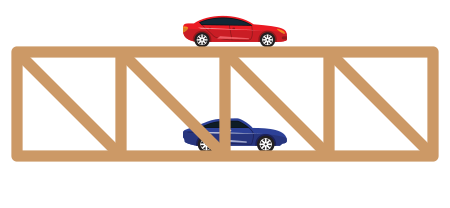
We are told that the Michigan Avenue Bridge in Chicago is a double-decker bridge. This means that there are two roadways, one underneath the other. The diagram below helps us to see that.
Each of these roads represents a plane. Since they do not intersect, they are parallel planes.