Sign In
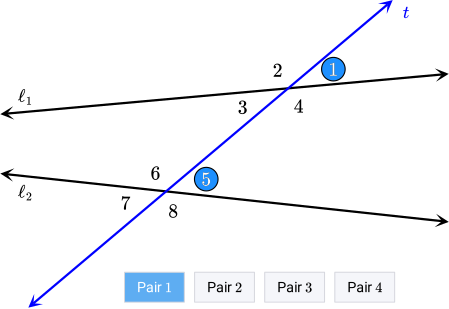
In the diagram, four pairs of angles can be identified as corresponding angles.
| Pair | Position Relative to the Vertex | Position Relative to the Transversal |
|---|---|---|
| ∠1 and ∠5 | Northeast | Right |
| ∠2 and ∠6 | Northwest | Left |
| ∠3 and ∠7 | Southwest | Left |
| ∠4 and ∠8 | Southeast | Right |
If two parallel lines are cut by a transversal, then the corresponding angles are congruent. The same logic in reverse can be applied. If two lines and a transversal form corresponding angles that are congruent, then the lines are parallel.
| If | Then |
|---|---|
| ℓ1∥ℓ2 | ∠1≅∠5, ∠2≅∠6, ∠3≅∠7, and ∠4≅∠8 |
| ∠1≅∠5, ∠2≅∠6, ∠3≅∠7, or ∠4≅∠8 | ℓ1∥ℓ2 |
These statements are supported by the Corresponding Angles Theorem and its converse.