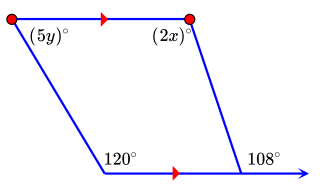
Find the relationships between the angles and use corresponding theorems and postulates.
x=54 by the Alternate Exterior Angles Theorem
y=12 by the Consecutive Interior Angles Theorem
Practice makes perfect
Consider the diagram below. In order to find the values of the variables, we need to find the relationships between the angles and use the corresponding theorems and postulates.
Let's calculate each value one at a time.
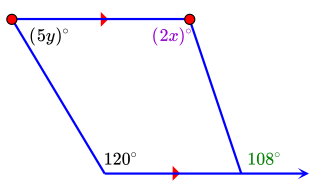
Value of x
Looking at the diagram we can see that the angles that measure 2x and 108 lie on opposite sides of the transversal. Therefore, they are interior angles formed by parallel lines.
If two parallel lines are cut by a transversal, then each pair of alternate interior angles is congruent.
According to this theorem, we know that the alternate interior angles are congruent, so their measures are the same.
2x= 108 ⇓
x=54
The value of x is 54 by the Alternate Interior Angles Theorem.
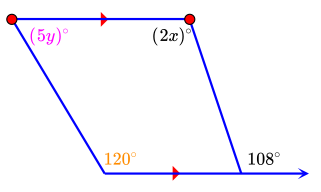
Recall that, by the Consecutive Interior Angles Theorem, the consecutive interior angles formed by parallel lines and a transversal are supplementary. Therefore, these angles are supplementary and the sum of their measures is 180.
5y+ 120=180
We can solve this equation to find the value of y.