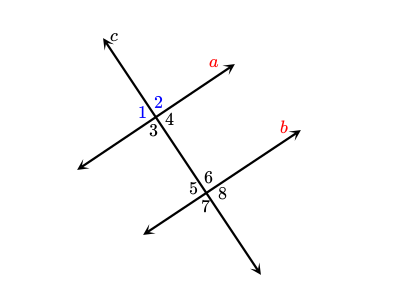
Let's begin by analyzing the given information. We are given that line a is parallel to line b, and that ∠ 1 ≅ ∠2.
We want to describe the relationship between lines a and b. First, notice that by the definition of congruent angles, we can conclude that the measures of ∠ 1 and ∠ 2 are equal.
m ∠ 1 = m ∠ 2
We can also tell that ∠ 1 and ∠ 2 form a linear pair. Therefore, by the Supplement Theorem they are supplementary, and hence the sum of their measures is 180.
m ∠ 1 + m ∠ 2 = 180
Next, we can substitute m ∠ 2 for m ∠ 1 in this equation, as m ∠ 1 = m ∠ 2.
m ∠ 2 + m ∠ 2 = 180 ⇔ 2 m ∠ 2 = 180
Notice that dividing both sides of the equation by 2, we get m ∠ 2 = 90. Since m ∠ 1 = m ∠ 2, we can conclude that m ∠ 1 =90. By the definition of a right angle, we can tell that ∠ 1 and ∠ 2 are right angles. Finally, by the definition of perpendicular lines, line a is perpendicular to line c.
a ⊥ c
Now we know that a ∥ b and a ⊥ c. Therefore, by the Perpendicular Transveral Theorem, b ⊥ c. The relationship between lines a and b is that they are perpendicular.