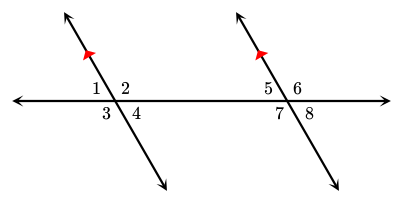
Now, we can assume that the measure of ∠ 1 is x, so m ∠ 1 = x. Let's see what we can say about the measures of other angles. First, notice that ∠ 1 and ∠ 2 form a linear pair. Therefore, by the Supplement Theorem these angles are supplementary, and hence the sum of their measures is 180.
m ∠ 1 + m∠ 2 = 180Next, we can substitute x for m ∠ 1 in this equation and calculate the measure of ∠ 2.
x + m ∠ 2 = 180 ⇔ m ∠ 2 = 180-x
Notice that ∠ 1 and ∠ 3 also form a linear pair. Therefore, using the same reasoning, we can conclude that the measure of ∠ 3 is also 180-x.
m ∠ 3 = 180-x
Next, we can tell that ∠ 1 and ∠ 4 are vertical angles. By the Vertical Angles Theorem, they are congruent. Furthermore, by the definition of congruent angles, the measures of ∠ 1 and ∠ 4 are equal.
m ∠ 1 = m ∠ 4
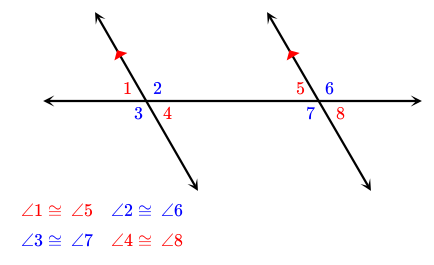
This means that the measure of ∠ 4 is x, m ∠ 4 =x. Now, notice that we can use the Corresponding Angles Theorem to find the measures of the remaining angles.
Corresponding Angles Theorem
If two parallel lines are cut by a transversal, then each pair of corresponding angles is congruent.
Recall that we already know that m ∠ 1 = x, m ∠ 2 = 180-x, m ∠ 3 = 180-x, and m ∠ 4 =x. The measures of congruent angles are equal, so we can conclude the following.
m ∠ 5 = x
m ∠ 6 = 180-x
m ∠ 7 = 180-x
m ∠ 8 = x
Notice that by knowing one angle measure, we found the measures of all the angles formed by two parallel lines cut by a transversal. Therefore, the minimum number of angle measures we have to know to find all of the other measures is one.