Sign In
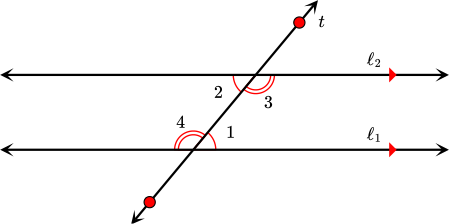
If parallel lines are cut by a transversal, then alternate interior angles are congruent.
Based on the characteristics of the diagram, the following relations hold true.
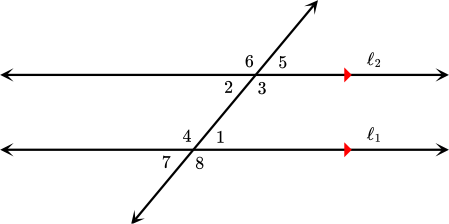
If l_1 ∥ l_2, then ∠ 1 ≅ ∠ 2 and ∠ 3 ≅ ∠ 4.
Notice that by definition ∠ 2 and ∠ 5 are vertical angles. By the Vertical Angles Theorem, they are therefore congruent angles. ∠ 2 ≅ ∠ 5 Furthermore, by definition ∠ 5 and ∠ 1 are corresponding angles. Hence, by the Corresponding Angles Theorem, ∠ 5 and ∠ 1 are also congruent angles. ∠ 5 ≅ ∠ 1 Applying the Transitive Property of Congruence, ∠ 2 and ∠ 1 can be concluded to be congruent angles as well. ∠ 2 ≅ ∠ 5 ∠ 5 ≅ ∠ 1 ⇒ ∠ 2 ≅ ∠ 1 The same reasoning applies to the other pair of alternate interior angles. Therefore, when a pair of parallel lines is cut by a transversal, the pairs of alternate interior angles are congruent.
The previous proof can be summarized in the following two-column table.
Statements
|
Reasons
|
1. ∠ 2 and ∠ 5 are vertical angles
|
1. Def. of vertical angles
|
2. ∠ 2≅ ∠ 5
|
2. Vertical Angles Theorem
|
3. ∠ 5 and ∠ 1 are corresponding angles
|
3. Def. of corresponding angles
|
4. ∠ 5≅ ∠ 1
|
4. Corresponding Angles Theorem
|
5. ∠ 2 ≅ ∠ 1
|
5. Transitive Property of Congruence
|
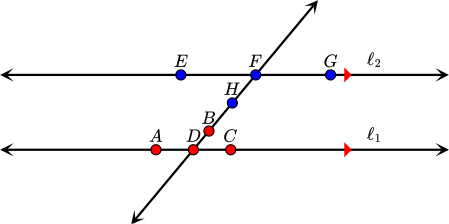
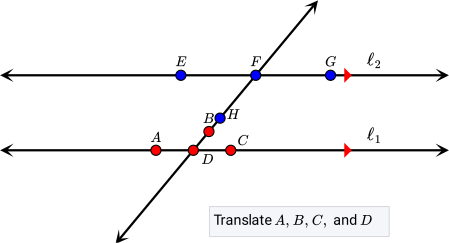
Next, A, B, C, and D will be translated parallel to the transversal until the points A, C, and D lie on l_2. Then, A, B, and C will be rotated 180^(∘) about F. It should be noted that since point D lies on the transversal, when translating it to l_2 the point will fall into the same position as F. Therefore, D will not be affected by the rotation around F.
After this combination of rigid motions, A, B, C, and D are mapped onto A', B', C', and D'. This means that ∠ ADB is mapped onto ∠ A'D'B'. Therefore, ∠ ADB and ∠ A'D'B' are congruent angles. ∠ ADB ≅ ∠ A'D'B' Note that D' and F share the same location. It can also be seen that A' lies on FG and B' lies on FH. Because of this, ∠ A'D'B' is congruent to ∠ GFH. ∠ A'D'B' ≅ ∠ GFH Applying the Transitive Property of Congruence, ∠ ADB is congruent to GFH. ∠ ADB ≅ ∠ A'D'B' ∠ A'D'B' ≅ ∠ GFH ⇓ ∠ ADB ≅ ∠ GFH