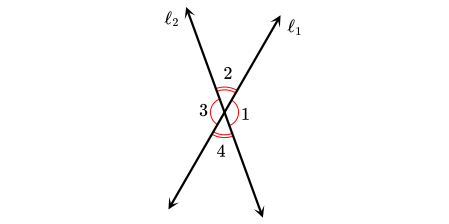
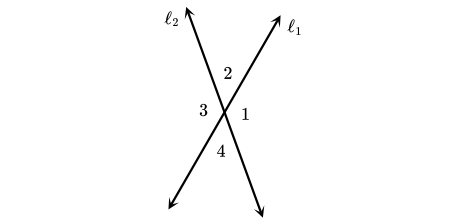
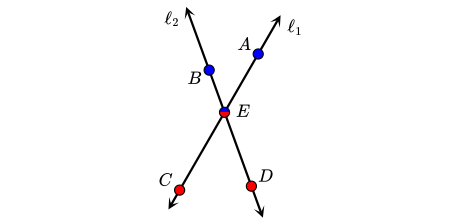
Analyzing the diagram, it can be seen that ∠1 and ∠2 form a , so these are . Similarly, ∠2 and ∠3 are also supplementary angles.
Therefore, by the , the sum of m∠1 and m∠2 is 180∘, and the sum of m∠2 and m∠3 is also 180∘. These facts can be used to express m∠2 in terms of m∠1 and in terms of m∠3.
| Angle Addition Postulate
|
Isolate m∠2
|
| m∠1+m∠2 = 180∘
|
m∠2 = 180∘−m∠1
|
| m∠2+m∠3 = 180∘
|
m∠2 = 180∘−m∠3
|
By the , the expressions representing
m∠2 can be set equal to each other.
{m∠2=180∘−m∠1m∠2=180∘−m∠3⇓180∘−m∠1=180∘−m∠3
Then the equation can be simplified.
180∘−m∠1=180∘−m∠3
-m∠1=-m∠3
m∠1=m∠3
By the definition of congruent angles, this means that the vertical angles
∠1 and
∠3 are congruent angles. The same process can be used to prove
∠2 and
∠4 congruent.
Two-Column Proof
The previous proof can be summarized in the following table.
| Statements
|
Reasons
|
| ℓ1 and ℓ2 lines
|
Given
|
| ∠1 and ∠2 supplementary
|
Definition of straight angle
|
| m∠1+m∠2=180∘
|
Definition of supplementary angles
|
| m∠2=180∘−m∠1
|
Subtraction Property of Equality
|
| ∠2 and ∠3 supplementary
|
Definition of straight angle
|
| m∠2+m∠3=180∘
|
Definition of supplementary angles
|
| m∠2=180∘−m∠3
|
Subtraction Property of Equality
|
| 180∘−m∠1=180∘−m∠3
|
Transitive Property of Equality
|
| m∠1=m∠3
|
Subtraction and Multiplication Properties of Equality
|