2. Greatest Common Factor and Least Common Multiple
Sign In
An error ocurred, try again later!
Chapter 1
2.
Greatest Common Factor and Least Common Multiple
This lesson delves into the mathematical concepts of greatest common factor (GCF) and least common multiple (LCM). It explains how to find these values using prime factorization and factor trees. Understanding GCF and LCM is crucial for various applications, from simplifying fractions in basic arithmetic to solving complex problems in engineering and computer science. The lesson uses factor trees to break down numbers into their prime factors, making it easier to find the GCF and LCM.
Show less Show more expand_more 


Lesson Settings & Tools
| | 16 Theory slides |
| | 16 Exercises - Grade E - A |
| | Each lesson is meant to take 1-2 classroom sessions |
Greatest Common Factor and Least Common Multiple
Slide of 16
Think about a delicious hot dog for a snack 🌭. A familiar problem for people who prepare it is knowing how many packs of hot dogs and buns are needed to have no leftovers. Although it sounds challenging, the greatest common factor and least common multiple are properties that are helpful to solve this and other similar situations. These properties will be discussed in this lesson.
Catch-Up and Review
Here are a few recommended readings before getting started with this lesson.
Explore
Share
Report error
Comparing Factors of 12 and 18
The following applet creates arrangements using the factors of 12 and 18 as the width of an arrangement of blocks. It considers vertical and horizontal arrangements as different arrangements.
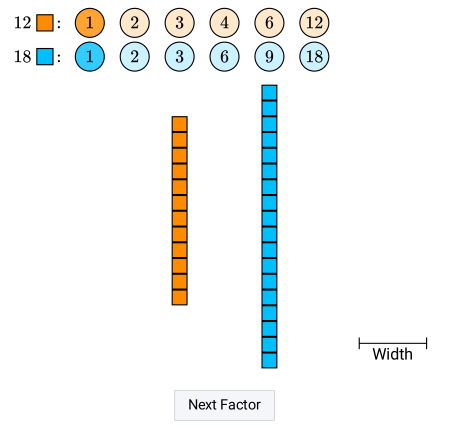 Now, think about the following questions.
- How many factors do these two numbers have in common?
- What is the greatest factor of both 12 and 18 that arranges the blocks in rectangles with the same width?
Discussion
Share
Report error
Breaking a Number Into Prime Factors
An essential property of any whole number greater than 1 is that it can be expressed as a product of prime numbers. This process is called prime factorization.
Concept
Share
Report error
Prime Factorization
Prime factorization, also called complete factorization, is the decomposition of a whole number into a product of its prime factors. 12 &= 2*2*3 &⇕ 12 &= 2^2* 3 The prime factors are found by dividing the number by the smallest prime number that is a factor of that number. This process is repeated with the quotient until the resulting quotient is a prime number. The following table shows the prime factorization of 80.
| Number | Smallest Prime Factor | Quotient |
|---|---|---|
| 80 | 2 | 80/2 = 40 |
| 40 | 2 | 40/2 = 20 |
| 20 | 2 | 20/2 = 10 |
| 10 | 2 | 10/2 = 5 |
| Prime Factorization | ||
| 80 = 2* 2* 2* 2* 5 | ||
Discussion
Share
Report error
Factor Tree
A factor tree is a diagram that shows the prime factors of a number. The tree begins with a root node that contains the number whose prime factorization is needed. Two branches extend from the root node and connect to a factor pair of the number. This process continues by breaking each factor into its factors until only prime factors appear at the end of the branches.
 Factor trees help express the prime factorization of a number by using the prime factors at the end of the branches.
Example
Share
Report error
Use Factor Trees to Find the Missing Values in a Math Puzzle
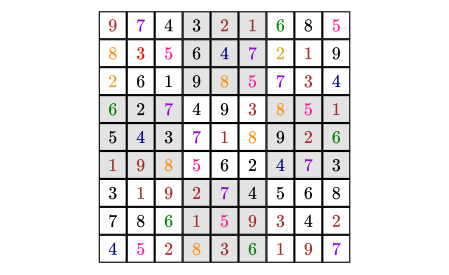
Magdalena loves puzzles. She is currently solving a special edition of a Sudoku, a game that consists of a 9×9 grid with some cells containing numbers and others blank. The purpose of the game is to find the missing values by using the numbers 1-9 only once in each row and column and in each of the nine 3×3 boxes.
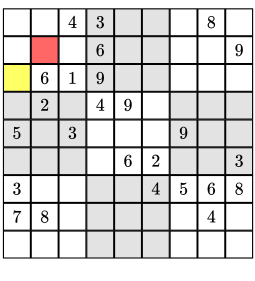
In this special version of the game, each cell contains a particular math challenge whose solution helps find the corresponding missing number. Magdalena is now focusing on filling in the red and yellow cells.
a The number that goes in the red cell is the most repeated prime factor of the prime factorization of 54. What is the missing value for the red cell?
{"type":"text","form":{"type":"math","options":{"comparison":"1","nofractofloat":true,"keypad":{"simple":true,"useShortLog":false,"variables":[],"constants":[]},"rendered":false},"text":" "},"formTextBefore":null,"formTextAfter":null,"answer":{"text":["3"]}}
b The yellow cell must contain the most repeated factor of the prime factorization of 64. What is the missing value for the yellow cell?
{"type":"text","form":{"type":"math","options":{"comparison":"1","nofractofloat":true,"keypad":{"simple":true,"useShortLog":false,"variables":[],"constants":[]},"rendered":false},"text":" "},"formTextBefore":null,"formTextAfter":null,"answer":{"text":["2"]}}
Hint
a Make a factor tree of 54.
b Find the prime factorization of 64 by using a factor tree.
Solution
a To find the missing value on the red cell, begin by finding the prime factorization of 54. This can done with a factor tree by following these steps.
- Create a root node that contains the number 54.
- From the root node, draw two branches that a factor pair of 54.
- Break each factor of 54 into its own factor pair.
- Continue this process until only there are only prime factors on each branch.

b Follow a similar procedure to find the prime factorization of 64.


Discussion
Share
Report error
Greatest Common Factor
Factors are used to divide a set of items into equal amounts. However, it may be difficult when two or more different sets are to be divided into a certain number of groups with equal amounts of each item. The common factors of the sets, and the greatest common factor in particular, can help find a solution to this type of problem.
Concept
Share
Report error
Greatest Common Factor
Factors that are shared by two or more numbers are called common factors. The greatest of these common factors is called the greatest common factor (GCF). Consider, for example, the factors of 4 and 8. Factors of4: & 1, 2, 4 Factors of8: & 1, 2, 4,8 The common factors of 4 and 8 are 1, 2, and 4. The GCF(4,8)= 4. The GCF can also be determined by multiplying the prime factors shared in the prime factorization of the numbers in question.
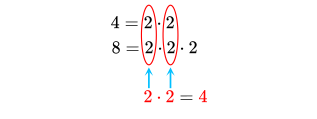
greatest common divisorbecause a factor of a number divides that number evenly.
Discussion
Share
Report error
Finding the Greatest Common Factor
The greatest common factor (GCF) of two numbers can be determined by finding the prime factorization of the numbers. Next, the common prime factors of the prime factorizations are identified. The GCF is then given by the product of the common prime factors. Consider the following pair of numbers.
42,24
The GCF(42,24) will be found by following these four steps.

1
Find the Prime Factorization of the First Number
expand_more Use a factor tree to determine the prime factorization of the first number. In this case, the factor tree of 42 must be found.

2
Find the Prime Factorization of the Second Number
expand_more Now, follow the same process to find the prime factorization of the second number. Consider the factor tree of 24.
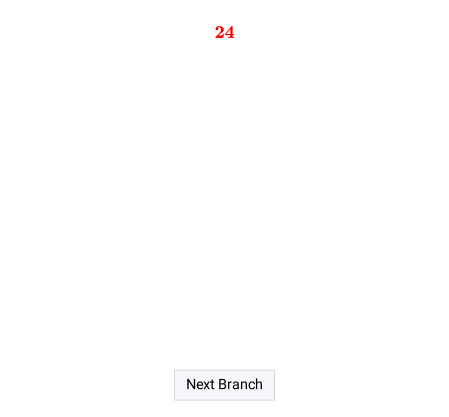
3
Identify the Common Prime Factors
expand_more Write the two prime factorizations together and circle the common prime factors. In this example, the prime factorizations of 42 and 24 will be written together.
4
Multiply the Prime Common Factors
expand_more The greatest common factor of the numbers is given by the product of the common prime factors of the prime factorization. In this case, the common prime factors of 42 and 24 are 2 and 3. 2* 3= 6 Therefore, the greatest common factor of 42 and 24 is 6.
Example
Share
Report error
Find the GCF to Fill in a Set of Sudoku Cells
Magdalena continues with the process of solving this special version of the Sudoku game. This time, she wants to know which number goes in the purple cells.
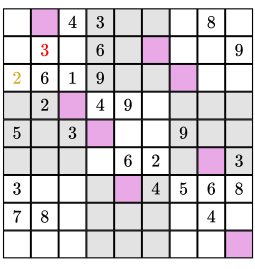
{"type":"text","form":{"type":"math","options":{"comparison":"1","nofractofloat":true,"keypad":{"simple":true,"useShortLog":false,"variables":[],"constants":[]},"rendered":false},"text":" "},"formTextBefore":null,"formTextAfter":null,"answer":{"text":["7"]}}
Hint
Find the prime factorization of 35. Next, find the prime factorization of 84. Identify the common prime factor between the two prime factorizations. Multiply the common prime factors to get the GCF.
Solution
The clue must be solved to help Magdalena figure out the number that goes in the purple cells. The clue claims that the number in the cells is given by the greatest common factor of 35 and 85. To find the GCF, these steps can be followed.
- Find the prime factorization of 35.
- Find the prime factorization of 84.
- Identify the common prime factors between the factorizations of 35 and 84.
- Multiply the common prime factors.
Each of these steps will now be applied.
Prime Factorization of 35
The prime factorization of 35 can be found by using a factor tree. The root node of the tree is 35 and then factor pairs of 35 will extend from the root node.
Prime Factorization of 84
A similar process can be followed to find the prime factorization of 84.
Identify Common Prime Factors
Now that the two prime factorizations are stated, find the common prime factor shared by these factorizations. &35=5* 7 &84=2*2*3* 7 The only common prime factors shared by these factorization is the number 7.
Multiply
In this case, only one factor is shared by the prime factorizations of 35 and 84, so the greatest common factor of 35 and 84 is 7. This number goes into the purple cells.
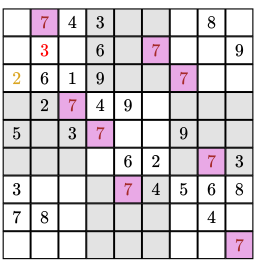
What a great achievement! Magdalena has made great progress on her puzzle.
Explore
Share
Report error
Comparing Multiples of 12 and 18
Consider the following applet that creates different arrangements of blocks using multiples of 12 and 18.
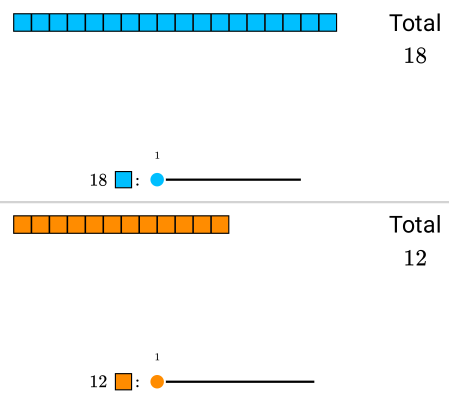 Now, consider the following questions and think about the possible answers to each.
- Is there any multiples in common?
- What is the least of the common multiples?
Discussion
Share
Report error
Least Common Multiple
Similar to factors, it may be of interest to find the smallest multiple of two or more different numbers. This number is called the least common multiple.
Concept
Share
Report error
Least Common Multiple
The least common multiple (LCM) of two whole numbers a and b is the smallest whole number that is a multiple of both a and b. It is denoted as LCM(a,b). The least common multiple of a and b is the smallest whole number that is divisible by both a and b. Some examples can be seen in the table below.
| Numbers | Multiples of Numbers | Common Multiples | Least Common Multiple |
|---|---|---|---|
| 2 and 3 | Multiples of2:& 2, 4, 6, 8, 10, 12, ... Multiples of3:& 3, 6, 9, 12, 15, ... | 6, 12, 18, 24, ... | LCM(2,3)= 6 |
| 8 and 12 | Multiples of 8:& 8, 16, 24, 32, 40, 48, ... Multiples of12:& 12, 24, 36, 48, ... | 24, 48, 72, 96, ... | LCM(8,12)= 24 |
Discussion
Share
Report error
Finding the Least Common Multiple
To determine the least common multiple (LCM) of two or more numbers, begin by finding the prime factorization of each number. Then, highlight all the instances of each prime factor in the prime factorization that is repeated most. Finally, the LCM is given by the product of the highlighted factors. This process will be illustrated with this pair of numbers.
54 and 60
The LCM(54,60) will be found by following these four steps.

1
Find the Prime Factorization of the First Number
expand_more Use a factor tree to determine the prime factorization of each number. For this situation, the factor tree of 54 will be drawn. 
2
Find the Prime Factorization of the Second Number
expand_more Follow the same process to find the prime factorization of the next number. Consider the factor tree of 60.

3
Match Prime Factors Vertically
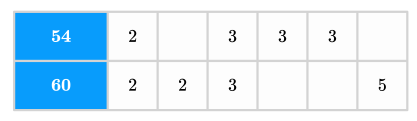
expand_more It can be helpful to write the prime factorizations of the numbers in a table. Place each prime factorization in a row of the table. Use columns for each factor and match common factors vertically when possible. The table for the prime factorization of 54 and 60 is shown here.
4
Bring Down the Primes in Each Column and Multiply
expand_more Lastly, bring down the prime factors in each column of the table. This process is done with the table containing the prime factorizations of 54 and 60 below.
The product of these prime factors is the least common multiple of the numbers.
| Prime Factors | Multiplication | LCM(54,60) |
|---|---|---|
| 2, 2, 3, 3, 3 and 5 | 2*2*3*3*3*5 | 540 |
The least common multiple of 54 and 60, which can also be written as LCM(54,60), is 540.
Example
Share
Report error
Cracking a Pair of Mystery Numbers With the LCM
Magdalena is having a great time solving her special Sudoku puzzle but the next clue looks scary.
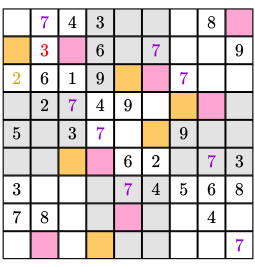
The clue claims that to find the numbers to fill in the orange and pink cells, first find the least common multiple (LCM) of 10 and 16. Next, these conditions must be met.
- The number for the orange cells multiplied by 10 is the LCM(10,16).
- The number for the pink cells multiplied by 16 is the LCM(10,16).
{"type":"text","form":{"type":"list","options":{"comparison":"1","nofractofloat":false,"keypad":{"simple":true,"useShortLog":false,"variables":[],"constants":[]},"rendered":false,"ordermatters":true,"numinput":2,"listEditable":false,"hideNoSolution":true},"text":" "},"formTextBefore":null,"formTextAfter":null,"answer":{"text":["8","5"]}}
Hint
Begin by determining the prime factorization of each number. Label each factor in the prime factorizations that are repeated most. Multiply the labeled factors.
Solution
Before finding the numbers to fill in the blue and pink cells, Magdalena first needs to find the least common multiple (LCM) of 10 and 16. Consider these steps to find the LCM.
- Determine the prime factorization of 10.
- Determine the prime factorization of 16.
- Write the prime factorization in a table to match prime factors vertically.
- Bring down the primes in each column and multiply them to get the LCM.
Next, each of these steps will be performed.
Prime Factorization of 10 and 16
Both prime factorizations will be found using factor trees. One tree will have 10 as its root, while the root of the second tree will be 16. Two branches extend from each root node to connect a factor pair. The process is repeated with the factors until only prime factors are on each branch.
Math Prime Factors Vertically
Now that the prime factorizations of 10 and 16 are found write them in a table. In the first row, place the prime factorization of 10 and the factorization of 16 in the second row. The table's columns will contain each factor while matching them vertically when possible.
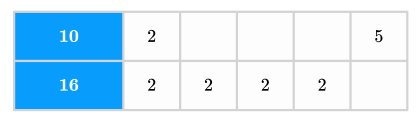
Bring Down the Primes in Each Column and Multiply
Lastly, bring down the factors of 10 and 16 in each column of the table created previously.

The product of these prime factors is the least common multiple of 10 and 16.
| Factors | Multiplication | LCM(10,16) |
|---|---|---|
| 2, 2, 2, 2, and 5 | 2*2*2*2*5 | 80 |
The least common multiple of 10 and 16 is 80.
Finding the Numbers to Fill in the Orange and Pink Cells
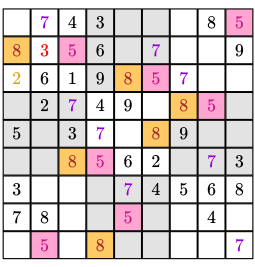
Magdalena found that the LCM(10,16) is 80 but she is not ready to fill in the cells in the puzzle yet. For the orange cells, she needs to find the number that gives 80 when multiplied by 10. orange* 10=80 ⇒ orange= 8 The number that goes in the pink cells can be found in a similar way. pink*16=80 ⇒ pink= 5 This means that the number that goes in the orange cells is 8 and the number that goes in the pink cells is 5. What a big step Magdalena has made now in her solution process!
Pop Quiz
Share
Report error
The GCF and the LCM of Random Numbers
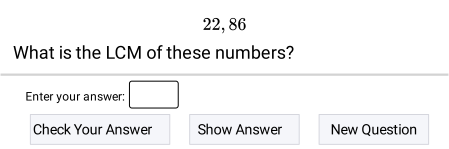
Find the greatest common factor (GCF) or the least common multiple (LCM) of the given numbers, as requested.
Discussion
Share
Report error
Distributive Property
An important use of the greatest common factor is that it can help simplify numeric expressions. Consider, for example, the following sum.
48+30
The greatest common factor of these numbers is 6. This means that each number can be rewritten using this common factor.
48+30 ⇔ 6* 8+ 6* 5
The greatest common factor can be pulled out of each addend. This factor will be multiplied by the sum of the numbers left after pulling it out. 6* 8+ 6* 5 ⇔ 6( 8+ 5)
The property applied to pull the greatest common factor out a sum is called the Distributive Property. This property states that multiplying a number by the sum of two or more addends produces the same result as multiplying the number by each addend individually and then adding all the products together.
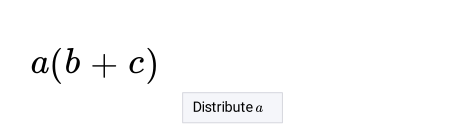 The factor outside the parentheses is multiplied by, or distributed to, every term inside the parentheses. It should be noted that pulling out a common factor can make calculations more straightforward in some cases, but distributing that factor may be better in other calculations. Which way is better for the calculations will be dictated by the situation being studied.
Example
Share
Report error
Creating Different Bouquets With the Same Amount of Flowers
Exhausted from solving math problems to solve the puzzle, Magdalena goes to the kitchen to have something to eat. She chooses a delicious slice of Italian pizza.

She is just about to return to her puzzle when her mother asks her for some help. Magdalena's mother works as a volunteer in a retirement home. She plans to gift some bouquets to the ladies in the retirement home next weekend.

She has 49 roses and 84 tulips. Each bouquet will have the same number of flowers and contain only roses or only tulips.
a What is the greatest number of flowers that Magdalena and her mother can use in each bouquet?
{"type":"text","form":{"type":"math","options":{"comparison":"1","nofractofloat":false,"keypad":{"simple":true,"useShortLog":false,"variables":[],"constants":[]},"rendered":false},"text":" "},"formTextBefore":null,"formTextAfter":"flowers","answer":{"text":["7"]}}
b How many bouquets can Magdalena and her mother create?
{"type":"text","form":{"type":"math","options":{"comparison":"1","nofractofloat":false,"keypad":{"simple":true,"useShortLog":false,"variables":[],"constants":[]},"rendered":false},"text":" "},"formTextBefore":null,"formTextAfter":"bouquets","answer":{"text":["19"]}}
Hint
a Find the greatest common factor of 49 and 89.
b Write an expression for the total number of flowers. Use the Distributive Property to rewrite the expression for the total number of flowers.
Solution
a Magdalena and her mother want each of the bouquets to have an equal number of flowers. This number must be the greatest possible number of flowers. Also, each bouquet must contain only one type of flower. In other words, they need to find the greatest common factor of 49 and 89.
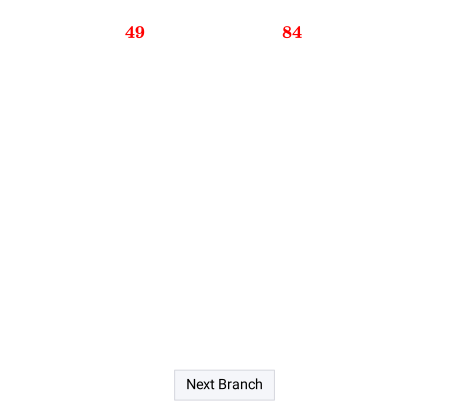
b Begin by finding the total number of flowers.
49 roses + 84 tulips= 133 flowers Let c be the greatest possible number of flowers per bouquet. Next, let a be the number of rose bouquets and b the number of tulip bouquets. Note that the sum of a and b represents the total number of bouquets. Total Number of Bouquets: a+ b Additionally, multiplying the total number of bouquets by the number of flowers per bouquet c will equal the number of flowers in total. It was previously determined that there are 7 flowers per bouquet. Total Number of Flowers: c( a+ b) ⇓ 7( a+ b) The Distributive Property can be applied to this expression. 7( a+ b) ⇕ 7 a+ 7 b Now, consider that the number of rose bouquets a times seven will equal 49, the total number of roses. The missing value of a can be found using this information. Number of Rose Bouquets: 7* a=49 ⇓ a= 7 The number of tulip bouquets b can be determined by following a similar procedure. Number of Tulip Bouquets: 7* b=84 ⇓ b= 12 This means that Magdalena and her mother can create 7 rose bouquets and 12 tulip bouquets. Total Number of Bouquets: 7+ 12=19 bouquets
Checking Our Answer
Checking if the Number of Bouquets for Each Flower Is CorrectSubstitute the values of a and b into the original expression and simplify to verify Magdalena's calculations. Total Number of Flowers: c( a+ b) ⇓ 7( 7+ 12)
This expression must equal the total number of flowers, 133. Use the Distributive Property to simplify this expression.
Notice that this is equivalent to multiplying the total number of bouquets, 7+12=19, by the total number of flowers per bouquet, 7.
19* 7= 133
Closure
Share
Report error
Completing the Puzzle
After helping her mom and having a snack, Magdalena returns to her Sudoku puzzle. The board is almost done, but she thinks the next riddles look extremely difficult.
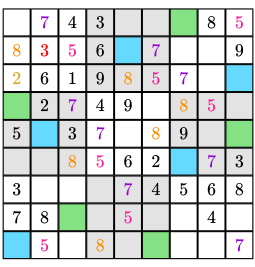
Solve the following situations to help Magdalena complete that challenging puzzle.
a The blue cells must be filled in with the solution to this riddle.
|
A citywide high school soccer club has 100 juniors, 88 sophomores, and 76 seniors. The head coach wants to divide the students into groups of the same size. Each team must have the same numbers of juniors, sophomores, and seniors. What is the greatest possible number of groups the coach can make? |
{"type":"text","form":{"type":"math","options":{"comparison":"1","nofractofloat":true,"keypad":{"simple":true,"useShortLog":false,"variables":[],"constants":[]},"rendered":false},"text":" "},"formTextBefore":null,"formTextAfter":null,"answer":{"text":["4"]}}
b The green cells must be filled in with the solution to this riddle.
|
Davontay, Vincenzo, and Tadeo saw each other at the cinema today. If Davontay goes to the cinema every 6^(th) day, Vincenzo every 10^(th) day, and Tadeo every 5^(th) day, how many times must Tadeo go before the three friends will meet at the cinema again? |
{"type":"text","form":{"type":"math","options":{"comparison":"1","nofractofloat":true,"keypad":{"simple":true,"useShortLog":false,"variables":[],"constants":[]},"rendered":false},"text":" "},"formTextBefore":null,"formTextAfter":null,"answer":{"text":["6"]}}
Solution
a The greatest possible number of groups needs to be determined. The groups must meet these conditions.
- Each group must contain the same number of juniors.
- Each group must contain the same number of sophomores.
- Each group must contain the same number of seniors.
There are 100 juniors, 88 sophomores, and 76 seniors in the club. The coach wants to divide each grade level evenly to create the greatest number of groups possible. In other words, he wants to find the greatest common factor of these numbers. First, list the factors of each number.
| Number | Factors |
|---|---|
| 100 | 1, 2, 4, 5, 10, 20, 25, 50, 100 |
| 88 | 1, 2, 4, 8, 11, 22, 44, 88 |
| 76 | 1, 2, 4, 19, 38, 76 |
Notice that these numbers have the common factors 1, 2, and 4. Their greatest common factor is then 4. This means that the greatest number of groups that the coach can make is 4. This is also the number for the blue cells of Magdalena's puzzle — 4.
b The riddle says that Davontay goes to the cinema every sixth day. It will take 6 days for him to come to the cinema after today, 12 days from now for the second, and so on. This means that Davontay's visits are multiples of 6.
Davontay's Visits Multiples of6: 6, 12, 18, 24, 30, ... The same thought can be applied to Vincenzo's and Tadeo's situations. This means that the least common multiple of 6, 10, and 5 will give the number of days until the boys visit the cinema on the same day again. List the multiples of each to find the LCM(6,10,5).
| Number | Multiples |
|---|---|
| 6 | 6, 12, 18, 24, 30, 36, 42, ... |
| 10 | 10, 20, 30, 40, 50, 60, 70, ... |
| 5 | 5, 10, 15, 20, 25, 30, 35, ... |
The least common multiple of 6, 10, and 5 is 30. This means it will take 30 days for the boys to visit the cinema on the same day. Now, recall that Tadeo goes to the cinema every five days. This means that 5 times a certain number must equal 30. 5* ?= 30 ? = 6 This number is 6. This means that Tadeo will go to the cinema 6 times before meeting his friends. This is the solution to the riddle, so Magdalena can fill in the green cells with the number 6.
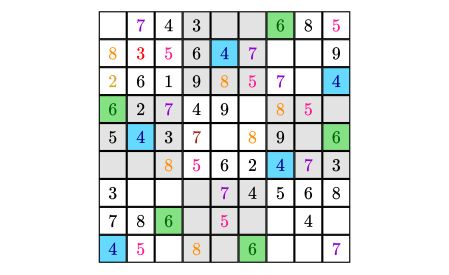
Great news — the remaining numbers are easy to decipher and Magdalena has now filled in the rest of the board. What an outstanding achievement!
Greatest Common Factor and Least Common Multiple
Exercise 1.1
Select the prime factorization of each given number.
{"type":"choice","form":{"alts":["2*139","3*3*31","2*2*3*23","5*41"],"noSort":false},"formTextBefore":"","formTextAfter":"","answer":0}
security
report
code
security
report
code
We are asked to find the prime factorization of 204. We will use a factor tree to find this prime factorization. Let's recall the process for creating a factor tree.
We now know how to create a factor tree! Let's create a factor tree for 204.
We found the prime factorization of 204. Prime Factorization of204 204=2*2*3*17
We will follow a similar process to find the prime factorization of 278.
The only prime factors in the prime factorization of 278 are 2 and 139. We can now write the prime factorization corresponding to 278. Prime Factorization of278 278=2*139
security
report
code
Find the number that corresponds to the given prime factorization.
{"type":"text","form":{"type":"math","options":{"comparison":"1","nofractofloat":false,"keypad":{"simple":true,"useShortLog":false,"variables":["x"],"constants":["PI"]},"rendered":false},"text":" "},"formTextBefore":"=","formTextAfter":null,"answer":{"text":["420"]}}
{"type":"text","form":{"type":"math","options":{"comparison":"1","nofractofloat":false,"keypad":{"simple":true,"useShortLog":false,"variables":["x"],"constants":["PI"]},"rendered":false},"text":" "},"formTextBefore":"=","formTextAfter":null,"answer":{"text":["260"]}}
{"type":"text","form":{"type":"math","options":{"comparison":"1","nofractofloat":false,"keypad":{"simple":true,"useShortLog":false,"variables":["x"],"constants":["PI"]},"rendered":false},"text":" "},"formTextBefore":"=","formTextAfter":null,"answer":{"text":["201"]}}
security
report
code
security
report
code
Let's begin by looking at the given prime factorization. 2*2*3*5*7 We want to determine the number represented by this prime factorization. We can use the Associative Property of Multiplication to calculate partial products. Then we will repeat this process until we get the final product.
The product of the given prime factorization is 420, which means that the prime factorization represents 420.
We will follow a similar process to calculate the number that corresponds to this prime factorization.
We can now say that this is the prime factorization of 260. 2*2*5*13 = 260
Finally, we only have a pair of prime factors. Let's calculate their product! 3*67= 201 The third prime factors represent the prime factorization of 201.
security
report
code
Dominika's favorite number is 9. Her best friend gives her a list with some pairs of numbers. He challenges Dominika to find which of the pairs in the list have Dominika's favorite number as their greatest common factor. Help Dominika choose the correct pair of numbers.
{"type":"choice","form":{"alts":["92 and 76","32 and 46","45 and 63","74 and 49"],"noSort":false},"formTextBefore":"","formTextAfter":"","answer":2}
security
report
code
security
report
code
We want to know which of the given pairs has as the greatest common factor 9. Let's begin by finding the greatest common factor of each pair. Recall the process for finding the greatest common factor of two numbers.
Let's find the greatest common factor of each pair of numbers. This will help us determine the pair that has Dominika's favorite number as its greatest common factor.
74 and 49
Let's create factor trees for 74 and 49 to find their prime factorizations.
Now let's write the prime factorizations together to identify their common prime factors. 74=& 2*37 49=& 7*7 Each number has only two prime factors and there are no common factors between them. This means that the only common factor between these numbers is 1. In other words, 1 is the greatest common factor of 74 and 49. GCF( 74, 49)= 1
45 and 63
Now let's find the greatest common factor of 45 and 63.
Let's find the common prime factors between these prime factorizations. 45=3*3*5 63=3*3*7 We have that 3* 3 are common factors between the prime factorizations. The product of these is the GCF( 45, 63). GCF( 45, 63)= 3* 3 ⇒ GCF( 45, 63)= 9
92 and 76
We can use a similar process to find the prime factorizations of 92 and 76. Consider the prime factorizations of these numbers. 92=2*2*23 76=2*2*19 The product of the common factors 2* 2, and therefore the greatest common factor of 92 and 76, is 4. GCF( 92, 76)= 4
32 and 46
Finally, let's look at the prime factorizations of 32 and 46. 32=& 2*2*2*2*2 46=& 2*23 The only common prime factor between 32 and 46 is 2 — that is, the GCF( 32, 46)= 2. GCF( 32, 46) = 2
Conclusion
We found the greatest common factor for each pair of numbers in Dominika's list. Let's summarize our results in a table!
| Numbers | Prime Factorization | GCF | Is 9 the GCF? |
|---|---|---|---|
| 74 and 49 | 74=2*37 | 1 | No |
| 49=7*7 | |||
| 45 and 63 | 45=3*3*5 | 9 | Yes |
| 63=3*3*7 | |||
| 92 and 76 | 92=2*2*23 | 4 | No |
| 76=2*2*19 | |||
| 32 and 46 | 32=2*2*2*2*2 | 2 | No |
| 46=2*23 |
We can see from this table that 45 and 63 are the only pair of numbers whose GCF is 9. Great! Dominika has successfully completed her friend's challenge.
security
report
code
Look at the following questions.
ll
A. &What is the highest common divisor of
&24and36? [0.5em]
B. &What is the greatest common factor of
&24and36? [0.5em]
C. &What is the product of the common
&factors in the prime factorization of
& 24 and 36? [0.5em]
D. &What is the greatest common prime
&factor of 24and36?
Which question does not belong with the other three?
{"type":"choice","form":{"alts":["A","B","C","D"],"noSort":true},"formTextBefore":"","formTextAfter":"","answer":3}
security
report
code
security
report
code
We will go through each of the questions and find their answers. This will allow us to determine which question does not belong with the other three.
Question A
Let's look at the question given in option A.
What is the highest common divisor of 24 and 36?
This question asks for the highest common divisor of 24 and 36. The word highest
means the greatest. Recall that a factor of a number divides that number evenly, without any remainder. This means that this question is asking for the greatest common factor of these two numbers. Let's list the factors of this pair of numbers.
| Factors | |
|---|---|
| 24 | 1, 2, 3, 4, 6, 8, 12, 24 |
| 36 | 1, 2, 3, 4, 6, 9, 12, 18, 36 |
These numbers has six common factors. The highest of these factors is 12.
Question B
Now, consider the question of option B.
What is the greatest common factor of 24 and 36?
This question also asks for the greatest common factor of 24 and 36. This means that the answer to this question is the same as the previous question. GCF( 24, 36)= 12
Question C
Next, let's analyze the question in option C.
What is the product of the common factors in the prime factorization of 24 and 36?
This time, we will calculate the product of the common factors in the prime factorization of 24 and 36. Let's first look at the prime factorizations of each. & 24= 2* 2*2* 3 & 36= 2* 2* 3*3 The common factors shared by the prime factorizations are 2, 2, and 3. Let's calculate their product. 2* 2* 3= 12 We got the same result as we did for the previous questions. This is because one way to determine the greatest common factor of two numbers is to multiply the common factors in their prime factorizations!
Question D
Finally, let's analyze the last question given in option D.
What is the greatest common prime factor of 24 and 36?
We are asked this time for the greatest prime common factor of 24 and 36. Let's consider the prime factorizations of the numbers again. & 24=2*2*2* 3 & 36=2*2* 3*3 The greatest common prime factor is 3. The answer for this question is 3.
Conclusion
We analyzed the four given questions. Let's summarize our results in a table to determine which question does not belong.
| Question | Answer | |
|---|---|---|
| A | What is the highest common divisor of 24 and 36? | 12 |
| B | What is the greatest common factor of 24 and 36? | 12 |
| C | What is the product of the common prime factors of 24 and 36? | 12 |
| D | What is the greatest common prime factor of 24 and 36? | 3 |
We can now conclude that the question that does not belong with the other three is option D.
security
report
code
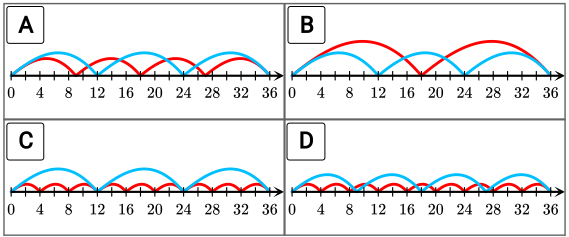
Ramsha used number lines to describe the multiples of some pair of numbers. However, she is having difficulty understanding these figures.
{"type":"choice","form":{"alts":["A","B","C","D"],"noSort":true},"formTextBefore":"","formTextAfter":"","answer":2}
security
report
code
security
report
code
Let's analyze the given models to identify the multiples they describe. We will then have a better idea of the least common multiple each represents, which will help us to determine which model is different from the other three.
Option A
Consider the model A.
Each path in this model describes the multiples of a certain number. Notice that the red path goes from 9 to 18, then to 27, and so on, until it reaches 36. This means we can say that the red path describes the multiples of 9. Multiples of9: 9, 18, 27,36 Let's consider the blue path. We can see that it increases by 12 for every jump. This means that this path describes multiples of 12, starting with 12 and going until it reaches 36. Multiples of12: 12, 24, 36 We found the multiple that each path describes. We can see from the list of multiples created that the least common multiple of 9 and 12 is 36. This corresponds with the point where both paths touch the number line together.
Option B
Now let's look at model B.
In this model, the red path increases by 18 each jump. This means that it describes the multiples of 18. The blue path increases by 12 on each step, so it describes the multiples of 12. Let's look at the meeting point of this model.
The meeting point of the paths is also 36. This means that the least common multiple described by this model is also 36.
Option C
Next, consider model C.
The red path in this model describes the multiples of 4 because it increases by 4 on every step. The blue path describes the multiples of 12 because it jumps by 12 every step. The first point where the lines meet, which represents the least common multiple of these numbers, is 12.
Option D
Finally, let's look at model D.
The red path describes the multiples of 4, while the blue path describes the multiples of 9. The LCM( 4,9) is shown to be 36.
Conclusion
We analyzed all the given models. Let's make a table summarizing the results!
| Model | Multiples of | Least Common Multiple |
|---|---|---|
| A | 9 and 12 | 36 |
| B | 18 and 12 | 36 |
| C | 4 and 12 | 12 |
| D | 4 and 9 | 36 |
We can see that models A, B, and C describe pairs of numbers whose least common multiple is 36. Conversely, model C describes a pair of numbers whose least common multiple is 12. This means that model C is the one that does not belong.
security
report
code
Calculate the greatest common factor for each pair of numbers.
{"type":"text","form":{"type":"math","options":{"comparison":"1","nofractofloat":false,"keypad":{"simple":true,"useShortLog":false,"variables":[],"constants":[]},"rendered":false},"text":" "},"formTextBefore":null,"formTextAfter":null,"answer":{"text":["3"]}}
{"type":"text","form":{"type":"math","options":{"comparison":"1","nofractofloat":false,"keypad":{"simple":true,"useShortLog":false,"variables":[],"constants":[]},"rendered":false},"text":" "},"formTextBefore":null,"formTextAfter":null,"answer":{"text":["2"]}}
security
report
code
security
report
code
One method to find the greatest common factor of two numbers is to list the factors of each number. The next step is to identify the common factors in this list. The greatest of these common factors represents the greatest common factor of the numbers. Let's create a list of all the factors of 51 and 48. Factors of51:& 1, 3, 17, 51 [0.5em] Factors of48:& 1, 2, 3, 4, 6, 8, 12, 16, & 24, 48 We can see that the common factors between these numbers are 1 and 3. The greater of these common factors is 3, so the greatest common factor of 51 and 48 is 3.
We will follow a similar process to find the greatest common factor of 74 and 80. We will start by creating a list of the factors of these numbers. Factors of74:& 1, 2, 37, 74 [0.5em] Factors of80:& 1, 2, 4, 5, 8, 10, 16, 20, & 40, 80 The common factors of these numbers are 1 and 2. Since 2 is greater than 1, this means that the GCF( 74, 80)= 2.
security
report
code
Find the least common multiple of the given pair of numbers.
{"type":"text","form":{"type":"math","options":{"comparison":"1","nofractofloat":false,"keypad":{"simple":true,"useShortLog":false,"variables":[],"constants":[]},"rendered":false},"text":" "},"formTextBefore":null,"formTextAfter":null,"answer":{"text":["374"]}}
{"type":"text","form":{"type":"math","options":{"comparison":"1","nofractofloat":false,"keypad":{"simple":true,"useShortLog":false,"variables":[],"constants":[]},"rendered":false},"text":" "},"formTextBefore":null,"formTextAfter":null,"answer":{"text":["30"]}}
security
report
code
security
report
code
We want to calculate the least common multiple (LCM) of 22 and 17. Let's begin by creating a factor tree for both numbers.
We have now the prime factorization of this pair of numbers. Let's write them together to see the different prime factors. & 22=2*11 & 17=17 The prime factorizations have three different factors that all appear only once. This means that we must multiply these three factors to get the LCM( 22, 17). Let's do it! LCM( 22, 17)=2*11*177 ⇕ LCM( 22, 17)=374
We want to find the least common multiple of 15 and 10. This time, we will create a list containing the first few multiples of each number. Then we will identify the common multiples between the lists. The least of these will be the least common multiple of 15 and 10. Let's do it! &Multiples of15: 15, 30, 45, 60, 75, 90,... &Multiples of10: 10, 20, 30, 40, 50, 60,... We found that the first two common multiples of 15 and 10 are 30 and 60. The smaller of these — and therefore the least common multiple — is 30. LCM( 15, 10)= 30
security
report
code
Greatest Common Factor and Least Common Multiple
Recommended exercises
To get personalized recommended exercises, please login first.
Loading content
≤
>
■2
■▢
e▢
7
8
9
×
÷■1
=
=
√▢
▢√
∫▢▢
4
5
6
+
−
≤
<
log
ln
log▢
1
2
3
()
∣
sin
cos
tan
0
.
π
x
y
Loading content