11. Geometry in Design
Sign In
An error ocurred, try again later!
Chapter 2
11.
Geometry in Design
This lesson delves into the fascinating intersection of geometry and design, focusing on the roles of trigonometry and similarity. For instance, trigonometry can help in calculating distances and angles in architectural designs, while similarity principles are crucial when scaling models or artworks. Understanding these mathematical concepts is not just for academic purposes; they have practical applications in various fields like architecture, engineering, and even in simple DIY home projects. Whether you are planning a garden layout or designing a skyscraper, these geometric methods offer invaluable tools for problem-solving and optimization.
Show less Show more expand_more Lesson Settings & Tools
| | 7 Theory slides |
| | 10 Exercises - Grade E - A |
| | Each lesson is meant to take 1-2 classroom sessions |
Geometry in Design
Slide of 7
In this lesson, geometric methods will be used to solve design problems.
Catch-Up and Review
Here are a few recommended readings before getting started with this lesson.
- Circles
- Arcs and arc length
- Circle sector and area of a circle sector
- Triangles
- Area
- Perimeter
- Trigonometric ratios
- Pythagorean Theorem
Try your knowledge on these topics.
Find the perimeter and area of the following figures.
a 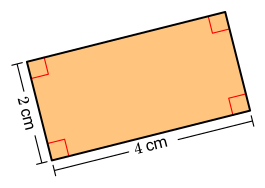
{"type":"text","form":{"type":"math","options":{"comparison":"1","nofractofloat":false,"keypad":{"simple":true,"useShortLog":false,"variables":[],"constants":[]},"rendered":false},"text":"<span class=\"katex\"><span class=\"katex-html\" aria-hidden=\"true\"><\/span><\/span>"},"formTextBefore":"Perimeter <span class=\"katex\"><span class=\"katex-html\" aria-hidden=\"true\"><span class=\"base\"><span class=\"strut\" style=\"height:0.36687em;vertical-align:0em;\"><\/span><span class=\"mrel\">=<\/span><\/span><\/span><\/span>","formTextAfter":"cm","answer":{"text":["12"]}}
{"type":"text","form":{"type":"math","options":{"comparison":"1","nofractofloat":false,"keypad":{"simple":true,"useShortLog":false,"variables":[],"constants":[]},"rendered":false},"text":"<span class=\"katex\"><span class=\"katex-html\" aria-hidden=\"true\"><\/span><\/span>"},"formTextBefore":"Area <span class=\"katex\"><span class=\"katex-html\" aria-hidden=\"true\"><span class=\"base\"><span class=\"strut\" style=\"height:0.36687em;vertical-align:0em;\"><\/span><span class=\"mrel\">=<\/span><\/span><\/span><\/span>","formTextAfter":"<span class=\"katex\"><span class=\"katex-html\" aria-hidden=\"true\"><span class=\"base\"><span class=\"strut\" style=\"height:0.8238736249999999em;vertical-align:-0.009765625em;\"><\/span><span class=\"mord\"><span class=\"mord text\"><span class=\"mord Roboto-Regular\">cm<\/span><\/span><span class=\"msupsub\"><span class=\"vlist-t\"><span class=\"vlist-r\"><span class=\"vlist\" style=\"height:0.8141079999999999em;\"><span style=\"top:-3.063em;margin-right:0.05em;\"><span class=\"pstrut\" style=\"height:2.7em;\"><\/span><span class=\"sizing reset-size6 size3 mtight\"><span class=\"mord mtight\">2<\/span><\/span><\/span><\/span><\/span><\/span><\/span><\/span><\/span><\/span><\/span>","answer":{"text":["8"]}}
b 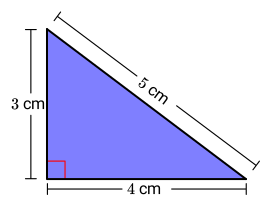
{"type":"text","form":{"type":"math","options":{"comparison":"1","nofractofloat":false,"keypad":{"simple":true,"useShortLog":false,"variables":[],"constants":[]},"rendered":false},"text":"<span class=\"katex\"><span class=\"katex-html\" aria-hidden=\"true\"><\/span><\/span>"},"formTextBefore":"Perimeter <span class=\"katex\"><span class=\"katex-html\" aria-hidden=\"true\"><span class=\"base\"><span class=\"strut\" style=\"height:0.36687em;vertical-align:0em;\"><\/span><span class=\"mrel\">=<\/span><\/span><\/span><\/span>","formTextAfter":"cm","answer":{"text":["12"]}}
{"type":"text","form":{"type":"math","options":{"comparison":"1","nofractofloat":false,"keypad":{"simple":true,"useShortLog":false,"variables":[],"constants":[]},"rendered":false},"text":"<span class=\"katex\"><span class=\"katex-html\" aria-hidden=\"true\"><\/span><\/span>"},"formTextBefore":"Area <span class=\"katex\"><span class=\"katex-html\" aria-hidden=\"true\"><span class=\"base\"><span class=\"strut\" style=\"height:0.36687em;vertical-align:0em;\"><\/span><span class=\"mrel\">=<\/span><\/span><\/span><\/span>","formTextAfter":"<span class=\"katex\"><span class=\"katex-html\" aria-hidden=\"true\"><span class=\"base\"><span class=\"strut\" style=\"height:0.8238736249999999em;vertical-align:-0.009765625em;\"><\/span><span class=\"mord\"><span class=\"mord text\"><span class=\"mord Roboto-Regular\">cm<\/span><\/span><span class=\"msupsub\"><span class=\"vlist-t\"><span class=\"vlist-r\"><span class=\"vlist\" style=\"height:0.8141079999999999em;\"><span style=\"top:-3.063em;margin-right:0.05em;\"><span class=\"pstrut\" style=\"height:2.7em;\"><\/span><span class=\"sizing reset-size6 size3 mtight\"><span class=\"mord mtight\">2<\/span><\/span><\/span><\/span><\/span><\/span><\/span><\/span><\/span><\/span><\/span>","answer":{"text":["6"]}}
c Calculate the sine, cosine, and tangent of ∠θ in the right triangle. Write the answers as fractions in their simplest form.
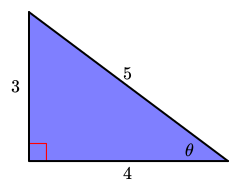
{"type":"text","form":{"type":"math","options":{"comparison":"1","nofractofloat":false,"keypad":{"simple":true,"useShortLog":false,"variables":[],"constants":[]},"rendered":false},"text":"<span class=\"katex\"><span class=\"katex-html\" aria-hidden=\"true\"><\/span><\/span>"},"formTextBefore":"<span class=\"katex\"><span class=\"katex-html\" aria-hidden=\"true\"><span class=\"base\"><span class=\"strut\" style=\"height:0.69444em;vertical-align:0em;\"><\/span><span class=\"mop\">sin<\/span><span class=\"mspace\" style=\"margin-right:0.16666666666666666em;\"><\/span><span class=\"mord mathdefault\" style=\"margin-right:0.02778em;\">\u03b8<\/span><span class=\"mspace\" style=\"margin-right:0.2777777777777778em;\"><\/span><span class=\"mrel\">=<\/span><\/span><\/span><\/span>","formTextAfter":null,"answer":{"text":["\\dfrac{3}{5}","\\frac{3}{5}","3\/5"]}}
{"type":"text","form":{"type":"math","options":{"comparison":"1","nofractofloat":false,"keypad":{"simple":true,"useShortLog":false,"variables":[],"constants":[]},"rendered":false},"text":"<span class=\"katex\"><span class=\"katex-html\" aria-hidden=\"true\"><\/span><\/span>"},"formTextBefore":"<span class=\"katex\"><span class=\"katex-html\" aria-hidden=\"true\"><span class=\"base\"><span class=\"strut\" style=\"height:0.69444em;vertical-align:0em;\"><\/span><span class=\"mop\">cos<\/span><span class=\"mspace\" style=\"margin-right:0.16666666666666666em;\"><\/span><span class=\"mord mathdefault\" style=\"margin-right:0.02778em;\">\u03b8<\/span><span class=\"mspace\" style=\"margin-right:0.2777777777777778em;\"><\/span><span class=\"mrel\">=<\/span><\/span><\/span><\/span>","formTextAfter":null,"answer":{"text":["\\dfrac{4}{5}","\\frac{4}{5}","4\/5"]}}
{"type":"text","form":{"type":"math","options":{"comparison":"1","nofractofloat":false,"keypad":{"simple":true,"useShortLog":false,"variables":[],"constants":[]},"rendered":false},"text":"<span class=\"katex\"><span class=\"katex-html\" aria-hidden=\"true\"><\/span><\/span>"},"formTextBefore":"<span class=\"katex\"><span class=\"katex-html\" aria-hidden=\"true\"><span class=\"base\"><span class=\"strut\" style=\"height:0.69444em;vertical-align:0em;\"><\/span><span class=\"mop\">tan<\/span><span class=\"mspace\" style=\"margin-right:0.16666666666666666em;\"><\/span><span class=\"mord mathdefault\" style=\"margin-right:0.02778em;\">\u03b8<\/span><span class=\"mspace\" style=\"margin-right:0.2777777777777778em;\"><\/span><span class=\"mrel\">=<\/span><\/span><\/span><\/span>","formTextAfter":null,"answer":{"text":["\\dfrac{3}{4}","\\frac{3}{4}","3\/4"]}}
d By using the Pythagorean Theorem, calculate the missing side length.
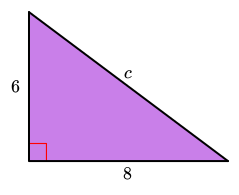
{"type":"text","form":{"type":"math","options":{"comparison":"1","nofractofloat":false,"keypad":{"simple":true,"useShortLog":false,"variables":[],"constants":[]},"rendered":false},"text":"<span class=\"katex\"><span class=\"katex-html\" aria-hidden=\"true\"><\/span><\/span>"},"formTextBefore":"<span class=\"katex\"><span class=\"katex-html\" aria-hidden=\"true\"><span class=\"base\"><span class=\"strut\" style=\"height:0.43056em;vertical-align:0em;\"><\/span><span class=\"mord mathdefault\">c<\/span><span class=\"mspace\" style=\"margin-right:0.2777777777777778em;\"><\/span><span class=\"mrel\">=<\/span><\/span><\/span><\/span>","formTextAfter":null,"answer":{"text":["10"]}}
e Calculate the length of the arc and the area of the sector. Write the answer correct to one decimal place.
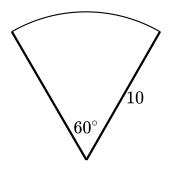
{"type":"text","form":{"type":"math","options":{"comparison":"1","nofractofloat":false,"keypad":{"simple":true,"useShortLog":false,"variables":[],"constants":[]},"rendered":false},"text":"<span class=\"katex\"><span class=\"katex-html\" aria-hidden=\"true\"><\/span><\/span>"},"formTextBefore":"Arc length <span class=\"katex\"><span class=\"katex-html\" aria-hidden=\"true\"><span class=\"base\"><span class=\"strut\" style=\"height:0.36687em;vertical-align:0em;\"><\/span><span class=\"mrel\">=<\/span><\/span><\/span><\/span>","formTextAfter":null,"answer":{"text":["10.5"]}}
{"type":"text","form":{"type":"math","options":{"comparison":"1","nofractofloat":false,"keypad":{"simple":true,"useShortLog":false,"variables":[],"constants":[]},"rendered":false},"text":"<span class=\"katex\"><span class=\"katex-html\" aria-hidden=\"true\"><\/span><\/span>"},"formTextBefore":"Area of the sector <span class=\"katex\"><span class=\"katex-html\" aria-hidden=\"true\"><span class=\"base\"><span class=\"strut\" style=\"height:0.36687em;vertical-align:0em;\"><\/span><span class=\"mrel\">=<\/span><\/span><\/span><\/span>","formTextAfter":null,"answer":{"text":["52.4"]}}
Challenge
Investigating Efficient Solutions Using Geometry
Paulina bought two sprinklers to water her 20-meter by 10-meter rectangular garden. Each sprinkler waters a circular region, and the radius of each circle measures equally. She does not want any part of her garden to flood. That is, the circles should not overlap. The radii can be adjusted by changing the water pressure. Try to place them in the garden in the most efficient manner!
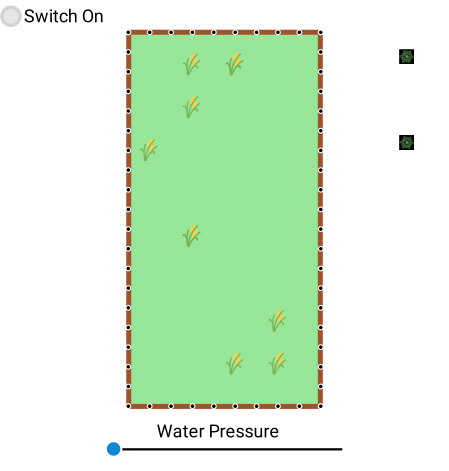 Where should Paulina place the sprinklers if she wants to water the greatest possible area of her garden?
Example
Using Geometry in Space
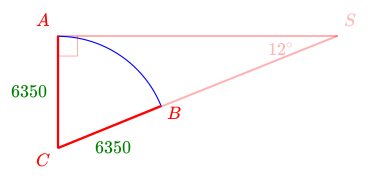
A satellite orbiting the Earth uses radar to communicate with two stations on the surface. The satellite is orbiting in such a way that it is always in line with the center of Earth and Station B. From the perspective of Station A, the satellite is on the horizon. From the perspective of station B, the satellite is always directly overhead.
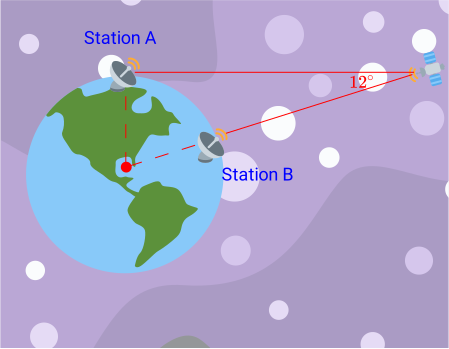
The measure of the angle between the lines from the satellite to the stations is 12∘. To answer the following questions, assume that the Earth is a sphere with a diameter of 12700 kilometers. Write all the answers in kilometer, rounded to the nearest hundred.
a How many kilometers will a signal sent from Station A to the satellite and then to Station B travel?
{"type":"text","form":{"type":"math","options":{"comparison":"1","nofractofloat":false,"keypad":{"simple":true,"useShortLog":false,"variables":[],"constants":[]},"rendered":false},"text":"<span class=\"katex\"><span class=\"katex-html\" aria-hidden=\"true\"><\/span><\/span>"},"formTextBefore":null,"formTextAfter":"kilometers","answer":{"text":["54100","54,100","54 100"]}}
b Two astronomers are flying from Station A to Station B in a direct path along the surface of the Earth. What is the distance they will fly?
{"type":"text","form":{"type":"math","options":{"comparison":"1","nofractofloat":false,"keypad":{"simple":true,"useShortLog":false,"variables":[],"constants":[]},"rendered":false},"text":"<span class=\"katex\"><span class=\"katex-html\" aria-hidden=\"true\"><\/span><\/span>"},"formTextBefore":null,"formTextAfter":"kilometers","answer":{"text":["8600","8,600","8 600"]}}
c Suppose a signal could travel through the surface of the Earth between stations. What is the shortest distance the signal would travel between Station A and Station B?
{"type":"text","form":{"type":"math","options":{"comparison":"1","nofractofloat":false,"keypad":{"simple":true,"useShortLog":false,"variables":[],"constants":[]},"rendered":false},"text":"<span class=\"katex\"><span class=\"katex-html\" aria-hidden=\"true\"><\/span><\/span>"},"formTextBefore":null,"formTextAfter":"kilometers","answer":{"text":["8000","8,000","8 000"]}}
Hint
a Consider the right triangle formed by the center of the Earth, Station A, and the satellite.
b The distance the astronomers will fly is the length of the arc whose endpoints are Station A and Station B.
c Consider the isosceles triangle formed by the center of the Earth, Station A and Station B.
Solution
a The radius of a sphere is half its diameter. When this information is combined with the knowledge that the diameter of the Earth is 12700 kilometers, its radius can be calculated.
The radius of the Earth is 6350 kilometers. Since the satellite is on the horizon from the perspective of Station A, the line through this station and the satellite is tangent to the Earth. Therefore, it makes a right angle with the radius. Consequently, the triangle formed by the center of the Earth, Station A, and the satellite is a right triangle. 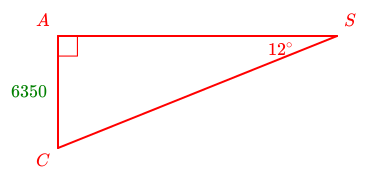 The distance traveled by signal from Station A to the satellite is equal to AS. This length can be calculated using trigonometric ratios. Note that m∠S is given. The length of AC, which is opposite to ∠S, is also known. The length of the side adjacent ∠S is desired. Therefore, the tangent ratio can be used.
The distance from Station A to the satellite is 29874 kilometers.
The distance traveled by signal from Station A to the satellite is equal to AS. This length can be calculated using trigonometric ratios. Note that m∠S is given. The length of AC, which is opposite to ∠S, is also known. The length of the side adjacent ∠S is desired. Therefore, the tangent ratio can be used.
The distance from Station A to the satellite is 29874 kilometers. 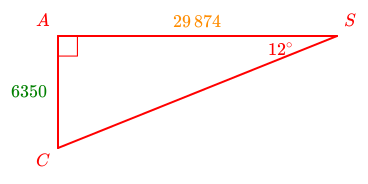 When two legs of a right triangle are known, its hypotenuse can be found. That can be done by using the Pythagorean Theorem.
Note that when solving the equation, only the principal root was considered. This is because side lengths are always positive. Therefore, it can be said that the distance from the center of the Earth to the satellite is 30541 kilometers.
When two legs of a right triangle are known, its hypotenuse can be found. That can be done by using the Pythagorean Theorem.
Note that when solving the equation, only the principal root was considered. This is because side lengths are always positive. Therefore, it can be said that the distance from the center of the Earth to the satellite is 30541 kilometers. 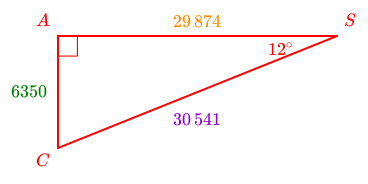
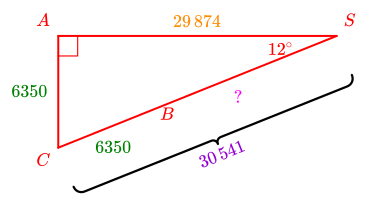 The distance from Station B to the satellite can be calculated by using the Segment Addition Postulate.
The distance from Station B to the satellite is 24191 kilometers.
The distance from Station B to the satellite can be calculated by using the Segment Addition Postulate.
The distance from Station B to the satellite is 24191 kilometers. 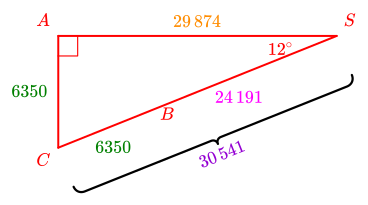 Finally, the distance that a signal sent from Station A to the satellite and then to Station B is the sum of AS and BS.
tan∠S=Adjacent side to∠SOpposite side to∠S⇓tan12∘=AS6350
The above equation can be solved by using inverse operations and Properties of Equality.
tan12∘=AS6350
AS≈29874
Next, consider Station B. Because it is located on the Earth's surface, its distance from the center is equal to the radius of the Earth, which is 6350 kilometers.
29874+24191=54065 km
This number approximated to the nearest hundred is 54100 kilometers. b First, note that the astronomers will travel along the surface of the Earth which is spherical. Therefore, their path is not linear, but rather an arc length.
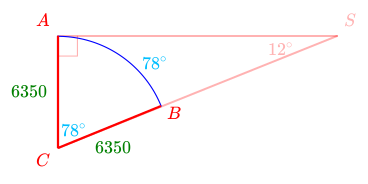
 To find the length of an arc, a proportion that relates it with the measure of the arc must be solved.
 Recall that the circumference of a sphere, Earth, is equal to its diameter multiplied by π.
The astronomers will travel 8600 kilometers, to the nearest hundred kilometers.
Recall that the circumference of a sphere, Earth, is equal to its diameter multiplied by π.
The astronomers will travel 8600 kilometers, to the nearest hundred kilometers.
CircumferenceArc length=360∘Arc measure
Recall that the measure of an arc is the same as the measure of its corresponding central angle. When considering △ACS, the angle of the corresponding sector, ∠C, can be found using the Triangle Angle Sum Theorem.
The angle of the sector that corresponds to AB measures 78∘. Therefore, the measure of AB is also 78∘. Circumference:12700π
Now the arc length can be calculated by using the formula previously mentioned.
CircumferenceArc length=360∘Arc measure
SubstituteII
Arc measure=78∘, Circumference=12700π
12700πArc length=360∘78∘
▼
Solve for arc length
MultEqn
LHS⋅12700π=RHS⋅12700π
Arc length=360∘78∘(12700π)
MoveRightFacToNum
ca⋅b=ca⋅b
arc length=360∘990600∘π
ReduceFrac
ba=b/120∘a/120∘
Arc length=38255π
UseCalc
Use a calculator
Arc length=8644.615785…
Approximate to nearest hundred
Arc length≈8600
c If a signal can travel through the Earth's surface, the shortest distance it will travel equals the length of the segment that connects the stations. It is already known that AC and BC are both 6350. Therefore, the triangle formed by the Earth's center and the stations is an isosceles triangle. It is also known that m∠C=78∘. 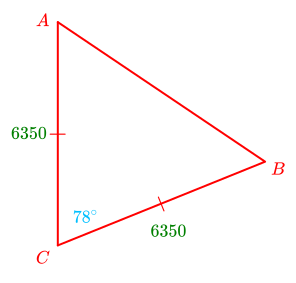 The distance that the signal will travel is equal to AB. To find this value, the altitude of △ABC through vertex C will be considered. Keep in mind that the altitude is perpendicular to the base. Also, this altitude bisects the vertex angle of the isosceles triangle. Let M be the point of intersection of the altitude and AB.
 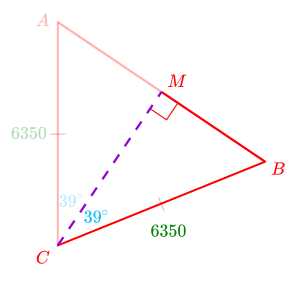 It can be seen above that △BCM is a right triangle whose hypotenuse is 6350. Since in this triangle MB is the side opposite ∠BCM, the sine ratio can be used to find MB. Once this length is obtained, it can be used to obtain AB — the distance that the signal will travel.
The length of MB is 3996. For symmetry reasons, the length of AM is also 3996.
It can be seen above that △BCM is a right triangle whose hypotenuse is 6350. Since in this triangle MB is the side opposite ∠BCM, the sine ratio can be used to find MB. Once this length is obtained, it can be used to obtain AB — the distance that the signal will travel.
The length of MB is 3996. For symmetry reasons, the length of AM is also 3996. 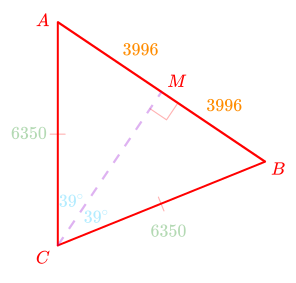 According to the Segment Addition Postulate, the length of AB — the distance that the signal will travel — can be found by adding MB and AM.
sinθ=HypotenuseLength of the side opposite θ
SubstituteValues
Substitute values
sin39∘=6350MB
▼
Solve for MB
MultEqn
LHS⋅6350=RHS⋅6350
sin39∘⋅6350=MB
UseCalc
Use a calculator
3996.184483…=MB
RearrangeEqn
Rearrange equation
MB=3996.184483…
RoundInt
Round to nearest integer
MB≈3996
AB=3996+3996 ⇔ AB=7992
Rounded to the nearest hundred the distance that the signal will travel is 8000 kilometers. Example
Optimizing Storage Using Geometry
Mark's favorite subject is Geometry. He can never get enough! While organizing his storage space, he came across a situation he calls the staggered pipes situation. There are six pipes, each with a radius of 3 centimeters. They need to be stored in a toolbox of width 18 centimeters. The pipes can be staggered or non-staggered piles.
 Mark would like to calculate the difference in heights of the two piles. Help him find that value! Round the answer to three significant figures.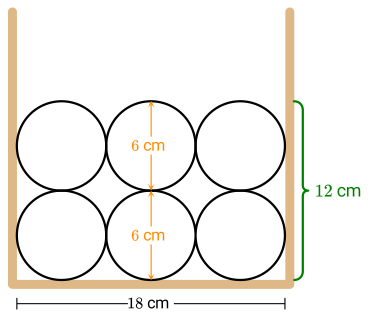
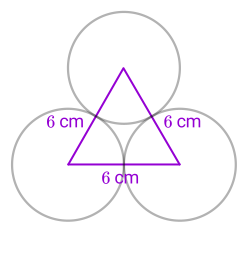
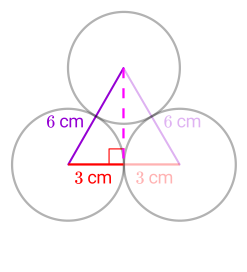 The altitude of the equilateral triangle is the missing leg of the right triangle. It can be found by using the Pythagorean Theorem. Let a and b be the legs of the right triangle, and c its hypotenuse.
Be aware that, when solving the equation, only the principal root was considered. That is because side lengths are always positive. Therefore, the length of the leg of the right triangle, which is the altitude of the equilateral triangle, is 33 centimeters.
The altitude of the equilateral triangle is the missing leg of the right triangle. It can be found by using the Pythagorean Theorem. Let a and b be the legs of the right triangle, and c its hypotenuse.
Be aware that, when solving the equation, only the principal root was considered. That is because side lengths are always positive. Therefore, the length of the leg of the right triangle, which is the altitude of the equilateral triangle, is 33 centimeters. 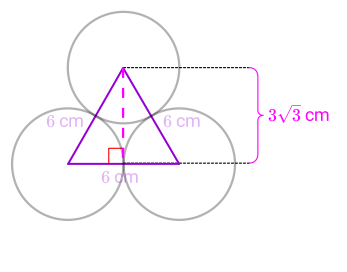
 The height of the pile can be calculated by using the Segment Addition Postulate.
{"type":"text","form":{"type":"math","options":{"comparison":"1","nofractofloat":false,"keypad":{"simple":true,"useShortLog":false,"variables":[],"constants":[]},"rendered":false},"text":"<span class=\"katex\"><span class=\"katex-html\" aria-hidden=\"true\"><\/span><\/span>"},"formTextBefore":null,"formTextAfter":"centimeters","answer":{"text":["4.39"]}}
Hint
For the staggered pipes, consider the triangle formed by the centers of two pipes next to each other and the pipe on top of them.
Solution
The heights of each pile will be calculated one at a time. Their difference can then be calculated.
Non-Staggered Pipes
The diameter of the pipes is twice their radius.Diameter2×3=6 centimeters
Since the pipes are not staggered, they are directly on stacked on top of each other without a gap. Therefore, the height of the pile is the sum of the diameters of two vertically stacked pipes. The height of the pile formed by the non-staggered pipes is 12 centimeters.
Staggered Pipes
To find the height of this pile, the triangle formed by the centers of two pipes next to each other and the pipe on top of them will be considered. Note that the length of each side of this triangle is equal to the sum of two radii.Side Length3+3=6 centimeters
Therefore, the triangle is an equilateral triangle with a side length of 6 centimeters. Consider now the altitude of the above triangle. Note that the altitude of an equilateral triangle bisects the base. Recall also that the altitude of a triangle is perpendicular to the base. Therefore, a right triangle with hypotenuse 6 centimeters and with side length of 3 centimeters is obtained.
This information can be added to the diagram of the staggered pipes.
Height of the Pile3+33+33+3=(6+63)cm
Difference
Finally, the difference between the heights of the piles can be calculated. With a difference of 4.39 inches, Mark will be able to fit a variety of other objects into the toolbox based on his preferred layout.Example
Optimizing Area Using Geometry
Ali bought 20 meters of fence to construct a playground in his backyard for his dog Rover. He is wavering between the ideas of making the playground's shape into a square, an equilateral triangle, or a circle. Help give Rover the most space to run.
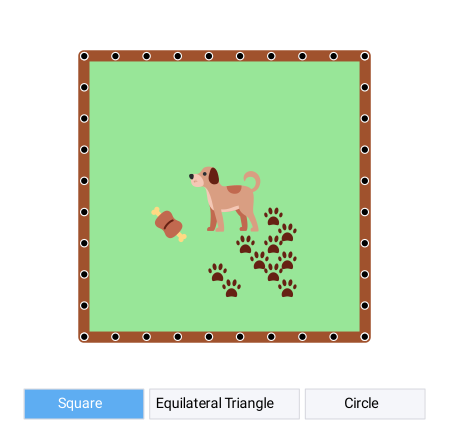 Which of these three shapes has the greatest area?
 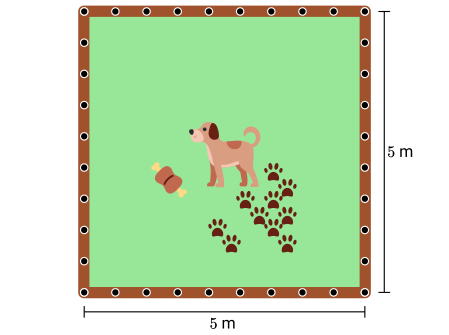 Now, to find its area, the side length can be squared.
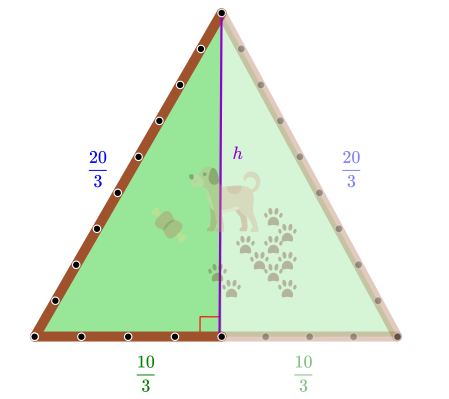 It can be seen that the right triangle formed at the left of the diagram has hypotenuse 320 and legs 310 and h. To find the missing value, the Pythagorean Theorem can be used.
Because side lengths are non-negative, when solving the equation only the principal root was considered. Therefore, the length of the leg of the right triangle, which is also the height of the equilateral triangle, is 3103 meters. Recall that the side length of the equilateral triangle is 320 meters. This means that its base is also 320 meters.
It can be seen that the right triangle formed at the left of the diagram has hypotenuse 320 and legs 310 and h. To find the missing value, the Pythagorean Theorem can be used.
Because side lengths are non-negative, when solving the equation only the principal root was considered. Therefore, the length of the leg of the right triangle, which is also the height of the equilateral triangle, is 3103 meters. Recall that the side length of the equilateral triangle is 320 meters. This means that its base is also 320 meters. 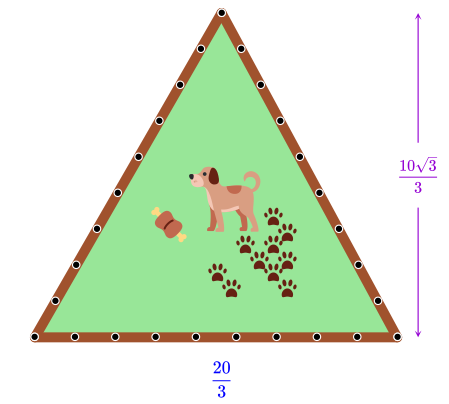 The area of a triangle is half the product of its base and its height. With this information, the area of the triangle can be found.
The area of the equilateral triangle is 91003 square meters.
The area of a triangle is half the product of its base and its height. With this information, the area of the triangle can be found.
The area of the equilateral triangle is 91003 square meters. 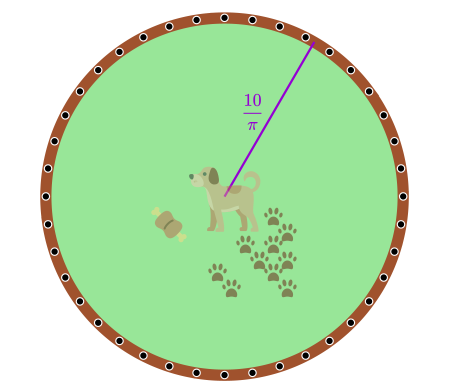 The area of a circle is the product of π and the square of its radius.
The area of the circle is π100 square meters.
The area of a circle is the product of π and the square of its radius.
The area of the circle is π100 square meters.
{"type":"choice","form":{"alts":["Equilateral Triangle","Square","Circle"],"noSort":false},"formTextBefore":"","formTextAfter":"","answer":2}
Hint
Calculate and compare the area of the three shapes.
Solution
The area of the three shapes will be calculated one at a time. Then, they will be compared.
Square
Let ℓ be the side length of a square region enclosed by 20 meters of fence. The perimeter of the region 4ℓ, will then be equal to 20. The side length of the square is 5 meters.Area of the Square:52=25 m2
Equilateral Triangle
The three sides of an equilateral triangle have the same length. Therefore, to find the side length, the perimeter of the triangle, which is equal to the length of the fence, must be divided by 3.Side Length:320 meters
To find the area of the triangle, its height h must be found first. To do so, the altitude of the triangle will be drawn. Recall that the altitude of an equilateral triangle bisects and is perpendicular to the base. A=21bh
SubstituteII
b=320, h=3103
A=21(320)(3103)
▼
Evaluate right-hand side
MultFrac
Multiply fractions
A=620(3103)
ReduceFrac
ba=b/2a/2
A=310(3103)
MultFrac
Multiply fractions
A=91003
Circle
Just one more major step. Finally, the area of the circle will be calculated. Since Ali bought 20 meters of fence, the circumference is 20 meters. Recall that the circumference of a circle is twice the product of π and its radius. With this information, the radius of the circle can be found. The radius of the circle is π10 meters.A=πr2
Substitute
r=π10
A=π(π10)2
▼
Evaluate right-hand side
PowQuot
(ba)m=bmam
A=π(π2100)
MoveLeftFacToNum
a⋅cb=ca⋅b
A=π2π(100)
CancelCommonFac
Cancel out common factors
SimpQuot
Simplify quotient
A=π100
Comparison
Now that the areas of the three figures are known, they can be compared. To do so, the area of the triangle and the area of the circle will be approximated to two decimal places.
| Area of the Square | Area of the Equilateral Triangle | Area of the Circle |
|---|---|---|
| 25 m2 | 91003 ≈ 19.25 m2 | π100 ≈ 31.83 m2 |
It can be seen above that the circle is the figure with the greatest area. Therefore, Ali should construct Rover's playground in the shape of a circle. Run and feel the wind Rover!
Example
Comparing Areas Using Geometry
Magdalena and Dylan want to build three grain bins in their field in the form of an equilateral triangle. Both sketch the field as an equilateral triangle with a side length of 10 centimeters. Magdalena draws three congruent circles, in contrast to Dylan, who draws the incircle of the triangle and two circles with a radius of 1 centimeter. 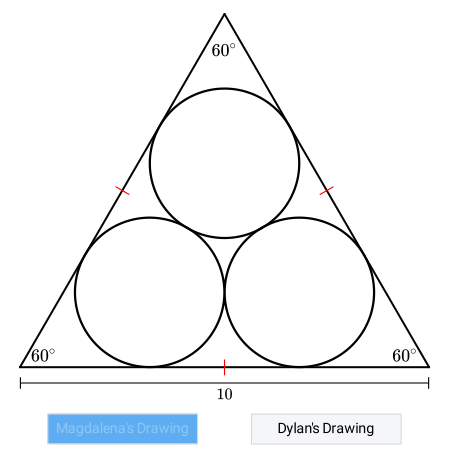 For the most efficient use of the field, the total area of the circles should be as large as possible. To find the total area in each case, they ask their teacher for some help. The teacher tells them that the radius of an incircle of a triangle is twice the quotient between the area and the perimeter of the triangle.
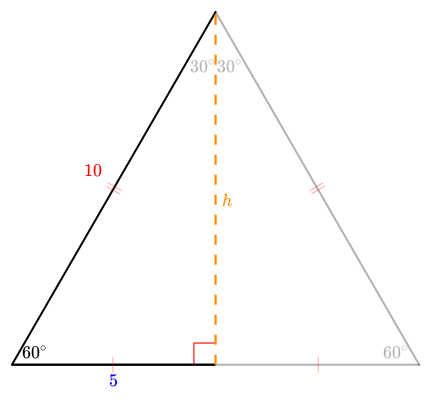 By using the Pythagorean Theorem, the height of the triangle can be calculated.
When solving the equation, only the principal root was considered because a length is always positive. Therefore, the height of the right triangle is 53 centimeters. With this information, its area can be calculated.
By using the Pythagorean Theorem, the height of the triangle can be calculated.
When solving the equation, only the principal root was considered because a length is always positive. Therefore, the height of the right triangle is 53 centimeters. With this information, its area can be calculated.
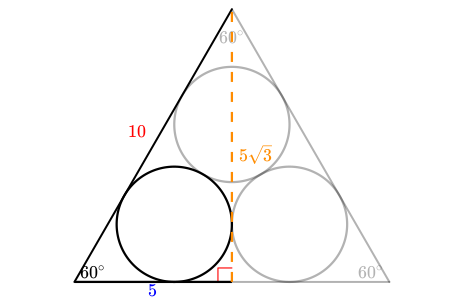 Therefore, its radius can be calculated by using the formula given by the teacher. To do this, the perimeter of the right triangle is needed.
The radius of Magdalena's circles is 253−5 centimeters.
Therefore, its radius can be calculated by using the formula given by the teacher. To do this, the perimeter of the right triangle is needed.
The radius of Magdalena's circles is 253−5 centimeters. 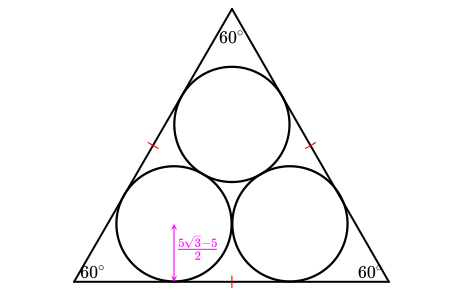 Now the area of one of the circles can be calculated.
The area of one of the circles that Magdalena drew is 250−253π square centimeters.
Now the area of one of the circles can be calculated.
The area of one of the circles that Magdalena drew is 250−253π square centimeters. 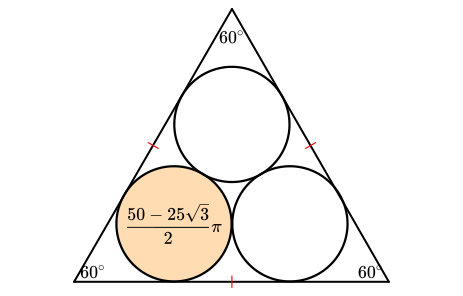 Since the three circles are congruent, they have the same area. Therefore, to calculate the sum of the areas, it is enough to multiply the area of one of the circle's by 3.
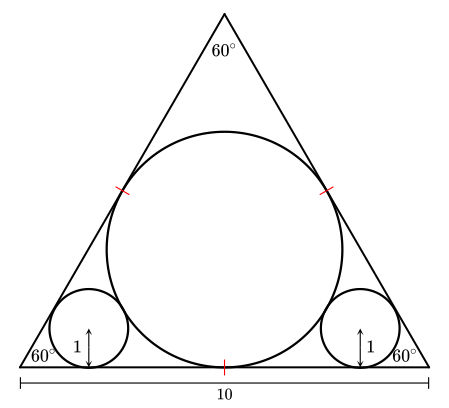 The formula given by the teacher can be used to calculate the radius of the incircle that Dylan drew. First, recall that the height and base of this equilateral triangle are 53 and 10 centimeters, respectively. This information will be used to calculate the area of the triangle.
The area of the equilateral triangle is 253 square centimeters. Its perimeter is the sum of the sides. Therefore, its perimeter is 10+10+10=30 centimeters. With this information, the formula given by the teacher can be used to find the radius of the incircle.
The radius of the incircle is 353 centimeters.
The formula given by the teacher can be used to calculate the radius of the incircle that Dylan drew. First, recall that the height and base of this equilateral triangle are 53 and 10 centimeters, respectively. This information will be used to calculate the area of the triangle.
The area of the equilateral triangle is 253 square centimeters. Its perimeter is the sum of the sides. Therefore, its perimeter is 10+10+10=30 centimeters. With this information, the formula given by the teacher can be used to find the radius of the incircle.
The radius of the incircle is 353 centimeters. 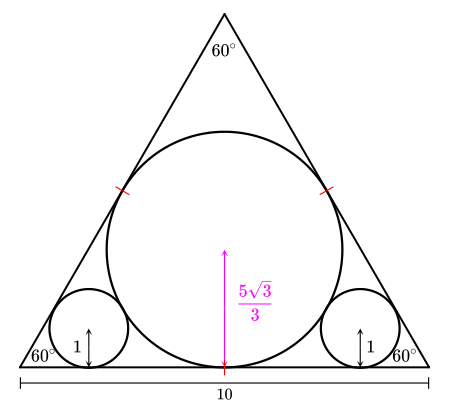 Therefore, the area of the incircle can be found.
The area of the incircle that Dylan drew is 325π square centimeters.
Therefore, the area of the incircle can be found.
The area of the incircle that Dylan drew is 325π square centimeters. 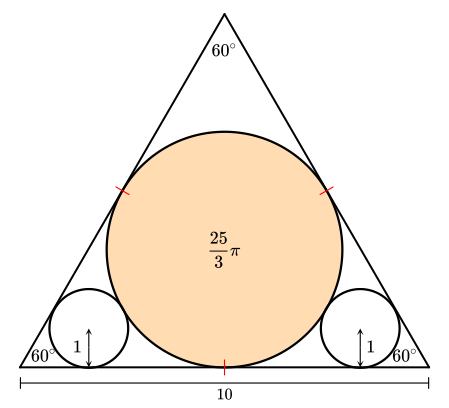 Next, the area of a circle of radius 1 can be calculated.
The sum of the areas of Dylan's circles is 331π square centimeters.
Next, the area of a circle of radius 1 can be calculated.
The sum of the areas of Dylan's circles is 331π square centimeters.
Radius of an Incircler=2(PA)
Use the given information to determine who drew their circles with the greatest sum of the circles' areas. {"type":"choice","form":{"alts":["Magdalena","Dylan"],"noSort":false},"formTextBefore":"","formTextAfter":"","answer":1}
Hint
The altitude of an equilateral triangle divides it into two right triangles. Use the Pythagorean Theorem to find the height of this triangle and then calculate its area. Finally, use the formula provided by the teacher to find the radius of Magdalena's circles and the radius of the incircle drawn by Dylan.
Solution
The area of the circles that Magdalena and Dylan drew will be calculated one at a time. Then, the results will be compared.
Area of Magdalena's Circles
The circles will be ignored for a moment, and the altitude of the triangle will be drawn. The altitude of a triangle is perpendicular to the base. Also, because the triangle is equilateral, the altitude bisects the base. As a result, the length of one leg and the hypotenuse of the obtained right triangle are 5 and 10 centimeters, respectively.
Area of a Right Triangle21(5)(53) = 2253 cm2
Next, note that one of the circles that Magdalena drew is the incircle of this right triangle. Perimeter of a Right Triangle5+53+10 = (15+53) cm
Now, the formula provided by the teacher can be used to find the radius of one of the circles that Magdalena drew.
r=2(PA)
SubstituteII
P=15+53, A=2253
r=2(15+532253)
▼
Evaluate right-hand side
MoveLeftFacToNum
a⋅cb=ca⋅b
r=15+532(2253)
DenomMultFracToNumber
2⋅2a=a
r=15+53253
ExpandFrac
ba=b⋅(15−53)a⋅(15−53)
r=(15+53)(15−53)253(15−53)
Distr
Distribute 253
r=(15+53)(15−53)3753−375
ExpandDiffSquares
(a+b)(a−b)=a2−b2
r=152−(53)23753−375
PowProdII
(ab)m=ambm
r=152−52(3)23753−375
CalcPow
Calculate power
r=225−25(3)23753−375
PowSqrt
(a)2=a
r=225−25(3)3753−375
Multiply
Multiply
r=225−753753−375
SubTerm
Subtract term
r=1503753−375
SplitIntoFactors
Split into factors
r=15075(5)3−75(5)
FactorOut
Factor out 75
r=15075(53−5)
ReduceFrac
ba=b/75a/75
r=253−5
Area of a Circle=πr2
Substitute
r=253−5
Area of a Circle=π(253−5)2
▼
Evaluate right-hand side
PowQuot
(ba)m=bmam
Area of a Circle=π4(53−5)2
CommutativePropMult
Commutative Property of Multiplication
Area of a Circle=4(53−5)2π
ExpandNegPerfectSquare
(a−b)2=a2−2ab+b2
Area of a Circle=4(53)2−2(53)(5)+52π
PowProdII
(ab)m=ambm
Area of a Circle=452(3)2−2(53)(5)+52π
CalcPowProd
Calculate power and product
Area of a Circle=425(3)2−503+25π
PowSqrt
(a)2=a
Area of a Circle=425(3)−503+25π
Multiply
Multiply
Area of a Circle=475−503+25π
AddTerms
Add terms
Area of a Circle=4100−503π
SplitIntoFactors
Split into factors
Area of a Circle=42(50)−2(25)3π
FactorOut
Factor out 2
Area of a Circle=42(50−253)π
ReduceFrac
ba=b/2a/2
Area of a Circle=250−253π
Area of Magdalena’s Circles3(250−253π)=2150−753πcm2
Area of Dylan's Circles
Calculating the sum of the areas of Dylan's circles takes less steps than calculating the sum of the areas of Magdalena's circles.
Area of a Triangle=21bh
SubstituteII
b=10, h=53
Area of a Triangle=21(10)(53)
▼
Evaluate right-hand side
MoveRightFacToNumOne
b1⋅a=ba
Area of a Triangle=210(53)
CalcQuot
Calculate quotient
Area of a Triangle=5(53)
Multiply
Multiply
Area of a Triangle=253
Area of a Circle=πr2
Substitute
r=353
Area of a Circle=π(353)2
▼
Evaluate right-hand side
PowQuot
(ba)m=bmam
Area of a Circle=π(32(53)2)
PowProdII
(ab)m=ambm
Area of a Circle=π(3252(3)2)
CalcPow
Calculate power
Area of a Circle=π(925(3)2)
PowSqrt
(a)2=a
Area of a Circle=π(925(3))
ReduceFrac
ba=b/3a/3
Area of a Circle=π(325)
CommutativePropMult
Commutative Property of Multiplication
Area of a Circle=325π
Area of One CircleArea=πr2⇒AreaArea=π(12)=π cm2
Finally, the areas of both circles of radius 1 and the area of the incircle will be added.
325π+π+π
▼
Simplify
IdPropMult
Identity Property of Multiplication
325π+1π+1π
OneToFrac
Rewrite 1 as 33
325π+33π+33π
FactorOut
Factor out π
(325+33+33)π
AddFrac
Add fractions
331π
Comparison
The sum of the areas of the circles that Magdalena and Dylan drew are known. For simplicity in the comparison, they will be approximated to one decimal place.
| Area of Magdalena's Circles | Area of Dylan's Circles |
|---|---|
| 2150−753π ≈ 31.6 cm2 | 331π ≈ 32.5 cm2 |
It can be concluded that the circles drawn by Dylan have a greater area than the circles drawn by Magdalena.
Closure
Optimizing Efficiency Using Geometry
In this lesson, different geometric methods were used to solve design problems. Here, the challenge presented at the beginning of the lesson will be examined in detail.
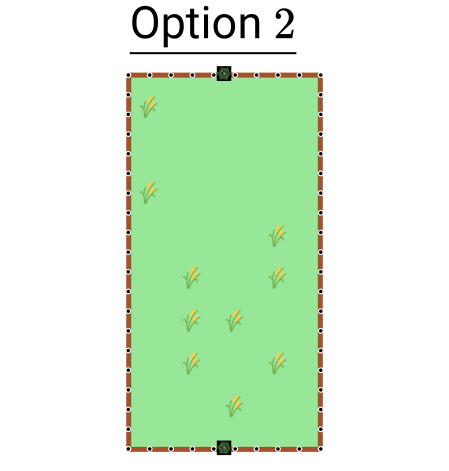
Paulina bought two sprinklers to water her 20-meter by 10-meter rectangular garden. Each sprinkler waters a circular region, and the radius of each circle has the same measurement. Paulina can adjust the radius, which will affect both sprinklers equally. Recall that the sprinklers should not water any same region of the garden.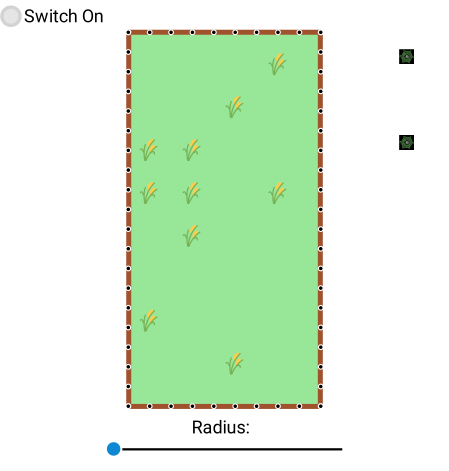
{"type":"text","form":{"type":"math","options":{"comparison":"1","nofractofloat":false,"keypad":{"simple":true,"useShortLog":false,"variables":[],"constants":[]},"rendered":false},"text":"<span class=\"katex\"><span class=\"katex-html\" aria-hidden=\"true\"><\/span><\/span>"},"formTextBefore":"Difference <span class=\"katex\"><span class=\"katex-html\" aria-hidden=\"true\"><span class=\"base\"><span class=\"strut\" style=\"height:0.36687em;vertical-align:0em;\"><\/span><span class=\"mrel\">=<\/span><\/span><\/span><\/span>","formTextAfter":"square meters","answer":{"text":["34"]}}
Hint
For the second option, consider dividing the area watered by one sprinkler into two right triangles and one circle sector.
Solution
The area of the garden watered in each of the options will be calculated one at a time. Then, their difference will be found.
Option 1
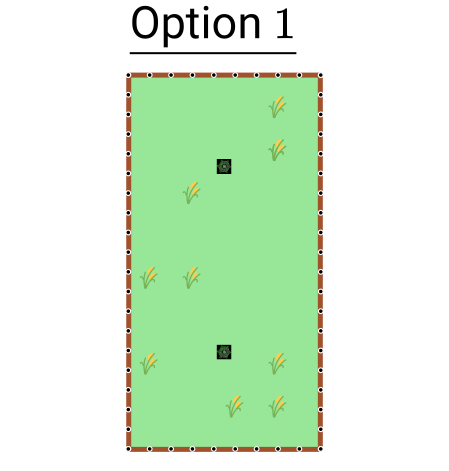
Here, the diameter of each circle that is formed by the water coming out of the sprinklers is equal to the width of the garden, which is 10 meters.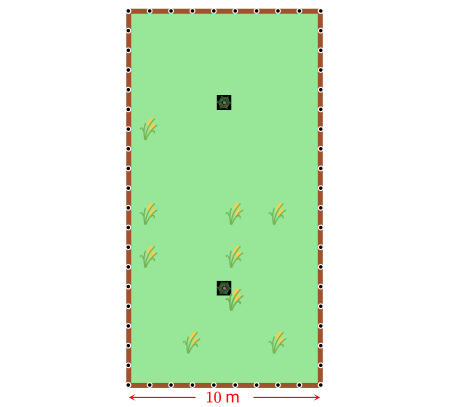
Radius: 210=5 meters
Now the formula for the area of a circle can be used.
The area of one circle is 25π square meters. The area of the two circles combined is twice the area of one circle.
Area Watered in Option 1 (m2)25π×2=50π
Option 2
For this option, the area watered by one sprinkler will be calculated. Then, to obtain the total area, that value will be multiplied by 2. Keep in mind that the radius of one circle is half the length of the garden. Additionally, since the sprinkler is located at the midpoint of the width, its distance to the endpoints of the width can also be calculated.Radius:Distance to Endpoints: 220=10 m 210=5 m
With this information, the area watered by one sprinkler can be divided into a circle sector with a radius of 10 meters and two right triangles with a hypotenuse and leg of 10 and 5 meters, respectively. Let h be the height of these right triangles.
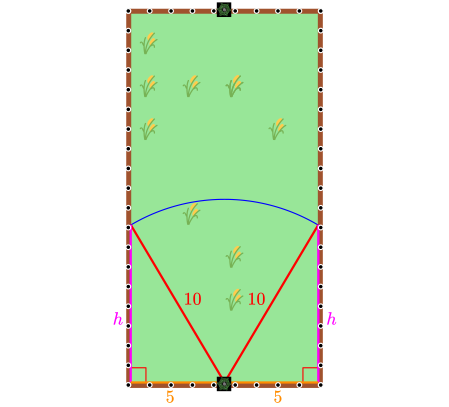
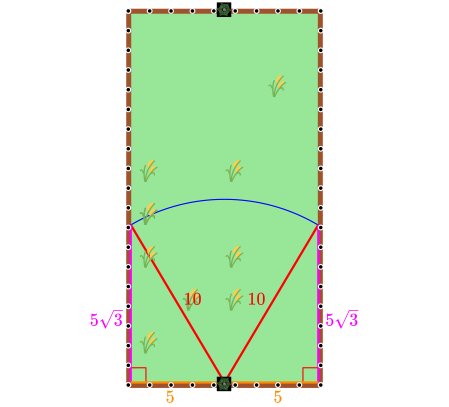
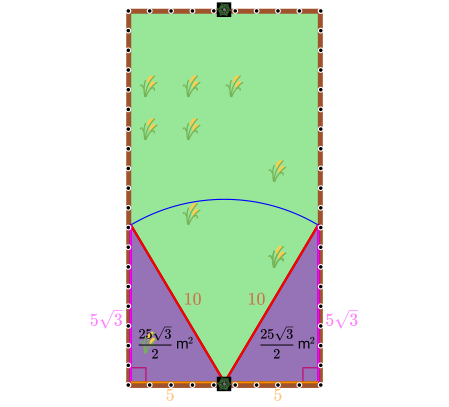
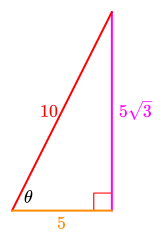
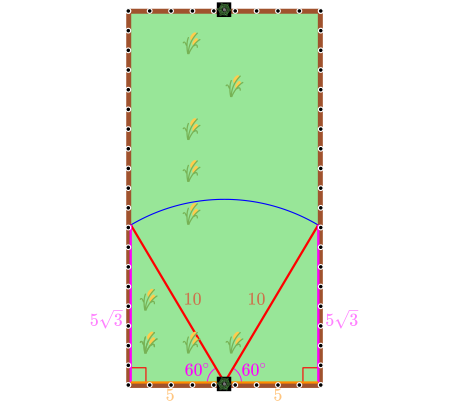
Angle of the Circle Sector180∘−60∘−60∘=60∘
The sector has a radius of 10 meters and an angle whose measure is 60∘. 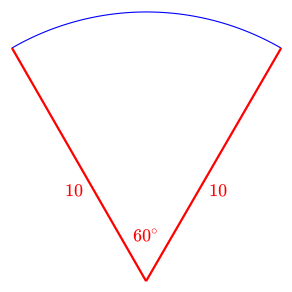
A=360∘θ⋅πr2
In the above formula, 60∘ and 10 can be substituted for θ and r, respectively.
A=360∘θ⋅πr2
SubstituteII
θ=60∘, r=10
A=360∘60∘⋅π(102)
▼
Evaluate right-hand side
CalcPow
Calculate power
A=360∘60∘⋅π(100)
CommutativePropMult
Commutative Property of Multiplication
A=360∘60∘(100)π
MoveRightFacToNum
ca⋅b=ca⋅b
A=360∘6000∘π
ReduceFrac
ba=b/120∘a/120∘
A=350π
Area Watered by One Sprinkler (m2)2253+2253+350π=253+350π
Finally, the area watered by both sprinklers is twice the above result.
Area Watered in Option 2 (m2)(253+350π)×2=503+3100π
Difference
Now that the area of the garden watered in both options is known, the difference can be found.difference=(503+3100π)−50π
▼
Evaluate right-hand side
difference≈34
What is the area of the shaded part of the triangle? Round the answer to two decimal places.
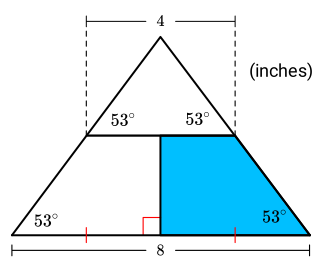
{"type":"text","form":{"type":"math","options":{"comparison":"1","nofractofloat":false,"keypad":{"simple":true,"useShortLog":false,"variables":["x"],"constants":["PI"]},"rendered":false},"text":"<span class=\"katex\"><span class=\"katex-html\" aria-hidden=\"true\"><\/span><\/span>"},"formTextBefore":"<span class=\"katex\"><span class=\"katex-html\" aria-hidden=\"true\"><span class=\"base\"><span class=\"strut\" style=\"height:0.68333em;vertical-align:0em;\"><\/span><span class=\"mord mathdefault\">A<\/span><span class=\"mspace\" style=\"margin-right:0.2777777777777778em;\"><\/span><span class=\"mrel\">=<\/span><\/span><\/span><\/span>","formTextAfter":"<span class=\"katex\"><span class=\"katex-html\" aria-hidden=\"true\"><span class=\"base\"><span class=\"strut\" style=\"height:0.963773625em;vertical-align:-0.009765625em;\"><\/span><span class=\"mord\"><span class=\"mord text\"><span class=\"mord Roboto-Regular\">inches<\/span><\/span><span class=\"msupsub\"><span class=\"vlist-t\"><span class=\"vlist-r\"><span class=\"vlist\" style=\"height:0.954008em;\"><span style=\"top:-3.2029em;margin-right:0.05em;\"><span class=\"pstrut\" style=\"height:2.7em;\"><\/span><span class=\"sizing reset-size6 size3 mtight\"><span class=\"mord mtight\">2<\/span><\/span><\/span><\/span><\/span><\/span><\/span><\/span><\/span><\/span><\/span>","answer":{"text":["7.96"]}}
security
report
code
security
report
code
From the diagram, we can identify two isosceles triangles with base angles of 53^(∘) and a base length of 8 and 4 units respectively. The height drawn to the vertex angle in an isosceles triangle bisects the base creating two congruent segments, and it divides the triangle into two congruent right triangles. Let's highlight these in the diagram.
Notice that the shaded area is the area of the larger right triangle minus the area of the smaller right triangle. To determine these areas, we want to know the length of both legs for both triangles. Since we know one leg and one acute angle, we can use the tangent ratio to determine the second leg. tan 53^(∘) = h_1/4 ⇔ h_1= 4tan 53^(∘) [1em] tan 53^(∘) = h_2/2 ⇔ h_2= 2tan 53^(∘) Now we can determine the area of each triangle by multiplying their two legs and dividing by 2. A_1=1/2(4)( 4tan 53^(∘))=8 tan 53^(∘) [1em] A_2=1/2(2)( 2tan 53^(∘))=2 tan 53^(∘) Notice that we are keeping the expressions for each area in exact form to avoid rounding errors. Finally, we will subtract the smaller triangle's area from the larger triangle's area.
The area of the shaded part of the triangle is about 7.96 square inches.
security
report
code
The figure consists of five congruent squares and has an area of 405 cm2. What is the perimeter of the figure?
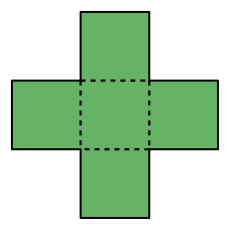
{"type":"text","form":{"type":"math","options":{"comparison":"1","nofractofloat":false,"keypad":{"simple":true,"useShortLog":false,"variables":["x"],"constants":["PI"]},"rendered":false},"text":"<span class=\"katex\"><span class=\"katex-html\" aria-hidden=\"true\"><\/span><\/span>"},"formTextBefore":"<span class=\"katex\"><span class=\"katex-html\" aria-hidden=\"true\"><span class=\"base\"><span class=\"strut\" style=\"height:0.68333em;vertical-align:0em;\"><\/span><span class=\"mord mathdefault\" style=\"margin-right:0.13889em;\">P<\/span><span class=\"mspace\" style=\"margin-right:0.2777777777777778em;\"><\/span><span class=\"mrel\">=<\/span><\/span><\/span><\/span>","formTextAfter":"cm","answer":{"text":["108"]}}
security
report
code
security
report
code
The perimeter consists of 12 congruent sides. Let's label these sides s.
To be able to calculate the perimeter, we first want to determine s. Since the area of a square is the square of its side, we can find s if we determine the area of one of these five squares. Notice that we have been given the area of the entire figure. Therefore, if we divide this number by 5, we get the area of one of the squares. 405/5=81 cm^2 When we know the area of one square, we can use it to determine the side length s.
The side is 9 centimeters. By multiplying this by 12, we find the perimeter of the shape. P=12( 9)=108 cm
security
report
code
What percentage of the rectangle is shaded? Round the answer to the nearest whole percent.
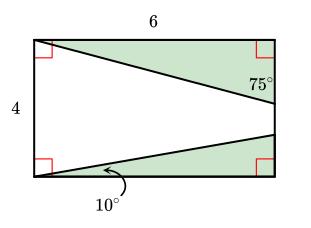
{"type":"text","form":{"type":"math","options":{"comparison":"1","nofractofloat":false,"keypad":{"simple":true,"useShortLog":false,"variables":["x"],"constants":["PI"]},"rendered":false},"text":"<span class=\"katex\"><span class=\"katex-html\" aria-hidden=\"true\"><\/span><\/span>"},"formTextBefore":null,"formTextAfter":"<span class=\"katex\"><span class=\"katex-html\" aria-hidden=\"true\"><span class=\"base\"><span class=\"strut\" style=\"height:0.80556em;vertical-align:-0.05556em;\"><\/span><span class=\"mspace\" style=\"margin-right:0.16666666666666666em;\"><\/span><span class=\"mord\">%<\/span><\/span><\/span><\/span>","answer":{"text":["33"]}}
security
report
code
security
report
code
Let's determine the area of the rectangle A_R by multiplying its length and width. A_R=(6)(4)=24cm^2 Next, we want to determine the area of the triangles, A_1 and A_2. Since these are right triangles, we can use the formula for the area of a triangle. In A_1, we have been given an acute angle of 75^(∘) and its opposite side of 6 centimeters. In A_2, we have an acute angle of 10^(∘) and its adjacent side of 6 centimeters. Let's label the legs with unknown lengths a and b, respectively.
By using the tangent ratio, we can write two equations. tan 10^(∘) = b/6 &⇔ b= 6tan 10^(∘) [1em] tan 75^(∘) = 6/a &⇔ a= 6/tan 75^(∘) Since we know the base values of each triangle and we have expressions for the height of each triangle, we can substitute them into the formula for the area of a triangle. A_1= 1/2(6)(6tan 10^(∘)) = 18tan 10^(∘) [1em] A_2= 1/2(6)(6/tan 75^(∘))=18/tan 75^(∘) The percent of the entire rectangle that is shaded is the ratio of the sum of the triangle areas A_1 and A_2 to the rectangle area A_R. That can be written as A_1+A_2A_R. Then we will substitute the corresponding values into this equation.
security
report
code
Geometry in Design
Recommended exercises
To get personalized recommended exercises, please login first.
Loading content
Loading content