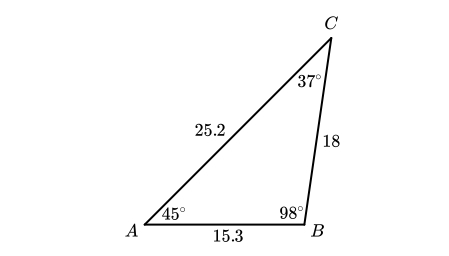
Which Law or Theorem Would You Use? Law of Sines Why? You are given two angle measures and the length of a side. Remaining Angle and Sides: m∠ A=45^(∘), b≈ 25.2, c≈ 15.3
Practice makes perfect
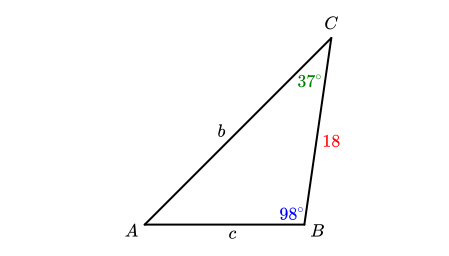
Let's start by sketching △ ABC and labeling angles ∠ B, ∠ C, and side a, which is opposite ∠ A. Remember that m∠ B= 98^(∘), m∠ C= 37^(∘), and a= 18.
We will solve △ ABC. This means we will find the values of m∠ A, b, and c. First, let's find the measure of the remaining angle and then move on to the remaining side lengths.
Remaining Angle
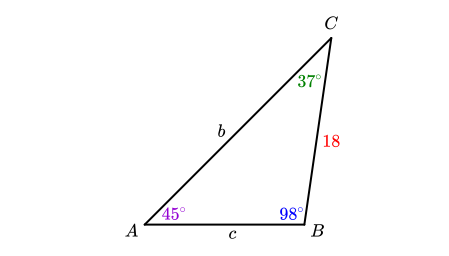
Since we are given the measures of two angles of a triangle, we will use the Triangle Sum Theorem to find the measure of the third angle, ∠ A.
Let's update our diagram by labeling the measure of ∠ A.
Remaining Sides
Next we will find the values of the two remaining side lengths. We know the length of only one side of △ ABC, so we cannot use the Law of Cosines. However, since we are given two angle measures and the length of a side, we should use the Law of Sines.
Law of Sines
For any triangle, the ratio between the length of the side and the sine value of its opposite angle is constant.
Let's apply the Law of Sines to the given triangle. Pay close attention when identifying the angle opposite each side.
18/sin45^(∘)=b/sin 98^(∘)=c/sin 37^(∘)
Let's split the obtained expression into two equations.
18/sin45^(∘)=b/sin98^(∘) and 18/sin45^(∘)=c/sin37^(∘)
We will start by solving the first equation for b.