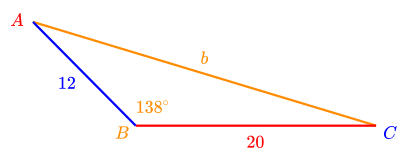
Let's begin by color coding the opposite angles and sides. We will also call the unknown side b. It will help us use the Law of Sines and Law of Cosines later.
Let's find the side length b, and the measures of ∠ A and ∠ C one at a time.
Finding the Side Length b
We are given the measures of two sides and the included angle of the triangle. Therefore, we can use the Law of Cosines to find the side length b.
b^2=a^2+c^2 -2 a c cos B
Let's substitute a= 20, c= 12, and m ∠ B= 138^(∘) to find the side length b.
Since a negative side length does not make sense, we only need to consider positive solutions.
Finding m ∠ A
To find the measure of ∠ A, we can use the Law of Sines. To do so, we can use the side length b that we found earlier.
sin A/a =sin B/b
Let's substitute a= 20, b= sqrt(544 - 480 cos 138^(∘)), and m ∠ B = 138^(∘) to isolate sin A.
Note that an angle A is acute, because the angle opposite to the longest side b is the largest angle. Therefore, we can now use the inverse sine ratio to find m ∠ A.
m ∠ A = sin ^(-1) 20 sin 138^(∘)/sqrt(544 - 480 cos 138^(∘))
Finally, to find m ∠ C we can use the Triangle Sum Theorem. This tells us that the measures of the angles in a triangle add up to 180.
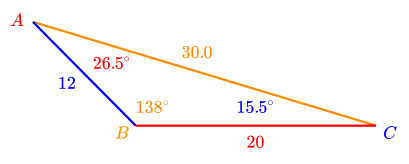
26.5^(∘)+ 138^(∘) + m ∠ C ≈ 180^(∘)
⇕
m ∠ C ≈ 15.5^(∘)
Completing the Triangle
With all of the angle measures and side lengths, we can complete our diagram.