13. Solving Triangles Using the Law of Sines
Sign In
An error ocurred, try again later!
Chapter 2
13.
Solving Triangles Using the Law of Sines
Grasping how to solve triangles with the law of sines is essential for numerous real-world applications. This mathematical principle shines when we possess a triangle with a known angle and side length, or when two angles are known without the side between them. By employing the law of sines, we can unveil the unknown sides or angles. This becomes invaluable in professions like architecture, engineering, and navigation. Whether you're determining a building's height with a given angle and distance or setting a sailing course, the law of sines proves to be a crucial asset.
Show less Show more expand_more 


Lesson Settings & Tools
| | 11 Theory slides |
| | 10 Exercises - Grade E - A |
| | Each lesson is meant to take 1-2 classroom sessions |
Solving Triangles Using the Law of Sines
Slide of 11
In this lesson, a new relation between side lengths and angle measures of a triangle will be derived and used.
Catch-Up and Review
Here are a few recommended readings before getting started with this lesson.
- Triangle Angle Sum Theorem
- Right triangles
- Pythagorean Theorem
- Trigonometric ratios
- Area of a triangle and area of a triangle using sine
Try your knowledge on these topics.
Find the value of x. If needed, write the answer to the nearest tenth.
a 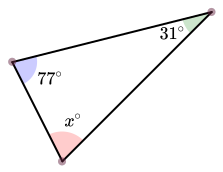
{"type":"text","form":{"type":"math","options":{"comparison":"1","nofractofloat":false,"keypad":{"simple":true,"useShortLog":false,"variables":[],"constants":[]},"rendered":false},"text":" "},"formTextBefore":"x=","formTextAfter":null,"answer":{"text":["72"]}}
b 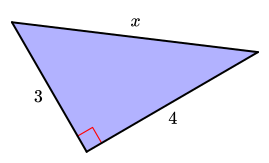
{"type":"text","form":{"type":"math","options":{"comparison":"1","nofractofloat":false,"keypad":{"simple":true,"useShortLog":false,"variables":[],"constants":[]},"rendered":false},"text":" "},"formTextBefore":"x=","formTextAfter":null,"answer":{"text":["5"]}}
c 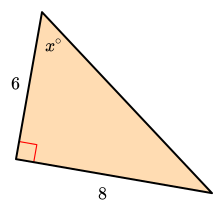
{"type":"text","form":{"type":"math","options":{"comparison":"1","nofractofloat":false,"keypad":{"simple":true,"useShortLog":false,"variables":[],"constants":[]},"rendered":false},"text":" "},"formTextBefore":"x=","formTextAfter":null,"answer":{"text":["53.1"]}}
Calculate the area of the following triangles. If needed, write the answer correct to the nearest integer.
d 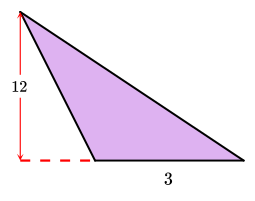
{"type":"text","form":{"type":"math","options":{"comparison":"1","nofractofloat":false,"keypad":{"simple":true,"useShortLog":false,"variables":[],"constants":[]},"rendered":false},"text":" "},"formTextBefore":"Area =","formTextAfter":null,"answer":{"text":["18"]}}
e 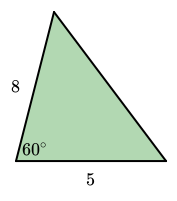
{"type":"text","form":{"type":"math","options":{"comparison":"1","nofractofloat":false,"keypad":{"simple":true,"useShortLog":false,"variables":[],"constants":[]},"rendered":false},"text":" "},"formTextBefore":"Area =","formTextAfter":null,"answer":{"text":["17"]}}
Challenge
Share
Report error
Investigate Triangles With Two Sides and an Angle Known
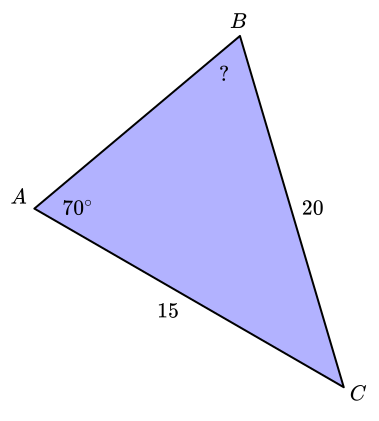
Can the measure of ∠ B be found with the given information? If so, what is its value?
Explore
Share
Report error
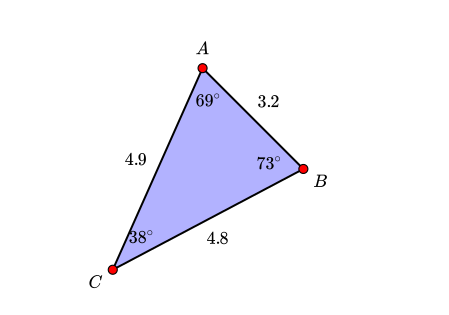
Relationship Between a Triangle's Angles and Their Opposite Sides
Discussion
Share
Report error
Law of Sines
One conclusion obtained in the previous exploration can be generalized to all triangles.
For any triangle, the ratio of the sine of an angle to its opposite side is constant.
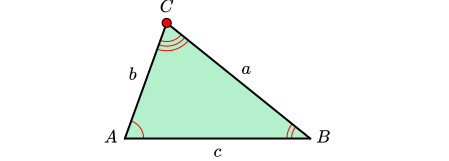 Based on the characteristics of the diagram, the following relation can be proven true.
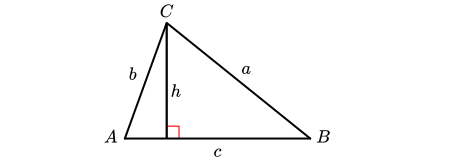 In these two right triangles, ∠ A and ∠ B are both opposite angles to h. Therefore, by applying the definition of the sine ratio to ∠ A and ∠ B, it is possible to relate the sine of these angles with the side lengths a and b.
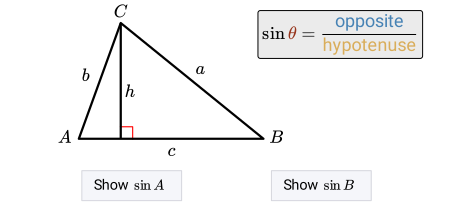 Next, h can be isolated and written in terms of the corresponding side length and angle, for both right triangles.
sin A = h/b &⇔ h = bsin A [1em]
sin B = h/a &⇔ h = asin B By the Transitive Property of Equality, it can be stated that bsin A and a sin B are equal. h = bsin A h = asin B ⇒ bsin A=asin B Finally, the obtained equation can be rearranged to obtain the desired result.
By following the same procedure but drawing the height from vertex A, it can be shown that sin Bb = sin Cc. Putting these two results together, the Law of Sines is obtained.
Next, h can be isolated and written in terms of the corresponding side length and angle, for both right triangles.
sin A = h/b &⇔ h = bsin A [1em]
sin B = h/a &⇔ h = asin B By the Transitive Property of Equality, it can be stated that bsin A and a sin B are equal. h = bsin A h = asin B ⇒ bsin A=asin B Finally, the obtained equation can be rearranged to obtain the desired result.
By following the same procedure but drawing the height from vertex A, it can be shown that sin Bb = sin Cc. Putting these two results together, the Law of Sines is obtained.
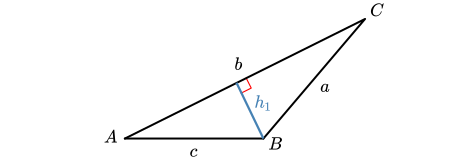 The sine ratio will be written for these right triangles.
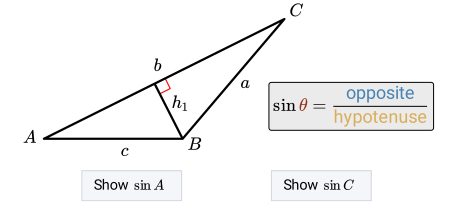 In the equations, h_1 can be isolated.
sin A = h_1/c &⇔ h_1 = csin A [1em]
sin C = h_1/a &⇔ h_1 = asin C By the Transitive Property of Equality, it can be stated that csin A and a sin C are equal. h_1 = csin A h_1 = asin C ⇒ csin A=asin C The obtained equation can be rearranged to obtain the desired result.
Next, the exterior height h_2 from vertex C will be drawn. Let E be the point of intersection of this height and the extension of AB.
In the equations, h_1 can be isolated.
sin A = h_1/c &⇔ h_1 = csin A [1em]
sin C = h_1/a &⇔ h_1 = asin C By the Transitive Property of Equality, it can be stated that csin A and a sin C are equal. h_1 = csin A h_1 = asin C ⇒ csin A=asin C The obtained equation can be rearranged to obtain the desired result.
Next, the exterior height h_2 from vertex C will be drawn. Let E be the point of intersection of this height and the extension of AB. 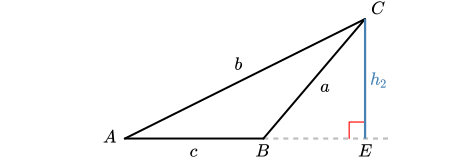
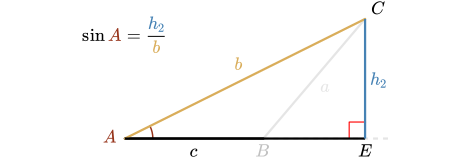
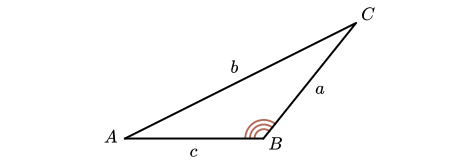 This allows sin ABC to be written as sin B. Therefore, asin B=bsin A, and this equation can be rearranged to obtain the desired formula.
Finally, this result can be combined with the previous determination sin Aa = sin Cc to derive the Law of Sines.
This allows sin ABC to be written as sin B. Therefore, asin B=bsin A, and this equation can be rearranged to obtain the desired formula.
Finally, this result can be combined with the previous determination sin Aa = sin Cc to derive the Law of Sines.
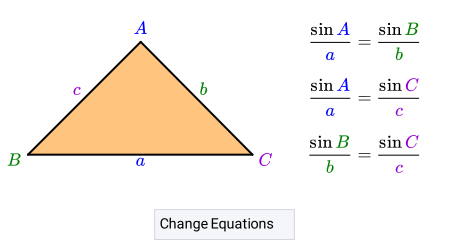
sin A/a=sin B/b=sin C/c
An alternative way to write the Law of Sines is involving the ratio of a side length to the sine of its opposite angle.
a/sin A=b/sin B=c/sin C
Proof
Acute Triangles
Consider an acute triangle with height h drawn from one of its vertices. Because h is perpendicular to the base, the original triangle is split into two right triangles.
bsin A = a sin B
▼
Simplify
DivEqn
.LHS /ab.=.RHS /ab.
bsin A/ab = asin B/ab
CancelCommonFac
Cancel out common factors
bsin A/ab = asin B/ab
SimpQuot
Simplify quotient
sin A/a = sin B/b
sin A/a=sin B/b=sin C/c
Obtuse Triangles
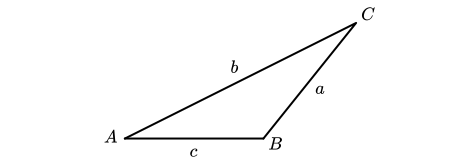
An obtuse triangle will now be considered.
This proof is very similar to the proof for acute triangles, but it uses an interior and an exterior height. First, the height h_1 from the vertex where the obtuse angle is located will be drawn. Just as before, this generates two right triangles.
csin A=asin C
▼
Simplify
DivEqn
.LHS /ac.=.RHS /ac.
csin A/ac = asin C/ac
CancelCommonFac
Cancel out common factors
csin A/ac = asin C/ac
SimpQuot
Simplify quotient
sin A/a = sin C/c
Here, ∠ ABC and ∠ CBE form a linear pair and are therefore supplementary angles. Because the sine of supplementary angles is the same, the sine of ∠ ABC equals the sine of ∠ CBE. Also, using the sine ratio on △ BCE, it can be stated that the sine of ∠ CBE is the ratio of h_2 to a. sin ABC = sin CBE and sin CBE = h_2/a By the Transitive Property of Equality, the sine of ∠ ABC can be written in terms of h_2 and a. sin ABC = sin CBE sin CBE = h_2/a ⇓ sin ABC=h_2/a Now △ ACE will be considered. By using the sine ratio, it follows that the sine of ∠ A is the ratio of h_2 to b.
Now, h_2 can be written in terms of sin ABC and a, and in terms of sin A and b. sin ABC = h_2/a &⇔ h_2 = asin ABC [1em] sin A = h_2/b &⇔ h_2 = bsin A The Transitive Property of Equality can be used one more time. h_2 = asin ABC h_2 = bsin A ⇓ asin ABC = bsin A If only △ ABC is considered, then ∠ ABC can be named as ∠ B.
asin B=bsin A
▼
Simplify
DivEqn
.LHS /ab.=.RHS /ab.
asin B/ab=bsin A/ab
CancelCommonFac
Cancel out common factors
asin B/ab=bsin A/ab
SimpQuot
Simplify quotient
sin B/b=sin A/a
sin A/a=sin B/b=sin C/c
Example
Share
Report error
Using the Law of Sines To Find the Side of a Triangle
As previously stated, the Law of Sines can be used to find side lengths of a triangle.
Magdalena will go golfing after school. The locations of her school, the golf course, and her house form a triangular shape. She knows the measures of two of the triangle's angles, and she knows the distance from her house to the school is 3 kilometers.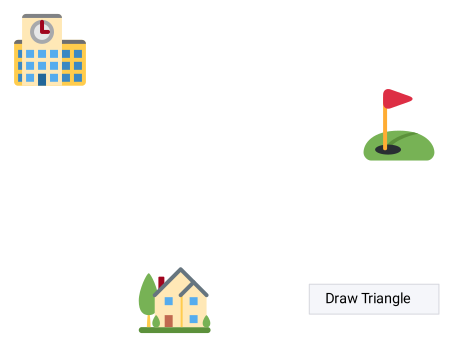
{"type":"text","form":{"type":"math","options":{"comparison":"1","nofractofloat":false,"keypad":{"simple":true,"useShortLog":false,"variables":[],"constants":[]},"rendered":false},"text":" "},"formTextBefore":"Distance =","formTextAfter":"kilometers","answer":{"text":["3.17"]}}
Hint
Start by labeling the sides and the angles of the triangle.
Solution
The sides of the triangle will be labeled a, b, and c. Similarly, the angles will be labeled A, B, and C.
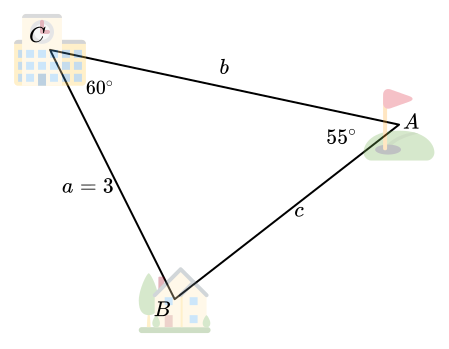
a/sin A=c/sin C
SubstituteValues
Substitute values
3/sin 55^(∘)=c/sin 60^(∘)
▼
Solve for c
MultEqn
LHS * sin 60^(∘)=RHS* sin 60^(∘)
3/sin 55^(∘) (sin 60^(∘))=c
RearrangeEqn
Rearrange equation
c=3/sin 55^(∘) (sin 60^(∘))
UseCalc
Use a calculator
c=3.171665...
RoundSigDig
Round to 3 significant digit(s)
c≈ 3.17
Pop Quiz
Share
Report error
Practice Finding Sides Using the Law of Sines
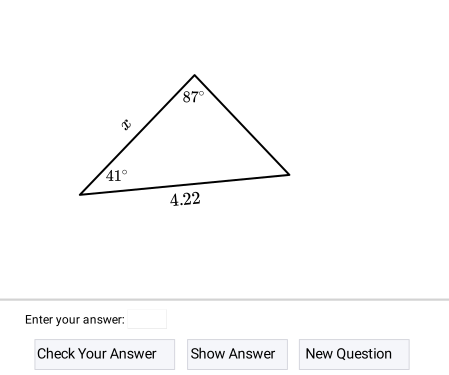
In the following applet, x represents the side length of a triangle. By using the Law of Sines and, if needed, the Triangle Angle Sum Theorem, find the value of x. Write the answer rounded to two decimal places.
Example
Share
Report error
Using the Law of Sines To Find Angles of a Triangle
The Law of Sines can also be used to find angle measures of a triangle.
Emily will go backpacking across South America! She will visit Buenos Aires, Santiago, and Asunción, among other cities. Emily knows that the distances from Buenos Aires to Santiago and Asunción are 1140 and 1040 kilometers, respectively. She also knows that the angle whose vertex is located at Santiago and whose sides pass through Buenos Aires and Asunción measures 44^(∘).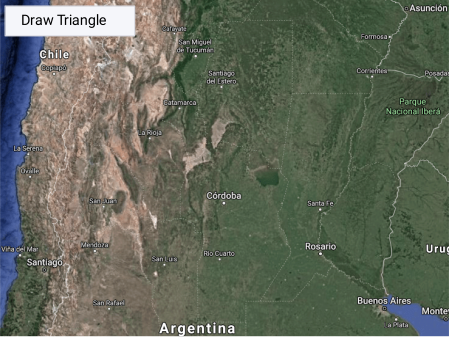
{"type":"text","form":{"type":"math","options":{"comparison":"1","nofractofloat":false,"keypad":{"simple":true,"useShortLog":false,"variables":[],"constants":[]},"rendered":false},"text":" "},"formTextBefore":"Angle at Asunci\u00f3n =","formTextAfter":"^(∘)","answer":{"text":["50"]}}
{"type":"text","form":{"type":"math","options":{"comparison":"1","nofractofloat":false,"keypad":{"simple":true,"useShortLog":false,"variables":[],"constants":[]},"rendered":false},"text":" "},"formTextBefore":"Angle at Buenos Aires =","formTextAfter":"^(∘)","answer":{"text":["86"]}}
{"type":"text","form":{"type":"math","options":{"comparison":"1","nofractofloat":false,"keypad":{"simple":true,"useShortLog":false,"variables":[],"constants":[]},"rendered":false},"text":" "},"formTextBefore":"Distance between Santiago and Asunci\u00f3n =","formTextAfter":null,"answer":{"text":[null]}}
Hint
Start by labeling the sides and the angles of the triangle.
Solution
The angles of the triangle will be labeled A, B, and S. Similarly, the sides will be labeled a, b, and s.
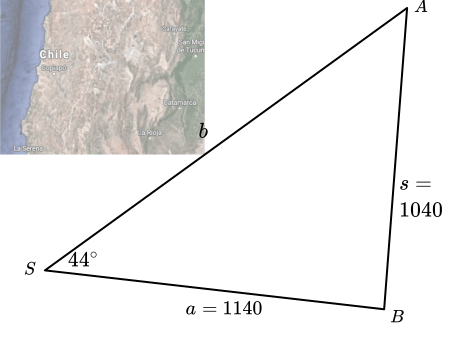 By the Law of Sines, the ratio of the sine of an angle to the length of its opposite side is constant. With this information, a proportion that relates A, a, S, and s can be written.
sin S/s=sin A/a
In the above formula, a=1140, s=1040, and S=44^(∘) can be substituted. Then the resulting equation can be solved for A, the measure of the angle formed at Asunción.
Rounded to the nearest degree, it was found that the angle formed at Asunción measures 50^(∘).
By the Law of Sines, the ratio of the sine of an angle to the length of its opposite side is constant. With this information, a proportion that relates A, a, S, and s can be written.
sin S/s=sin A/a
In the above formula, a=1140, s=1040, and S=44^(∘) can be substituted. Then the resulting equation can be solved for A, the measure of the angle formed at Asunción.
Rounded to the nearest degree, it was found that the angle formed at Asunción measures 50^(∘).
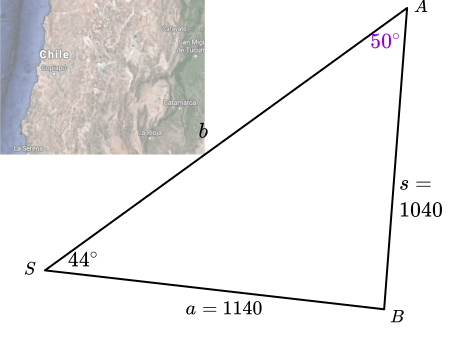 Finally, to find the measure of the angle at Buenos Aires, the Triangle Angle Sum Theorem can be used.
44^(∘)+ 50^(∘)+B=180^(∘) ⇕ B= 86^(∘)
This information can be added to the diagram.
Finally, to find the measure of the angle at Buenos Aires, the Triangle Angle Sum Theorem can be used.
44^(∘)+ 50^(∘)+B=180^(∘) ⇕ B= 86^(∘)
This information can be added to the diagram.
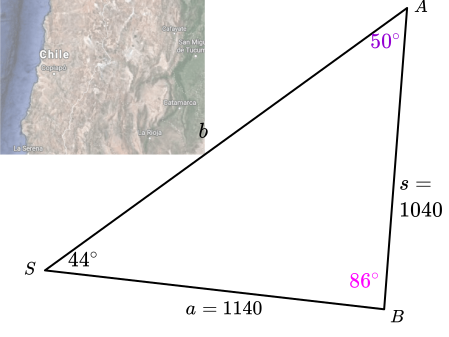 Finally, the Law of Sines can be used again to find the distance between Santiago and Asunción. To do so, recall that the ratio of the length of a side to the sine of its opposite angle is constant.
b/sin B=s/sin S
Next, s=1040, S=44^(∘), and B=86^(∘) will be substituted into the above equation.
Emily has all she needs to have a great journey!
Finally, the Law of Sines can be used again to find the distance between Santiago and Asunción. To do so, recall that the ratio of the length of a side to the sine of its opposite angle is constant.
b/sin B=s/sin S
Next, s=1040, S=44^(∘), and B=86^(∘) will be substituted into the above equation.
Emily has all she needs to have a great journey!
sin S/s=sin A/a
SubstituteValues
Substitute values
sin 44^(∘)/1040=sin A/1140
▼
Solve for A
MultEqn
LHS * 1140=RHS* 1140
sin 44^(∘)/1040(1140)=sin A
RearrangeEqn
Rearrange equation
sin A = sin 44^(∘)/1040(1140)
sin^(-1)(LHS) = sin^(-1)(RHS)
A=sin ^(- 1)(sin 44^(∘)/1040(1140))
UseCalc
Use a calculator
A=49.592410... ^(∘)
RoundInt
Round to nearest integer
A≈ 50^(∘)
Pop Quiz
Share
Report error
Practice Finding Angles Using the Law of Sines
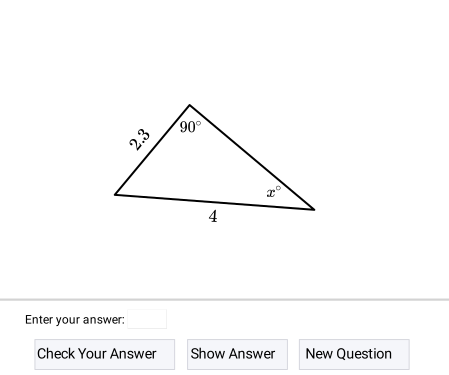
In the following applet, x represents the measure of an angle of a triangle. By using the Law of Sines and, if needed, the Triangle Angle Sum Theorem, find the value of x. Write the answer as a single number rounded to the nearest degree, without the degree symbol.
Example
Share
Report error
Using the Law of Sines To Find Measurements of a Triangle
The Law of Sines can be used to find missing side lengths and angle measures of a triangle. When those side lengths and angle measures are known, the area and perimeter of a triangle can also be found.
Emily is planning to continue her travels. This time, she wants to visit some cities in the UK, as well as Ireland. She would really like to visit London, Edinburgh, and Dublin. It becomes clear to her that these three cities form a triangle. She is able to figure out that the angles at London and Edinburgh measure 41^(∘) and 59^(∘), respectively. She also knows that the distance between these two cities is 530 kilometers.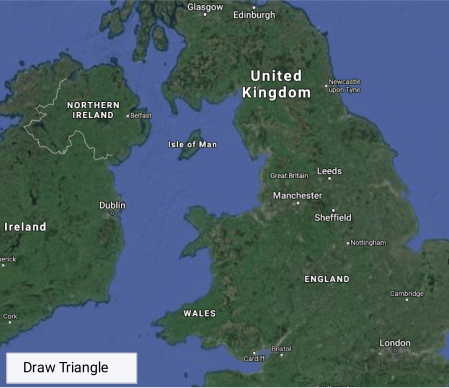
{"type":"text","form":{"type":"math","options":{"comparison":"1","nofractofloat":false,"keypad":{"simple":true,"useShortLog":false,"variables":[],"constants":[]},"rendered":false},"text":" "},"formTextBefore":"Perimeter =","formTextAfter":"kilometers","answer":{"text":["1344"]}}
{"type":"text","form":{"type":"math","options":{"comparison":"1","nofractofloat":false,"keypad":{"simple":true,"useShortLog":false,"variables":[],"constants":[]},"rendered":false},"text":" "},"formTextBefore":"Area =","formTextAfter":"square kilometers","answer":{"text":["80000","80,000","80 000"]}}
Hint
The perimeter of a triangle is the sum of its three side lengths. The area of the triangle can be found by calculating half the product of two side lengths and the sine of their included angle.
Solution
The perimeter and the area of the triangle will be calculated one at a time.
Perimeter
The perimeter of a triangle is the sum of its three side lengths. Therefore, the missing side lengths need to be found. To make things clearer, the angles and sides will first be labeled.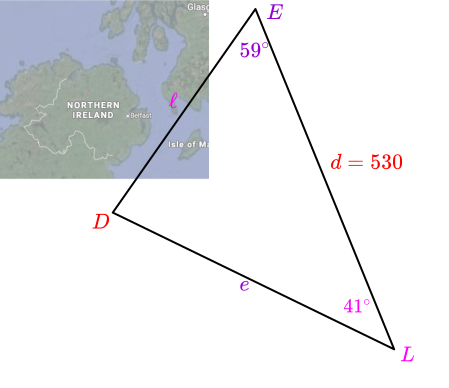
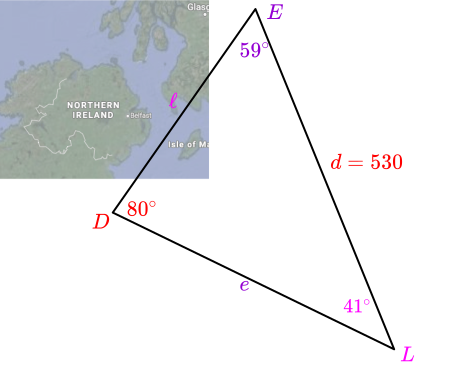
| Law of Sines | Substitute | Simplify |
|---|---|---|
| l/sin L=d/sin D | l/sin 41^(∘)=530/sin 80^(∘) | l≈ 353 |
| e/sin E=d/sin D | e/sin 59^(∘)=530/sin 80^(∘) | e≈ 461 |
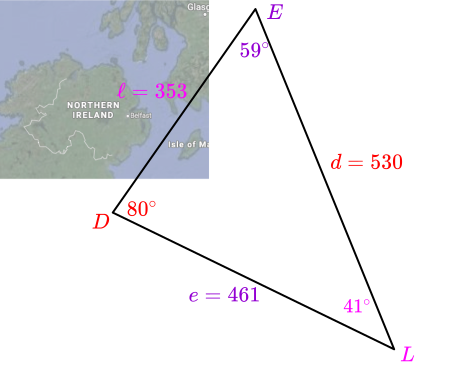
Area
The area of a triangle can be found by calculating half the product of two side lengths and the sine of their included angle. Since all angle measures and sides lengths are known, any of them can be used. In this case, E, d, and l will be arbitrarily used. Area: 1/2 d l sin E The respective values can be substituted to find the area of the triangle.Area= 1/2 d l sin E
SubstituteValues
Substitute values
Area= 1/2( 530)( 353) sin 59^(∘)
▼
Evaluate right-hand side
Multiply
Multiply
Area= 1/2(187 090) sin 59^(∘)
MoveRightFacToNumOne
1/b* a = a/b
Area= 187 090/2 sin 59^(∘)
CalcQuot
Calculate quotient
Area= 93 545 sin 59^(∘)
UseCalc
Use a calculator
Area= 80 183.715144...
Approximate to the nearest thousand
Area≈ 80 000
Discussion
Share
Report error
The Ambiguous Case of the Law of Sines
The Law of Sines is useful to find missing angle measures and side lengths for any type of triangle.
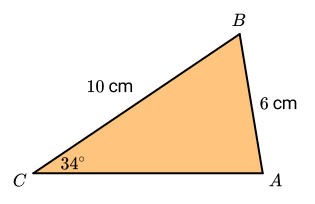
 Consider a triangle with vertices A, B, and C, where the measure of the angle at C is 34^(∘), and the lengths of AB and BC are 6 and 10 centimeters, respectively. The following diagram represents the triangle that was just described.
  The measure of the angle at A can be found by using the Law of Sines.
Using the Law of Sines, it was found that the measure of the angle at A is about 69^(∘).
The measure of the angle at A can be found by using the Law of Sines.
Using the Law of Sines, it was found that the measure of the angle at A is about 69^(∘). 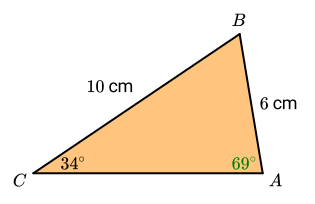
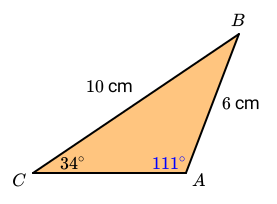 Therefore, in the given context, there are two valid measures for the angle at A, which are 69^(∘) and 111^(∘). Consequently, the measure of a missing angle is ambiguous. This shows a limitation of the Law of Sines. To avoid this ambiguity, it must be said whether the missing angle is acute or obtuse, or a diagram of the triangle should be provided.
sin A/10=sin 34^(∘)/6
▼
Solve for A
MultEqn
LHS * 10=RHS* 10
sin A=sin 34^(∘)/6 (10)
CommutativePropMult
Commutative Property of Multiplication
sin A=10 (sin 34^(∘)/6)
MoveLeftFacToNum
a*b/c= a* b/c
sin A=10sin 34^(∘)/6
ReduceFrac
a/b=.a /2./.b /2.
sin A=5sin 34^(∘)/3
sin^(-1)(LHS) = sin^(-1)(RHS)
A=sin ^(- 1)(5sin 34^(∘)/3)
UseCalc
Use a calculator
A=68.746886... ^(∘)
RoundInt
Round to nearest integer
A≈ 69^(∘)
Is this the only possible measure for the angle at A? To find the measure of this angle, the Law of Sines was applied. That is, for any triangle, the ratio of the sine of an angle to the length of its opposite side is constant. sin 69^(∘)/10=sin 34^(∘)/6 Recall now that the sine of an angle is equal to the sine of the supplement of the angle. sin θ = sin (180^(∘)-θ) With this information, it can be stated that the sine of an angle whose measure is 69^(∘) is equal to the sine of an angle whose measure is 180^(∘)- 69^(∘)= 111^(∘). Therefore, by the Substitution Property of Equality, a new proportion can be derived. sin 69^(∘)/10=sin 34^(∘)/6 sin 69^(∘)= sin 111^(∘) ⇓ sin 111^(∘)/10=sin 34^(∘)/6 The obtained proportion implies a new triangle that satisfies the initial conditions.
Closure
Share
Report error
Calculating an Angle of a Triangle Using the Law of Sines
The challenge presented at the beginning of this lesson can be solved by using the Law of Sines.
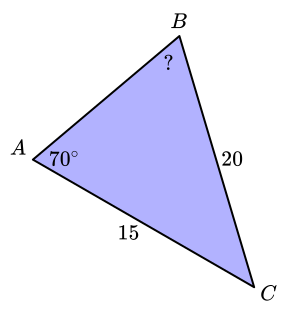
{"type":"text","form":{"type":"math","options":{"comparison":"1","nofractofloat":false,"keypad":{"simple":true,"useShortLog":false,"variables":[],"constants":[]},"rendered":false},"text":" "},"formTextBefore":null,"formTextAfter":"^(∘)","answer":{"text":["45"]}}
Solution
Since the ratio of the sine of an angle to the length of its opposite side is constant, a proportion can be written.
sin B/AC=sin A/BC ⇒ sin B/15=sin 70^(∘)/20
The above equation can be solved for B.
The measure of the angle at B is about 45^(∘). 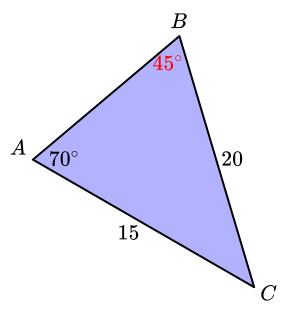
sin B/15=sin 70^(∘)/20
B≈ 45^(∘)
Solving Triangles Using the Law of Sines
Exercises
Determine the length of the side labeled x. Round the answer to one decimal place.
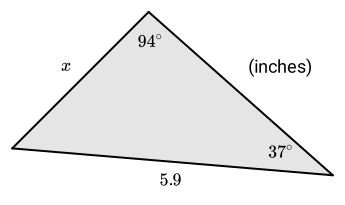
{"type":"text","form":{"type":"math","options":{"comparison":"1","nofractofloat":false,"keypad":{"simple":true,"useShortLog":false,"variables":["x"],"constants":["PI"]},"rendered":false},"text":" "},"formTextBefore":"x\u2248","formTextAfter":"inches","answer":{"text":["3.6"]}}
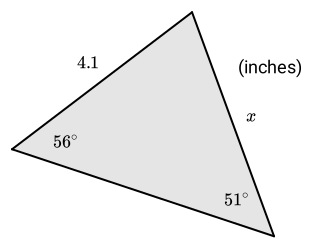
{"type":"text","form":{"type":"math","options":{"comparison":"1","nofractofloat":false,"keypad":{"simple":true,"useShortLog":false,"variables":["x"],"constants":["PI"]},"rendered":false},"text":" "},"formTextBefore":"x\u2248","formTextAfter":"inches","answer":{"text":["4.4"]}}
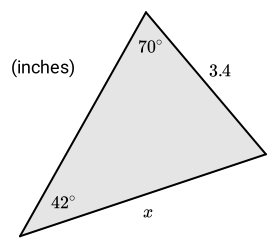
{"type":"text","form":{"type":"math","options":{"comparison":"1","nofractofloat":false,"keypad":{"simple":true,"useShortLog":false,"variables":["x"],"constants":["PI"]},"rendered":false},"text":" "},"formTextBefore":"x\u2248","formTextAfter":"inches","answer":{"text":["4.8"]}}
security
report
code
security
report
code
To solve for x, we can use the Law of Sines. Let's highlight sides opposite the given angles in the triangle.
Having identified the angles' opposite sides, we can write the following proportionality. x/sin 37^(∘) =5.9/sin 94^(∘) Let's solve for x.
As in Part A, we will use the Law of Sines to solve for x. Let's first identify opposite sides to the given angles.
Now we can write a proportionality. x/sin 56^(∘) =4.1/sin 51^(∘) Let's solve for x.
As in previous parts, we will first identify opposite sides of the given angles.
Now we can write a proportionality. x/sin 70^(∘) =3.4/sin 42^(∘) Let's solve for x.
security
report
code
Calculate the perimeter P of △ ABC in inches. Round the answer to one decimal place.
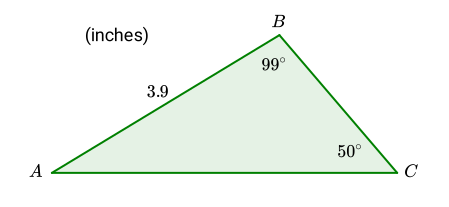
{"type":"text","form":{"type":"math","options":{"comparison":"1","nofractofloat":false,"keypad":{"simple":true,"useShortLog":false,"variables":["x"],"constants":["PI"]},"rendered":false},"text":" "},"formTextBefore":"P\u2248","formTextAfter":"inches","answer":{"text":["11.6"]}}
security
report
code
security
report
code
To determine the perimeter of the triangle, we must know all of its sides. Since we know m∠ C, its opposite side, and m∠ B, we can determine the length of AC by using the Law of Sines.
Let's keep the length of AC in exact form for now to minimize rounding errors. Before, we can calculate the length of BC, we need to find the measure of its opposite angle. Since we know the measures of two angles in the triangle, we can use the Interior Angles Theorem to determine the unknown angle. m∠ A+99^(∘) + 50^(∘) =180^(∘) ⇓ m∠ A=31^(∘) Now we can calculate the length of BC by using the Law of Sines again.
Again, we are keeping the length of the side in its exact form. Let's add all of the sides to the original diagram.
Finally, we will add all of the side lengths to determine the perimeter.
The perimeter is about 11.6 inches.
security
report
code
What is the length of AC? Round the answer to two decimal places.
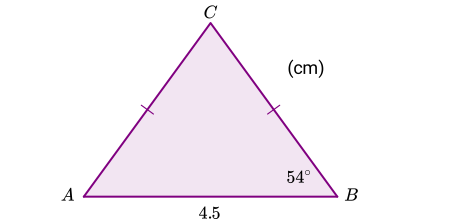
{"type":"text","form":{"type":"math","options":{"comparison":"1","nofractofloat":false,"keypad":{"simple":true,"useShortLog":false,"variables":["x"],"constants":["PI"]},"rendered":false},"text":" "},"formTextBefore":"AC\u2248","formTextAfter":"cm","answer":{"text":["3.83"]}}
security
report
code
security
report
code
The sides AC and BC are congruent which means △ ABC is an isosceles triangle. According to the Base Angles Theorem, we know that ∠ A and ∠ B are congruent angles. Now we can also calculate m∠ C using the Interior Angles Theorem. m∠ C+54^(∘)+54^(∘)=180^(∘) ⇓ m∠ C=72^(∘) Let's add all of the angle measures to the diagram.
Now we can use the Law of Sines to determine AC or BC.
security
report
code
In a triangle ABC we have the following relationship.
sin A/a=sin B/b=sin C/c=0.25
We also know that one side has a length of 1 unit. Could the opposite angle of this side have a measure of 30^(∘)? Please explain your reasoning.
{"type":"choice","form":{"alts":["Yes","No"],"noSort":true},"formTextBefore":"","formTextAfter":"","answer":1}
security
report
code
security
report
code
In △ ABC, we know that the ratio of an angle's sine value to its opposite side is 0.25. If the side with the length of 1 unit has an opposite angle with the measure 30^(∘), the follow statement can be made. sin 30^(∘)/1 must equal 0.25 Let's investigate if this equation holds true.
Since the ratio equals 12, not 0.25, we know that the angle that is opposite the side with the length 1 unit cannot have a measure of 30^(∘).
security
report
code
Solving Triangles Using the Law of Sines
Recommended exercises
To get personalized recommended exercises, please login first.
Loading content
≤
>
■2
■▢
e▢
7
8
9
×
÷■1
=
=
√▢
▢√
∫▢▢
4
5
6
+
−
≤
<
log
ln
log▢
1
2
3
()
∣
sin
cos
tan
0
.
π
x
y
Loading content