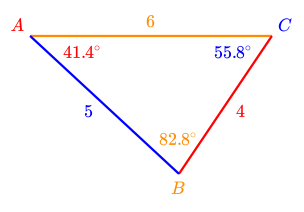
m ∠ A ≈ 41.4^(∘)
m ∠ B ≈ 82.8^(∘)
m ∠ C ≈ 55.8^(∘)
Practice makes perfect
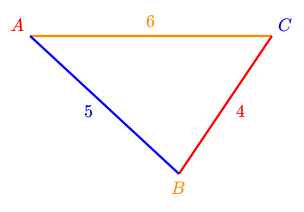
We need to solve the given triangle. Let's begin by drawing △ ABC and labeling the lengths of the sides. We will also color code the opposite angles and sides. It will help us use the Law of Sines and Law of Cosines later.
First, we can tell that it is not a right triangle, as the sides do not satisfy the Pythagorean Theorem.
5^2+ 4^2 ≠ 6^2
We will start with finding the largest angle using the Law of Cosines to make sure that the other two angles are acute. This way, when we use the Law of Sines to find another angle measure, we will know that it is between 0^(∘) and 90^(∘). Let's find the measures of ∠ B, ∠ A, and ∠ C one at a time.
Finding m ∠ B
The measures of all three sides of the triangle are given. Therefore, we can use the Law of Cosines to find m ∠ B.
b^2=a^2+c^2 -2 a c cos B
Let's substitute a= 4, b= 6, and c= 5 to isolate cos B.
Now that we know the measure of ∠ B, we can find m ∠ A using the Law of Sines.
sin A/a =sin B/b
Let's substitute a= 4, b= 6, and m ∠ B ≈ 82.8^(∘) to isolate sin A.
Finally, to find m ∠ C we can use the Triangle Sum Theorem. This tells us that the measures of the angles in a triangle add up to 180.
41.4^(∘)+ 82.8^(∘) + m ∠ C ≈ 180^(∘)
⇕
m ∠ C ≈ 55.8^(∘)
Completing the Triangle
With all of the angle measures, we can complete our diagram.