1. Area and Volume Scale Factors
Sign In
An error ocurred, try again later!
Chapter 3
1.
Area and Volume Scale Factors
Scale factors serve as a mathematical tool to understand how the area and volume of similar figures relate to each other. Whether you're working on a construction project or resizing a recipe, understanding these factors can be invaluable. The concept allows you to proportionally adjust the size of objects or spaces, making it easier to plan and execute various tasks. For example, if you're an architect, you can use scale factors to determine how the area of a room changes if its dimensions are altered. Similarly, in cooking, knowing how to adjust the volume of ingredients can save you from culinary disasters. Overall, mastering scale factors in the context of area and volume can offer practical solutions in diverse fields.
Show less Show more expand_more 


Lesson Settings & Tools
| | 13 Theory slides |
| | 11 Exercises - Grade E - A |
| | Each lesson is meant to take 1-2 classroom sessions |
Area and Volume Scale Factors
Slide of 13
In this lesson, similar figures will be compared in terms of their surface areas and volumes.
Catch-Up and Review
Here are a few recommended readings before getting started with this lesson.
Challenge
Share
Report error
Using Scale Factor of Similar Pyramids
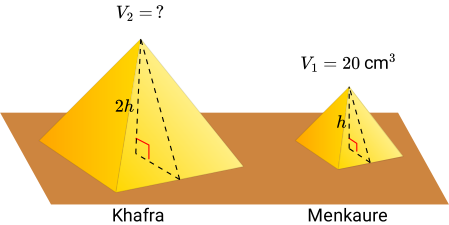
On a trip to Egypt, Emily is visiting the Great Egyptian Museum. She sees two models of Pyramids, Khafra and Menkaure, on display. She decides to buy the model of Menkaure, but now as she exits the gift shop, she has become even more curious about the volume of Khafra.
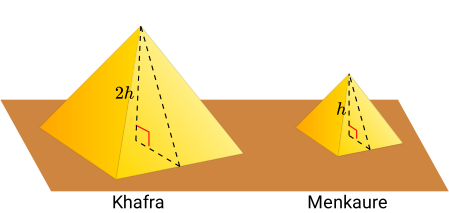
Suppose that the models of the pyramids are similar. If the scale factor of the corresponding side lengths is 1:2 and the volume of the smaller pyramid is 20 cubic centimeters, what is the volume of the larger model?
{"type":"text","form":{"type":"math","options":{"comparison":"1","nofractofloat":false,"keypad":{"simple":true,"useShortLog":false,"variables":["x"],"constants":["PI"]},"rendered":false},"text":" "},"formTextBefore":null,"formTextAfter":"cm^3","answer":{"text":["160"]}}
Discussion
Share
Report error
Area Scale Factor
If two figures are similar, then the ratio of their areas is equal to the square of the ratio of their corresponding side lengths.
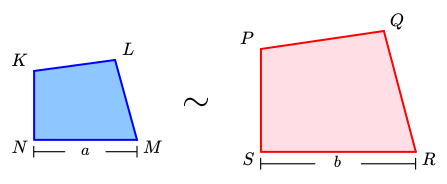
Let KLMN and PQRS be similar figures, and A_1 and A_2 be their respective areas. The length scale factor between corresponding side lengths is ab. Here, the following conditional statement holds true.
KLMN ~ PQRS ⇒ A_1/A_2 = (a/b )^2
Proof
The statement will be proven for similar rectangles, but this proof can be adapted for other similar figures.
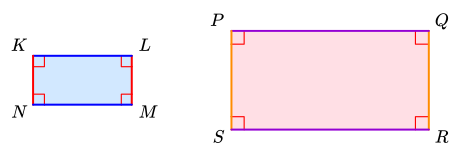
The area of a rectangle is the product of its length and its width.
| Area of KLMN | Area of PQRS |
|---|---|
| A_1 = KL* LM | A_2 = PQ * QR |
A_1 = KL* LM
SubstituteII
KL= PQ * a/b, LM= QR * a/b
A_1 = ( PQ * a/b) ( QR * a/b)
▼
Simplify right-hand side
RemovePar
Remove parentheses
A_1 = PQ * a/b * QR * a/b
CommutativePropMult
Commutative Property of Multiplication
A_1 = a/b * a/b * PQ * QR
ProdToPowTwoFac
a* a=a^2
A_1 = (a/b )^2 * PQ * QR
AssociativePropMult
Associative Property of Multiplication
A_1 = (a/b )^2(PQ * QR)
A_1 = (a/b )^2( PQ* QR)
Substitute
PQ* QR= A_2
A_1 = (a/b )^2 A_2
DivEqn
.LHS /A_2.=.RHS /A_2.
A_1/A_2 = (a/b )^2
Scale Factor & & Area Scale Factor a/b & ⇒ & A_1/A_2 = (a/b )^2
Example
Share
Report error
Using Area Scale Factor to Determine an Unknown Area
Dominika is making a flyer for a concert and wants to compare the areas of the two pieces of paper. The widths of A4 and A2 papers are 21 and 42 centimeters, respectively.
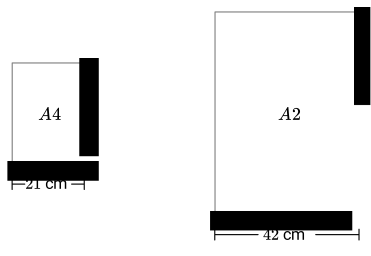
If these two pieces of paper are similar and the area of A4 paper is about 624 square centimeters, find the area of the A2 paper. Round the answer to the nearest integer.
{"type":"text","form":{"type":"math","options":{"comparison":"1","nofractofloat":false,"keypad":{"simple":true,"useShortLog":false,"variables":["x"],"constants":["PI"]},"rendered":false},"text":" "},"formTextBefore":null,"formTextAfter":"cm^2","answer":{"text":["2496"]}}
Hint
If the scale factor of two similar figures is ab, then the ratio of their areas is a^2b^2.
Solution
The two pieces of paper are similar and two corresponding sides measure 21 centimeters and 42 centimeters.
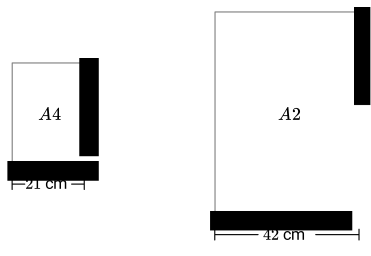
624/A_2 = 1/4
▼
Solve for A_2
MultEqn
LHS * A_2=RHS* A_2
624/A_2 * A_2 = 1/4 * A_2
FracMultDenomToNumber
a/A_2* A_2 = a
624 = 1/4 * A_2
MoveRightFacToNumOne
1/b* a = a/b
624 = A_2/4
MultEqn
LHS * 4=RHS* 4
2496 = A_2
RearrangeEqn
Rearrange equation
A_2 = 2496
Example
Share
Report error
Using Area Scale Factor to Determine an Unknown Side
It was just learned that if the length scale factor of two similar figures and one of the areas of the figures are known, then the unknown area can be found. Next, consider if both areas but only the side length of one figure are known. It will be possible to solve for the other similar figure's corresponding side length.
The diagram shows two similar figures. Figure A has an area of 9 square inches, and Figure B has an area of 25 square inches.
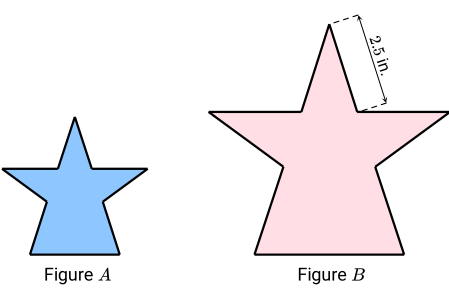
{"type":"text","form":{"type":"math","options":{"comparison":"1","nofractofloat":false,"keypad":{"simple":true,"useShortLog":false,"variables":["x"],"constants":["PI"]},"rendered":false},"text":" "},"formTextBefore":null,"formTextAfter":"in.","answer":{"text":["1.5","3\/2"]}}
Hint
If the scale factor of two similar figures is ab, then the ratio of their areas is a^2b^2.
Solution
Recall that the ratio of areas of two similar figures is equal to the square of the ratio of their corresponding side lengths.
ccc
Scale Factor & & Area Scale Factor [0.8em]
a/b & ⇒ & (a/b)^2
Since the areas are given, the following proportion can be written.
(a/b)^2 = 9/25
Now, take square roots of both sides of the equation to find the value of ab, the scale factor. Keep in mind that only the principal roots will be considered because only positive numbers make sense in this situation.
The scale factor of the figures is 3:5. Finally, with the scale factor and knowing that the side length of Figure B is 2.5 inches, the length of the corresponding side in Figure A represented by x can be found.
The corresponding length in Figure A is 1.5 inches.
3/5=x/2.5
▼
Solve for x
MultEqn
LHS * 2.5=RHS* 2.5
3/5 * 2.5 = x
MoveRightFacToNum
a/c* b = a* b/c
7.5/5 = x
CalcQuot
Calculate quotient
1.5 = x
RearrangeEqn
Rearrange equation
x = 1.5
Pop Quiz
Share
Report error
Practice Finding Linear Scale Factor Given Areas
Determine the linear scale factor of the shape on the right to the shape on the left.
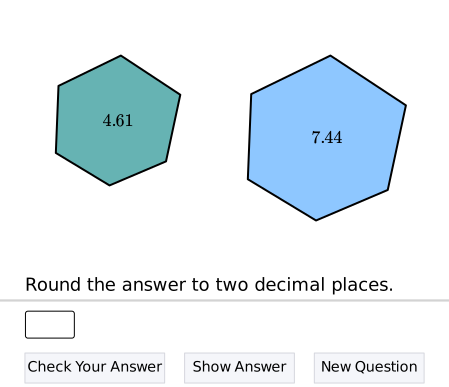
Discussion
Share
Report error
Volume Scale Factor
For similar three-dimensional figures, the volume scale factor and the length scale factor are also related.
If two figures are similar, then the ratio of their volumes is equal to the cube of the ratio of their corresponding side lengths.
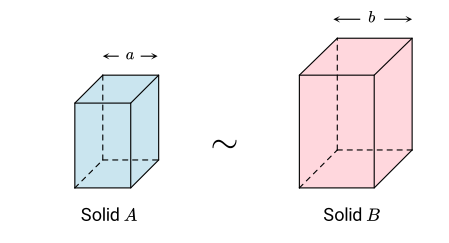
Let Solid A and Solid B be similar solids and V_1 and V_2 be their respective volumes. The length scale factor between corresponding linear measures is ab. Given these characteristics, the following conditional statement holds true.
SolidA ~ SolidB ⇒ V_1/V_2 = (a/b)^3
Proof
The statement will be proven for similar rectangular prisms, but this proof can be adapted to prove other similar solids. As shown in the diagram, let a_1, a_2, and a_3 be the dimensions of Solid A and b_1, b_2, and b_3 be the dimensions of Solid B.
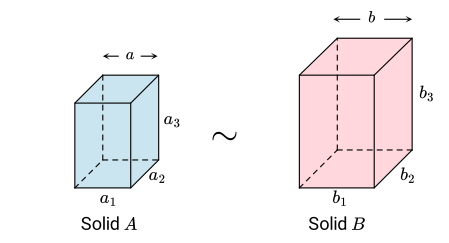
The volume of a rectangular prism is the product of its base area and its height.
| Volume of Solid A | Volume of Solid B |
|---|---|
| V_1 = a_1* a_2 * a_3 | V_2 = b_1 * b_2 * b_3 |
V_1 = a_1 * a_2 * a_3
SubstituteExpressions
Substitute expressions
V_1 = ( b_1 * a/b) ( b_2 * a/b) ( b_3 * a/b)
▼
Simplify right-hand side
RemovePar
Remove parentheses
V_1 = b_1 * a/b * b_2 * a/b * b_3 * a/b
CommutativePropMult
Commutative Property of Multiplication
V_1 = a/b * a/b * a/b * b_1 * b_2 * b_3
ProdToPowThreeFac
a* a* a=a^3
V_1 = (a/b )^3 * b_1 * b_2 * b_3
AssociativePropMult
Associative Property of Multiplication
V_1 = (a/b )^3 (b_1 * b_2 * b_3)
V_1 = (a/b )^3 (b_1 * b_2 * b_3)
Substitute
b_1 * b_2 * b_3= V_2
V_1 = (a/b )^3 V_2
DivEqn
.LHS /V_2.=.RHS /V_2.
V_1/V_2 = (a/b )^3
Scale Factor & & Volume Scale Factor a/b & ⇒ & V_1/V_2 = (a/b )^3
Example
Share
Report error
Using Volume Scale Factor to Determine an Unknown Volume
The scale factor of two similar figures can be used to find the volume of one of the figures when the volume of the other figure is known.
The suitcase company Case-O-La produces snazzy suitcases of various sizes. When a large-sized suitcase is bought, the company offers its cabin-sized version at a discounted price to the same customer.
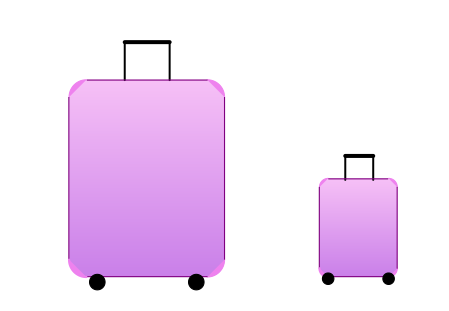
{"type":"text","form":{"type":"math","options":{"comparison":"1","nofractofloat":false,"keypad":{"simple":true,"useShortLog":false,"variables":["x"],"constants":["PI"]},"rendered":false},"text":" "},"formTextBefore":null,"formTextAfter":"L","answer":{"text":["26.7"]}}
Hint
If the scale factor of two similar figures is ab, then the ratio of their volumes is ( ab)^3.
Solution
The suitcases can be considered as two similar rectangular prisms with heights 27 and 18 inches.
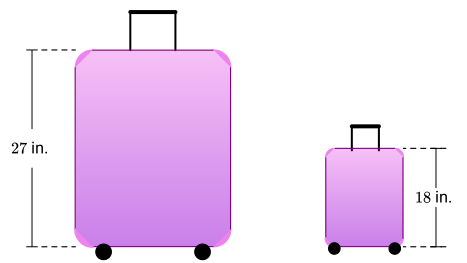
a/b=18/27
ReduceFrac
a/b=.a /9./.b /9.
a/b=2/3
RaiseEqn
LHS^3=RHS^3
(a/b)^3=(2/3)^3
PowQuot
(a/b)^m=a^m/b^m
a^3/b^3=2^3/3^3
CalcPow
Calculate power
a^3/b^3=8/27
FracToScale
\dfrac a b = a:b
a^3:b^3=8:27
V_1/90=8/27
▼
Solve for V_1
MultEqn
LHS * 90=RHS* 90
V_1 = 8/27 * 90
MoveRightFacToNum
a/c* b = a* b/c
V_1 = 720/27
CalcQuot
Calculate quotient
V_1 = 26.6666666...
RoundDec
Round to 1 decimal place(s)
V_1 ≈ 26.7
Example
Share
Report error
Using Volume Scale Factor to Determine an Unknown Side
After reading a physics magazine, Mark feels confident in estimating the radius of the Sun. To do so, he will use the volumes of the Sun and Earth, which are 1.41 * 10^(18) and 1.08 * 10^(12) cubic kilometers, respectively.
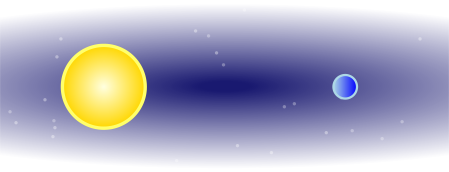
If the radius of the Earth is about 6300 kilometers, help Mark find the radius of the Sun.
{"type":"text","form":{"type":"math","options":{"comparison":"1","nofractofloat":false,"keypad":{"simple":true,"useShortLog":false,"variables":["x"],"constants":["PI"]},"rendered":false},"text":" "},"formTextBefore":null,"formTextAfter":"km","answer":{"text":["692,000","692000"]}}
Hint
Sun and Earth can be regarded as two similar spheres. Therefore, the volume scale factor can be used to find the radius of the Sun.
Solution
The Sun and Earth are two similar spheres. Consequently, the ratio of their volumes is equal to the cube of the ratio of their corresponding linear measures, which in this case is the ratio of their radii. Let r and R be the radii of the Earth and Sun, respectively.
ccc
Scale Factor & & Ratio of the Volumes [0.8em]
r/R & ⇒ & (r/R)^3
Given that the volumes are known, the volume scale factor can be used to find the scale factor of the Earth to the Sun. (r/R)^3 = 1.08 * 10^(12)/1.41 * 10^(18)
Next, take the cube roots of both sides of the equation to find the value of rR, the length scale factor.
Finally, with the scale factor and knowing that the radius of the Earth is about 6300 kilometers, the radius of the Sun R can be found. The ratio of 6300 to R is equal to the scale factor.
The radius of Sun is about 6.92 * 10^5, or 692 000, kilometers.
(r/R)^3 = 1.08 * 10^(12)/1.41 * 10^(18)
▼
Solve for a/b
WriteProdFrac
Write as a product of fractions
(r/R)^3 = (1.08/1.41)( 10^(12)/10^(18))
DivPow
a^m/a^n= a^(m-n)
(r/R)^3= (1.08/1.41)(10^(- 6))
RadicalEqn
sqrt(LHS)=sqrt(RHS)
r/R = sqrt((1.08/1.41)(10^(- 6)))
RootProd
sqrt(a* b)=sqrt(a)*sqrt(b)
r/R= sqrt(1.08/1.41) * sqrt(10^(- 6))
UseCalc
Use a calculator
r/R = (0.914958...)( 10^(- 2))
RoundDec
Round to 2 decimal place(s)
r/R ≈ (0.91)( 10^(- 2))
Write in scientific notation
r/R ≈ 9.1 * 10^(- 3)
6300/R = 9.1 * 10^(- 3)
▼
Solve for R
MultEqn
LHS * R=RHS* R
6300 = (9.1 * 10^(- 3))(R)
DivEqn
.LHS /(9.1 * 10^(- 3)).=.RHS /(9.1 * 10^(- 3)).
6300/9.1 * 10^(- 3) =R
WriteProdFrac
Write as a product of fractions
(6300/9.1) ( 1/10^(- 3) ) = R
CalcQuot
Calculate quotient
(692.307692 ...) ( 1/10^(- 3) ) = R
FracToNegExponent
1/a^m=a^(- m)
(692.307692 ...) (10^3) = R
RearrangeEqn
Rearrange equation
R = (692.307692 ...) (10^3)
RoundInt
Round to nearest integer
R ≈ (692)(10^3)
Write in scientific notation
R ≈ 6.92 * 10^5
Pop Quiz
Share
Report error
Practice Finding Linear Scale Factor Given Volumes
The applet shows the volumes of two similar solids. Determine the scale factor of the blue solid to the orange solid.
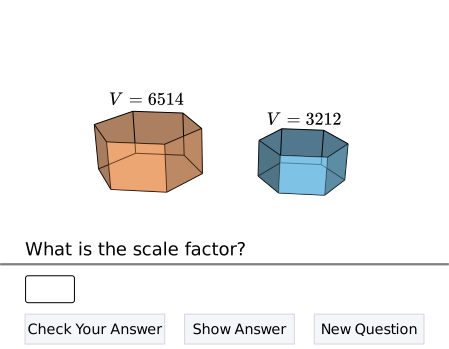
Example
Share
Report error
Finding Area Given Volume of Similar Solids
The corresponding faces of two similar three-dimensional figures are also similar. Subsequently, the ratio of the areas of the corresponding faces is proportional to the square of the length scale factor of the figures.
Dylan has a golden retriever and a chihuahua. He buys two similar doghouses, whose corresponding side lengths are proportional. When he is about to finish painting the doghouses, he realizes that there is not enough paint for the front face of the small doghouse!
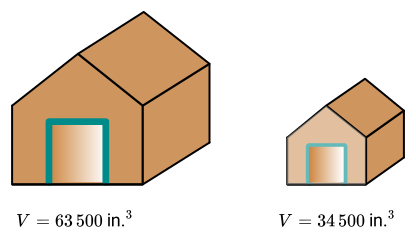
Dylan knows the volumes of each doghouse. They are about 63 500 and 34 500 cubic inches. He also knows that the front face of the big doghouse has an area of 650 square inches. Help Dylan determine the area of the front face of the small doghouse. This will help him determine how much more paint to buy. Round the answer to the nearest integer.
{"type":"text","form":{"type":"math","options":{"comparison":"1","nofractofloat":false,"keypad":{"simple":true,"useShortLog":false,"variables":["x"],"constants":["PI"]},"rendered":false},"text":" "},"formTextBefore":null,"formTextAfter":"in.^2","answer":{"text":["437"]}}
Hint
Start by finding the length scale factor. Then, use the ratio for the areas of similar figures.
Solution
The length scale factor will be found first. To do so, the cube root of the volume scale factor will be calculated. Recall that the ratio of volumes of two similar solids is equal to the cube of the ratio of their corresponding side lengths.
ccc
Scale Factor & & Volume Scale Factor [0.8em]
a/b & ⇒ & (a/b)^3
A proportion can be written using the ratio of the volumes.
(a/b)^3 = 34 500/63 500
Now, take cube roots of both sides of the equation to find the value of ab, the length scale factor.
The area scale factor can be found by squaring the scale factor for length.
ccc
Scale Factor & & Area Scale Factor [0.8em]
0.82 & ⇒ & 0.82^2
Finally, knowing that the larger doghouse's front face area is about 650 square inches, the corresponding area in the other one can be calculated. Let A_1 be that area. Then, 0.82^2 should be equal to the ratio of A_1 to 650.
The smaller doghouse has a front face with an area about 437 square inches. He can now go shopping for more paint to appease his cool chihuahua.
(a/b)^3 = 34 500/63 500
▼
Solve for a/b
RadicalEqn
sqrt(LHS)=sqrt(RHS)
a/b = sqrt(34 500/63 500)
CalcQuot
Calculate quotient
a/b = sqrt(0.543307...)
UseCalc
Use a calculator
a/b = 0.815984 ...
RoundDec
Round to 2 decimal place(s)
a/b ≈ 0.82
0.82^2 =A_1/650
▼
Solve for A_1
MultEqn
LHS * 650=RHS* 650
0.82^2 * 650 = A_1
CalcPow
Calculate power
0.6724 * 650 = A_1
Multiply
Multiply
437.06 = A_1
RearrangeEqn
Rearrange equation
A_1 = 437.06
RoundInt
Round to nearest integer
A_1 ≈ 437
Example
Share
Report error
Finding Volume of Similar Composite Solids
A three-dimensional figure is called a composite solid if it is the combination of two or more solids. Like similar solids, if the corresponding linear measures of two composite solids are proportional, the composite solids are said to be similar. Therefore, their length scale factor can be determined and used to find certain characteristics of the shapes.
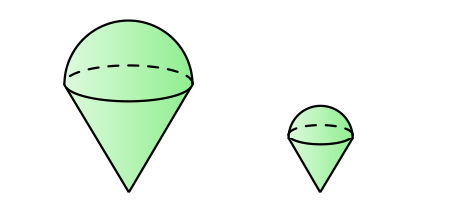
The amount of material used to construct the larger silo is three times that of the smaller one. That is, the surface area of the larger silo is three times as large as the surface area of the smaller silo. These two silos can be considered to be similar solids. Furthermore, each silo is composed of a cone and a cylinder as shown.
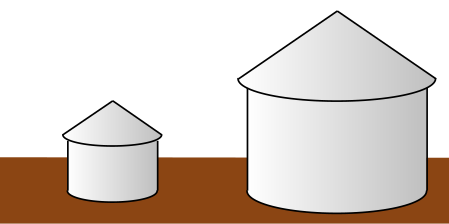
{"type":"text","form":{"type":"math","options":{"comparison":"1","nofractofloat":false,"keypad":{"simple":true,"useShortLog":false,"variables":["x"],"constants":["PI"]},"rendered":false},"text":" "},"formTextBefore":null,"formTextAfter":"m^3","answer":{"text":["1299"]}}
Hint
Use the area scale factor to determine the length scale factor.
Solution
The given silos are similar composite solids. Since they are similar, their corresponding linear measures are proportional. Therefore, each silo can be considered as a whole. To find the volume of the smaller silo, these steps will be followed.
- The ratio of their surface areas will be used to determine the length scale factor.
- The length scale factor will be used to determine the volume scale factor.
- Finally, the volume scale factor will be used to determine the volume of the smaller silo.
It is given that the surface area of the larger silo is three times as large as the surface area of the smaller silo.
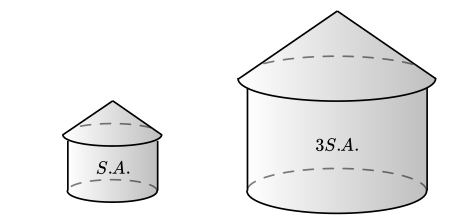
(a/b)^2 = 1/3
▼
Solve for a/b
SqrtEqn
sqrt(LHS)=sqrt(RHS)
sqrt((a/b)^2) = sqrt(1/3)
SqrtPowToNumber
sqrt(a^2)=a
a/b = sqrt(1/3)
SqrtQuot
sqrt(a/b)=sqrt(a)/sqrt(b)
a/b = sqrt(1)/sqrt(3)
CalcRoot
Calculate root
a/b = 1/sqrt(3)
Closure
Share
Report error
Relationship Between Length, Area, and Volume Scale Factor
In this course, the relationships between the length scale factor, area scale factor and volume scale factor have been discussed. If the scale factor between two similar figures is ab, then the ratio for their areas and volumes can be expressed as the table shows.
| Length Scale Factor | Area Scale Factor | Volume Scale Factor |
|---|---|---|
| a/b | ( a/b )^2 | ( a/b )^3 |
Considering these expressions, the challenge presented at the beginning can be solved with more confidence.
Emily knows that the models in the museum are similar pyramids and the scale factor between the corresponding side lengths is 1:2.
{"type":"text","form":{"type":"math","options":{"comparison":"1","nofractofloat":false,"keypad":{"simple":true,"useShortLog":false,"variables":["x"],"constants":["PI"]},"rendered":false},"text":" "},"formTextBefore":null,"formTextAfter":"cm^3","answer":{"text":["160"]}}
Hint
If the scale factor of two similar figures is ab, then the ratio of their volumes is ( ab)^3.
Answer
To find the volume of the larger model, first, find the volume scale factor. Note that the volume scale factor is equal to the cube of the length scale factor. The length scale factor is given as 1:2, or 12. Length Scale Factor & & Volume Scale Factor 1/2 & ⇒ & (1/2)^3 = 1/8
An equation can now be written using the known volume scale factor and the ratio of the model's volumes. Recall that it is given that the volume of the smaller model is 20 cubic centimeters. Substitute that value into the equation to solve for the volume of the larger model.
The volume of the larger model is 160 cubic centimeters.
1/8 = V_1/V_2
Substitute
V_1= 20
1/8 = 20/V_2
MultEqn
LHS * 8=RHS* 8
1 = 160/V_2
MultEqn
LHS * V_2=RHS* V_2
V_2 = 160
Area and Volume Scale Factors
Exercise 3.1
A scale model of the base of the world's largest cruise ship Gigantor is a rectangular shaped. The model is 120 millimeters long and 40 millimeters wide with a linear scale factor to the actual ship of 1:2750. Next year, the cruise line will produce an even larger ship named Xplosion. How many square meters does the base of Xplosion cover if the length scale factor between Xplosion and Gigantor is 2:1?
{"type":"text","form":{"type":"math","options":{"comparison":"1","nofractofloat":false,"keypad":{"simple":true,"useShortLog":false,"variables":["x"],"constants":["PI"]},"rendered":false},"text":" "},"formTextBefore":"A=","formTextAfter":"m^2","answer":{"text":["145200"]}}
security
report
code
security
report
code
To calculate the area that base of Xplosion will cover, we can use the area of the scale model of Gigantor. Let's find the scale model area of Gigantor. Since we want the area in square meters, let's begin by converting the units from millimeters to meters.
From Millimeters to Meters
Since 1 meter equals 1000 centimeters, we can write the following conversion factor. 1m/1000 mm With this information, we can convert our measurements to meters.
| Dimension | *1m/1000mm | Evaluate |
|---|---|---|
| 120 mm | 120 mm * 1 m/1000 mm | 0.12 m |
| 40 mm | 40 mm * 1 m/1000 mm | 0.04 m |
Area of the Model
Since the base is a rectangle, we can use the formula for the area of a rectangle to find the area of the base of the model.
It is a given that the length scale factor between the model of Gigantor and the actual ship is 1:2750. Recall that the ratio of the areas of similar figures is equal to the square of the ratio of their corresponding side lengths. With this information, we can write the area scale factor for the model and the actual ship.
| Length Scale Factor | Area Scale Factor |
|---|---|
| 1/2750 | ( 1/2750)^2=1/2750^2 |
We can now equate the area scale factor to the ratio of the area of the base of the model to the area of the base of the real ship. Let A_1 be the area of the model and A_2 be the area of the real ship. 1/2750=A_1/A_2 Earlier we found that A_1 is 0.0048 square meters. We can substitute its value into the equation and solve for A_2.
Therefore, the real area of the base of the Gigantor ship is 36 300 square meters.
Area of Xplosion
We are given that the length scale factor between the Xplosion and the Gigantor is 2:1. In a similar way, let's first find the area scale factor.
| Length Scale Factor | Area Scale Factor |
|---|---|
| 2/1 | ( 2/1)^2=4 |
Again, we need to equate the area scale factor to the ratio of the area of the Explosion to the area of the Gigantor. Let A_1 be the area of the Xplosion and A_2 be the area of the Gigantor. A_1/A_2=4 ⇒ A_1=4* A_2 The area of the Xplosion is 4 times the area of the Gigantor ship. Let's substitute 36 300 into the equation. A_1=4* 36 300 ⇒ A_1=145 200m^2 Therefore, the area of the base of the Xplosion ship is 145 200 square meters.
security
report
code
Kriz is blowing up a balloon for a friend's birthday party. So far, Kriz has inflated it with three full breaths, which fills it to the point that the balloon is half the possible width. If Kriz fills in equal amounts of air with each breath, after how many more breaths is the balloon at its full width?

{"type":"text","form":{"type":"math","options":{"comparison":"1","nofractofloat":false,"keypad":{"simple":true,"useShortLog":false,"variables":["x"],"constants":["PI"]},"rendered":false},"text":" "},"formTextBefore":null,"formTextAfter":"breaths","answer":{"text":["21"]}}
security
report
code
security
report
code
We will find the number of breaths that Kriz needs to inflate the balloon at its full width. Let B represent the volume that enters the balloon from one full breath and x represent the number of breaths to get the full width of the balloon. Therefore, the volume of the balloon after three breaths is 3 times B. Similarly, the volume of the balloon when it is at full width is x times B.
At its total width, the balloon has twice the radius of the balloon after 3 breaths. Therefore, the length scale factor is 1:2 or 12. Length scale factor= 1/2 Recall that the ratio of the volumes of similar solids is equal to the cube of the ratio of their corresponding linear measures. With this information, we can write the volume scale factor for the balloon at half the width and the balloon at full.
| Length Scale Factor | Volume Scale Factor |
|---|---|
| 1/2 | ( 1/2)^2=1/8 |
We can now equate the volume scale factor to the ratio of the volume of the balloon at half the width to the volume of the balloon at full. 1/8=3B/xB By solving the equation for x, we will find the number of breaths needed to get the full width of the balloon.
Therefore, when the balloon is at its maximum capacity, it contains air from 24 full breaths.
Since the smaller balloon already has 3 breaths, Kriz must add 21 more breaths to fill the balloon to its maximum capacity.
security
report
code
Area and Volume Scale Factors
Recommended exercises
To get personalized recommended exercises, please login first.
Loading content
≤
>
■2
■▢
e▢
7
8
9
×
÷■1
=
=
√▢
▢√
∫▢▢
4
5
6
+
−
≤
<
log
ln
log▢
1
2
3
()
∣
sin
cos
tan
0
.
π
x
y
Loading content