Dimensional Analysis and Using Units
Concept

Conversion Factor

A conversion factor is a fraction where the numerator and denominator represent the same quantity with different units. Example Conversion Factor [0.5em] 60 minutes/1 hour Recall that 1 hour and 60 minutes represent the same quantity. Multiplying a quantity by a conversion factor changes the quantity to an equivalent quantity in different units. Examine how to convert 2 hours to minutes using the above conversion factor.
Given Quantity Conversion Result
2 hours 2 hours * 60 minutes/1 hour 120 minutes

Although the final result is in minutes, both quantities represent the same amount of time. Note that the opposite conversion, from minutes to hours, has a conversion factor of 1 hour60 minutes. If the task was to convert 120 minutes to hours, 120 minutes would be multiplied by this conversion factor.

Given Quantity Conversion Result
120 minutes 120 minutes * 1 hour/60 minutes 2 hours

As shown in the examples above, the process of including units of measurement as factors is called dimensional analysis. Dimensional analysis can also be used when deciding which conversion factor will produce the desired units. In the table, some common conversion factors are used to convert the given measures.

Given Quantity Conversion Result
3 pounds 3 pounds * 16 ounces/1 pound 48 ounces
160 ounces 160 ounces * 1 pound/16 ounces 10 pounds
1 mile 1 mile * 1760 yards/1 mile 1760 yards
Some common conversions involve distance, mass, area, volume, time, and temperature.

Why

The Reason That the Quantities Are Equivalent

The numerator and denominator of the conversion factor represent the same quantity. That means their quotient equals 1. Then, by the Identity Property of Multiplication, the amount of the given quantity does not change when multiplied by the conversion factor.

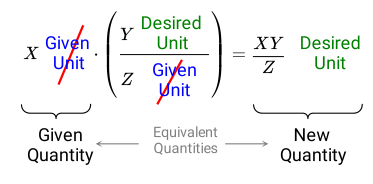
When converting from one unit to another, the desired unit needs to be in the numerator of the conversion factor while the given unit needs to be in the denominator. That way when the quantity is multiplied by the conversion factor, the given unit will cancel out and the desired unit will remain.

Keep in mind that, despite the given quantity and the new quantity have different values, they represent the same amount.

Exercises
Edit Lesson