2. Sum and Difference Angle Identities
Sign In
An error ocurred, try again later!
Chapter 7
2.
Sum and Difference Angle Identities
This lesson delves into the mathematical realm of trigonometric identities, specifically focusing on angle sum and difference identities. It provides a step-by-step guide for calculating trigonometric values using these identities. The use cases are diverse, ranging from academic exercises to practical applications like landscape design and physics. For example, the identities are used to calculate the exact value of sine, cosine, or tangent of a given angle, which can be crucial in fields like engineering and architecture. The lesson also incorporates real-life scenarios, such as calculating the length of a river in a park design, to demonstrate the practical utility of these mathematical tools.
Show less Show more expand_more 


Lesson Settings & Tools
| | 12 Theory slides |
| | 10 Exercises - Grade E - A |
| | Each lesson is meant to take 1-2 classroom sessions |
Sum and Difference Angle Identities
Slide of 12
There are identities that relate the trigonometric values of two angles to the trigonometric values of the sum or difference of these two angles. In this lesson, they will be introduced and practiced.
Catch-Up and Review
Here are a few recommended readings before getting started with this lesson.
Challenge
Share
Report error
Designing a City Park
Tiffaniqua, who works as a landscape designer, received a job to create a new design for an old city park. Since the park is quite huge, she divided its area into six rectangular sections. The first section contains a fountain (F) and is crossed by a river at two points — south (S) and north (N).
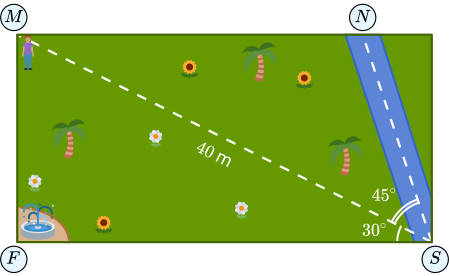
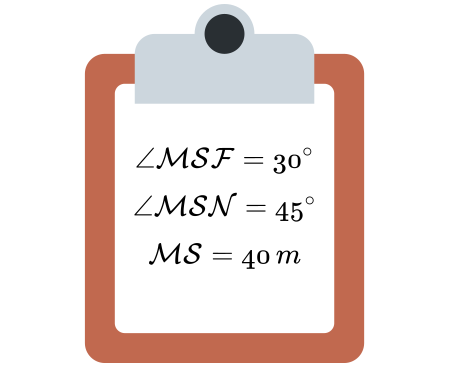
When she first came to analyze the park, she stood at the north-west corner of the first section, which she marked as point M. Then, she took notes of some measures of angles and distances.

Later when returning to her work space, Tiffaniqua used her notes to make additional calculations. What is the length of the river within the first section of the park? Round the answer to the first decimal place.
{"type":"text","form":{"type":"math","options":{"comparison":"1","nofractofloat":false,"keypad":{"simple":true,"useShortLog":false,"variables":[],"constants":[]},"rendered":false},"text":" "},"formTextBefore":"\u2248","formTextAfter":"meters","answer":{"text":["20.7"]}}
Discussion
Share
Report error
Introducing Angle Sum and Difference Identities
There are identities that allow calculating the values of trigonometric functions of the sum or difference of two angles.
Rule
Share
Report error
Angle Sum and Difference Identities
To evaluate trigonometric functions of the sum of two angles, the following identities can be applied.
sin(x+y) &= sin x cos y + cos x sin y [0.8em] cos(x+y) &= cos x cos y - sin x sin y [0.8em] tan(x+y) &= tan x + tan y/1 - tan x tan y
There are also similar identities for the difference of two angles.
sin(x-y) &= sin x cos y - cos x sin y [0.8em] cos(x-y) &= cos x cos y + sin x sin y [0.8em] tan(x-y) &= tan x - tan y/1 + tan x tan y
Proof
Let △ AFD be a right triangle with hypotenuse 1 and an acute angle with measure x+y.
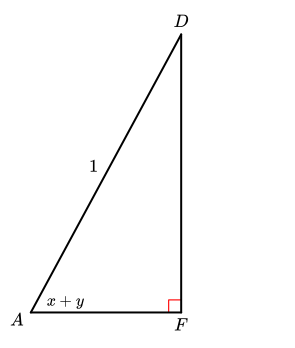
By definition, the sine of an angle is the ratio between the lengths of the opposite side and the hypotenuse. sin(x+y) = DF/1 ⇓ DF = sin(x+y) The idea now is to rewrite DF in terms of sin x, sin y, cos x, and cos y. To do it, draw a ray so that ∠ A is divided into two angles with measures x and y. Let C be a point on this ray such that △ ACD and △ ABC are right triangles.
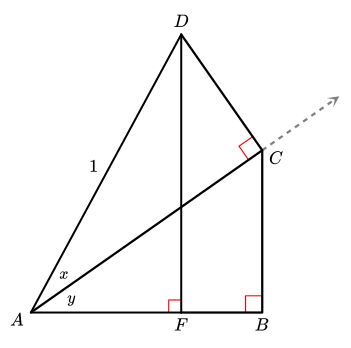
sin y = BC/AC
▼
Solve for BC
Substitute
AC= cos x
sin y = BC/cos x
MultEqn
LHS * cos x=RHS* cos x
cos xsin y=BC
RearrangeEqn
Rearrange equation
BC=cos xsin y
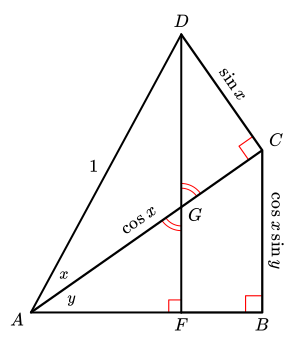
By the Third Angle Theorem, it is known that ∠ GAF ≅ ∠ GDC. Therefore, m∠ GDC = y.
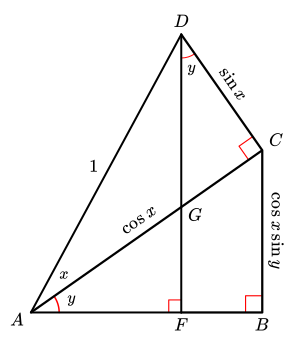
Since the purpose is to rewrite DF, plot a point E on DF such that EC ∥ AB. This way a rectangle ECBF is formed. The opposite sides of a rectangle have the same length, so EF and CB are equal. Also, CE⊥ DF makes △ CED a right triangle.
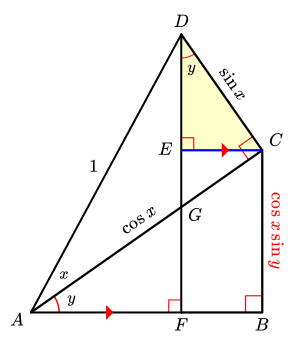
Consequently, EF = cos x sin y and DE can be written in terms of sin x and cos y using the cosine ratio. cos y = DE/sin x ⇓ DE = sin x cos y Finally, by the Segment Addition Postulate, DF is equal to the sum of DE and EF. All these lengths have been rewritten in terms of the sine and cosine of x and y. DF = DE+ EF ⇓ sin(x+y) = sin x cos y + cos xsin y This concludes the proof of the first identity. The other identities can be proven using similar reasoning.
Extra
Calculating sin 120^(∘)Consider the following process for calculating the exact value of sin 120^(∘).
- To be able to use the angle sum identities, the angle 120^(∘) needs to be rewritten as the sum of two angles for which the sine and cosine are known. For example, 120^(∘) can be rewritten as 90^(∘)+ 30^(∘).
- Use the first formula for the angle sum.
- Based on the trigonometric ratios of common angles, it is known that sin 90^(∘)=1, sin 30^(∘)= 12, cos 90^(∘)=0, and cos 30^(∘)= sqrt(3)2.
sin 120^(∘)
Rewrite
Rewrite 120^(∘) as 90^(∘)+30^(∘)
sin(90^(∘)+30^(∘))
sin(x+y) = sin x cos y + cos x sin y
sin 90^(∘) * cos 30^(∘) + cos 90^(∘) * sin 30^(∘)
SubstituteValues
Substitute values
1 * sqrt(3)/2 + 0 * 1/2
▼
Simplify
OneMult
1* a=a
sqrt(3)/2 + 0 * 1/2
ZeroPropMult
Zero Property of Multiplication
sqrt(3)/2 + 0
IdPropAdd
Identity Property of Addition
sqrt(3)/2
Example
Share
Report error
Evaluating Trigonometric Expressions at Random Values
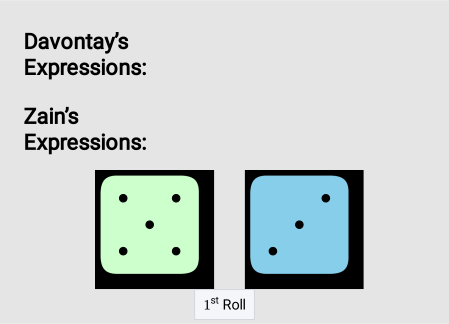
When Tiffaniqua came home from work, she saw that her son Davontay and his friend Zain came up with a game. Davontay assigned numbers 1 through 6 to the trigonometric functions of sine, cosine, and tangent, while Zain assigned numbers 1 through 6 to six angle measures.
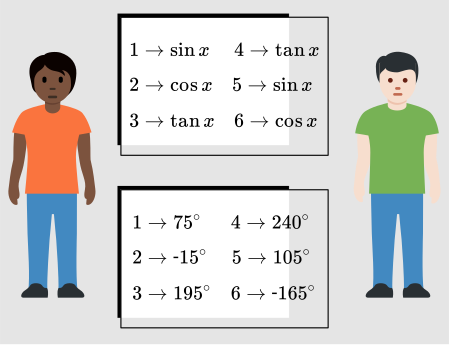
a sin 105^(∘)
{"type":"text","form":{"type":"math","options":{"comparison":"1","nofractofloat":false,"keypad":{"simple":false,"useShortLog":false,"variables":[],"constants":[]},"rendered":false},"text":" "},"formTextBefore":null,"formTextAfter":null,"answer":{"text":["\\dfrac{\\sqrt{6}+\\sqrt{2}}{4}","\\dfrac{\\sqrt{2}+\\sqrt{6}}{4}"]}}
b tan 195^(∘)
{"type":"text","form":{"type":"math","options":{"comparison":"1","nofractofloat":false,"keypad":{"simple":false,"useShortLog":false,"variables":[],"constants":[]},"rendered":false},"text":" "},"formTextBefore":null,"formTextAfter":null,"answer":{"text":["2-\\sqrt{3}","-\\sqrt{3}+2"]}}
c cos 75^(∘)
{"type":"text","form":{"type":"math","options":{"comparison":"1","nofractofloat":false,"keypad":{"simple":false,"useShortLog":false,"variables":[],"constants":[]},"rendered":false},"text":" "},"formTextBefore":null,"formTextAfter":null,"answer":{"text":["\\dfrac{\\sqrt{6}-\\sqrt{2}}{4}","\\dfrac{-\\sqrt{2}+\\sqrt{6}}{4}"]}}
d tan (- 15^(∘))
{"type":"text","form":{"type":"math","options":{"comparison":"1","nofractofloat":false,"keypad":{"simple":false,"useShortLog":false,"variables":[],"constants":[]},"rendered":false},"text":" "},"formTextBefore":null,"formTextAfter":null,"answer":{"text":["-2+\\sqrt{3}","\\sqrt{3}-2"]}}
Hint
a Express 105^(∘) as the sum or difference of two notable angles.
b Use the Angle Sum and Difference Identities for tangent.
c Note that 75^(∘) can be expressed as the difference of 120^(∘) and 45^(∘).
d Try to simplify the fraction by multiplying both the numerator and denominator by such an expression that would remove a radical from the denominator.
Solution
a The exact value of sin 105^(∘) should be found. Recall that the values of the trigonometric functions of some notable angles are known. Try to represent the angle of 105^(∘) as the sum or difference of two notable angles.
sin (x+y)=sin xcos y+cos xsin y
SubstituteII
x= 60^(∘), y= 45^(∘)
sin ( 60^(∘)+ 45^(∘))=sin 60^(∘)cos 45^(∘)+cos 60^(∘)sin 45^(∘)
AddTerms
Add terms
sin 105^(∘)=sin 60^(∘)cos 45^(∘)+cos 60^(∘)sin 45^(∘)
▼
Substitute values
\ifnumequal{60}{0}{\sin\left(0^\circ\right)=0}{}\ifnumequal{60}{30}{\sin\left(30^\circ\right)=\dfrac{1}{2}}{}\ifnumequal{60}{45}{\sin\left(45^\circ\right)=\dfrac{\sqrt{2}}{2}}{}\ifnumequal{60}{60}{\sin\left(60^\circ\right)=\dfrac{\sqrt{3}}{2}}{}\ifnumequal{60}{90}{\sin\left(90^\circ\right)=1}{}\ifnumequal{60}{120}{\sin\left(120^\circ\right)=\dfrac{\sqrt{3}}{2}}{}\ifnumequal{60}{135}{\sin\left(135^\circ\right)=\dfrac{\sqrt{2}}{2}}{}\ifnumequal{60}{150}{\sin\left(150^\circ\right)=\dfrac{1}{2}}{}\ifnumequal{60}{180}{\sin\left(180^\circ\right)=0}{}\ifnumequal{60}{210}{\sin\left(210^\circ\right)=\text{-} \dfrac 1 2}{}\ifnumequal{60}{225}{\sin\left(225^\circ\right)=\text{-} \dfrac {\sqrt{2}} {2}}{}\ifnumequal{60}{240}{\sin\left(240^\circ\right)=\text{-} \dfrac {\sqrt 3}2}{}\ifnumequal{60}{270}{\sin\left(270^\circ\right)=\text{-}1}{}\ifnumequal{60}{300}{\sin\left(300^\circ\right)=\text{-}\dfrac {\sqrt 3}2}{}\ifnumequal{60}{315}{\sin\left(315^\circ\right)=\text{-} \dfrac {\sqrt{2}} {2}}{}\ifnumequal{60}{330}{\sin\left(330^\circ\right)=\text{-} \dfrac 1 2}{}\ifnumequal{60}{360}{\sin\left(360^\circ\right)=0}{}
sin 105^(∘)=sqrt(3)/2cos 45^(∘)+cos 60^(∘)sin 45^(∘)
\ifnumequal{45}{0}{\cos\left(0^\circ\right)=1}{}\ifnumequal{45}{30}{\cos\left(30^\circ\right)=\dfrac{\sqrt{3}}{2}}{}\ifnumequal{45}{45}{\cos\left(45^\circ\right)=\dfrac{\sqrt{2}}{2}}{}\ifnumequal{45}{60}{\cos\left(60^\circ\right)=\dfrac{1}{2}}{}\ifnumequal{45}{90}{\cos\left(90^\circ\right)=0}{}\ifnumequal{45}{120}{\cos\left(120^\circ\right)=\text{-} \dfrac{1}{2}}{}\ifnumequal{45}{135}{\cos\left(135^\circ\right)=\text{-} \dfrac{\sqrt{2}}{2}}{}\ifnumequal{45}{150}{\cos\left(150^\circ\right)=\text{-} \dfrac{\sqrt{3}}{2}}{}\ifnumequal{45}{180}{\cos\left(180^\circ\right)=\text{-} 1}{}\ifnumequal{45}{210}{\cos\left(210^\circ\right)=\text{-} \dfrac{\sqrt 3}2}{}\ifnumequal{45}{225}{\cos\left(225^\circ\right)=\text{-} \dfrac {\sqrt{2}} {2}}{}\ifnumequal{45}{240}{\cos\left(240^\circ\right)=\text{-} \dfrac {1}2}{}\ifnumequal{45}{270}{\cos\left(270^\circ\right)=0}{}\ifnumequal{45}{300}{\cos\left(300^\circ\right)=\dfrac{1}2}{}\ifnumequal{45}{315}{\cos\left(315^\circ\right)=\dfrac {\sqrt{2}} {2}}{}\ifnumequal{45}{330}{\cos\left(330^\circ\right)=\dfrac{\sqrt 3}2}{}\ifnumequal{45}{360}{\cos\left(360^\circ\right)=1}{}
sin 105^(∘)=sqrt(3)/2* sqrt(2)/2+cos 60^(∘)sin 45^(∘)
\ifnumequal{60}{0}{\cos\left(0^\circ\right)=1}{}\ifnumequal{60}{30}{\cos\left(30^\circ\right)=\dfrac{\sqrt{3}}{2}}{}\ifnumequal{60}{45}{\cos\left(45^\circ\right)=\dfrac{\sqrt{2}}{2}}{}\ifnumequal{60}{60}{\cos\left(60^\circ\right)=\dfrac{1}{2}}{}\ifnumequal{60}{90}{\cos\left(90^\circ\right)=0}{}\ifnumequal{60}{120}{\cos\left(120^\circ\right)=\text{-} \dfrac{1}{2}}{}\ifnumequal{60}{135}{\cos\left(135^\circ\right)=\text{-} \dfrac{\sqrt{2}}{2}}{}\ifnumequal{60}{150}{\cos\left(150^\circ\right)=\text{-} \dfrac{\sqrt{3}}{2}}{}\ifnumequal{60}{180}{\cos\left(180^\circ\right)=\text{-} 1}{}\ifnumequal{60}{210}{\cos\left(210^\circ\right)=\text{-} \dfrac{\sqrt 3}2}{}\ifnumequal{60}{225}{\cos\left(225^\circ\right)=\text{-} \dfrac {\sqrt{2}} {2}}{}\ifnumequal{60}{240}{\cos\left(240^\circ\right)=\text{-} \dfrac {1}2}{}\ifnumequal{60}{270}{\cos\left(270^\circ\right)=0}{}\ifnumequal{60}{300}{\cos\left(300^\circ\right)=\dfrac{1}2}{}\ifnumequal{60}{315}{\cos\left(315^\circ\right)=\dfrac {\sqrt{2}} {2}}{}\ifnumequal{60}{330}{\cos\left(330^\circ\right)=\dfrac{\sqrt 3}2}{}\ifnumequal{60}{360}{\cos\left(360^\circ\right)=1}{}
sin 105^(∘)=sqrt(3)/2* sqrt(2)/2+1/2sin 45^(∘)
\ifnumequal{45}{0}{\sin\left(0^\circ\right)=0}{}\ifnumequal{45}{30}{\sin\left(30^\circ\right)=\dfrac{1}{2}}{}\ifnumequal{45}{45}{\sin\left(45^\circ\right)=\dfrac{\sqrt{2}}{2}}{}\ifnumequal{45}{60}{\sin\left(60^\circ\right)=\dfrac{\sqrt{3}}{2}}{}\ifnumequal{45}{90}{\sin\left(90^\circ\right)=1}{}\ifnumequal{45}{120}{\sin\left(120^\circ\right)=\dfrac{\sqrt{3}}{2}}{}\ifnumequal{45}{135}{\sin\left(135^\circ\right)=\dfrac{\sqrt{2}}{2}}{}\ifnumequal{45}{150}{\sin\left(150^\circ\right)=\dfrac{1}{2}}{}\ifnumequal{45}{180}{\sin\left(180^\circ\right)=0}{}\ifnumequal{45}{210}{\sin\left(210^\circ\right)=\text{-} \dfrac 1 2}{}\ifnumequal{45}{225}{\sin\left(225^\circ\right)=\text{-} \dfrac {\sqrt{2}} {2}}{}\ifnumequal{45}{240}{\sin\left(240^\circ\right)=\text{-} \dfrac {\sqrt 3}2}{}\ifnumequal{45}{270}{\sin\left(270^\circ\right)=\text{-}1}{}\ifnumequal{45}{300}{\sin\left(300^\circ\right)=\text{-}\dfrac {\sqrt 3}2}{}\ifnumequal{45}{315}{\sin\left(315^\circ\right)=\text{-} \dfrac {\sqrt{2}} {2}}{}\ifnumequal{45}{330}{\sin\left(330^\circ\right)=\text{-} \dfrac 1 2}{}\ifnumequal{45}{360}{\sin\left(360^\circ\right)=0}{}
sin 105^(∘)=sqrt(3)/2* sqrt(2)/2+1/2* sqrt(2)/2
MultFrac
Multiply fractions
sin 105^(∘)=sqrt(6)/4+sqrt(2)/4
AddFrac
Add fractions
sin 105^(∘)=sqrt(6)+sqrt(2)/4
b Similarly to Part A, start by expressing 195^(∘) as the sum or difference of two notable angles.
tan(x-y)=tan x-tan y/1+tan xtan y
SubstituteII
x= 240^(∘), y= 45^(∘)
tan( 240^(∘)- 45^(∘))=tan 240^(∘) -tan 45^(∘)/1+tan 240^(∘)tan 45^(∘)
SubTerm
Subtract term
tan 195^(∘) =tan 240^(∘) -tan 45^(∘)/1+tan 240^(∘)tan 45^(∘)
Substitute
tan (240^(∘))= sqrt(3)
tan 195^(∘) =sqrt(3) -tan 45^(∘)/1+sqrt(3)tan 45^(∘)
450tan(0^(∘))=0 4530tan(30^(∘))=sqrt(3)/3 4545tan(45^(∘))=1 4560tan(60^(∘))=sqrt(3) 4590tan(90^(∘)) undefined 45120tan(120^(∘))=- sqrt(3) 45135tan(135^(∘))=- 1 45150tan(150^(∘))=- sqrt(3)/3 45180tan(180^(∘))=0 45270tan(270^(∘)) odef. 45360tan(360^(∘))=0
tan 195^(∘) =sqrt(3) -1/1+sqrt(3)* 1
MultByOne
a * 1=a
tan 195^(∘) =sqrt(3)-1/1+sqrt(3)
tan 195^(∘) =sqrt(3)-1/1+sqrt(3)
ExpandFrac
a/b=a * (1-sqrt(3))/b * (1-sqrt(3))
tan 195^(∘) =(sqrt(3)-1)(1-sqrt(3))/(1+sqrt(3))(1-sqrt(3))
▼
Simplify right-hand side
ExpandDiffSquares
(a+b)(a-b)=a^2-b^2
tan 195^(∘) =(sqrt(3)-1)(1-sqrt(3))/1^2-(sqrt(3))^2
MultPar
Multiply parentheses
tan 195^(∘) =sqrt(3)-(sqrt(3))^2-1+sqrt(3)/1^2-(sqrt(3))^2
CalcPow
Calculate power
tan 195^(∘) =sqrt(3)-3-1+sqrt(3)/1-3
AddSubTerms
Add and subtract terms
tan 195^(∘) =2sqrt(3)-4/- 2
MoveNegDenomToFrac
Put minus sign in front of fraction
tan 195^(∘) =- 2sqrt(3)-4/2
SimpQuot
Simplify quotient
tan 195^(∘) =- (sqrt(3)-2)
Distr
Distribute - 1
tan 195^(∘) =- sqrt(3)+2
CommutativePropAdd
Commutative Property of Addition
tan 195^(∘) =2-sqrt(3)
c First, note that the angle of 75^(∘) can be represented as the difference of 120^(∘) and 45^(∘). Therefore, the Angle Difference Identity for cosine can be used to calculate the value of cos 75^(∘).
cos(x-y)=cos x cos y +sin x sin y
SubstituteII
x= 120^(∘), y= 45^(∘)
cos( 120^(∘)- 45^(∘))=cos 120^(∘) cos 45^(∘) +sin 120^(∘) sin 45^(∘)
SubTerm
Subtract term
cos(75^(∘))=cos 120^(∘) cos 45^(∘) +sin 120^(∘) sin 45^(∘)
▼
Substitute values
\ifnumequal{120}{0}{\cos\left(0^\circ\right)=1}{}\ifnumequal{120}{30}{\cos\left(30^\circ\right)=\dfrac{\sqrt{3}}{2}}{}\ifnumequal{120}{45}{\cos\left(45^\circ\right)=\dfrac{\sqrt{2}}{2}}{}\ifnumequal{120}{60}{\cos\left(60^\circ\right)=\dfrac{1}{2}}{}\ifnumequal{120}{90}{\cos\left(90^\circ\right)=0}{}\ifnumequal{120}{120}{\cos\left(120^\circ\right)=\text{-} \dfrac{1}{2}}{}\ifnumequal{120}{135}{\cos\left(135^\circ\right)=\text{-} \dfrac{\sqrt{2}}{2}}{}\ifnumequal{120}{150}{\cos\left(150^\circ\right)=\text{-} \dfrac{\sqrt{3}}{2}}{}\ifnumequal{120}{180}{\cos\left(180^\circ\right)=\text{-} 1}{}\ifnumequal{120}{210}{\cos\left(210^\circ\right)=\text{-} \dfrac{\sqrt 3}2}{}\ifnumequal{120}{225}{\cos\left(225^\circ\right)=\text{-} \dfrac {\sqrt{2}} {2}}{}\ifnumequal{120}{240}{\cos\left(240^\circ\right)=\text{-} \dfrac {1}2}{}\ifnumequal{120}{270}{\cos\left(270^\circ\right)=0}{}\ifnumequal{120}{300}{\cos\left(300^\circ\right)=\dfrac{1}2}{}\ifnumequal{120}{315}{\cos\left(315^\circ\right)=\dfrac {\sqrt{2}} {2}}{}\ifnumequal{120}{330}{\cos\left(330^\circ\right)=\dfrac{\sqrt 3}2}{}\ifnumequal{120}{360}{\cos\left(360^\circ\right)=1}{}
cos 75^(∘)=- 1/2 cos 45^(∘) +sin 120^(∘) sin 45^(∘)
\ifnumequal{45}{0}{\cos\left(0^\circ\right)=1}{}\ifnumequal{45}{30}{\cos\left(30^\circ\right)=\dfrac{\sqrt{3}}{2}}{}\ifnumequal{45}{45}{\cos\left(45^\circ\right)=\dfrac{\sqrt{2}}{2}}{}\ifnumequal{45}{60}{\cos\left(60^\circ\right)=\dfrac{1}{2}}{}\ifnumequal{45}{90}{\cos\left(90^\circ\right)=0}{}\ifnumequal{45}{120}{\cos\left(120^\circ\right)=\text{-} \dfrac{1}{2}}{}\ifnumequal{45}{135}{\cos\left(135^\circ\right)=\text{-} \dfrac{\sqrt{2}}{2}}{}\ifnumequal{45}{150}{\cos\left(150^\circ\right)=\text{-} \dfrac{\sqrt{3}}{2}}{}\ifnumequal{45}{180}{\cos\left(180^\circ\right)=\text{-} 1}{}\ifnumequal{45}{210}{\cos\left(210^\circ\right)=\text{-} \dfrac{\sqrt 3}2}{}\ifnumequal{45}{225}{\cos\left(225^\circ\right)=\text{-} \dfrac {\sqrt{2}} {2}}{}\ifnumequal{45}{240}{\cos\left(240^\circ\right)=\text{-} \dfrac {1}2}{}\ifnumequal{45}{270}{\cos\left(270^\circ\right)=0}{}\ifnumequal{45}{300}{\cos\left(300^\circ\right)=\dfrac{1}2}{}\ifnumequal{45}{315}{\cos\left(315^\circ\right)=\dfrac {\sqrt{2}} {2}}{}\ifnumequal{45}{330}{\cos\left(330^\circ\right)=\dfrac{\sqrt 3}2}{}\ifnumequal{45}{360}{\cos\left(360^\circ\right)=1}{}
cos 75^(∘)=- 1/2 * sqrt(2)/2 +sin 120^(∘) sin 45^(∘)
\ifnumequal{120}{0}{\sin\left(0^\circ\right)=0}{}\ifnumequal{120}{30}{\sin\left(30^\circ\right)=\dfrac{1}{2}}{}\ifnumequal{120}{45}{\sin\left(45^\circ\right)=\dfrac{\sqrt{2}}{2}}{}\ifnumequal{120}{60}{\sin\left(60^\circ\right)=\dfrac{\sqrt{3}}{2}}{}\ifnumequal{120}{90}{\sin\left(90^\circ\right)=1}{}\ifnumequal{120}{120}{\sin\left(120^\circ\right)=\dfrac{\sqrt{3}}{2}}{}\ifnumequal{120}{135}{\sin\left(135^\circ\right)=\dfrac{\sqrt{2}}{2}}{}\ifnumequal{120}{150}{\sin\left(150^\circ\right)=\dfrac{1}{2}}{}\ifnumequal{120}{180}{\sin\left(180^\circ\right)=0}{}\ifnumequal{120}{210}{\sin\left(210^\circ\right)=\text{-} \dfrac 1 2}{}\ifnumequal{120}{225}{\sin\left(225^\circ\right)=\text{-} \dfrac {\sqrt{2}} {2}}{}\ifnumequal{120}{240}{\sin\left(240^\circ\right)=\text{-} \dfrac {\sqrt 3}2}{}\ifnumequal{120}{270}{\sin\left(270^\circ\right)=\text{-}1}{}\ifnumequal{120}{300}{\sin\left(300^\circ\right)=\text{-}\dfrac {\sqrt 3}2}{}\ifnumequal{120}{315}{\sin\left(315^\circ\right)=\text{-} \dfrac {\sqrt{2}} {2}}{}\ifnumequal{120}{330}{\sin\left(330^\circ\right)=\text{-} \dfrac 1 2}{}\ifnumequal{120}{360}{\sin\left(360^\circ\right)=0}{}
cos 75^(∘)=- 1/2 * sqrt(2)/2 +sqrt(3)/2 sin 45^(∘)
\ifnumequal{45}{0}{\sin\left(0^\circ\right)=0}{}\ifnumequal{45}{30}{\sin\left(30^\circ\right)=\dfrac{1}{2}}{}\ifnumequal{45}{45}{\sin\left(45^\circ\right)=\dfrac{\sqrt{2}}{2}}{}\ifnumequal{45}{60}{\sin\left(60^\circ\right)=\dfrac{\sqrt{3}}{2}}{}\ifnumequal{45}{90}{\sin\left(90^\circ\right)=1}{}\ifnumequal{45}{120}{\sin\left(120^\circ\right)=\dfrac{\sqrt{3}}{2}}{}\ifnumequal{45}{135}{\sin\left(135^\circ\right)=\dfrac{\sqrt{2}}{2}}{}\ifnumequal{45}{150}{\sin\left(150^\circ\right)=\dfrac{1}{2}}{}\ifnumequal{45}{180}{\sin\left(180^\circ\right)=0}{}\ifnumequal{45}{210}{\sin\left(210^\circ\right)=\text{-} \dfrac 1 2}{}\ifnumequal{45}{225}{\sin\left(225^\circ\right)=\text{-} \dfrac {\sqrt{2}} {2}}{}\ifnumequal{45}{240}{\sin\left(240^\circ\right)=\text{-} \dfrac {\sqrt 3}2}{}\ifnumequal{45}{270}{\sin\left(270^\circ\right)=\text{-}1}{}\ifnumequal{45}{300}{\sin\left(300^\circ\right)=\text{-}\dfrac {\sqrt 3}2}{}\ifnumequal{45}{315}{\sin\left(315^\circ\right)=\text{-} \dfrac {\sqrt{2}} {2}}{}\ifnumequal{45}{330}{\sin\left(330^\circ\right)=\text{-} \dfrac 1 2}{}\ifnumequal{45}{360}{\sin\left(360^\circ\right)=0}{}
cos 75^(∘)=- 1/2 * sqrt(2)/2 +sqrt(3)/2* sqrt(2)/2
MultFrac
Multiply fractions
cos 75^(∘)=- sqrt(2)/4+sqrt(6)/4
CommutativePropAdd
Commutative Property of Addition
cos 75^(∘)=sqrt(6)/4-sqrt(2)/4
SubFrac
Subtract fractions
cos 75^(∘)=sqrt(6)-sqrt(2)/4
d To find the value of tan (- 15^(∘)), first express the angle of - 15^(∘) as the sum or difference of two notable angles.
tan(x-y)=tan x-tan y/1+tan xtan y
SubstituteII
x= 30^(∘), y= 45^(∘)
tan( 30^(∘)- 45^(∘))=tan 30^(∘) -tan 45^(∘)/1+tan 30^(∘)tan 45^(∘)
SubTerm
Subtract term
tan(- 15^(∘))=tan 30^(∘) -tan 45^(∘)/1+tan 30^(∘)tan 45^(∘)
▼
Simplify right-hand side
300tan(0^(∘))=0 3030tan(30^(∘))=sqrt(3)/3 3045tan(45^(∘))=1 3060tan(60^(∘))=sqrt(3) 3090tan(90^(∘)) undefined 30120tan(120^(∘))=- sqrt(3) 30135tan(135^(∘))=- 1 30150tan(150^(∘))=- sqrt(3)/3 30180tan(180^(∘))=0 30270tan(270^(∘)) odef. 30360tan(360^(∘))=0
tan(- 15^(∘))=sqrt(3)/3 -tan 45^(∘)/1+sqrt(3)/3tan 45^(∘)
450tan(0^(∘))=0 4530tan(30^(∘))=sqrt(3)/3 4545tan(45^(∘))=1 4560tan(60^(∘))=sqrt(3) 4590tan(90^(∘)) undefined 45120tan(120^(∘))=- sqrt(3) 45135tan(135^(∘))=- 1 45150tan(150^(∘))=- sqrt(3)/3 45180tan(180^(∘))=0 45270tan(270^(∘)) odef. 45360tan(360^(∘))=0
tan(- 15^(∘))=sqrt(3)/3-1/1+sqrt(3)/3* 1
MultByOne
a * 1=a
tan(- 15^(∘))=sqrt(3)/3-1/1+sqrt(3)/3
OneToFrac
Rewrite 1 as 3/3
tan(- 15^(∘))=sqrt(3)/3-3/3/3/3+sqrt(3)/3
AddFrac
Add fractions
tan(- 15^(∘))=sqrt(3)-3/3/sqrt(3)+3/3
DivFracByFracSL
.a/b /c/d.=a/b*d/c
tan(- 15^(∘))=sqrt(3)-3/3* 3/sqrt(3)+3
MultFrac
Multiply fractions
tan(- 15^(∘))=3(sqrt(3)-3)/3(sqrt(3)+3)
ReduceFrac
a/b=.a /3./.b /3.
tan(- 15^(∘))=sqrt(3)-3/sqrt(3)+3
tan(- 15^(∘))=sqrt(3)-3/sqrt(3)+3
ExpandFrac
a/b=a * (sqrt(3)-3)/b * (sqrt(3)-3)
tan(- 15^(∘))=(sqrt(3)-3)(sqrt(3)-3)/(sqrt(3)+3)(sqrt(3)-3)
▼
Simplify right-hand side
ExpandDiffSquares
(a+b)(a-b)=a^2-b^2
tan(- 15^(∘))=(sqrt(3)-3)(sqrt(3)-3)/(sqrt(3))^2-3^2
ProdToPowTwoFac
a* a=a^2
tan(- 15^(∘))=(sqrt(3)-3)^2/(sqrt(3))^2-3^2
ExpandNegPerfectSquare
(a-b)^2=a^2-2ab+b^2
tan(- 15^(∘))=(sqrt(3))^2-6sqrt(3)+3^2/(sqrt(3))^2-3^2
CalcPow
Calculate power
tan(- 15^(∘))=3-6sqrt(3)+9/3-9
AddSubTerms
Add and subtract terms
tan(- 15^(∘))=12-6sqrt(3)/- 6
MoveNegDenomToFrac
Put minus sign in front of fraction
tan(- 15^(∘))=- 12-6sqrt(3)/6
SimpQuot
Simplify quotient
tan(- 15^(∘))=- (2-sqrt(3))
Distr
Distribute - 1
tan(- 15^(∘))=- 2+sqrt(3)
CommutativePropAdd
Commutative Property of Addition
tan(- 15^(∘))=sqrt(3)-2
Example
Share
Report error
Evaluating Trigonometric Functions
In the game that Davontay and Zain created and played, Davontay solved everything correctly. Zain, on the other hand, made one mistake. This was on Zain's mind as they came home, so they decided to practice by evaluating more trigonometric functions.
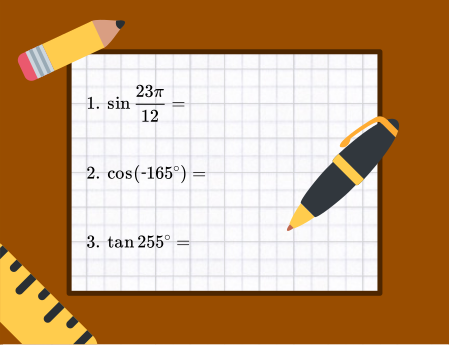
Find the values of the given expressions along with Zain.
a sin 23π/12
{"type":"text","form":{"type":"math","options":{"comparison":"1","nofractofloat":false,"keypad":{"simple":false,"useShortLog":false,"variables":[],"constants":[]},"rendered":false},"text":" "},"formTextBefore":null,"formTextAfter":null,"answer":{"text":["\\dfrac{\\sqrt{2}-\\sqrt{6}}{4}","-\\dfrac{\\sqrt{6}-\\sqrt{2}}{4}"]}}
b cos(- 165^(∘))
{"type":"text","form":{"type":"math","options":{"comparison":"1","nofractofloat":false,"keypad":{"simple":false,"useShortLog":false,"variables":[],"constants":[]},"rendered":false},"text":" "},"formTextBefore":null,"formTextAfter":null,"answer":{"text":["\\dfrac{-\\sqrt{2}-\\sqrt{6}}{4}","-\\dfrac{\\sqrt{2}+\\sqrt{6}}{4}","-\\dfrac{\\sqrt{6}+\\sqrt{2}}{4}","\\dfrac{-\\sqrt{6}-\\sqrt{2}}{4}"]}}
c tan 255^(∘)
{"type":"text","form":{"type":"math","options":{"comparison":"1","nofractofloat":false,"keypad":{"simple":false,"useShortLog":false,"variables":[],"constants":[]},"rendered":false},"text":" "},"formTextBefore":null,"formTextAfter":null,"answer":{"text":["\\dfrac{6+\\sqrt{3}}{3}","\\dfrac{\\sqrt{3}+6}{3}","\\dfrac{\\sqrt{3}+3}{3-\\sqrt{3}}","\\dfrac{3+\\sqrt{3}}{3-\\sqrt{3}}"]}}
Hint
a The angle 23π12 can be expressed as the sum of 20π12 and 3π12.
b Start by using the Negative Angle Identity for cosine.
c Apply the Angle Sum or Difference Identity for tangent.
Solution
a To calculate the value of sin 23π12, start by expressing the angle of 23π12 as the sum or difference of two notable angles.
sin(x+y)=sin xcos y+cos xsin y
SubstituteII
x= 20π/12, y= 3π/12
sin( 20π/12+ 3π/12)=sin 20π/12cos 3π/12+cos 20π/12sin 3π/12
AddFrac
Add fractions
sin(23π/12)=sin 20π/12cos 3π/12+cos 20π/12sin 3π/12
ReduceFrac
a/b=.a /4./.b /4.
sin(23π/12)=sin 5π/3cos 3π/12+cos 5π/3sin 3π/12
ReduceFrac
a/b=.a /3./.b /3.
sin(23π/12)=sin 5π/3cos π/4+cos 5π/3sin π/4
▼
Substitute values
\ifnumequal{300}{0}{\sin\left(0\right)=0}{}\ifnumequal{300}{30}{\sin\left(\dfrac{\pi}{6}\right)=\dfrac{1}{2}}{}\ifnumequal{300}{45}{\sin\left(\dfrac{\pi}{4}\right)=\dfrac{\sqrt{2}}{2}}{}\ifnumequal{300}{60}{\sin\left(\dfrac{\pi}{3}\right)=\dfrac{\sqrt{3}}{2}}{}\ifnumequal{300}{90}{\sin\left(\dfrac{\pi}{2}\right)=1}{}\ifnumequal{300}{120}{\sin\left(\dfrac{2\pi}{3}\right)=\dfrac{\sqrt{3}}{2}}{}\ifnumequal{300}{135}{\sin\left(\dfrac{3\pi}{4}\right)=\dfrac{\sqrt{2}}{2}}{}\ifnumequal{300}{150}{\sin\left(\dfrac{5\pi}{6}\right)=\dfrac{1}{2}}{}\ifnumequal{300}{180}{\sin\left(\pi\right)=0}{}\ifnumequal{300}{210}{\sin\left(\dfrac{7\pi}6\right)=\text{-} \dfrac 1 2}{}\ifnumequal{300}{225}{\sin\left(\dfrac{5\pi}{4}\right)=\text{-} \dfrac {\sqrt{2}} {2}}{}\ifnumequal{300}{240}{\sin\left(\dfrac{4\pi}3\right)=\text{-} \dfrac {\sqrt 3}2}{}\ifnumequal{300}{270}{\sin\left(\dfrac{3\pi}{2}\right)=\text{-} 1}{}\ifnumequal{300}{300}{\sin\left(\dfrac{5\pi}3\right)=\text{-} \dfrac {\sqrt 3}2}{}\ifnumequal{300}{315}{\sin\left(\dfrac{7\pi}4\right)=\text{-} \dfrac {\sqrt{2}} {2}}{}\ifnumequal{300}{330}{\sin\left(\dfrac{11\pi}6\right)=\text{-} \dfrac 1 2}{}\ifnumequal{300}{360}{\sin\left(2\pi\right)=0}{}
sin(23π/12)=- sqrt(3)/2cos π/4+cos 5π/3sin π/4
\ifnumequal{45}{0}{\cos\left(0\right)=1}{}\ifnumequal{45}{30}{\cos\left(\dfrac{\pi}{6}\right)=\dfrac{\sqrt{3}}{2}}{}\ifnumequal{45}{45}{\cos\left(\dfrac{\pi}{4}\right)=\dfrac{\sqrt{2}}{2}}{}\ifnumequal{45}{60}{\cos\left(\dfrac{\pi}{3}\right)=\dfrac{1}{2}}{}\ifnumequal{45}{90}{\cos\left(\dfrac{\pi}{2}\right)=0}{}\ifnumequal{45}{120}{\cos\left(\dfrac{2\pi}{3}\right)=\text{-} \dfrac{1}{2}}{}\ifnumequal{45}{135}{\cos\left(\dfrac{3\pi}{4}\right)=\text{-} \dfrac{\sqrt{2}}{2}}{}\ifnumequal{45}{150}{\cos\left(\dfrac{5\pi}{6}\right)=\text{-} \dfrac{\sqrt{3}}{2}}{}\ifnumequal{45}{180}{\cos\left(\pi\right)=\text{-} 1}{}\ifnumequal{45}{210}{\cos\left(\dfrac{7\pi}6\right)=\text{-} \dfrac{\sqrt 3}2}{}\ifnumequal{45}{225}{\cos\left(\dfrac{5\pi}{4}\right)=\text{-} \dfrac {\sqrt{2}} {2}}{}\ifnumequal{45}{240}{\cos\left(\dfrac{4\pi}3\right)=\text{-} \dfrac {1}2}{}\ifnumequal{45}{270}{\cos\left(\dfrac{3\pi}{2}\right)=0}{}\ifnumequal{45}{300}{\cos\left(\dfrac{5\pi}3\right)=\dfrac{1}2}{}\ifnumequal{45}{315}{\cos\left(\dfrac{7\pi}4\right)=\dfrac {\sqrt{2}} {2}}{}\ifnumequal{45}{330}{\cos\left(\dfrac{11\pi}6\right)=\dfrac{\sqrt 3}2}{}\ifnumequal{45}{360}{\cos\left(2\pi\right)=1}{}
sin(23π/12)=- sqrt(3)/2* sqrt(2)/2+cos 5π/3sin π/4
\ifnumequal{300}{0}{\cos\left(0\right)=1}{}\ifnumequal{300}{30}{\cos\left(\dfrac{\pi}{6}\right)=\dfrac{\sqrt{3}}{2}}{}\ifnumequal{300}{45}{\cos\left(\dfrac{\pi}{4}\right)=\dfrac{\sqrt{2}}{2}}{}\ifnumequal{300}{60}{\cos\left(\dfrac{\pi}{3}\right)=\dfrac{1}{2}}{}\ifnumequal{300}{90}{\cos\left(\dfrac{\pi}{2}\right)=0}{}\ifnumequal{300}{120}{\cos\left(\dfrac{2\pi}{3}\right)=\text{-} \dfrac{1}{2}}{}\ifnumequal{300}{135}{\cos\left(\dfrac{3\pi}{4}\right)=\text{-} \dfrac{\sqrt{2}}{2}}{}\ifnumequal{300}{150}{\cos\left(\dfrac{5\pi}{6}\right)=\text{-} \dfrac{\sqrt{3}}{2}}{}\ifnumequal{300}{180}{\cos\left(\pi\right)=\text{-} 1}{}\ifnumequal{300}{210}{\cos\left(\dfrac{7\pi}6\right)=\text{-} \dfrac{\sqrt 3}2}{}\ifnumequal{300}{225}{\cos\left(\dfrac{5\pi}{4}\right)=\text{-} \dfrac {\sqrt{2}} {2}}{}\ifnumequal{300}{240}{\cos\left(\dfrac{4\pi}3\right)=\text{-} \dfrac {1}2}{}\ifnumequal{300}{270}{\cos\left(\dfrac{3\pi}{2}\right)=0}{}\ifnumequal{300}{300}{\cos\left(\dfrac{5\pi}3\right)=\dfrac{1}2}{}\ifnumequal{300}{315}{\cos\left(\dfrac{7\pi}4\right)=\dfrac {\sqrt{2}} {2}}{}\ifnumequal{300}{330}{\cos\left(\dfrac{11\pi}6\right)=\dfrac{\sqrt 3}2}{}\ifnumequal{300}{360}{\cos\left(2\pi\right)=1}{}
sin(23π/12)=- sqrt(3)/2* sqrt(2)/2+1/2sin π/4
\ifnumequal{45}{0}{\sin\left(0\right)=0}{}\ifnumequal{45}{30}{\sin\left(\dfrac{\pi}{6}\right)=\dfrac{1}{2}}{}\ifnumequal{45}{45}{\sin\left(\dfrac{\pi}{4}\right)=\dfrac{\sqrt{2}}{2}}{}\ifnumequal{45}{60}{\sin\left(\dfrac{\pi}{3}\right)=\dfrac{\sqrt{3}}{2}}{}\ifnumequal{45}{90}{\sin\left(\dfrac{\pi}{2}\right)=1}{}\ifnumequal{45}{120}{\sin\left(\dfrac{2\pi}{3}\right)=\dfrac{\sqrt{3}}{2}}{}\ifnumequal{45}{135}{\sin\left(\dfrac{3\pi}{4}\right)=\dfrac{\sqrt{2}}{2}}{}\ifnumequal{45}{150}{\sin\left(\dfrac{5\pi}{6}\right)=\dfrac{1}{2}}{}\ifnumequal{45}{180}{\sin\left(\pi\right)=0}{}\ifnumequal{45}{210}{\sin\left(\dfrac{7\pi}6\right)=\text{-} \dfrac 1 2}{}\ifnumequal{45}{225}{\sin\left(\dfrac{5\pi}{4}\right)=\text{-} \dfrac {\sqrt{2}} {2}}{}\ifnumequal{45}{240}{\sin\left(\dfrac{4\pi}3\right)=\text{-} \dfrac {\sqrt 3}2}{}\ifnumequal{45}{270}{\sin\left(\dfrac{3\pi}{2}\right)=\text{-} 1}{}\ifnumequal{45}{300}{\sin\left(\dfrac{5\pi}3\right)=\text{-} \dfrac {\sqrt 3}2}{}\ifnumequal{45}{315}{\sin\left(\dfrac{7\pi}4\right)=\text{-} \dfrac {\sqrt{2}} {2}}{}\ifnumequal{45}{330}{\sin\left(\dfrac{11\pi}6\right)=\text{-} \dfrac 1 2}{}\ifnumequal{45}{360}{\sin\left(2\pi\right)=0}{}
sin(23π/12)=- sqrt(3)/2* sqrt(2)/2+1/2* sqrt(2)/2
MultFrac
Multiply fractions
sin(23π/12)=- sqrt(6)/4+sqrt(2)/4
CommutativePropAdd
Commutative Property of Addition
sin(23π/12)=sqrt(2)/4-sqrt(6)/4
SubFrac
Subtract fractions
sin(23π/12)=sqrt(2)-sqrt(6)/4
b First, use the Negative Angle Identity for cosine.
cos(x+y)=cos xcos y-sin xsin y
SubstituteII
x= 120^(∘), y= 45^(∘)
cos( 120^(∘)+ 45^(∘))=cos 120^(∘)cos 45^(∘)-sin 120^(∘)sin 45^(∘)
AddTerms
Add terms
cos 165^(∘) =cos 120^(∘)cos 45^(∘)-sin 120^(∘)sin 45^(∘)
▼
Substitute values
\ifnumequal{120}{0}{\cos\left(0^\circ\right)=1}{}\ifnumequal{120}{30}{\cos\left(30^\circ\right)=\dfrac{\sqrt{3}}{2}}{}\ifnumequal{120}{45}{\cos\left(45^\circ\right)=\dfrac{\sqrt{2}}{2}}{}\ifnumequal{120}{60}{\cos\left(60^\circ\right)=\dfrac{1}{2}}{}\ifnumequal{120}{90}{\cos\left(90^\circ\right)=0}{}\ifnumequal{120}{120}{\cos\left(120^\circ\right)=\text{-} \dfrac{1}{2}}{}\ifnumequal{120}{135}{\cos\left(135^\circ\right)=\text{-} \dfrac{\sqrt{2}}{2}}{}\ifnumequal{120}{150}{\cos\left(150^\circ\right)=\text{-} \dfrac{\sqrt{3}}{2}}{}\ifnumequal{120}{180}{\cos\left(180^\circ\right)=\text{-} 1}{}\ifnumequal{120}{210}{\cos\left(210^\circ\right)=\text{-} \dfrac{\sqrt 3}2}{}\ifnumequal{120}{225}{\cos\left(225^\circ\right)=\text{-} \dfrac {\sqrt{2}} {2}}{}\ifnumequal{120}{240}{\cos\left(240^\circ\right)=\text{-} \dfrac {1}2}{}\ifnumequal{120}{270}{\cos\left(270^\circ\right)=0}{}\ifnumequal{120}{300}{\cos\left(300^\circ\right)=\dfrac{1}2}{}\ifnumequal{120}{315}{\cos\left(315^\circ\right)=\dfrac {\sqrt{2}} {2}}{}\ifnumequal{120}{330}{\cos\left(330^\circ\right)=\dfrac{\sqrt 3}2}{}\ifnumequal{120}{360}{\cos\left(360^\circ\right)=1}{}
cos 165^(∘) =- 1/2cos 45^(∘)-sin 120^(∘)sin 45^(∘)
\ifnumequal{45}{0}{\cos\left(0^\circ\right)=1}{}\ifnumequal{45}{30}{\cos\left(30^\circ\right)=\dfrac{\sqrt{3}}{2}}{}\ifnumequal{45}{45}{\cos\left(45^\circ\right)=\dfrac{\sqrt{2}}{2}}{}\ifnumequal{45}{60}{\cos\left(60^\circ\right)=\dfrac{1}{2}}{}\ifnumequal{45}{90}{\cos\left(90^\circ\right)=0}{}\ifnumequal{45}{120}{\cos\left(120^\circ\right)=\text{-} \dfrac{1}{2}}{}\ifnumequal{45}{135}{\cos\left(135^\circ\right)=\text{-} \dfrac{\sqrt{2}}{2}}{}\ifnumequal{45}{150}{\cos\left(150^\circ\right)=\text{-} \dfrac{\sqrt{3}}{2}}{}\ifnumequal{45}{180}{\cos\left(180^\circ\right)=\text{-} 1}{}\ifnumequal{45}{210}{\cos\left(210^\circ\right)=\text{-} \dfrac{\sqrt 3}2}{}\ifnumequal{45}{225}{\cos\left(225^\circ\right)=\text{-} \dfrac {\sqrt{2}} {2}}{}\ifnumequal{45}{240}{\cos\left(240^\circ\right)=\text{-} \dfrac {1}2}{}\ifnumequal{45}{270}{\cos\left(270^\circ\right)=0}{}\ifnumequal{45}{300}{\cos\left(300^\circ\right)=\dfrac{1}2}{}\ifnumequal{45}{315}{\cos\left(315^\circ\right)=\dfrac {\sqrt{2}} {2}}{}\ifnumequal{45}{330}{\cos\left(330^\circ\right)=\dfrac{\sqrt 3}2}{}\ifnumequal{45}{360}{\cos\left(360^\circ\right)=1}{}
cos 165^(∘) =- 1/2* sqrt(2)/2-sin 120^(∘)sin 45^(∘)
\ifnumequal{120}{0}{\sin\left(0^\circ\right)=0}{}\ifnumequal{120}{30}{\sin\left(30^\circ\right)=\dfrac{1}{2}}{}\ifnumequal{120}{45}{\sin\left(45^\circ\right)=\dfrac{\sqrt{2}}{2}}{}\ifnumequal{120}{60}{\sin\left(60^\circ\right)=\dfrac{\sqrt{3}}{2}}{}\ifnumequal{120}{90}{\sin\left(90^\circ\right)=1}{}\ifnumequal{120}{120}{\sin\left(120^\circ\right)=\dfrac{\sqrt{3}}{2}}{}\ifnumequal{120}{135}{\sin\left(135^\circ\right)=\dfrac{\sqrt{2}}{2}}{}\ifnumequal{120}{150}{\sin\left(150^\circ\right)=\dfrac{1}{2}}{}\ifnumequal{120}{180}{\sin\left(180^\circ\right)=0}{}\ifnumequal{120}{210}{\sin\left(210^\circ\right)=\text{-} \dfrac 1 2}{}\ifnumequal{120}{225}{\sin\left(225^\circ\right)=\text{-} \dfrac {\sqrt{2}} {2}}{}\ifnumequal{120}{240}{\sin\left(240^\circ\right)=\text{-} \dfrac {\sqrt 3}2}{}\ifnumequal{120}{270}{\sin\left(270^\circ\right)=\text{-}1}{}\ifnumequal{120}{300}{\sin\left(300^\circ\right)=\text{-}\dfrac {\sqrt 3}2}{}\ifnumequal{120}{315}{\sin\left(315^\circ\right)=\text{-} \dfrac {\sqrt{2}} {2}}{}\ifnumequal{120}{330}{\sin\left(330^\circ\right)=\text{-} \dfrac 1 2}{}\ifnumequal{120}{360}{\sin\left(360^\circ\right)=0}{}
cos 165^(∘) =- 1/2* sqrt(2)/2-sqrt(3)/2sin 45^(∘)
\ifnumequal{45}{0}{\sin\left(0^\circ\right)=0}{}\ifnumequal{45}{30}{\sin\left(30^\circ\right)=\dfrac{1}{2}}{}\ifnumequal{45}{45}{\sin\left(45^\circ\right)=\dfrac{\sqrt{2}}{2}}{}\ifnumequal{45}{60}{\sin\left(60^\circ\right)=\dfrac{\sqrt{3}}{2}}{}\ifnumequal{45}{90}{\sin\left(90^\circ\right)=1}{}\ifnumequal{45}{120}{\sin\left(120^\circ\right)=\dfrac{\sqrt{3}}{2}}{}\ifnumequal{45}{135}{\sin\left(135^\circ\right)=\dfrac{\sqrt{2}}{2}}{}\ifnumequal{45}{150}{\sin\left(150^\circ\right)=\dfrac{1}{2}}{}\ifnumequal{45}{180}{\sin\left(180^\circ\right)=0}{}\ifnumequal{45}{210}{\sin\left(210^\circ\right)=\text{-} \dfrac 1 2}{}\ifnumequal{45}{225}{\sin\left(225^\circ\right)=\text{-} \dfrac {\sqrt{2}} {2}}{}\ifnumequal{45}{240}{\sin\left(240^\circ\right)=\text{-} \dfrac {\sqrt 3}2}{}\ifnumequal{45}{270}{\sin\left(270^\circ\right)=\text{-}1}{}\ifnumequal{45}{300}{\sin\left(300^\circ\right)=\text{-}\dfrac {\sqrt 3}2}{}\ifnumequal{45}{315}{\sin\left(315^\circ\right)=\text{-} \dfrac {\sqrt{2}} {2}}{}\ifnumequal{45}{330}{\sin\left(330^\circ\right)=\text{-} \dfrac 1 2}{}\ifnumequal{45}{360}{\sin\left(360^\circ\right)=0}{}
cos 165^(∘) =- 1/2* sqrt(2)/2-sqrt(3)/2* sqrt(2)/2
MultFrac
Multiply fractions
cos 165^(∘) =- sqrt(2)/4-sqrt(6)/4
SubFrac
Subtract fractions
cos 165^(∘) =- sqrt(2)-sqrt(6)/4
FactorOut
Factor out - 1
cos 165^(∘) =- (sqrt(2)+sqrt(6))/4
MoveNegNumToFrac
Put minus sign in front of fraction
cos 165^(∘) =- sqrt(2)+sqrt(6)/4
c Start by expressing 255^(∘) as the sum or difference of two notable angles.
tan (x+y)=tan x+tan y/1-tan xtan y
SubstituteII
x= 225^(∘), y= 30^(∘)
tan ( 225^(∘)+ 30^(∘))=tan 225^(∘)+tan 30^(∘)/1-tan 225^(∘)tan 30^(∘)
AddTerms
Add terms
tan 255^(∘)=tan 225^(∘)+tan 30^(∘)/1-tan 225^(∘)tan 30^(∘)
▼
Substitute values
tan(225^(∘))=1
tan 255^(∘)=1+tan 30^(∘)/1-1* tan 30^(∘)
300tan(0^(∘))=0 3030tan(30^(∘))=sqrt(3)/3 3045tan(45^(∘))=1 3060tan(60^(∘))=sqrt(3) 3090tan(90^(∘)) undefined 30120tan(120^(∘))=- sqrt(3) 30135tan(135^(∘))=- 1 30150tan(150^(∘))=- sqrt(3)/3 30180tan(180^(∘))=0 30270tan(270^(∘)) odef. 30360tan(360^(∘))=0
tan 255^(∘)=1+sqrt(3)/3/1-1* sqrt(3)/3
IdPropMult
Identity Property of Multiplication
tan 255^(∘)=1+sqrt(3)/3/1-sqrt(3)/3
OneToFrac
Rewrite 1 as 3/3
tan 255^(∘)=3/3+sqrt(3)/3/3/3-sqrt(3)/3
AddSubFrac
Add and subtract fractions
tan 255^(∘)=3+sqrt(3)/3/3-sqrt(3)/3
DivFracByFracSL
.a/b /c/d.=a/b*d/c
tan 255^(∘)=3+sqrt(3)/3* 3/3-sqrt(3)
MultFrac
Multiply fractions
tan 255^(∘)=(3+sqrt(3))3/3(3-sqrt(3))
SimpQuot
Simplify quotient
tan 255^(∘)=3+sqrt(3)/3-sqrt(3)
tan 255^(∘)=3+sqrt(3)/3-sqrt(3)
ExpandFrac
a/b=a * (3+sqrt(3))/b * (3+sqrt(3))
tan 255^(∘)=(3+sqrt(3))(3+sqrt(3))/(3-sqrt(3))(3+sqrt(3))
▼
Simplify right-hand side
(a-b)(a+b)=a^2-b^2
tan 255^(∘)=(3+sqrt(3))(3+sqrt(3))/3^2-(sqrt(3))^2
MultPow
a^m*a^n=a^(m+n)
tan 255^(∘)=(3+sqrt(3))^2/3^2-(sqrt(3))^2
ExpandPosPerfectSquare
(a+b)^2=a^2+2ab+b^2
tan 255^(∘)=3^2+2sqrt(3)+(sqrt(3))^2/3^2-(sqrt(3))^2
CalcPow
Calculate power
tan 255^(∘)=9+2sqrt(3)+3/9-3
AddSubTerms
Add and subtract terms
tan 255^(∘)=12+2sqrt(3)/6
ReduceFrac
a/b=.a /2./.b /2.
tan 255^(∘)=6+sqrt(3)/3
Pop Quiz
Share
Report error
Practicing Using the Angle Sum and Difference Identities
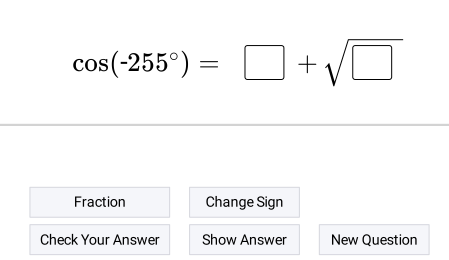
Find the trigonometric value of the given angle by using the Angle Sum and Difference Identities. When inputting the answer, write the radical with the greater radicand first.
Example
Share
Report error
Comparing Different Answers of an Exercise
The following day at school, Davontay and Zain had a tough test in Physics. After completing it, they discussed how to solve one of the exercises that had them stumped.
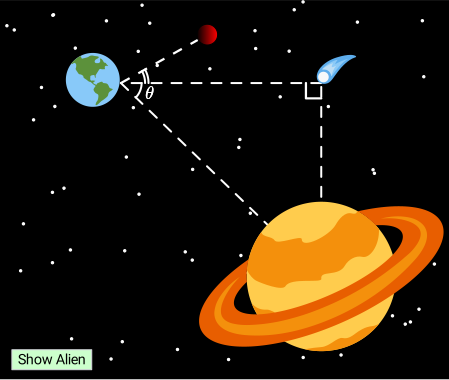 Davontay said he wrote cos(60^(∘)+θ) as the answer, however Zain got sin(30^(∘)-θ) as the answer. Are their results equivalent, or did someone made a mistake?
External credits: @brgfx
{"type":"choice","form":{"alts":["Someone made a mistake.","Their answers are equivalent."],"noSort":false},"formTextBefore":"","formTextAfter":"","answer":1}
Hint
Can cos(60^(∘)+θ) be rewritten into sin(30^(∘)-θ)? Use Cofunction Identities.
Solution
To determine whether the results that Davontay and Zain obtained are equivalent, the following equation should be verified.
cos(60^(∘)+θ)? =sin(30^(∘)-θ)
Use the Angle Sum and Difference Identities for sine and cosine to rewrite both sides of the equation until they match. By one of these identities, the right-hand side can be rewritten as follows.
sin(30^(∘) - θ)=sin 30^(∘)cosθ-cos 30^(∘)sin θ
Now, try to rewrite the left-hand side to make it match the right-hand side. Note that Cofunction Identities can be useful here.
This expression is equal to sin(30^(∘)-θ). This means that the expression on the left-hand side of the equation can be rewritten into the expression on the right-hand side. Therefore, Davontay's and Zain's results are equivalent.
cos(60^(∘)+θ)=sin(30^(∘)-θ) ✓
cos(60^(∘)+θ)
cos(α+β)=cos(α)cos(β)-sin(α)sin(β)
cos 60^(∘)cosθ-sin 60^(∘)sinθ
Rewrite
Rewrite 60^(∘) as 90^(∘)-30^(∘)
cos (90^(∘)-30^(∘))cosθ-sin (90^(∘)-30^(∘))sinθ
cos(90^(∘)-θ)=sin(θ)
sin 30^(∘)cosθ-sin (90^(∘)-30^(∘))sinθ
sin(90^(∘)-θ)=cos(θ)
sin 30^(∘)cosθ-cos30^(∘)sinθ
Example
Share
Report error
Checking Whether Two Expressions Are Equivalent
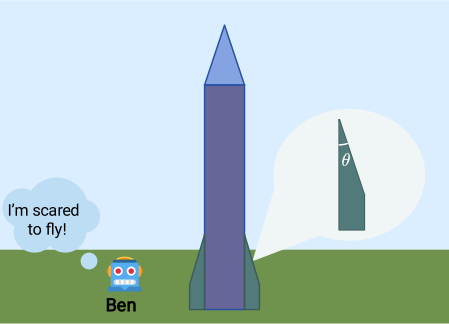
Later, while walking to the cafeteria, Zain and Davontay started jokingly imagining how cool it would be to meet an alien in space. Although they could not go to space themselves — they made weekend plans to build a board game — they came up with an idea to build a small rocket and send their representative Ben!
{"type":"choice","form":{"alts":["Yes","No"],"noSort":false},"formTextBefore":"","formTextAfter":"","answer":0}
Hint
Use the Angle Difference Identity for sine to rewrite Davontay's expression as Zain's expression.
Solution
To determine whether Zain's result is equivalent to Davontay's, the following equation should be verified.
sin (3π/2-θ)? =- cos θ
Use the Angle Difference Identity for sine to rewrite the left-hand side.
As determined, Zain's expression can be rewritten as Davontay's expression. Therefore, Davontay's and Zain's results are equivalent.
sin (3π/2-θ)=- cos θ ✓
sin(3π/2-θ)
sin(α-β)=sin(α)cos(β)-cos(α)sin(β)
sin 3π/2cos θ-cos 3π/2sinθ
\ifnumequal{270}{0}{\sin\left(0\right)=0}{}\ifnumequal{270}{30}{\sin\left(\dfrac{\pi}{6}\right)=\dfrac{1}{2}}{}\ifnumequal{270}{45}{\sin\left(\dfrac{\pi}{4}\right)=\dfrac{\sqrt{2}}{2}}{}\ifnumequal{270}{60}{\sin\left(\dfrac{\pi}{3}\right)=\dfrac{\sqrt{3}}{2}}{}\ifnumequal{270}{90}{\sin\left(\dfrac{\pi}{2}\right)=1}{}\ifnumequal{270}{120}{\sin\left(\dfrac{2\pi}{3}\right)=\dfrac{\sqrt{3}}{2}}{}\ifnumequal{270}{135}{\sin\left(\dfrac{3\pi}{4}\right)=\dfrac{\sqrt{2}}{2}}{}\ifnumequal{270}{150}{\sin\left(\dfrac{5\pi}{6}\right)=\dfrac{1}{2}}{}\ifnumequal{270}{180}{\sin\left(\pi\right)=0}{}\ifnumequal{270}{210}{\sin\left(\dfrac{7\pi}6\right)=\text{-} \dfrac 1 2}{}\ifnumequal{270}{225}{\sin\left(\dfrac{5\pi}{4}\right)=\text{-} \dfrac {\sqrt{2}} {2}}{}\ifnumequal{270}{240}{\sin\left(\dfrac{4\pi}3\right)=\text{-} \dfrac {\sqrt 3}2}{}\ifnumequal{270}{270}{\sin\left(\dfrac{3\pi}{2}\right)=\text{-} 1}{}\ifnumequal{270}{300}{\sin\left(\dfrac{5\pi}3\right)=\text{-} \dfrac {\sqrt 3}2}{}\ifnumequal{270}{315}{\sin\left(\dfrac{7\pi}4\right)=\text{-} \dfrac {\sqrt{2}} {2}}{}\ifnumequal{270}{330}{\sin\left(\dfrac{11\pi}6\right)=\text{-} \dfrac 1 2}{}\ifnumequal{270}{360}{\sin\left(2\pi\right)=0}{}
- 1* cos θ-cos 3π/2sinθ
\ifnumequal{270}{0}{\cos\left(0\right)=1}{}\ifnumequal{270}{30}{\cos\left(\dfrac{\pi}{6}\right)=\dfrac{\sqrt{3}}{2}}{}\ifnumequal{270}{45}{\cos\left(\dfrac{\pi}{4}\right)=\dfrac{\sqrt{2}}{2}}{}\ifnumequal{270}{60}{\cos\left(\dfrac{\pi}{3}\right)=\dfrac{1}{2}}{}\ifnumequal{270}{90}{\cos\left(\dfrac{\pi}{2}\right)=0}{}\ifnumequal{270}{120}{\cos\left(\dfrac{2\pi}{3}\right)=\text{-} \dfrac{1}{2}}{}\ifnumequal{270}{135}{\cos\left(\dfrac{3\pi}{4}\right)=\text{-} \dfrac{\sqrt{2}}{2}}{}\ifnumequal{270}{150}{\cos\left(\dfrac{5\pi}{6}\right)=\text{-} \dfrac{\sqrt{3}}{2}}{}\ifnumequal{270}{180}{\cos\left(\pi\right)=\text{-} 1}{}\ifnumequal{270}{210}{\cos\left(\dfrac{7\pi}6\right)=\text{-} \dfrac{\sqrt 3}2}{}\ifnumequal{270}{225}{\cos\left(\dfrac{5\pi}{4}\right)=\text{-} \dfrac {\sqrt{2}} {2}}{}\ifnumequal{270}{240}{\cos\left(\dfrac{4\pi}3\right)=\text{-} \dfrac {1}2}{}\ifnumequal{270}{270}{\cos\left(\dfrac{3\pi}{2}\right)=0}{}\ifnumequal{270}{300}{\cos\left(\dfrac{5\pi}3\right)=\dfrac{1}2}{}\ifnumequal{270}{315}{\cos\left(\dfrac{7\pi}4\right)=\dfrac {\sqrt{2}} {2}}{}\ifnumequal{270}{330}{\cos\left(\dfrac{11\pi}6\right)=\dfrac{\sqrt 3}2}{}\ifnumequal{270}{360}{\cos\left(2\pi\right)=1}{}
- 1* cos θ-0* sinθ
MultPropNegOne
Multiplication Property of -1
- cos θ-0* sinθ
ZeroPropMult
Zero Property of Multiplication
- cos θ
Example
Share
Report error
Equation of a Standing Wave on a Guitar String
Zain's friend Davontay recently took up guitar lessons. One day, Zain went over to his house to hang out and saw Davontay practicing. Zain told Davontay that they just learned how every time a taut string is pulled and released, a wave is created. Davontay wants to know more!

standing waverepresented by the following formula. y = Acos ( 2π t/3 - 2π x/5 ) + Acos ( 2π t/3 + 2π x/5 ) Here, y is the displacement of each point on the string, which depends on the time t and the point's position x. How can this formula be simplified for t=1?
{"type":"text","form":{"type":"math","options":{"comparison":"1","nofractofloat":false,"keypad":{"simple":false,"useShortLog":false,"variables":["x"],"constants":["PI","A"]},"rendered":false},"text":" "},"formTextBefore":"y=","formTextAfter":null,"answer":{"text":["-A\\cos((2\\pi x)\/5)"]}}
Hint
Substitute 1 for t and apply the Angle Sum and Difference Identities for cosine.
Solution
The given formula consists of two cosine expressions whose arguments are the sum or difference of the same two angles, namely, 2π t3 and 2π x5. Therefore, use the Angle Sum and Difference Identities for cosine to simplify the formula. Before doing that, however, first substitute 1 for t.
y=Acos(2π t/3-2π x/5)+Acos(2π t/3+2π x/5)
Substitute
t= 1
y=Acos(2π * 1/3-2π x/5)+Acos(2π * 1/3+2π x/5)
MultByOne
a * 1=a
y=Acos(2π/3-2π x/5)+Acos(2π/3+2π x/5)
FactorOut
Factor out A
y=A[cos(2π/3-2π x/5)+cos(2π/3+2π x/5)]
cos(α-β)=cos(α)cos(β)+sin(α)sin(β)
y=A[cos(2π/3)cos(2π x/5)+sin(2π/3)sin(2π x/5)+cos(2π/3+2π x/5)]
cos(α+β)=cos(α)cos(β)-sin(α)sin(β)
y=A[cos(2π/3)cos(2π x/5)+sin(2π/3)sin(2π x/5)+cos(2π/3)cos(2π x/5)-sin(2π/3)sin(2π x/5)]
AddSubTerms
Add and subtract terms
y=2Acos(2π/3)cos(2π x/5)
\ifnumequal{120}{0}{\cos\left(0\right)=1}{}\ifnumequal{120}{30}{\cos\left(\dfrac{\pi}{6}\right)=\dfrac{\sqrt{3}}{2}}{}\ifnumequal{120}{45}{\cos\left(\dfrac{\pi}{4}\right)=\dfrac{\sqrt{2}}{2}}{}\ifnumequal{120}{60}{\cos\left(\dfrac{\pi}{3}\right)=\dfrac{1}{2}}{}\ifnumequal{120}{90}{\cos\left(\dfrac{\pi}{2}\right)=0}{}\ifnumequal{120}{120}{\cos\left(\dfrac{2\pi}{3}\right)=\text{-} \dfrac{1}{2}}{}\ifnumequal{120}{135}{\cos\left(\dfrac{3\pi}{4}\right)=\text{-} \dfrac{\sqrt{2}}{2}}{}\ifnumequal{120}{150}{\cos\left(\dfrac{5\pi}{6}\right)=\text{-} \dfrac{\sqrt{3}}{2}}{}\ifnumequal{120}{180}{\cos\left(\pi\right)=\text{-} 1}{}\ifnumequal{120}{210}{\cos\left(\dfrac{7\pi}6\right)=\text{-} \dfrac{\sqrt 3}2}{}\ifnumequal{120}{225}{\cos\left(\dfrac{5\pi}{4}\right)=\text{-} \dfrac {\sqrt{2}} {2}}{}\ifnumequal{120}{240}{\cos\left(\dfrac{4\pi}3\right)=\text{-} \dfrac {1}2}{}\ifnumequal{120}{270}{\cos\left(\dfrac{3\pi}{2}\right)=0}{}\ifnumequal{120}{300}{\cos\left(\dfrac{5\pi}3\right)=\dfrac{1}2}{}\ifnumequal{120}{315}{\cos\left(\dfrac{7\pi}4\right)=\dfrac {\sqrt{2}} {2}}{}\ifnumequal{120}{330}{\cos\left(\dfrac{11\pi}6\right)=\dfrac{\sqrt 3}2}{}\ifnumequal{120}{360}{\cos\left(2\pi\right)=1}{}
y=2A(- 1/2)cos(2π x/5)
MultPosNeg
a(- b)=- a * b
y=- Acos(2π x/5)
Pop Quiz
Share
Report error
Find the Exact Values of Trigonometric Expressions
Consider the given expression involving trigonometric functions. Instead of calculating the value of each trigonometric function, first simplify the expression by applying the Angle Sum and Difference Identities.
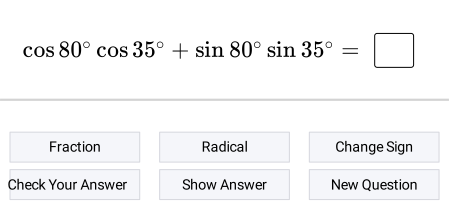
Example
Share
Report error
Playing a Board Game
After building the rocket and successfully launching it into the neighbour's garden, Zain and Davontay went home and created an amazing board game from scratch! Its central circular part is divided into six equal sectors. 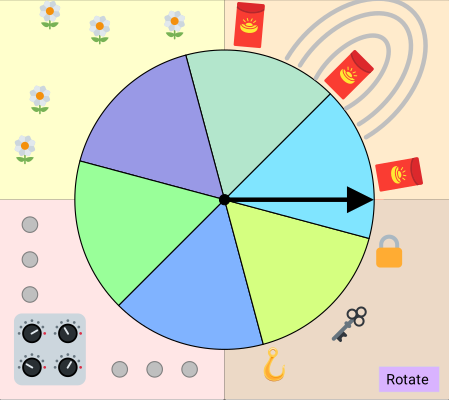 First, Davontay spun the arrow and placed his rabbit chip at the point where the arrow stopped. Zain then did the same, placing their flamingo chip.
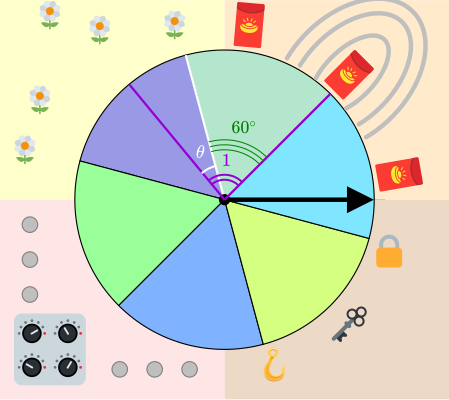 Therefore, the cosine of ∠ 1 is the cosine of the sum of θ and 60^(∘).
cos m∠ 1=cos(θ+60^(∘))
Now, the Angle Sum Identity for cosine can be used to find the value of cos(θ+60^(∘)).
Therefore, the cosine of ∠ 1 is the cosine of the sum of θ and 60^(∘).
cos m∠ 1=cos(θ+60^(∘))
Now, the Angle Sum Identity for cosine can be used to find the value of cos(θ+60^(∘)).
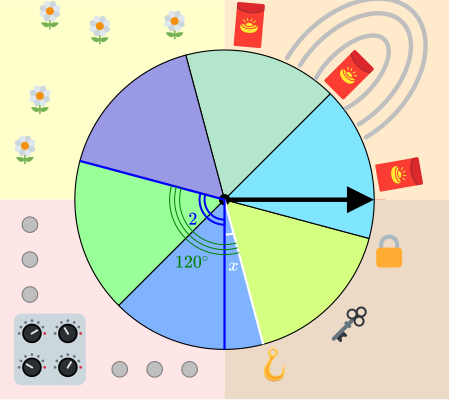 As can be seen, ∠ 2 can be expressed as the difference between two central angles and x. This means that the following is true.
sin m∠ 2 = sin(120^(∘)-x)
Now, use the Angle Difference Identity for sine to calculate the value of sin m∠ 2.
As can be seen, ∠ 2 can be expressed as the difference between two central angles and x. This means that the following is true.
sin m∠ 2 = sin(120^(∘)-x)
Now, use the Angle Difference Identity for sine to calculate the value of sin m∠ 2.
a What is the cosine of ∠ 1?
{"type":"text","form":{"type":"math","options":{"comparison":"1","nofractofloat":false,"keypad":{"simple":false,"useShortLog":false,"variables":[],"constants":["THETA"]},"rendered":false},"text":" "},"formTextBefore":null,"formTextAfter":null,"answer":{"text":["1\/2(\\cos\\theta-\\sqrt{3}\\sin\\theta)","1\/2\\t \\cos\\theta-\\sqrt{3}\/2\\sin\\theta","\\dfrac{\\cos\\theta-\\sqrt{3}\\sin\\theta}{2}"]}}
b What is the sine of ∠ 2?
{"type":"text","form":{"type":"math","options":{"comparison":"1","nofractofloat":false,"keypad":{"simple":false,"useShortLog":false,"variables":[],"constants":["x"]},"rendered":false},"text":" "},"formTextBefore":null,"formTextAfter":null,"answer":{"text":["1\/2(\\sqrt{3}\\cos x+\\sin x)","\\sqrt{3}\/2\\cos x+1\/2\\sin x","\\dfrac{\\sqrt{3}\\cos x+\\sin x}{2}"]}}
Hint
a Express the measure of ∠ 1 as the sum of the central angle's measure and θ. Then use one of the Angle Sum Identities.
b Express the measure of ∠ 2 as the difference of two central angles' measures and x. Then use one of the Angle Difference Identities.
Solution
a It is given that the circle is divided into six equal sectors. The measure of a full circle is 360^(∘), which means that the central angle of each sector is 3606=60^(∘). Note that ∠ 1 can be expressed as the sum of one central angle of 60^(∘) and θ.
cos(θ+60^(∘))
cos(α+β)=cos(α)cos(β)-sin(α)sin(β)
cos θcos 60^(∘) - sin θsin 60^(∘)
\ifnumequal{60}{0}{\cos\left(0^\circ\right)=1}{}\ifnumequal{60}{30}{\cos\left(30^\circ\right)=\dfrac{\sqrt{3}}{2}}{}\ifnumequal{60}{45}{\cos\left(45^\circ\right)=\dfrac{\sqrt{2}}{2}}{}\ifnumequal{60}{60}{\cos\left(60^\circ\right)=\dfrac{1}{2}}{}\ifnumequal{60}{90}{\cos\left(90^\circ\right)=0}{}\ifnumequal{60}{120}{\cos\left(120^\circ\right)=\text{-} \dfrac{1}{2}}{}\ifnumequal{60}{135}{\cos\left(135^\circ\right)=\text{-} \dfrac{\sqrt{2}}{2}}{}\ifnumequal{60}{150}{\cos\left(150^\circ\right)=\text{-} \dfrac{\sqrt{3}}{2}}{}\ifnumequal{60}{180}{\cos\left(180^\circ\right)=\text{-} 1}{}\ifnumequal{60}{210}{\cos\left(210^\circ\right)=\text{-} \dfrac{\sqrt 3}2}{}\ifnumequal{60}{225}{\cos\left(225^\circ\right)=\text{-} \dfrac {\sqrt{2}} {2}}{}\ifnumequal{60}{240}{\cos\left(240^\circ\right)=\text{-} \dfrac {1}2}{}\ifnumequal{60}{270}{\cos\left(270^\circ\right)=0}{}\ifnumequal{60}{300}{\cos\left(300^\circ\right)=\dfrac{1}2}{}\ifnumequal{60}{315}{\cos\left(315^\circ\right)=\dfrac {\sqrt{2}} {2}}{}\ifnumequal{60}{330}{\cos\left(330^\circ\right)=\dfrac{\sqrt 3}2}{}\ifnumequal{60}{360}{\cos\left(360^\circ\right)=1}{}
cos θ* 1/2 - sin θsin 60^(∘)
\ifnumequal{60}{0}{\sin\left(0^\circ\right)=0}{}\ifnumequal{60}{30}{\sin\left(30^\circ\right)=\dfrac{1}{2}}{}\ifnumequal{60}{45}{\sin\left(45^\circ\right)=\dfrac{\sqrt{2}}{2}}{}\ifnumequal{60}{60}{\sin\left(60^\circ\right)=\dfrac{\sqrt{3}}{2}}{}\ifnumequal{60}{90}{\sin\left(90^\circ\right)=1}{}\ifnumequal{60}{120}{\sin\left(120^\circ\right)=\dfrac{\sqrt{3}}{2}}{}\ifnumequal{60}{135}{\sin\left(135^\circ\right)=\dfrac{\sqrt{2}}{2}}{}\ifnumequal{60}{150}{\sin\left(150^\circ\right)=\dfrac{1}{2}}{}\ifnumequal{60}{180}{\sin\left(180^\circ\right)=0}{}\ifnumequal{60}{210}{\sin\left(210^\circ\right)=\text{-} \dfrac 1 2}{}\ifnumequal{60}{225}{\sin\left(225^\circ\right)=\text{-} \dfrac {\sqrt{2}} {2}}{}\ifnumequal{60}{240}{\sin\left(240^\circ\right)=\text{-} \dfrac {\sqrt 3}2}{}\ifnumequal{60}{270}{\sin\left(270^\circ\right)=\text{-}1}{}\ifnumequal{60}{300}{\sin\left(300^\circ\right)=\text{-}\dfrac {\sqrt 3}2}{}\ifnumequal{60}{315}{\sin\left(315^\circ\right)=\text{-} \dfrac {\sqrt{2}} {2}}{}\ifnumequal{60}{330}{\sin\left(330^\circ\right)=\text{-} \dfrac 1 2}{}\ifnumequal{60}{360}{\sin\left(360^\circ\right)=0}{}
cos θ* 1/2 - sin θ* sqrt(3)/2
FactorOut
Factor out 1/2
1/2(cos θ - sin θ* sqrt(3))
CommutativePropMult
Commutative Property of Multiplication
1/2(cos θ - sqrt(3)sin θ)
b Start by analyzing ∠ 2 on the diagram.
sin(120^(∘)-x)
sin(α-β)=sin(α)cos(β)-cos(α)sin(β)
sin 120^(∘) cos x - cos 120^(∘) sin x
\ifnumequal{120}{0}{\sin\left(0^\circ\right)=0}{}\ifnumequal{120}{30}{\sin\left(30^\circ\right)=\dfrac{1}{2}}{}\ifnumequal{120}{45}{\sin\left(45^\circ\right)=\dfrac{\sqrt{2}}{2}}{}\ifnumequal{120}{60}{\sin\left(60^\circ\right)=\dfrac{\sqrt{3}}{2}}{}\ifnumequal{120}{90}{\sin\left(90^\circ\right)=1}{}\ifnumequal{120}{120}{\sin\left(120^\circ\right)=\dfrac{\sqrt{3}}{2}}{}\ifnumequal{120}{135}{\sin\left(135^\circ\right)=\dfrac{\sqrt{2}}{2}}{}\ifnumequal{120}{150}{\sin\left(150^\circ\right)=\dfrac{1}{2}}{}\ifnumequal{120}{180}{\sin\left(180^\circ\right)=0}{}\ifnumequal{120}{210}{\sin\left(210^\circ\right)=\text{-} \dfrac 1 2}{}\ifnumequal{120}{225}{\sin\left(225^\circ\right)=\text{-} \dfrac {\sqrt{2}} {2}}{}\ifnumequal{120}{240}{\sin\left(240^\circ\right)=\text{-} \dfrac {\sqrt 3}2}{}\ifnumequal{120}{270}{\sin\left(270^\circ\right)=\text{-}1}{}\ifnumequal{120}{300}{\sin\left(300^\circ\right)=\text{-}\dfrac {\sqrt 3}2}{}\ifnumequal{120}{315}{\sin\left(315^\circ\right)=\text{-} \dfrac {\sqrt{2}} {2}}{}\ifnumequal{120}{330}{\sin\left(330^\circ\right)=\text{-} \dfrac 1 2}{}\ifnumequal{120}{360}{\sin\left(360^\circ\right)=0}{}
sqrt(3)/2cos x - cos 120^(∘) sin x
\ifnumequal{120}{0}{\cos\left(0^\circ\right)=1}{}\ifnumequal{120}{30}{\cos\left(30^\circ\right)=\dfrac{\sqrt{3}}{2}}{}\ifnumequal{120}{45}{\cos\left(45^\circ\right)=\dfrac{\sqrt{2}}{2}}{}\ifnumequal{120}{60}{\cos\left(60^\circ\right)=\dfrac{1}{2}}{}\ifnumequal{120}{90}{\cos\left(90^\circ\right)=0}{}\ifnumequal{120}{120}{\cos\left(120^\circ\right)=\text{-} \dfrac{1}{2}}{}\ifnumequal{120}{135}{\cos\left(135^\circ\right)=\text{-} \dfrac{\sqrt{2}}{2}}{}\ifnumequal{120}{150}{\cos\left(150^\circ\right)=\text{-} \dfrac{\sqrt{3}}{2}}{}\ifnumequal{120}{180}{\cos\left(180^\circ\right)=\text{-} 1}{}\ifnumequal{120}{210}{\cos\left(210^\circ\right)=\text{-} \dfrac{\sqrt 3}2}{}\ifnumequal{120}{225}{\cos\left(225^\circ\right)=\text{-} \dfrac {\sqrt{2}} {2}}{}\ifnumequal{120}{240}{\cos\left(240^\circ\right)=\text{-} \dfrac {1}2}{}\ifnumequal{120}{270}{\cos\left(270^\circ\right)=0}{}\ifnumequal{120}{300}{\cos\left(300^\circ\right)=\dfrac{1}2}{}\ifnumequal{120}{315}{\cos\left(315^\circ\right)=\dfrac {\sqrt{2}} {2}}{}\ifnumequal{120}{330}{\cos\left(330^\circ\right)=\dfrac{\sqrt 3}2}{}\ifnumequal{120}{360}{\cos\left(360^\circ\right)=1}{}
sqrt(3)/2cos x - (- 1/2)sin x
SubNeg
a-(- b)=a+b
sqrt(3)/2cos x +1/2 sin x
FactorOut
Factor out 1/2
1/2(sqrt(3)cos x + sin x)
Closure
Share
Report error
Calculating the Length of the River
In the challenge at the beginning, it was said that a landscape designer Tiffaniqua got received a job to create a new design for an old city park. She divided its area into six rectangular sections. The first section contains a fountain (F) and is crossed by a river at two points — south (S) and north (N).
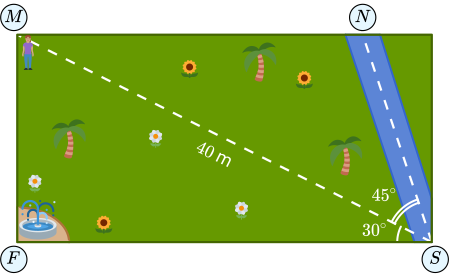
When she first came to analyze the park, she stood at the north-west corner of the first section, which she marked as point M. She then took notes of some measures of angles and distances.
{"type":"text","form":{"type":"math","options":{"comparison":"1","nofractofloat":false,"keypad":{"simple":true,"useShortLog":false,"variables":[],"constants":[]},"rendered":false},"text":" "},"formTextBefore":"\u2248","formTextAfter":"meters","answer":{"text":["20.7"]}}
Hint
Start by calculating MF by using the the ratio of the sine of 30^(∘). Find the measure of the angle the river forms with the right side of the section and then use the Angle Difference Identity.
Solution
To calculate the lengths of the river in the first section, NS should be found. For the purpose of the following calculations, let R be the right upper corner of the rectangular section.
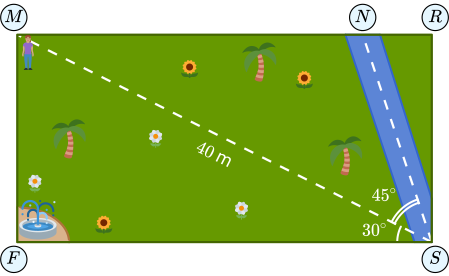
Since the section is a rectangle, ∠ NRS is a right angle, which means that △ NRS is a right triangle. Additionally, the lengths of the opposite sides of a rectangle are equal, so MF=RS. To find the length of these sides, consider △ MSF.
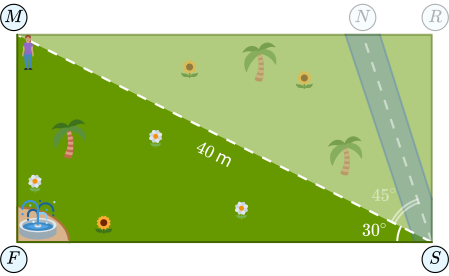
sin 30^(∘)=MF/MS
Substitute
MS= 40
sin 30^(∘)=MF/40
▼
Solve for MF
MultEqn
LHS * 40=RHS* 40
40sin 30^(∘)=MF
RearrangeEqn
Rearrange equation
MF=40sin 30^(∘)
\ifnumequal{30}{0}{\sin\left(0^\circ\right)=0}{}\ifnumequal{30}{30}{\sin\left(30^\circ\right)=\dfrac{1}{2}}{}\ifnumequal{30}{45}{\sin\left(45^\circ\right)=\dfrac{\sqrt{2}}{2}}{}\ifnumequal{30}{60}{\sin\left(60^\circ\right)=\dfrac{\sqrt{3}}{2}}{}\ifnumequal{30}{90}{\sin\left(90^\circ\right)=1}{}\ifnumequal{30}{120}{\sin\left(120^\circ\right)=\dfrac{\sqrt{3}}{2}}{}\ifnumequal{30}{135}{\sin\left(135^\circ\right)=\dfrac{\sqrt{2}}{2}}{}\ifnumequal{30}{150}{\sin\left(150^\circ\right)=\dfrac{1}{2}}{}\ifnumequal{30}{180}{\sin\left(180^\circ\right)=0}{}\ifnumequal{30}{210}{\sin\left(210^\circ\right)=\text{-} \dfrac 1 2}{}\ifnumequal{30}{225}{\sin\left(225^\circ\right)=\text{-} \dfrac {\sqrt{2}} {2}}{}\ifnumequal{30}{240}{\sin\left(240^\circ\right)=\text{-} \dfrac {\sqrt 3}2}{}\ifnumequal{30}{270}{\sin\left(270^\circ\right)=\text{-}1}{}\ifnumequal{30}{300}{\sin\left(300^\circ\right)=\text{-}\dfrac {\sqrt 3}2}{}\ifnumequal{30}{315}{\sin\left(315^\circ\right)=\text{-} \dfrac {\sqrt{2}} {2}}{}\ifnumequal{30}{330}{\sin\left(330^\circ\right)=\text{-} \dfrac 1 2}{}\ifnumequal{30}{360}{\sin\left(360^\circ\right)=0}{}
MF=40(1/2)
Multiply
Multiply
MF=20
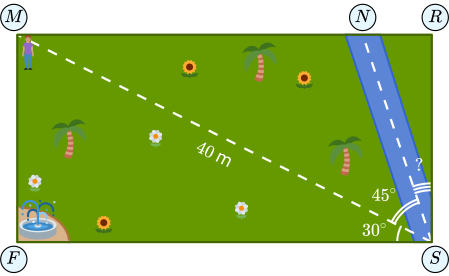
Note that three angles at the vertex S are complementary, which means that the sum of their measures is 90^(∘). 30^(∘)+45^(∘)+m∠ NSR=90^(∘) ⇓ m∠ NSR=15^(∘) Now it is known that one of the acute angles in △ NSR has measure of 15^(∘) and its adjacent side is 20 meters long.
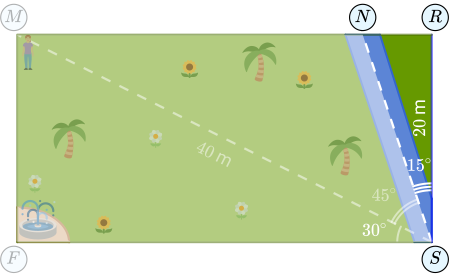
cos(x-y)=cos xcos y + sin xsin y
SubstituteII
x= 45^(∘), y= 30
cos( 45^(∘)- 30^(∘))=cos 45^(∘)cos 30^(∘) + sin 45^(∘)sin 30^(∘)
SubTerm
Subtract term
cos 15^(∘)=cos 45^(∘)cos 30^(∘) + sin 45^(∘)sin 30^(∘)
▼
Substitute values
\ifnumequal{45}{0}{\cos\left(0^\circ\right)=1}{}\ifnumequal{45}{30}{\cos\left(30^\circ\right)=\dfrac{\sqrt{3}}{2}}{}\ifnumequal{45}{45}{\cos\left(45^\circ\right)=\dfrac{\sqrt{2}}{2}}{}\ifnumequal{45}{60}{\cos\left(60^\circ\right)=\dfrac{1}{2}}{}\ifnumequal{45}{90}{\cos\left(90^\circ\right)=0}{}\ifnumequal{45}{120}{\cos\left(120^\circ\right)=\text{-} \dfrac{1}{2}}{}\ifnumequal{45}{135}{\cos\left(135^\circ\right)=\text{-} \dfrac{\sqrt{2}}{2}}{}\ifnumequal{45}{150}{\cos\left(150^\circ\right)=\text{-} \dfrac{\sqrt{3}}{2}}{}\ifnumequal{45}{180}{\cos\left(180^\circ\right)=\text{-} 1}{}\ifnumequal{45}{210}{\cos\left(210^\circ\right)=\text{-} \dfrac{\sqrt 3}2}{}\ifnumequal{45}{225}{\cos\left(225^\circ\right)=\text{-} \dfrac {\sqrt{2}} {2}}{}\ifnumequal{45}{240}{\cos\left(240^\circ\right)=\text{-} \dfrac {1}2}{}\ifnumequal{45}{270}{\cos\left(270^\circ\right)=0}{}\ifnumequal{45}{300}{\cos\left(300^\circ\right)=\dfrac{1}2}{}\ifnumequal{45}{315}{\cos\left(315^\circ\right)=\dfrac {\sqrt{2}} {2}}{}\ifnumequal{45}{330}{\cos\left(330^\circ\right)=\dfrac{\sqrt 3}2}{}\ifnumequal{45}{360}{\cos\left(360^\circ\right)=1}{}
cos 15^(∘)=sqrt(2)/2cos 30^(∘) + sin 45^(∘)sin 30^(∘)
\ifnumequal{30}{0}{\cos\left(0^\circ\right)=1}{}\ifnumequal{30}{30}{\cos\left(30^\circ\right)=\dfrac{\sqrt{3}}{2}}{}\ifnumequal{30}{45}{\cos\left(45^\circ\right)=\dfrac{\sqrt{2}}{2}}{}\ifnumequal{30}{60}{\cos\left(60^\circ\right)=\dfrac{1}{2}}{}\ifnumequal{30}{90}{\cos\left(90^\circ\right)=0}{}\ifnumequal{30}{120}{\cos\left(120^\circ\right)=\text{-} \dfrac{1}{2}}{}\ifnumequal{30}{135}{\cos\left(135^\circ\right)=\text{-} \dfrac{\sqrt{2}}{2}}{}\ifnumequal{30}{150}{\cos\left(150^\circ\right)=\text{-} \dfrac{\sqrt{3}}{2}}{}\ifnumequal{30}{180}{\cos\left(180^\circ\right)=\text{-} 1}{}\ifnumequal{30}{210}{\cos\left(210^\circ\right)=\text{-} \dfrac{\sqrt 3}2}{}\ifnumequal{30}{225}{\cos\left(225^\circ\right)=\text{-} \dfrac {\sqrt{2}} {2}}{}\ifnumequal{30}{240}{\cos\left(240^\circ\right)=\text{-} \dfrac {1}2}{}\ifnumequal{30}{270}{\cos\left(270^\circ\right)=0}{}\ifnumequal{30}{300}{\cos\left(300^\circ\right)=\dfrac{1}2}{}\ifnumequal{30}{315}{\cos\left(315^\circ\right)=\dfrac {\sqrt{2}} {2}}{}\ifnumequal{30}{330}{\cos\left(330^\circ\right)=\dfrac{\sqrt 3}2}{}\ifnumequal{30}{360}{\cos\left(360^\circ\right)=1}{}
cos 15^(∘)=sqrt(2)/2* sqrt(3)/2 + sin 45^(∘)sin 30^(∘)
\ifnumequal{45}{0}{\sin\left(0^\circ\right)=0}{}\ifnumequal{45}{30}{\sin\left(30^\circ\right)=\dfrac{1}{2}}{}\ifnumequal{45}{45}{\sin\left(45^\circ\right)=\dfrac{\sqrt{2}}{2}}{}\ifnumequal{45}{60}{\sin\left(60^\circ\right)=\dfrac{\sqrt{3}}{2}}{}\ifnumequal{45}{90}{\sin\left(90^\circ\right)=1}{}\ifnumequal{45}{120}{\sin\left(120^\circ\right)=\dfrac{\sqrt{3}}{2}}{}\ifnumequal{45}{135}{\sin\left(135^\circ\right)=\dfrac{\sqrt{2}}{2}}{}\ifnumequal{45}{150}{\sin\left(150^\circ\right)=\dfrac{1}{2}}{}\ifnumequal{45}{180}{\sin\left(180^\circ\right)=0}{}\ifnumequal{45}{210}{\sin\left(210^\circ\right)=\text{-} \dfrac 1 2}{}\ifnumequal{45}{225}{\sin\left(225^\circ\right)=\text{-} \dfrac {\sqrt{2}} {2}}{}\ifnumequal{45}{240}{\sin\left(240^\circ\right)=\text{-} \dfrac {\sqrt 3}2}{}\ifnumequal{45}{270}{\sin\left(270^\circ\right)=\text{-}1}{}\ifnumequal{45}{300}{\sin\left(300^\circ\right)=\text{-}\dfrac {\sqrt 3}2}{}\ifnumequal{45}{315}{\sin\left(315^\circ\right)=\text{-} \dfrac {\sqrt{2}} {2}}{}\ifnumequal{45}{330}{\sin\left(330^\circ\right)=\text{-} \dfrac 1 2}{}\ifnumequal{45}{360}{\sin\left(360^\circ\right)=0}{}
cos 15^(∘)=sqrt(2)/2* sqrt(3)/2 + sqrt(2)/2sin 30^(∘)
\ifnumequal{30}{0}{\sin\left(0^\circ\right)=0}{}\ifnumequal{30}{30}{\sin\left(30^\circ\right)=\dfrac{1}{2}}{}\ifnumequal{30}{45}{\sin\left(45^\circ\right)=\dfrac{\sqrt{2}}{2}}{}\ifnumequal{30}{60}{\sin\left(60^\circ\right)=\dfrac{\sqrt{3}}{2}}{}\ifnumequal{30}{90}{\sin\left(90^\circ\right)=1}{}\ifnumequal{30}{120}{\sin\left(120^\circ\right)=\dfrac{\sqrt{3}}{2}}{}\ifnumequal{30}{135}{\sin\left(135^\circ\right)=\dfrac{\sqrt{2}}{2}}{}\ifnumequal{30}{150}{\sin\left(150^\circ\right)=\dfrac{1}{2}}{}\ifnumequal{30}{180}{\sin\left(180^\circ\right)=0}{}\ifnumequal{30}{210}{\sin\left(210^\circ\right)=\text{-} \dfrac 1 2}{}\ifnumequal{30}{225}{\sin\left(225^\circ\right)=\text{-} \dfrac {\sqrt{2}} {2}}{}\ifnumequal{30}{240}{\sin\left(240^\circ\right)=\text{-} \dfrac {\sqrt 3}2}{}\ifnumequal{30}{270}{\sin\left(270^\circ\right)=\text{-}1}{}\ifnumequal{30}{300}{\sin\left(300^\circ\right)=\text{-}\dfrac {\sqrt 3}2}{}\ifnumequal{30}{315}{\sin\left(315^\circ\right)=\text{-} \dfrac {\sqrt{2}} {2}}{}\ifnumequal{30}{330}{\sin\left(330^\circ\right)=\text{-} \dfrac 1 2}{}\ifnumequal{30}{360}{\sin\left(360^\circ\right)=0}{}
cos 15^(∘)=sqrt(2)/2* sqrt(3)/2 + sqrt(2)/2* 1/2
MultFrac
Multiply fractions
cos 15^(∘)=sqrt(6)/4 + sqrt(2)/4
AddFrac
Add fractions
cos 15^(∘)=sqrt(6)+sqrt(2)/4
cos 15^(∘)=20/NS
▼
Solve for NS
MultEqn
LHS * NS=RHS* NS
NScos 15^(∘)=20
DivEqn
.LHS /cos 15^(∘).=.RHS /cos 15^(∘).
NS=20/cos 15^(∘)
Substitute
cos 15^(∘)= sqrt(6)+sqrt(2)/4
NS=20/sqrt(6)+sqrt(2)/4
DivByFracD
a/b/c= a * c/b
NS=20* 4/sqrt(6)+sqrt(2)
Multiply
Multiply
NS=80/sqrt(6)+sqrt(2)
UseCalc
Use a calculator
NS=20.705523...
RoundDec
Round to 1 decimal place(s)
NS≈ 20.7
Sum and Difference Angle Identities
Exercise 2.1
The cosine value of a and the sine value of b are known. cos a= 3/5, & where 0
{"type":"text","form":{"type":"math","options":{"comparison":"1","nofractofloat":false,"keypad":{"simple":false,"useShortLog":false,"variables":[],"constants":[]},"rendered":false},"text":" "},"formTextBefore":null,"formTextAfter":null,"answer":{"text":["\\dfrac{16\\sqrt{2}+21}{45}","\\dfrac{21+16\\sqrt{2}}{45}"]}}
{"type":"text","form":{"type":"math","options":{"comparison":"1","nofractofloat":false,"keypad":{"simple":false,"useShortLog":false,"variables":[],"constants":[]},"rendered":false},"text":" "},"formTextBefore":null,"formTextAfter":null,"answer":{"text":["\\dfrac{12\\sqrt{2}+28}{45}","\\dfrac{28+12\\sqrt{2}}{45}"]}}
{"type":"text","form":{"type":"math","options":{"comparison":"1","nofractofloat":false,"keypad":{"simple":false,"useShortLog":false,"variables":[],"constants":[]},"rendered":false},"text":" "},"formTextBefore":null,"formTextAfter":null,"answer":{"text":["-\\dfrac{972+700\\sqrt{2}}{496}","-\\dfrac{700\\sqrt{2}+972}{496}"]}}
security
report
code
security
report
code
To find the value of sin (a-b), we will use the Angle Difference Identity for sine. sin (a-b)=sin acos b -cos asin b We need to find the values of sin a and cos b because we already know the values of cos a and sin b. cos a = 35 and sin b = - 79 To find the values of sin a and cos b, we can use these values.
Finding sin a
Let's start by finding sin a. To do so, we will use one of the Pythagorean Identities. sin^2 a + cos^2 a =1 Let's substitute 35 for cos a and solve the obtained equation for sin a.
Let's now determine the sign of sin a. We are told that a is greater than 0 and less than π2. Therefore, if we draw angle a in standard position, its terminal side will be located in the first quadrant.
The angle a is in Quadrant I where sine is positive. Therefore, we can conclude that sin a= 35.
Finding cos a
Let's now find cos b. We will substitute the given value sin b= - 79 into the same identity.
Let's now determine the sign of cos b. We are given that b is greater than 3π2 and less than 2π. Therefore, its terminal side is located in the fourth quadrant.
In the fourth quadrant cosine is positive. Therefore, we have that cos b= 4sqrt(2)9.
Finding sin (a-b)
Now we have all the information we need to calculate sin (a-b).
To find the value of cos (a+b), we will start by recalling the Angle Sum Identity for cosine.
cos (a+b)=cos acos b -sin asin b
As we can see, we need to use the values of cos a, cos b, sin a, and sin b, which we already know by Part A.
| a | b | |
|---|---|---|
| sin | 4/5 | 4 sqrt(2)/9 |
| cos | 3/5 | - 7/9 |
Let's use these values to calculate cos (a+b).
We are asked to find the value of tan (a-b). Let's start by recalling the Angle Difference Identity for a tangent function.
tan (a-b)=tan a - tan b/1+tan a tan b
We need to know the values of tan a, and tan b. To do it, recall the Tangent Identity.
tan (θ)=sin θ/cos θ
Therefore, to find tan a and tan b, we need to know sin a, cos a, sin b and cos b. We are given that cos a= 35 and sin b= - 79. In Part A, we also found that sin a= 45 and cos b= 4sqrt(2)9. With this information, we can find the values of tan a and tan b.
| tan a=sin a/cos a | tan b=sin b/cos b | |
|---|---|---|
| Substitute | tan a=45/35 | tan b=- 79/4sqrt(2)9 |
| Simplify | tan a=4/5* 5/3 | tan b=- 7/9* 9/4sqrt(2) |
| Evaluate | tan a=4/3 | tan b=- 7/4sqrt(2) |
Now we have all the information we need to calculate tan (a-b).
We obtained a fraction that has a radical in its denominator. Let's rationalize it by multiplying the numerator and denominator by the denominator's conjugate 12sqrt(2)+28.
security
report
code
The monthly high temperatures in Phoenix, Arizona, can be modeled by y_1 and the monthly low temperatures in Phoenix can be modeled by y_2. y_1=32.1sin( π6x-2.12)+53.47 [0.8em] y_2=29.3sin( π6x-2.26)+34.73 In these equations, x represents the months starting from January and the argument of the sine is given in radians.

{"type":"text","form":{"type":"math","options":{"comparison":"1","nofractofloat":false,"keypad":{"simple":false,"useShortLog":false,"variables":["x"],"constants":["PI"]},"rendered":false},"text":" "},"formTextBefore":"y_\\text{average}=","formTextAfter":null,"answer":{"text":["-17.7\\sin(\\dfrac{\\pi}{6}x)-25\\cos(\\dfrac{\\pi}{6}x)+44.1","-25\\cos(\\dfrac{\\pi}{6}x)-17.7\\sin(\\dfrac{\\pi}{6}x)+44.1"]}}
security
report
code
security
report
code
To find the function for the monthly average temperature in Phoenix, we will add the functions for the monthly high and monthly low temperatures and divide the sum by 2. Average=High+Low/2 We are given two equations modeling the monthly high and low temperatures in Phoenix, Arizona. High: & y_1=32.1sin( π6x-2.12)+53.47 [0.8em] Low: & y_2=29.3sin( π6x-2.26)+34.73 As we can see, the sine functions have two different arguments. To be able to add the functions, we first need to rewrite the sines. To do so, let's use the Angle Difference Identity for sine. sin(x-y)=sin xcos y-cos xsin y We can start by rewriting the first function y_1. Note that the argument of sine is given in radians. We will keep this in mind when finding the values of sine and cosine using a calculator.
Similarly, we can use the identity to simplify the second function y_2.
Finally, let's use these rewritten functions to find the function for the monthly average temperature.
The expression we have obtained is the function we wanted to find. y_(average) = - 17.7 sin ( π6x) - 25 cos( π6x) + 44.1
security
report
code
When using a wireless internet connection, sometimes the signal can be temporarily lost. This happens because waves that pass through the same place at the same moment can combine to have a greater or smaller amplitude than either of the original waves causing interference.

{"type":"text","form":{"type":"math","options":{"comparison":"1","nofractofloat":false,"keypad":{"simple":false,"useShortLog":false,"variables":["x"],"constants":[]},"rendered":false},"text":" "},"formTextBefore":"y=","formTextAfter":null,"answer":{"text":["0"]}}
security
report
code
security
report
code
We are given two functions modeling different signals. First signal: & y=18sin(4θ+45^(∘)) Second signal: & y=18sin(4θ+225^(∘)) We want to find the sum of these two functions. Before we do so, let's rewrite each of them by using the appropriate Sum Identity. For these functions, we need to use the Sum Identity for sine. sin(A+B)=sin Acos B + cos Asin B Let's simplify the first function.
Let's now use the same identity to simplify the second function.
Now, after we have simplified both functions, we can add them.
The sum of the given functions is the function y=0. This means that when two signal waves combined, they created a horizontal line, causing interference and signal loss.
security
report
code
Determine whether the following equation is an identity.
sin(A-B)=tan A-tan B/sec Asec B
{"type":"choice","form":{"alts":["Yes","No"],"noSort":false},"formTextBefore":"","formTextAfter":"","answer":0}
security
report
code
security
report
code
We want to check whether the given equation is a trigonometric identity. sin (A-B)=tan A - tan B/sec A sec B We will start on the right-hand side and use the Tangent Identity, Reciprocal Identities, and Angle Sum and Difference Identities to see if we can obtain the expression on the left-hand side. Let's start by recalling one of the Tangent Identities. tan θ = sin θ/cos θ, cos θ ≠ 0 Now, we can substitute sin Acos A for tan A and sin Bcos B for tan B in our expression on the right-hand side.
Next, let's recall one of the Reciprocal Identities that involves secant. sec θ =1/cos θ, cos θ ≠ 0 We can substitute 1cos A for sec A and 1cos B for sec B into our expression. Then we will simplify it.
Finally, let's recall the Angle Sum and Difference Identities and see if we can use any of them.
| Sum Identities | sin(x+y) = sin x cos y + cos x sin y |
|---|---|
| cos(x+y) = cos x cos y - sin x sin y | |
| tan(x+y) = tan x + tan y/1 - tan x tan y | |
| Difference Identities | sin(x-y) = sin x cos y - cos x sin y |
| cos(x-y) = cos x cos y + sin x sin y | |
| tan(x-y) = tan x - tan y/1 + tan x tan y |
As we can see, our expression matches the Angle Difference Identity for sine. Therefore, we can substitute sin (A+B) for sin A cos B+cos A sin B into our expression.
We started on the right-hand side of the identity and, after applying different identities, obtained the expression on the left-hand side. Therefore, the given equation is an identity.
security
report
code
Sum and Difference Angle Identities
Recommended exercises
To get personalized recommended exercises, please login first.
Loading content
≤
>
■2
■▢
e▢
7
8
9
×
÷■1
=
=
√▢
▢√
∫▢▢
4
5
6
+
−
≤
<
log
ln
log▢
1
2
3
()
∣
sin
cos
tan
0
.
π
x
y
Loading content